AI Agents in Healthcare: Driving Smarter, Faster, Better Care
Table of Contents
Subscribe To Our Newsletter
Healthcare has a lot of problems right now. There are too many patients, not enough doctors, and costs keep going up. Technology has tried to help, but most tools don’t really fix things. An online form here, a chatbot there- it’s helpful, but it’s not enough.
This is where Agentic AI in healthcare comes in. Unlike regular AI that just gives predictions, agentic AI can actually take action. It can plan, decide, and do tasks, almost like a digital teammate that helps doctors and nurses, not just a tool that shows data.
Healthcare is a great place for this because there’s so much information to handle every day. Agentic AI development can make sense of it, reduce extra work, save money, and make patient care faster and better.
In this blog, we’ll explain what AI agents in healthcare are, why they matter, how they’re already being used, and what hospitals can do to get ready.
Curious how agentic AI can unlock efficiencies in your healthcare workflows?
What is Agentic AI?
In plain terms, agentic AI is a form of artificial intelligence that doesn’t just predict outcomes, it takes action. These are AI agents that can interpret data, make decisions, and trigger workflows independently.
The shift from traditional AI to agentic AI is like moving from a weather app that says “rain tomorrow” to an AI assistant that reschedules your outdoor meeting, books an indoor space, and alerts your team.
In healthcare, that autonomy is critical. Clinicians juggle patient safety, complex data, and administrative overhead. Agentic AI can offload the cognitive burden by not just suggesting but acting.
Why Healthcare Needs Agentic AI
Healthcare isn’t broken, but it is messy and inefficient. Patient numbers keep rising, systems don’t always connect well, and staff are buried under huge amounts of data. Past digital tools tried to help, but many just added more clicks and more admin work.
This is where the role of agentic AI in healthcare industry becomes important. Instead of being reactive, AI agents in healthcare take a proactive role. They don’t just show data; they organize it. They don’t just point out risks; they act on them.
Put simply, the system doesn’t need another dashboard or another app. What it needs are agentic AI medical applications that actually do the work—so doctors, nurses, and hospitals can focus on patients, not paperwork.
Key Use Cases of Agentic AI in Healthcare
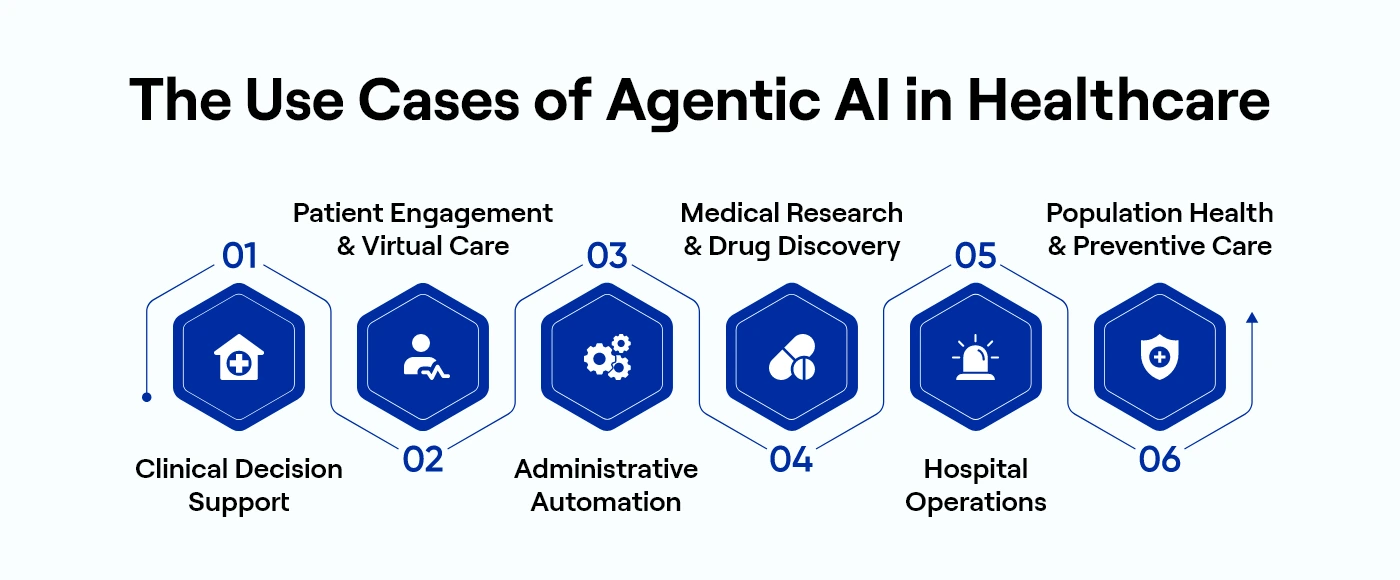
When people hear “AI in healthcare,” they often imagine a chatbot in a waiting room or some fancy dashboard that no one really uses. That’s the shallow end. The deeper story is agentic AI: autonomous systems that don’t just analyze but actually act. And that’s where things get interesting.
Clinical Decision Support
Doctors are brilliant, but they’re human. They’re juggling a dozen patients, flipping through endless EHR tabs, and trying not to miss something critical. Traditional AI might flash a risk score or highlight an anomaly. Useful, sure, but it still leaves the hard work to clinicians.
Agentic AI steps in differently. Think of it like a hyper-attentive resident who not only spots a problem but also books the follow-up test, loops in cardiology, and reminds the nurse on shift. At Mayo Clinic, AI agents now read echocardiograms in real time, flagging subtle signs of heart disease and scheduling next steps automatically.
That’s not “assistive tech.” That’s life-saving delegation.
Patient Engagement & Virtual Care
Generic text reminders are like junk mail. Most patients ignore them. What they need is something smarter and more personal—something that adapts.
Enter AI health coaches. These agents check in daily, track vitals, adjust reminders if you’re slipping, and ping a doctor if things look shaky. Cleveland Clinic rolled this out with post-surgical patients. The result? Fewer readmissions and patients who actually felt supported between visits.
Let’s be real: this is how agentic AI is transforming patient care. Not with hype but with simple, everyday nudges that keep people healthier.
Administrative Automation
Ask any clinician what burns them out, and paperwork is probably in the top three. Scheduling, billing, claims… it’s a never-ending treadmill. Humans aren’t built for it. AI agents are.
Mount Sinai in New York tried agentic AI for claims processing. Instead of teams slogging through stacks of forms, the system flagged anomalies and potential fraud instantly. That shaved weeks off reimbursement cycles and saved millions.
It’s not glamorous, but let’s be honest, sometimes the biggest wins come from killing the admin monster.
Medical Research & Drug Discovery
Drug discovery is like running a marathon with ankle weights. Years of trial and error, billions spent, and most compounds never make it past testing. Agentic AI doesn’t just speed things up; it flips the model.
Insilico Medicine showed this when they used AI agents to identify a fibrosis drug candidate in just 18 months. Normally, you’d be looking at 4–5 years. The AI sifted through massive datasets, generated hypotheses, and even optimized compounds.
For patients waiting on treatments, that’s not just efficiency. That’s hope arriving faster.
Hospital Operations
Hospitals are organized chaos. Staffing, bed management, supply chains—it’s a daily juggling act. And when demand spikes, chaos wins.
The UK’s NHS piloted predictive staffing with AI agents. During flu season, the system forecasted surges and reallocated staff before bottlenecks happened. ER wait times dropped by more than 20 percent.
That’s the kind of agentic AI for hospitals and healthcare providers impact that doesn’t make headlines but makes a massive difference to families waiting in those ER chairs.
Population Health & Preventive Care
Most healthcare systems are reactive. Someone gets sick, shows up at the ER, and the machine kicks in. By then, it’s often too late or too expensive. But what if AI could flip that script?
Agentic AI in population health is exactly about that. Imagine digital agents quietly scanning anonymized community health data, wearable metrics, pharmacy records, and even environmental signals like air quality. They don’t just predict that a diabetes spike or flu outbreak is coming, they mobilize.
Public health officials dream of early warning systems. This is it, only supercharged. Instead of “we should have seen this coming,” you get “we saw it, acted, and contained it.”
Benefits of Agentic AI for Healthcare Stakeholders
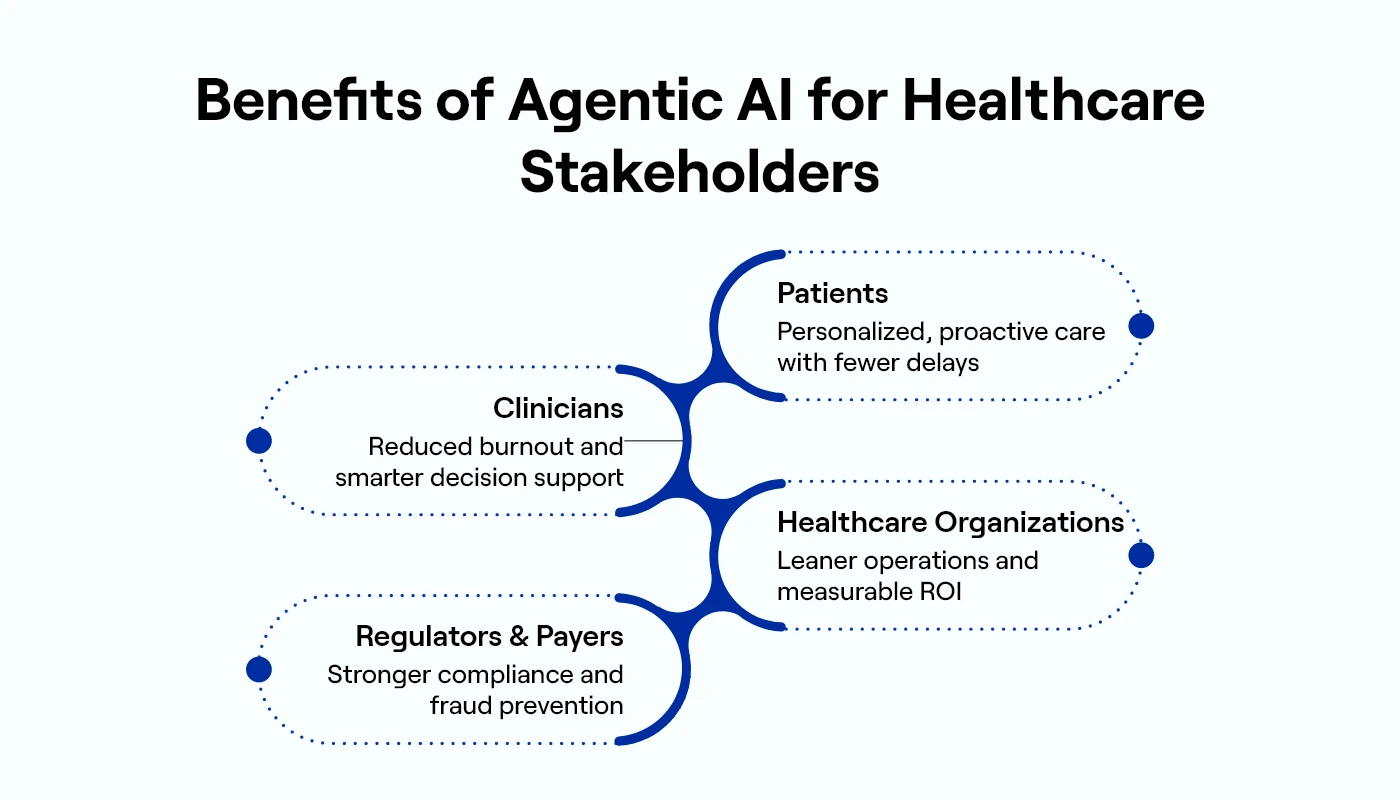
The benefits of agentic AI for healthcare aren’t just buzzwords on a slide deck. They’re tangible, measurable, and touch every corner of the ecosystem.
- Patients: Personalized, proactive care with fewer delays
Instead of waiting weeks for a follow-up, AI agents act as 24/7 health companions. They monitor vitals, nudge adherence, and escalate to doctors when needed. The result? Earlier interventions and fewer “if only we had caught this earlier” moments.
- Clinicians: Reduced burnout and smarter decision support
Paperwork eats more time than patients do. Agentic AI automates charting, scheduling, and documentation. It also surfaces real-time insights from oceans of data, flagging at-risk patients before things go south. Doctors get time back and sharper tools to work with.
- Healthcare Organizations: Leaner operations and measurable ROI
Rising costs and tight margins are the industry’s reality. AI agents cut through waste by automating claims, optimizing resources, and forecasting demand. Hospitals report lower costs and higher efficiency. “Operational excellence” finally feels real.
- Regulators & Payers: Stronger compliance and fraud prevention
Agentic AI provides transparent audit trails, simplifying HIPAA and GDPR compliance. For payers, fraud detection becomes proactive, not reactive. Millions in losses are prevented before they ever leave the system.
Don’t just analyze the promise of AI. Build with Codiant AI and start scaling smarter across patient care and hospital operations.
Real-World Examples and Case Studies of Agentic AI in Healthcare
Agentic AI may sound like future-speak, but it’s already reshaping healthcare today. Let’s look at a few standout examples where AI agents are more than theory—they’re working solutions.
Mayo Clinic: AI agents for clinical decision support
Mayo Clinic has been testing AI-powered diagnostic tools that move beyond static recommendations. In cardiology, for example, AI models analyze echocardiograms in real time, detecting early signs of heart disease before a physician might. Similar progress is being seen with AI skin analysis technology, where AI supports early detection and personalized assessment. These systems don’t just flag issues, they trigger follow-up imaging, notify care teams, and streamline next steps. This is agentic AI in healthcare, quietly improving outcomes and saving lives.
Cleveland Clinic: Virtual health assistants for patient engagement
Cleveland Clinic deployed conversational AI agents to manage post-surgical recovery, highlighting the growing role of AI in healthcare industry innovation. These digital health coaches track pain levels, nudge patients to stick with therapy, and escalate issues when recovery isn’t going as planned. The results include a reduction in unplanned readmissions and higher patient satisfaction scores, making this a strong case study in how agentic AI is transforming patient care beyond hospital walls.
NHS (UK): AI for hospital operations
The UK’s National Health Service has experimented with AI-driven agents for staffing and scheduling in busy urban hospitals. One London pilot used predictive models to forecast ER surges. The AI agent then reallocated staff in advance, cutting wait times during flu season by over 20%. This shows the role of agentic AI in healthcare industry operations at scale.
Insilico Medicine: Drug discovery at record speed
In pharma, Insilico Medicine’s AI agents helped discover a new fibrosis drug candidate in less than 18 months, a process that typically drags on for 4–5 years. Here, AI didn’t just assist scientists; it drove hypothesis generation, selected molecular targets, and optimized compounds. It’s a prime example of agentic AI medical applications accelerating research.
Mount Sinai: Fraud detection and compliance
Mount Sinai Health System in New York piloted AI agents to analyze insurance claims. These systems autonomously flagged suspicious billing patterns, preventing millions in potential fraudulent claims. For regulators and payers, it illustrates the benefits of agentic AI for healthcare beyond clinical work.
Key Takeaway:
These aren’t futuristic pilots. They’re proof points showing that agentic AI for hospitals and healthcare providers is already delivering measurable ROI—whether in faster diagnoses, better patient engagement, leaner operations, or safer compliance.
Challenges and Ethical Considerations
Of course, adoption isn’t smooth sailing. A few hurdles:
- Data Privacy & HIPAA: Patient trust is fragile and can’t be compromised.
- Explainability: Doctors won’t accept a “black box” diagnosis. Clarity matters.
- Bias: Skewed training data leads to skewed outcomes—and in healthcare, bias is dangerous.
- Oversight: The balance between AI autonomy and human accountability must be maintained.
Implementation Roadmap for Healthcare Providers
Talking about agentic AI is one thing. Putting it to work inside a hospital or clinic is another. The good news? You don’t have to overhaul everything at once. Here’s a practical roadmap most providers can follow:
- Build strong data foundations.
AI is only as good as the information it runs on. Clean, structured, and standardized data isn’t optional—it’s the backbone. - Start with pilot projects.
Go for quick wins. Tools like patient engagement bots or claims automation show value fast without overwhelming teams. - Scale across departments.
Once pilots prove their worth, expand into bigger areas—clinical decision support, hospital operations, and even population health. That’s where the real impact shows up. - Govern and monitor.
Don’t just “set it and forget it.” Continuous oversight ensures systems stay ethical, compliant, and effective over time.
Future Outlook: Agentic AI as the Digital Backbone of Healthcare
The future of agentic AI in the healthcare industry isn’t about replacing doctors or nurses. It’s about augmenting them. AI agents will act as digital colleagues, integrated with IoMT devices, wearables, and telehealth platforms.
They’ll monitor patients continuously, flag risks proactively, and reduce preventable hospitalizations. For hospitals, agentic AI will move from “nice to have” to “must-have”—a digital backbone running alongside human expertise.
Conclusion
Healthcare is under pressure, and dashboards won’t save it. What will? AI agents in healthcare that not only predict but act, thus, transforming patient care, reducing burnout, and streamlining operations.
The opportunity is here, but the window is narrow. Waiting risks falling behind.
Ready to reimagine care with AI?
Partner with Codiant AI and explore agentic healthcare solutions today.
Frequently Asked Questions
Some of the top agentic AI medical applications are helping doctors with diagnosis, reminding patients about medicines, reducing hospital paperwork, improving hospital operations, and even finding new drugs faster. AI agents in healthcare can take action, not just give advice. For example, they can schedule a check-up or warn staff if something looks wrong. Companies like Codiant AI are already building these smart tools for hospitals.
Traditional AI only sends alerts or reminders. Agentic AI in healthcare does more. It watches patient data, checks if medicines are taken, and tells a doctor if there is a problem. This is how agentic AI is transforming patient care—it feels like a health buddy that helps every day.
The benefits of agentic AI for healthcare are big. Patients get faster, personal care. Doctors have less paperwork and more time with people. Hospitals save money by working smarter. And health insurance or government groups can catch fraud and check compliance more easily. With Codiant AI, these benefits are real because it helps providers use AI agents to cut costs and improve care at the same time.
Hospitals should start small. First, clean the data so it’s ready. Then, test simple projects like patient engagement bots or claims automation. Next, expand into harder areas like clinical support or hospital operations. Finally, keep checking and monitoring for safety and fairness. This is the best way to adopt agentic AI for hospitals and healthcare providers. Many hospitals work with Codiant AI to guide them step by step in this journey.
AI agents in healthcare can be very helpful, but there are risks. Sometimes the AI may not explain why it made a choice, which makes doctors unsure. Bad or biased data can give unfair results. Privacy rules like HIPAA must also be followed.
The future of agentic AI in the healthcare industry looks exciting. In the next 10 years, AI agents will work like digital teammates. They’ll connect with wearables, hospital systems, and even home devices to give faster, preventive care. Patients will get more personal care, and hospitals will run smoother. Codiant AI is already helping providers get ready for this future by building strong, reliable AI systems today.
Featured Blogs
Read our thoughts and insights on the latest tech and business trends

AI Strategy for CTOs- When to Invest in Machine Learning, NLP & Computer Vision
- April 15, 2026
- Artificial Intelligence
AI is no longer a “future investment.” It’s an operational decision. For CTOs, the real challenge isn’t whether to adopt AI. It’s deciding where it fits, when it delivers value and which technology actually solves... Read more
How AI-Powered Virtual Assistants Automate Enterprise Workflows in 2026?
- April 8, 2026
- Artificial Intelligence
Enterprises are no longer asking if AI should be part of operations. The real question now is how deeply it can be embedded. And in 2026, one answer keeps showing up across industries- AI-powered virtual... Read more
Implementing Agentic RAG in Enterprises: Architecture, Challenges & ROI
- April 2, 2026
- Artificial Intelligence
In 2026, enterprises are no longer satisfied with static AI responses or generic large language model outputs. The demand has shifted toward systems that can think, retrieve, act and refine responses dynamically this is where... Read more