How eCommerce Brands Can Use AI to Boost Holiday Sales and Reduce Operational Load
Table of Contents
Subscribe To Our Newsletter

The holiday season is the most critical revenue window for eCommerce brands. Events like Black Friday, Cyber Monday, Christmas, and year-end sales bring massive traffic spikes, aggressive discounting, and customers ready to buy fast. For many brands, these few weeks determine whether the year ends in profit or pressure.
But while revenue opportunities surge, operational complexity rises just as sharply. Inventory planning becomes unpredictable, fulfillment teams operate at maximum capacity, customer support queues multiply overnight, and even small execution gaps can result in lost sales or long-term trust issues.
This is where AI for eCommerce holiday sales becomes essential rather than optional. Instead of reacting to demand after it peaks, AI allows brands to predict behavior, personalize experiences, and automate operations at scale. From forecasting demand to managing fulfillment, customer support, and returns, AI enables brands to boost holiday sales with AI while keeping teams efficient and workloads under control.
As competition intensifies and customer expectations rise, AI for high-traffic holiday sales is no longer a future investment—it is a core requirement for scalable growth.
Why Holiday Sales Create Operational Pressure for eCommerce Brands?
Holiday campaigns place extraordinary pressure on systems that work fine during normal sales periods.
This is often the moment brands realize why AI is useful for managing high traffic during holiday sales because manual workflows cannot scale overnight.
Common operational challenges during holiday sales include sudden traffic spikes that stress websites and checkout systems, inventory miscalculations caused by rapidly shifting demand, and increased cart abandonment due to delays or unclear delivery timelines.
Customer support teams face a flood of order-tracking and return-related queries, while manual workflows—spreadsheets, approvals, and disconnected tools—fail at scale.
These challenges reveal a fundamental truth: traditional eCommerce operations are not built to handle peak-season volatility. Automation and predictive systems are required to maintain stability when volume increases overnight.
Holiday Pressure Doesn’t Have to Break Your Operations
AI helps eCommerce teams handle holiday spikes without burnout, breakdowns, or last-minute firefighting across systems.
How eCommerce Brands Can Start Using AI Before the Next Holiday Season?
Adopting AI is not a single upgrade—it is a phased journey. Brands that prepare early can reduce ecommerce workload with AI, stabilize operations, and avoid last-minute chaos.
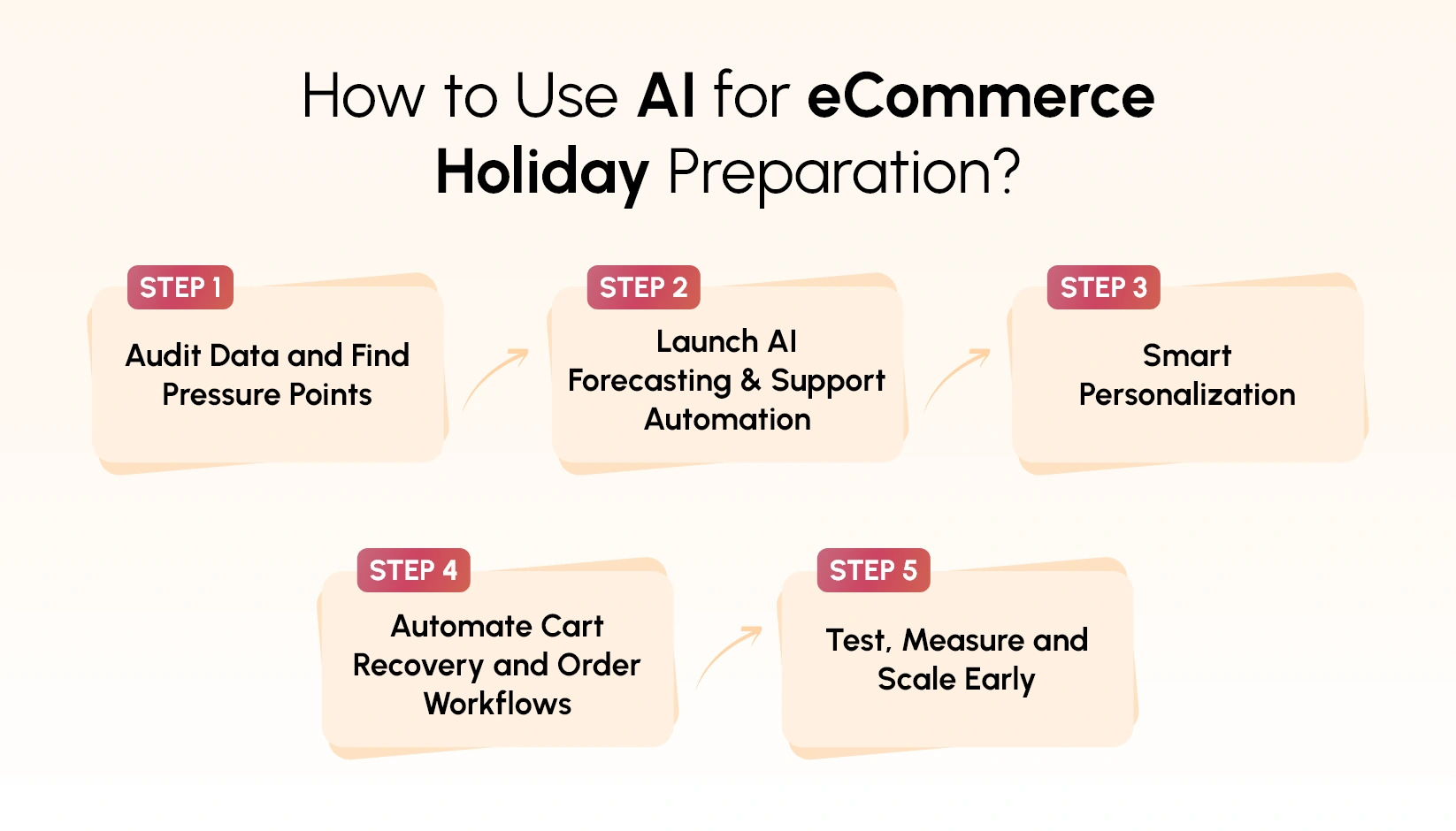
One of the most common questions decision-makers ask is: how fast can eCommerce companies implement AI solutions before peak sales begin?
The answer lies in phased adoption rather than big-bang transformation.
Step 1: Audit Data and Identify Pressure Points
Start by reviewing where breakdowns typically occur during peak seasons. Inventory planning, customer support, fulfillment delays, and returns are common stress areas. Clean, structured data from orders, customers, and operations is essential before introducing AI.
Step 2: Implement AI Forecasting and Support Automation
AI demand forecasting and AI chatbots deliver the fastest operational impact. Forecasting reduces stock issues, while chatbots handle repetitive customer queries, significantly lowering manual workload before traffic spikes.
Step 3: Add Personalization and Recommendation Engines
Once core systems are stable, AI-powered personalization can be introduced. Product recommendations, dynamic offers, and behavior-based messaging increase conversions while reducing manual campaign management.
Step 4: Automate Order and Cart Recovery Workflows
This step plays a critical role in answering how does AI help prevent cart abandonment during holiday sales? AI-driven order routing, cart abandonment recovery, and pricing adjustments improve checkout completion and fulfillment speed. Automation here directly supports revenue growth during high-volume periods.
Step 5: Test, Measure, and Scale Before Peak Season
Pilots should run well ahead of the holidays. Measuring conversion rates, support volume reduction, and fulfillment efficiency ensures AI systems perform reliably when demand surges.
How AI Is Reshaping Holiday Commerce Strategy?
As holiday competition intensifies, eCommerce leaders increasingly focus on how AI can help eCommerce stores increase holiday sales without adding operational chaos.
Rather than reacting to problems after they appear, AI-driven strategies allow brands to anticipate demand, optimize decisions, and act in real time.
AI functions as a digital operations layer connecting marketing, inventory, fulfillment, and customer support into a coordinated system.
Campaign adjustments, stock updates, order routing, and support responses happen automatically, reducing reliance on manual coordination.
This shift explains why ecommerce automation tools in 2025 and ecommerce automation 2026 are becoming standard across competitive brands. The outcome is smoother holiday execution, faster decision-making, and tighter control over both revenue and operational load.
How AI Reduces Overall eCommerce Operational Load During Holidays?
During the holiday rush, operational pressure increases across inventory, fulfillment, customer support, and internal coordination. This is where many teams clearly see how AI reduces operational workload for eCommerce teams—by removing repetitive tasks from human hands.
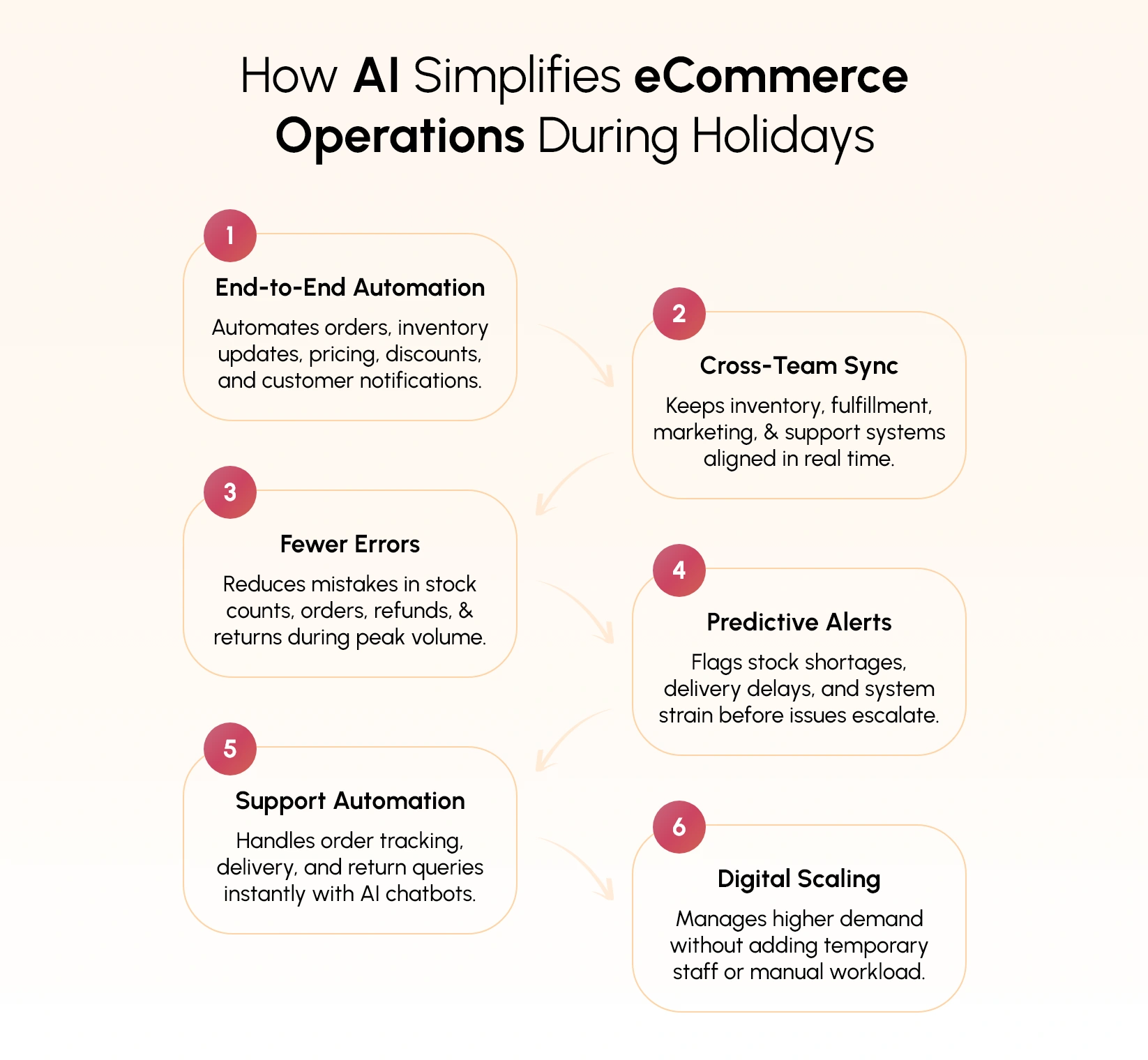
AI helps eCommerce brands manage this complexity by automating routine processes, improving cross-team synchronization, and scaling operations without adding manual overhead.
- End-to-end task automation across the eCommerce lifecycle
AI automates high-frequency operational tasks such as order confirmations, inventory updates, pricing rules, discount application, and customer notifications, significantly reducing manual effort during peak sales periods. - Real-time coordination between departments
Inventory, marketing, fulfillment, and customer support systems remain synchronized through AI-driven workflows, eliminating delays caused by disconnected tools and manual handoffs. - Reduced human errors and operational bottlenecks
By handling repetitive actions automatically, AI minimizes mistakes in stock counts, order status updates, and refund tracking—common issues when order volumes surge. - Predictive issue detection instead of reactive firefighting
AI identifies early warning signs such as inventory shortages, delivery delays, or system overloads, allowing teams to resolve issues before they impact customers. - Lower customer support load through automation
AI chatbots instantly handle common holiday queries like order tracking, delivery timelines, and return policies, reducing ticket volume and customer wait times. - Digital scaling without temporary headcount expansion
Rather than hiring large seasonal teams, AI enables brands to manage higher order volumes and customer interactions by scaling systems digitally instead of increasing staff linearly.
Using AI to Predict Holiday Demand More Accurately
Holiday demand shifts rapidly due to promotions, buying trends, and real-time customer behavior, making static forecasts unreliable. AI-driven demand prediction helps eCommerce brands anticipate changes early and align inventory and operations with actual demand patterns.
- Analysis of historical holiday sales patterns – AI models learn from past seasonal data, promotion performance, pricing changes, and customer behavior to establish reliable demand baselines.
- Incorporation of real-time customer activity signals – Live browsing behavior, search trends, wishlist activity, and cart interactions are continuously analyzed to adjust forecasts as demand evolves.
- Integration of external demand indicators – Regional buying momentum, market trends, and external influences, enhanced through NLP-driven insights, are included to improve forecast accuracy beyond internal sales data.
- SKU-level demand forecasting instead of broad estimates – AI predicts demand at an individual product level, allowing brands to identify fast-moving items and potential slow sellers with higher precision.
- Continuous forecast updates during peak periods – Demand predictions refresh automatically as customer behavior changes, helping teams respond quickly to sudden spikes or slowdowns.
- Stronger alignment between inventory and marketing campaigns – Forecast-driven insights ensure promotional efforts are supported by available stock, reducing the risk of overstocking or stockouts.
- Improved cash flow and inventory efficiency – By directing inventory investments toward high-demand products, AI helps reduce waste, prevent lost sales, and maintain healthier cash flow throughout the holiday season.
How AI Inventory Forecasting Prevents Lost Holiday Sales?
Missed holiday sales often result from outdated or disconnected inventory data. AI inventory forecasting maintains real-time visibility across warehouses, stores, and online channels.
Automated replenishment triggers activate when inventory reaches risk thresholds, while region-specific stock allocation ensures products are positioned closer to demand centers.
AI also helps coordinate supplier lead times, reducing upstream bottlenecks during peak periods. By keeping inventory aligned with demand, brands avoid canceled orders, delayed shipments, and customer dissatisfaction—protecting both revenue and brand trust during high-volume sales windows.
Personalizing the Holiday Shopping Experience with AI
Holiday shoppers face time pressure and choice overload. In this environment, many brands evaluate which AI tools improve customer experience during festive sales by reducing friction and decision fatigue.
A strong AI personalized shopping experience reduces friction by surfacing the most relevant products quickly. AI continuously tracks browsing patterns, past purchases, repeat behavior, and real-time intent signals such as searches and cart actions.
Using this data, an AI recommendation engine for ecommerce delivers dynamic suggestions tailored to each shopper. Personalization spans multiple touchpoints, including personalized homepages, targeted emails, and customized bundles aligned with seasonal intent.
By guiding customers toward relevant products faster, AI improves engagement, conversion rates, and overall satisfaction during peak sales periods.
How AI Recommendation Engines Increase Average Order Value During Holidays?
Holiday shoppers are more open to add-ons, bundles, and gift suggestions. AI recommendation engines increase average order value by presenting complementary products at the right moment.
Cross-sell and upsell automation suggests relevant accessories or upgrades based on behavior, while AI-curated bundles simplify gift buying and encourage larger baskets. Recommendations adjust in real time as inventory and demand shift, ensuring relevance even during traffic surges.
Because recommendations are data-driven and continuously updated, they remain effective throughout the season, capturing more value from each transaction without disrupting the buying experience, especially when powered by reliable AI data analytics services that turn real-time insights into smarter, customer-focused decisions.
Reducing Cart Abandonment with AI-Driven Recovery Strategies
Cart abandonment rises sharply during the holidays as shoppers compare prices or get distracted. This makes how AI helps prevent cart abandonment a critical concern during peak sales.
AI for cart recovery identifies abandonment intent in real time by analyzing exit behavior, pauses, and price-comparison signals.
Once intent is detected, AI triggers personalized recovery actions such as tailored reminders, targeted incentives, and time-optimized follow-ups via email, push notifications, or messaging platforms.
Unlike manual remarketing, AI systems scale instantly across thousands of abandoned carts, improving recovery rates while reducing operational effort.
Read more: How to Develop an AI-Powered Marketplace App- Complete Guide
Using AI to Optimize Holiday Marketing Campaigns in Real Time
Holiday sales are campaign-driven, and AI plays a key role in optimizing marketing performance during peak periods. AI analyzes campaign data continuously, adjusting bids, budgets, creatives, and audience targeting in real time.
Email and SMS timing is optimized based on engagement patterns, while AI tests messaging variations to maximize conversions. Underperforming campaigns are paused automatically, ensuring marketing spend remains efficient even as conditions change rapidly.
This level of automation allows marketing teams to manage complex holiday campaigns without manual micromanagement, improving ROI while reducing workload.
How AI Helps Optimize Holiday Pricing Without Killing Margins?
Aggressive discounts can increase order volume during the holidays, but they often come at the cost of shrinking margins.

Here’s how AI helps eCommerce brands optimize holiday pricing while protecting profitability.
- Adjusts prices dynamically based on demand changes
AI monitors real-time demand signals and customer buying patterns to update prices automatically instead of relying on fixed, pre-set discounts. - Aligns discounts with inventory availability
Pricing strategies are linked to stock levels, ensuring limited or fast-moving products are not over-discounted while slow-moving items receive targeted price reductions. - Tracks competitor pricing without price wars
AI analyzes competitor promotions and pricing movements, helping brands stay competitive without blindly matching discounts that could harm margins. - Applies discounts only where they influence conversions
AI identifies products and customer segments that truly need incentives, allowing other items to maintain stable pricing without reducing sales. - Optimizes promotions in real time during campaigns
Holiday offer performance is tracked continuously, enabling pricing adjustments mid-campaign instead of waiting until the sale period ends. - Balances revenue growth with long-term profitability
By optimizing when and where discounts are applied, AI ensures holiday sales growth remains sustainable rather than purely volume-driven.
Protect Margins While Scaling Holiday Revenue
Use AI-driven pricing strategies to maximize holiday sales without sacrificing profitability or long-term customer trust.
Using AI to Streamline Order Fulfillment During Holiday Surges
As holiday order volumes rise, fulfillment operations are often the first area to experience strain.
Here’s how AI helps eCommerce brands streamline order fulfillment and maintain delivery reliability during peak demand.
- Selects the most efficient fulfillment route automatically
AI evaluates inventory location, warehouse capacity, and delivery distance to route each order through the fastest and most cost-effective path. - Optimizes carrier and shipping method selection
Shipping partners and delivery options are chosen dynamically based on real-time capacity, cost efficiency, and performance metrics. - Improves delivery time predictions
AI calculates more accurate delivery ETAs by factoring in live logistics data, helping brands set clear and realistic expectations for customers. - Detects delays before they impact customers
Potential disruptions are identified early, allowing orders to be rerouted or adjusted proactively rather than reacting after delays occur. - Automates exception handling at scale
Inventory mismatches, carrier issues, and fulfillment errors are resolved through automated workflows, reducing manual coordination across teams. - Reduces cancellations and refund risks
By stabilizing fulfillment operations and maintaining delivery promises, AI helps protect revenue and customer trust throughout the holiday rush.
Managing Holiday Returns at Scale Using AI Automation
Returns surge after holidays, often eroding profits. AI predicts return probability using product attributes, customer behavior, and order context.
Automated return workflows guide customers through self-service processes, while AI-driven fraud detection flags suspicious return activity. Refunds and exchanges are processed faster, improving customer satisfaction while protecting margins.
Efficient reverse logistics ensures holiday success extends beyond checkout.
Handling Holiday Support Volume Using AI Chatbots
Holiday sales overwhelm support teams with order-tracking, delivery, and return queries. AI chatbots for ecommerce support resolve these requests instantly, 24/7.
Chatbots provide real-time order updates, guide customers through returns, and answer product questions during flash sales. Complex issues are routed to human agents with full context, reducing resolution time and agent burnout.
This hybrid model maintains high service quality without increasing support headcount.
Why 2025–2026 Is a Turning Point for AI-Led Holiday Commerce
Rising competition, higher customer expectations, and tighter margins are accelerating AI adoption. Brands delaying AI risk operational breakdowns and lost market share during peak seasons.
Ecommerce automation 2026 represents a shift toward predictive, scalable commerce where holiday readiness becomes a year-round capability rather than a last-minute scramble.
How Codiant AI Helps eCommerce Brands Win the Holiday Season
Preparing for high-traffic holiday sales requires more than standalone AI tools. eCommerce brands need a unified AI strategy that connects forecasting, personalization, automation, and operations into one scalable system. Codiant AI helps brands design, build, and deploy AI-driven eCommerce solutions that are ready for peak-season pressure.
Codiant AI works closely with eCommerce teams to identify operational bottlenecks and implement AI where it delivers the fastest impact before the holiday rush begins.
Key ways Codiant AI supports holiday readiness include:
- AI-powered demand forecasting and inventory optimization to prevent stockouts and overstocking
- Intelligent recommendation engines and personalization layers to increase conversion rates and average order value
- AI chatbots and automation workflows to reduce customer support load during peak sales
- Scalable order, pricing, and fulfillment automation aligned with existing eCommerce platforms
By combining deep eCommerce domain expertise with practical AI implementation, Codiant AI enables brands to boost holiday sales while keeping operations stable, efficient, and profitable.
Final Thoughts: Turning Holiday Pressure into Scalable Growth
Holiday sales will always be intense—but they no longer have to be chaotic. AI enables eCommerce brands to predict demand, personalize experiences, automate operations, and scale without overwhelming teams.
Brands that invest early gain more than seasonal success. They build resilient, future-ready operations that perform under pressure and drive sustainable growth long after the holidays end.
Get Holiday-Ready with AI That Actually Scales
Prepare your eCommerce operations for peak demand with AI-driven forecasting, personalization, and automation – without disrupting existing systems or overloading teams.
Frequently Asked Questions
AI-powered demand forecasting, personalized recommendations, dynamic pricing, cart recovery automation, and real-time marketing optimization directly improve conversions, average order value, and revenue during high-traffic holiday sales periods.
AI forecasting tools analyze historical trends, live browsing behavior, and sales velocity to predict demand accurately, helping brands avoid stockouts, reduce overstocking, and align inventory with active promotions.
Automation tools for order processing, inventory updates, customer support chatbots, fulfillment routing, and returns management reduce manual workload, minimize errors, and allow teams to scale operations without additional headcount.
Most modern AI solutions integrate easily with platforms like Shopify, Magento, WooCommerce, and custom stacks through APIs, plugins, or middleware without disrupting existing checkout, inventory, or fulfillment workflows.
AI adoption budgets vary by scope, but many brands start with focused implementations like forecasting or chatbots, delivering measurable returns within weeks rather than requiring large upfront enterprise investments.
Featured Blogs
Read our thoughts and insights on the latest tech and business trends
AI Strategy for CTOs- When to Invest in Machine Learning, NLP & Computer Vision
- April 15, 2026
- Artificial Intelligence
AI is no longer a “future investment.” It’s an operational decision. For CTOs, the real challenge isn’t whether to adopt AI. It’s deciding where it fits, when it delivers value and which technology actually solves... Read more
How AI-Powered Virtual Assistants Automate Enterprise Workflows in 2026?
- April 8, 2026
- Artificial Intelligence
Enterprises are no longer asking if AI should be part of operations. The real question now is how deeply it can be embedded. And in 2026, one answer keeps showing up across industries- AI-powered virtual... Read more
Implementing Agentic RAG in Enterprises: Architecture, Challenges & ROI
- April 2, 2026
- Artificial Intelligence
In 2026, enterprises are no longer satisfied with static AI responses or generic large language model outputs. The demand has shifted toward systems that can think, retrieve, act and refine responses dynamically this is where... Read more