AI in FinTech Explained: Examples, Challenges, Market Growth & Future Opportunities
Table of Contents
Subscribe To Our Newsletter
Finance isn’t what it used to be. Swipe, tap, verify -today money moves faster than thought, and customers expect every transaction to feel as instant as messaging a friend. That’s the new world powered by fintech artificial intelligence, where sophisticated algorithms make decisions behind the scenes in milliseconds.
What changed? Data. A staggering amount of it. Digital payments are exploding, fraudsters are evolving, and customer loyalty now depends on who delivers the smartest, most personalized experience. And here’s the thing: spreadsheets and legacy systems simply can’t keep up.
Meanwhile, AI-powered financial services and apps are turning once-manual processes into invisible automation -from onboarding to risk scoring to compliance checks that happen before you even blink. The FinTech market knows it too. Analysts believe AI could push the sector beyond $50 billion in value by 2029, with adoption skyrocketing across payments, lending, insurance, and wealth management.
This is a definitive shift -not from paper to digital, but from digital to AI-first finance. Algorithms that think. Models that learn. Systems that protect. And startups aren’t waiting. Artificial intelligence in fintech startups is becoming the competitive lever that separates category leaders from laggards stuck in the past.
So the question isn’t if AI belongs in FinTech. It’s a matter of who leverages it boldly enough to shape the future of financial services -and who gets left watching from the sidelines.
How Artificial Intelligence Is Reshaping the Future of FinTech
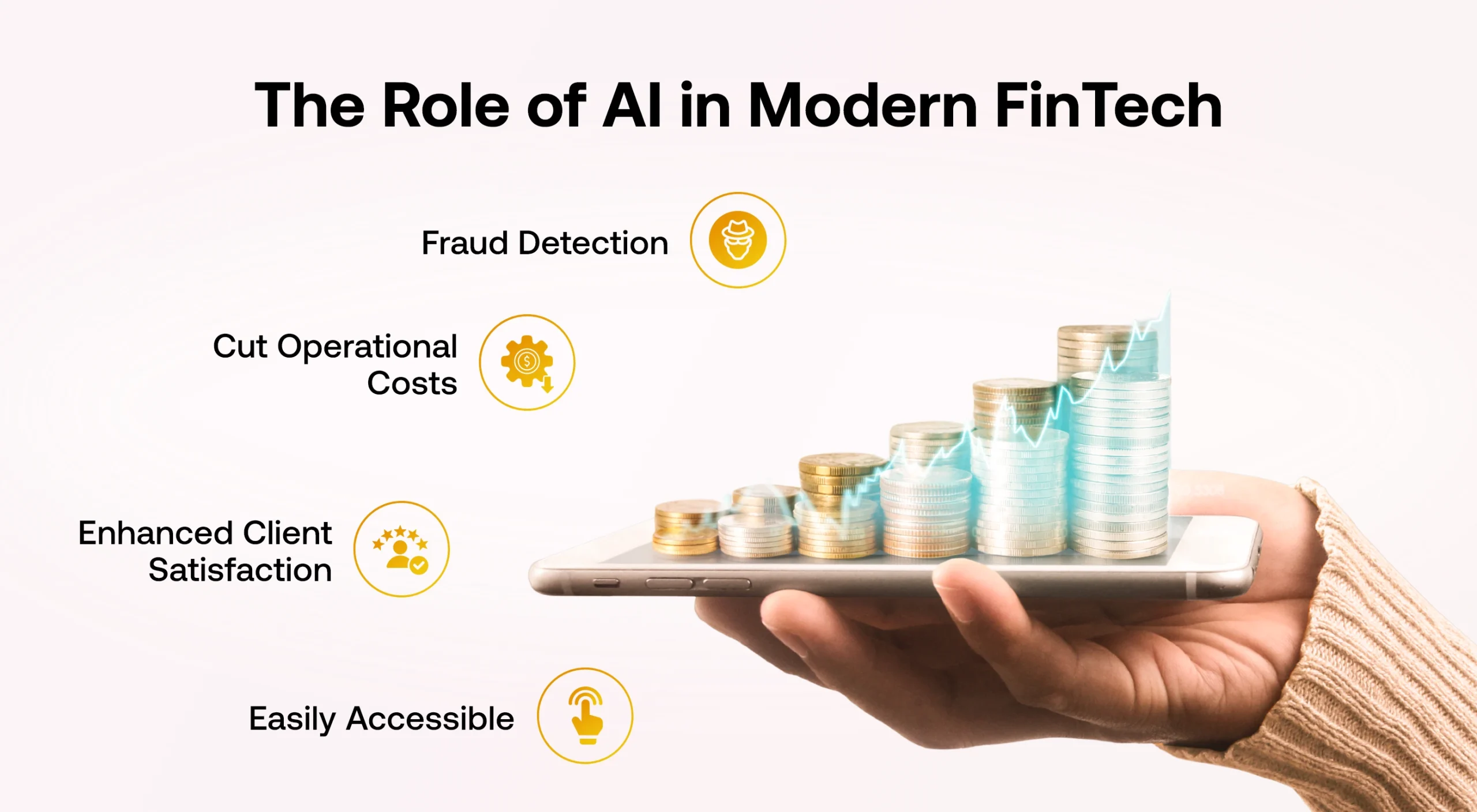
FinTech isn’t just “adding AI.” It’s being rebuilt around it. The industry is shifting from slow, rule-based systems to real-time intelligence. When your customers want instant credit checks, personalized offers, and zero friction… the old playbooks snap.
Let’s break down the five forces rewriting finance:
1️. Real-time decisions driven by massive data pipes
FinTechs can now analyze creditworthiness, spending behavior, and risk signals in milliseconds. Mastercard says its AI algorithms prevent $20 billion in fraud annually. That’s automation protecting trust at scale.
2️. Fraud challenges are rising -and compliance isn’t optional
Global payment fraud is expected to hit $40.6 billion by 2027 (Statista). Regulators have tightened their grip. AI-powered detection keeps businesses ahead of risk while helping them maintain regulatory hygiene without slowing down growth.
3️. Hyper-personalization is the new experience benchmark
Consumers reward brands that “get them.” Think real-time budgeting nudges, adaptive credit limits, AI advisors that speak in your context. Personalization can boost revenues by 10–15% (McKinsey) and in financial services, tailored advice significantly lifts engagement and product conversions. That’s not UX fluff – that’s business math.
4️. Efficiency is a boardroom KPI
Scaling without burning runway matters. AI eliminates back-office choke points, accelerates loan processing, and reduces support volumes through intelligent automation. More output. Less cost. Yes, CFOs smile.
5️. Open Banking + Embedded Finance = growth on tap
APIs have cracked open banks’ walled gardens. Pair that with AI and suddenly every retailer, travel app, or delivery app can become a financial brand overnight. And customers love invisible finance that just works.
The takeaway?
AI isn’t a feature. It’s the infrastructure powering FinTech’s next decade – faster, safer, and intensely personal.
Benefits of AI in the FinTech
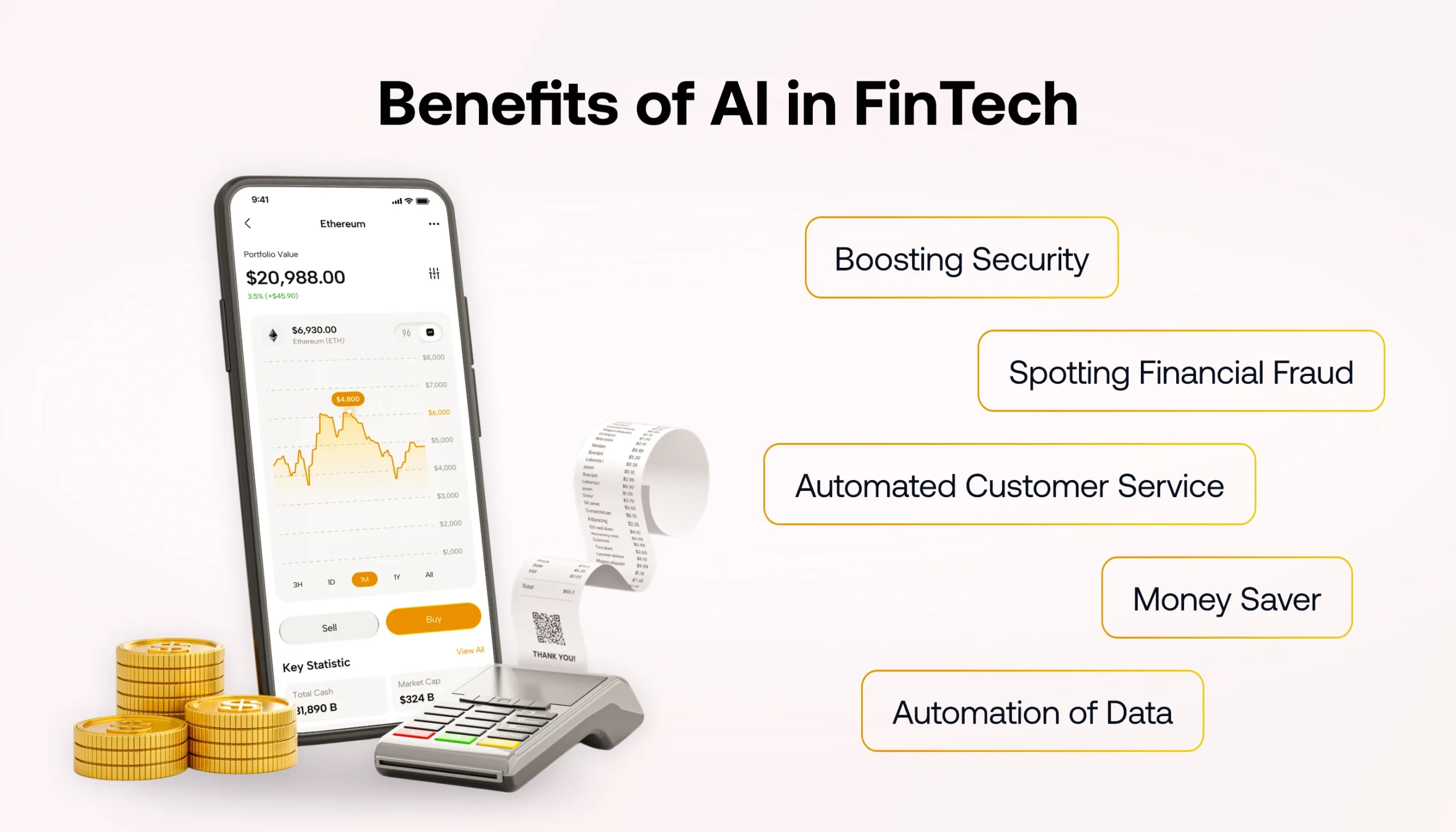
For years, financial innovation meant digitizing what already existed -online forms instead of paper, mobile apps instead of branches. Useful, yes. Transformative, not quite.
AI changes the equation entirely. It doesn’t just speed up existing systems; it makes finance smarter, more context-aware, and infinitely more secure. From real-time fraud defense to hyper-personalized banking experiences and fairer credit access, AI is enabling FinTech companies to do what was previously impossible at scale.
The result is a financial ecosystem that doesn’t just react to customer needs – it predicts them, learns from them, and improves continuously.
1️. Sharper Fraud Prevention & Security
AI is transforming fraud defense from a reactive process into real-time intelligence. Today’s digital transactions create massive behavioral and contextual data.
AI analyzes these signals instantly using advanced data engineering techniques to detect anomalies that humans and rule-based systems often miss. Instead of blocking legitimate customers due to outdated rules, AI continuously learns from fraud patterns and adapts before attackers escalate.
This shifts financial security from basic monitoring to proactive risk elimination – without slowing down the customer experience.
How AI strengthens fraud protection
- Behavioral biometrics (typing pattern, location habits, device footprint)
- Real-time anomaly detection across millions of transactions
- Continuous learning against evolving fraud vectors
- Fewer false declines → Higher trust and revenue
Business impact:
→ Instant fraud blocking without friction
→ Fewer false declines → higher customer trust + revenue retention
→ Improved compliance with anti-money laundering (AML) requirements
2️. Automated Compliance & Regulatory Intelligence
FinTechs operate in one of the world’s most heavily regulated sectors. AI serves as a compliance co-pilot, scanning transactions, customer data, and regulatory updates at a scale impossible for manual teams.
With intelligent monitoring and automated audits, AI-powered DevOps solutions help minimize human error, accelerate reporting, and ensure consistent enforcement of policies across jurisdictions while maintaining compliance at scale.
This helps companies maintain trust with regulators and customers while freeing specialists to focus on strategic oversight.
RegTech intelligence powered by AI
- Real-time AML/KYC screening and risk scoring
- NLP to interpret new regulations automatically
- Audit-ready evidence trails for regulatory bodies
- Reduction in compliance costs and penalties
Business impact:
→ Faster regulatory reporting
→ Lower compliance costs
→ Protection against fines and license risks
3️. Better Risk Modeling with Alternative Data
AI brings inclusion and intelligence to lending. Instead of relying solely on rigid credit bureau files, models now evaluate real-world digital signals like income flows, bill payments, spending patterns, and mobile behavior.
As a result, lenders can build deeper, fairer profiles especially for thin-file consumers, gig workers, and small merchants. Risk decisions become sharper and update dynamically based on ongoing behavioral data.
Smarter risk evaluation with AI
- Real-time scoring using diverse digital data sources
- Fairer assessments for underserved customer segments
- Earlier detection of repayment distress
- More resilient loan portfolios over time
Business impact:
→ Higher approval rates with lower default risk
→ Deeper lending segments + business growth
→ More resilient portfolios through continuous learning
4️. Personalized Banking at Scale
Banking customers expect services that feel tailor-made for their goals. AI understands spending behaviors, lifestyle needs, and decision triggers to deliver suggestions that improve financial outcomes not generic notifications.
From money-saving insights to contextual product recommendations and predictive support, AI becomes a financial assistant that works silently behind the scenes. Banks benefit from deeper loyalty and more meaningful engagement across channels.
Personalization capabilities
- Predictive insights (savings nudges, bill reminders, credit usage)
- AI chat and voice assistants for instant support
- Adaptive recommendations aligned to financial goals
- Increased customer lifetime value and retention
Business impact:
→ Stronger lifetime value (LTV)
→ Reduced churn → higher share of wallet
→ Engagement driven by real results, not notifications
5️. Faster & Bias-Reduced Credit Decisions
Traditional underwriting slows conversion and can expose institutions to unfair decision-making.
AI introduces standardized, explainable scoring techniques that evaluate customers in milliseconds. With transparent insights into why decisions were made, lenders gain stronger regulatory alignment while customers receive faster access to credit products.
It’s a win-win that strengthens financial accessibility without compromising risk management.
AI underwriting advantages
- Instant approvals with minimal manual review
- Bias detection and decision explainability (XAI)
- Higher conversion from reduced application drop-offs
- Greater inclusion for credit-worthy applicants
Business impact:
→ Faster onboarding = More conversions
→ Lower operational costs
→ Expanded access to responsible lending
6️. Operational Efficiency & Cost Savings
Financial workflows are often burdened by repetitive verification, investigation, and support tasks. AI automates these processes, accelerates response times, and reduces cost per transaction.
Customers receive faster resolutions, while teams shift their focus to revenue-driving and compliance-critical functions.
By modernizing operations with intelligent automation, FinTechs scale smoothly without a parallel rise in overhead.
Workflows AI optimizes
- Document & identity verification using OCR/NLP
- Claims, settlements, and ledger reconciliation
- Tier-1 support automation through chatbots/voice bots
Business impact:
→ 30–60% productivity lift in major ops units (as seen industry-wide)
→ Faster turnaround times
→ Ability to scale without ballooning workforce
See What AI Could Do for Your FinTech
Discover how intelligent automation and real-time insights can cut fraud, speed approvals, and grow revenue faster than ever.
Use Cases of AI in FinTech
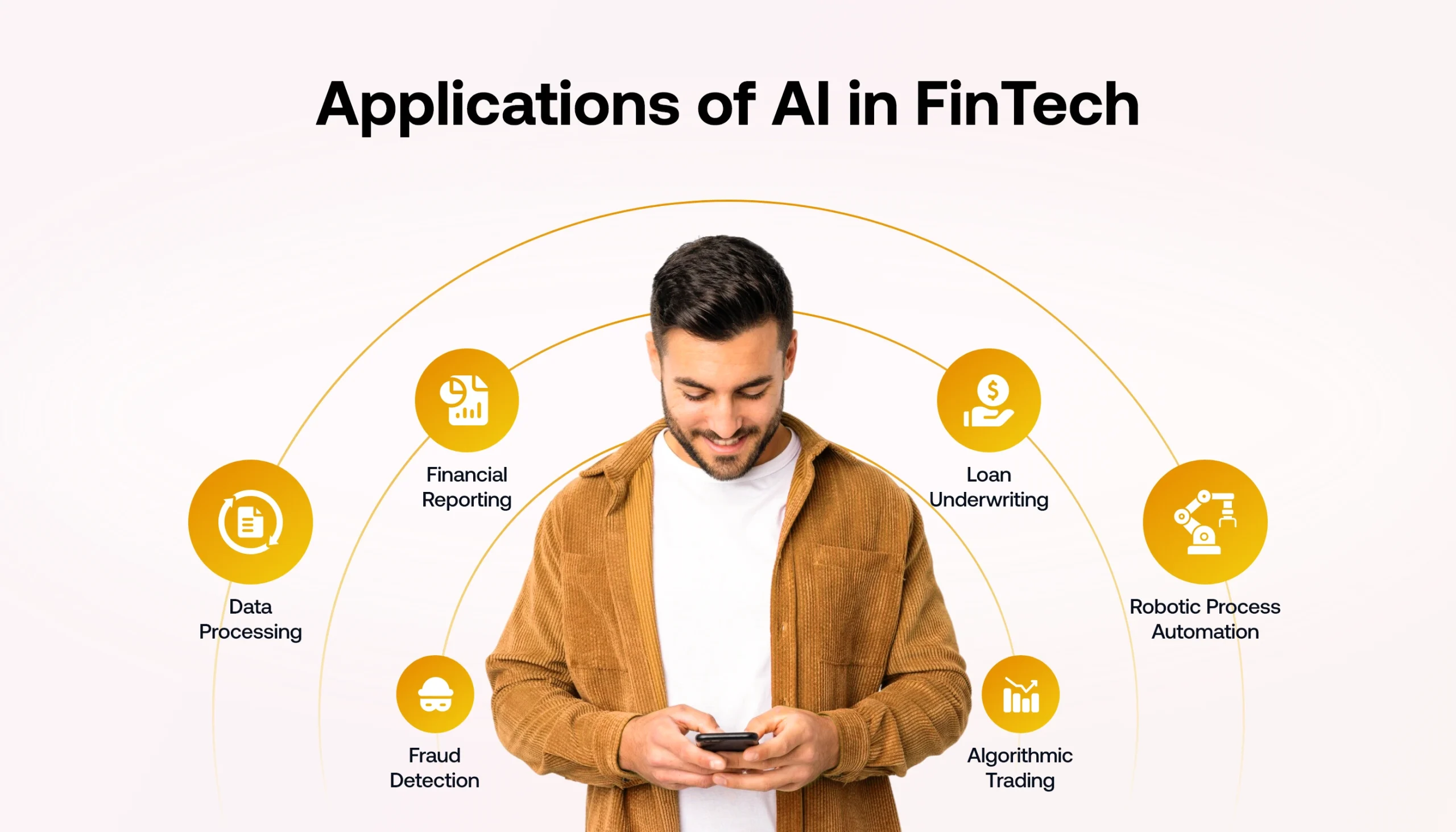
AI is no longer a futuristic add-on in financial services; it’s the operating system behind how leading FinTechs grow, innovate, and stay compliant. From everyday banking to complex investments, AI unlocks decisions that are faster, safer, and incredibly personalized.
Banks, lenders, digital wallets, wealth platforms, and payment processors are now competing not just on products, but on intelligence.
And the companies winning the market are those using AI to predict risks, remove friction, detect fraud before it happens, and tailor every experience at a one-to-one level. Below are the most transformative ways AI is reshaping FinTech today.
1. Predictive AI for Hyper-Personalized Financial Guidance
Traditional banking treats customers as account numbers; AI treats them as individuals with unique needs, spending habits, and financial goals. Predictive intelligence processes vast data streams -every purchase, income change, mobile click, and digital conversation -to understand what a user truly values. It senses life transitions like salary increases, travel planning, or rising expenses and presents tailor-made advice at the exact moment of need. Instead of generic product pushes, customers get budgeting insights aligned to goals, investment nudges fitting their appetite, and credit suggestions they are likely to qualify for. With AI, personalization isn’t a feature; it’s the foundation of customer loyalty and lifetime value.
Core AI Functions
- Behavior-Driven Recommendations: Converts historical + real-time actions into relevant financial suggestions that feel natural and timely.
- Dynamic Engagement Journeys: Adapts messaging based on changing behavior so customers stay informed and supported.
- Identity-Aware Omnichannel Sync: Ensures the same personalized experience on mobile, web, wearables, and voice assistants with zero data conflict.
2. Self-Learning Fraud Detection with Machine Intelligence
Fraud patterns mutate quickly, making rule-based systems obsolete within months. Machine learning changes the game by continuously adapting to emerging threats across the entire digital finance landscape. It analyzes behavioral anomalies, device metadata, location inconsistencies, and network patterns to detect suspicious activity instantly without blocking legitimate users. Every transaction processed adds intelligence, sharpening fraud prevention models in real time. This shift from reactive defense to proactive protection means fraudsters get stopped before they strike. Financial ecosystems stay trusted, friction stays low, and customers feel secure without being asked to prove themselves repeatedly. AI becomes the always-awake security analyst that never blinks.
Core AI Functions
- Real-Time Threat Scoring: Assigns dynamic risk scores to every action, blocking high-risk behavior instantly.
- Behavioral Biometrics Monitoring: Validates identity based on natural user habits vs. static credentials.
- Collective Threat Intelligence: Learns from global fraud signals to prevent first-time attacks at local scale.
3. AI-Powered Risk Forecasting and Compliance Automation
Markets move fast and regulations move faster. Even the most mature financial institutions struggle to assess risk holistically in a world full of volatility. AI acts as both the risk predictor and compliance guardian. It identifies future vulnerabilities in lending portfolios, liquidity positions, and operational exposure long before they surface. It monitors shifts in regulation in real time and updates internal policies automatically to ensure organizations always stay one step ahead of auditors. AI not only reduces penalties and capital loss, it turns risk management into a competitive advantage by enabling decisive action based on clear forecasts.
Core AI Functions
- Predictive Risk Modeling: Quantifies exposure through scenario-based simulations and macro-trends.
- Regulatory Surveillance Engines: Track compliance rules around the clock and update workflows automatically.
- Decision-Support Insights: Generates alerts and strategies backed by deep statistical confidence.
4. Algorithmic Trading Engines for High-Precision Market Execution
Financial markets operate in microseconds, far beyond human reaction time. AI trading systems ingest live order book signals, price movements, economic shifts, social sentiment, and volatility trends to execute trades with surgical precision. They eliminate emotional bias, enabling strategies based purely on data logic. These systems self-optimize by learning from every win or loss, continually sharpening entry/exit timing and risk thresholds. The outcome is smarter capital deployment, reduced slippage, and competitive edge over traders still reacting to old data. In short, AI gives financial firms the power to act faster than opportunity disappears.
Core AI Functions
- High-Frequency Arbitrage: Capitalizes on micro-price deviations that appear for only milliseconds.
- Adaptive Strategy Evolution: Updates trading logic automatically based on real-time win/loss trends.
- Market Mood Interpretation: Uses NLP and sentiment scoring to react to news before markets do.
5. AI-Driven Lending Approvals & Alternative Credit Scoring
Credit history isn’t the only history that matters. But for decades, lenders ignored everyone without a thick credit file. Freelancers. Gig workers. First-time borrowers. AI finally brings them into the financial mainstream.
How? By connecting the dots no one else saw -spending consistency, cashflow, digital payments, even behavioral patterns. It approves good borrowers faster while keeping risky ones in check. No bias. No manual backlog. Just smarter inclusion that drives revenue and trust.
Core AI Functions
- Next-Gen Scoring Models: Evaluate borrowers through broader digital signals, not outdated rules.
- Underwriting Automation: Cuts decision cycles from days → minutes -with fewer errors.
- Default Risk Alerts: Flags potential repayment trouble before customers fall behind.
6. Smart Blockchain Automation with AI Security Intelligence
Blockchain’s transparency is powerful -but it still needs brains. AI becomes that brain. It interprets blockchain activity, catching shady behavior instantly while enabling transactions that enforce rules without lawyers or middle layers.
DeFi is moving fast, and so are criminals. AI is the difference between growth and chaos -helping smart contracts think smarter and keeping decentralized finance truly trustless.
Core AI Functions
- Cognitive Smart Contracts: Execute real business logic -not just “if condition then action.”
- Ledger-Wide Threat Scans: Exposes fraudulent patterns hidden in wallet flows.
- Yield Optimization Assistants: Recommend better borrowing/trading strategies in real time.
7. Operational AI for Automation & Cost Efficiency
A huge chunk of fintech operations is still held together by spreadsheets, swivel-chair copying, and heroic employees avoiding burnout. AI wipes out that inefficiency. It automates identity checks, reconciliations, approvals -the stuff human talent shouldn’t waste brain cells on.
The twist: automation isn’t just speed. It’s intelligence. AI tells you where time is leaking, why service is slow, and which bottlenecks are blowing up costs. Suddenly, operations actually feel… operational.
Core AI Functions
- KYC/AML Workflow Automation: Compliance gets faster, cheaper, and more accurate.
- Process Performance Insights: Pinpoints what’s slowing growth -with fix-ready clarity.
- Faster Customer Turnaround: Reduces approval latency across the customer lifecycle.
8. Adaptive Cybersecurity with Continuous Threat Learning
Cybercrime adapts constantly. So why are so many defenses stuck in static mode? AI patrols networks 24/7 -reading logins, APIs, device changes -and spots trouble while attackers still think they’re invisible. It doesn’t just detect attacks… it predicts them.
A breach prevented is a breach never reported. Less PR damage. Less cost. More customer loyalty. That’s the security metric that matters.
Core AI Functions
- Autonomous Attack Prevention: Intercepts threats mid-attempt -not after damage is done.
- Dark Web Leak Tracking: Finds stolen credentials before criminals weaponize them.
- Pattern-Learning Shields: Every attack attempt strengthens defense rules.
9. Wealth Intelligence Platforms for Smarter Investing
Investing shouldn’t require a finance degree. AI democratizes wealth building so anyone can grow intelligently -not emotionally. It weighs risk appetite, market behavior, and personal goals to shape personalized investment paths. And when the market dips? AI doesn’t panic-sell. It rebalances.
What used to be “private wealth luxury” becomes standard fintech value. Users get outcomes that feel designed just for them -because they are.
Core AI Functions
- Personalized Allocation Engines: Align investment mixes with personal priorities.
- Auto-Rebalancing Logic: Protects against volatility before it becomes a real loss.
- ESG Portfolio Filters: Let users invest with values, not compromises.
10. Gamified AI Coaching for Everyday Financial Education
Money is stressful when you don’t understand it. AI lowers that barrier. It adapts to what users know -or don’t -and turns complex financial logic into relatable micro-learning moments. Layer in gamification and suddenly budgeting feels like leveling up, not punishment.
Smart habits compound. Better savings. Better planning. Better future. And no boring financial textbooks required.
Core AI Functions
- Adaptive Learning Paths: Builds confidence one topic at a time -at your pace.
- Reward-Driven Progression: Keeps users hooked, so lessons actually stick.
- On-Demand Coaches: Knowledge available anytime -no fees, no intimidation.
11. Automated ESG Intelligence for Responsible Finance
Everyone claims “sustainability.” AI proves it. Financial institutions get real visibility into environmental and social impacts -without armies of analysts. It detects greenwashing risks, identifies climate-positive lending, and streamlines disclosure reporting.
The result? Responsible finance isn’t branding. It’s measurable strategy.
Core AI Functions
- Live ESG Risk Detection: Uncovers sustainability blind spots before they become scandals.
- Climate-Positive Lending Signals: Guides capital toward greener businesses.
- Auto-Generated Compliance Reports: Keeps regulators satisfied with verifiable data.
12. Conversational AI for Human Banking Experiences
Nobody enjoys waiting on hold. And chatbots that say “I didn’t understand that” aren’t much better. Modern conversational AI actually listens, interprets emotion, and responds with context -not scripts.
Banking becomes something you can just… talk to. No forms. No fuss. Just answers and action.
Core AI Functions
- Scalable AI Assistants: Handle massive query volumes without queue lines.
- Voice-Enabled Transactions: Banking by speaking -easy for everyone, inclusive by design.
- Sentiment-Aware Routing: Escalates to humans when emotions or complexity spike.
Read More: How Much Does AI App Development Cost? Your Only Guide
Challenges & Risks of AI Adoption in FinTech
Innovation always comes with complexity. And when financial services meet artificial intelligence, the stakes are even higher. Yes, AI promises faster decisions, smarter insights, and fraud defense that never sleeps. But the FinTech arena isn’t a playground. It’s a regulated battlefield where trust is non-negotiable -and mistakes can cost millions.
Let’s break down what keeps FinTech leaders awake at night.
Bias & Fairness in Automated Decisions
AI learns from historical data. But history hasn’t always been fair.
If past behavior shows lending preference toward certain zip codes or professions, the model may unknowingly discriminate -denying loans to creditworthy applicants or overpricing risk for underserved groups.
No regulator wants a “computer said no” defense. And no brand can afford to be seen as biased.
FinTechs must ensure:
- Transparent training data governance
- Regular fairness audits
- Human-in-the-loop decision checks
Data Privacy & PII Security
Financial data is personal. And personal data is powerful.
Every transaction, identity document, and biometric scan increases exposure. FinTech organizations are attractive targets for cybercriminals because a single breach can unlock bank accounts, loan credentials, and investment access.
So while consumers love seamless onboarding, regulators demand airtight protection. Achieving both? That’s hard. And expensive. And unavoidable.
Regulation Isn’t Slowing Down (It’s Accelerating)
FinTech’s world is governed by alphabet soup:
- PCI-DSS for secure card processing
- KYC/AML to fight fraud and money laundering
- GDPR for consumer data rights in Europe
- CCPA for privacy control in the U.S.
AI models must explain the why behind predictions:
- Why was a transaction flagged as suspicious?
- Why was a loan declined?
- Why did pricing change in real time?
Explainability isn’t just transparency -it’s compliance survival.
Legacy Technology Throwing Wrenches
Banks still run core platforms older than the internet.
(Seriously -mainframes from the 80s are still in production.)
That causes real friction:
- Real-time AI meets batch-processing cores → delays
- Cloud-native APIs meet on-prem black boxes → bottlenecks
- Modern analytics meets missing data → poor model accuracy
Before AI can transform finance, infrastructure must evolve.
The Black-Box Problem
Many AI models operate like genius-level interns: brilliant outputs, zero explanation.
That’s terrifying when:
- You’re reporting to regulators
- A customer disputes a decision
- A risk flag causes a costly transaction block
AI must speak in clear business language:
Show your work. Explain your logic. Prove your fairness.
New Cyber Threats Targeting AI Pipelines
Hackers are now attacking the model itself:
- Feeding misleading training data
- Reverse engineering prediction patterns
- Injecting prompts into API communication
- Manipulating risk engines to approve fraudulent behavior
Put simply: AI elevates defense but expands attack surface.
Read More: NLP vs LLM: What Works Best for Your AI Strategy?
How Codiant AI Helps FinTechs Overcome These AI Barriers
Codiant AI builds AI responsibly -with innovation and compliance hand-in-hand:
| Challenge | Codiant AI’s Mitigation Approach |
| Bias, fairness, accountability | Fair-AI guidelines, bias detection engines, human governance |
| Data security & PII protection | Zero-trust architecture, encryption at every layer, secure cloud |
| Complex compliance frameworks | RegTech automation aligned with PCI-DSS, AML/KYC, GDPR |
| Legacy integration | Cloud modernization + modular API bridges for smooth rollout |
| Explainability gaps | XAI techniques + traceable decision logs auditors love |
| AI-specific cyber threats | Continuous monitoring + adversarial testing + model hardening |
The Future of AI in FinTech Industry: Emerging AI Innovations to Watch
The next chapter of FinTech isn’t just about faster transactions or smarter fraud filters. It’s about an intelligent ecosystem that predicts, adapts, and personalizes every financial moment.
As customer expectations skyrocket and regulation evolves, AI will become the invisible engine shaping how money moves -and how trust is earned. The winning FinTechs will be those that treat AI as a core decision-maker, not a background tool.
And the shift has already begun -76% of financial institutions have adopted AI technologies in some form (Acrew Capital / Money20/20, 2024).
Here’s where the future is already headed:
1️. Hyper-Personal Finance Will Become the Default
AI will curate financial lives like Netflix curates’ content -personalized spending controls, context-aware budgeting tips, and investment nudges aligned with real-time goals. No more one-size-fits-all banking.
2️. Autonomous Finance Will Take Over Mundane Decisions
Payments and savings will manage themselves: automated bill routing, dynamic credit limits, and hands-free portfolio rebalancing using predictive modeling.
3️. AI-Native Fraud & Risk Intelligence Will Go Proactive
Instead of reacting to breaches, systems will sniff out threats before they appear -spotting anomalies, spoofing patterns, and deepfake-driven fraud with multimodal verification.
4️. Open Finance + AI Will Unlock a Connected Money Ecosystem
Unified data pipes across banks, lenders, wallets, and insurtechs will give AI a 360° understanding of customers -enabling faster onboarding, fairer scoring, and frictionless payments. As investment flows follow this direction, AI-focused FinTechs already made up 16% of all FinTech deals in Q1 2025 (CB Insights).
5️. Compliance Will Be Built into the Model
RegTech powered by AI will automate reporting, audit trails, and KYC/AML checks. Expect “compliance by design,” not compliance by afterthought.
6️. GenAI-Driven Wealth & Insurance Advisory Will Go Mainstream
AI co-pilots for retail investors and policyholders will decode complex jargon into human-speak -financial literacy meets democratized expertise.
7️. Digital Identity Will Become Biometrics-First
Voice signatures, behavioral patterns, and liveness checks will replace passwords. Zero-trust identity systems will tighten protection without ruining UX.
8️. Agentic AI in Finance Will Operate End-to-End Journeys
Automated assistants will execute complex financial workflows -disputing charges, applying for loans, restructuring debt -without human queues.
The signal is clear: AI won’t just support FinTech products -it will be the product. And with the AI in FinTech market expected to grow from $14.13B in 2024 to $51.08B by 2029 (The Business Research Company), the opportunity window is wide open -for those who build responsibly and build now.
How AI Improves FinTech Performance: KPIs That Drive Growth
FinTech innovation isn’t driven by fancy algorithms or cutting-edge patents. It’s driven by numbers. Adoption, activation, approval rates, risk exposure, churn, compliance penalties -these are the scorecards that decide who leads and who fades into the noise.
Today’s financial companies are under pressure from every angle. Razor-thin margins. Fraud that never sleeps. Customers who won’t wait more than 5 seconds for an approval screen to load. Regulators who expect airtight compliance while demanding increased accessibility. It’s a tightrope walk with high voltage on both sides.
Which is exactly why AI has become the force multiplier FinTech leaders can’t ignore.
Let’s break down how AI delivers measurable outcomes across the customer and revenue lifecycle -in ways that are too big to miss.
1. Reduce Fraud Losses Before They Happen
Fraud is the biggest tax on FinTech growth. Every unauthorized transaction or identity theft incident erodes trust -and that trust is your currency.
Traditional rule-based systems are great at blocking yesterday’s fraud patterns. But today’s fraudsters evolve faster than rule engines can update.
Artificial intelligence changes the game.
Machine learning models hunt anomalies in real-time. Deep learning identifies behavioral shifts invisible to human analysts. Graph intelligence maps networks of high-risk relationships before damage spreads.
The business impact?
Your fraud losses start trending down, not up.
In fact:
- AI-driven fraud detection can reduce false positives by 20–50%
- Fraud prevention accuracy jumps from 70% to 95%+
- Chargebacks shrink by 30–45%
Fewer bad transactions. Fewer unhappy customers. Stronger bottom line.
2. Higher LTV & Retention: Personalization That Actually Works
Here’s a secret every FinTech leader knows: retention pays for everything.
Acquisition costs keep climbing -up to 200–300% higher in some markets vs. pre-2020. The only sustainable edge is to keep customers engaged, loyal, and transacting more frequently.
AI powers ultra-personalized finance:
- Tailored product recommendations
- Dynamic savings nudges
- Predictive churn alerts
- Context-aware offers (not spam)
When customers feel like the product knows them, they stay.
What this means financially:
- Average transaction value increases 8–20%
- Monthly active usage rises 22–40%
- LTV can grow by 30–60% in a year
That’s the kind of impact CFOs can toast to.
3. Lower Operating & Underwriting Costs: Automate the Expensive Stuff
A big chunk of FinTech costs still go toward:
- Manual risk evaluation
- KYC and document verification
- Compliance reporting
- Customer servicing
- Claims and dispute handling
AI doesn’t just make these faster. It makes them radically cheaper.
Picture this:
- Automated KYC reduces processing hours by 70–90%
- AI agents eliminate 25–45% of call center load
- Underwriting decisions go from hours → milliseconds
- Workforce productivity jumps 35–50% in critical ops teams
Same output. Better output. At a fraction of the spend. That’s operational efficiency worth bragging about.
4. Real-time Decisioning = Faster Onboarding = Higher Conversions
The fastest growing FinTechs have one thing in common:
Their approval process feels like it happens instantly.
Speed wins revenue.
With AI scoring risk in milliseconds, FinTechs can:
- Approve more users instantly
- Reduce friction, abandonment, and KYC drop-offs
- Drive higher verified user signups
Impact snapshot:
- Onboarding completion rates increase 25–50%
- Account activation timelines drop by 60–80%
- Checkout approval conversions rise 10–30%
Every second saved is revenue gained.
5. Better Compliance Posture: Stay Ahead of Regulators
Compliance is that strict teacher who never goes easy -and the consequences of falling behind are becoming brutal.
AI helps you stay three steps ahead:
- Automated AML monitoring
- AI-driven suspicious activity reports
- Transparent audit trails
- Real-time risk scoring
It’s not just checking boxes -it’s reducing exposure.
The business effect:
- Regulatory fines drop significantly (up to 40–60%)
- Audit cycles become 2–4x faster
- Governance improves → customer trust improves
Compliance doesn’t have to be a cost center. AI turns it into a reputation advantage.
6. Higher Loan Conversion Rates: Expand Your Credit Universe
Millions of customers are creditworthy but invisible to traditional scoring systems.
AI changes that.
It evaluates alternative signals:
- Utility payments
- Spending behaviors
- Mobile usage + transaction history
- Employment patterns
- Psychometric indicators
The results are transformative:
- Credit approval rates rise 15–35%
- NPL rates remain flat or improve
- Revenue and market expansion go hand-in-hand
The Impact: AI-Powered FinTech KPIs Lift
Here’s a clean snapshot of what FinTech leaders typically achieve with AI:
| Business Metric | Traditional Result | With AI Adoption | Expected Lift |
| Fraud Loss Reduction | Baseline | Smarter anomaly detection + real-time blocking | 20–50% lower fraud losses |
| Customer Retention / LTV | Flat growth | Personalized offers & churn predictions | 30–60% higher LTV |
| Operational Efficiency | High manual dependency | Automation-first workflows | 35–50% lower ops costs |
| Onboarding Conversion | High drop-offs | Real-time approval decisions | 25–50% more approvals |
| Compliance Cost Exposure | Penalty-prone | Predictive compliance analytics | 40–60% fewer fines |
| Loan Approvals | Limited customer eligibility | Alt-data scoring | 15–35% more approvals |
Pros and Cons of AI in Fintech
AI is changing how we use money. It helps apps and banks make smarter choices. It can stop fraud, give loan advice, and help more people get access to money. But like every big technology, AI has good sides and bad sides. Let’s look at both.
Pros: Why AI Is Helpful in Fintech
1️. Better Protection From Fraud
AI can spot strange money activity very fast. It checks tons of transactions at once and warns banks when something looks wrong. This keeps your money safe.
2️. More Personal Services
AI learns what each person likes and needs. It can suggest saving goals, spending tips, and better loan offers that fit you. It makes apps feel smarter and more helpful.
3️. Faster Work and Lower Costs
AI does boring tasks like checking IDs and reviewing paperwork. This saves time for workers and lets companies help more customers without extra cost.
4️. Helps More People Get Loans
Some people do not have credit history. AI uses other information like phone payments or buying habits to decide if someone can get a loan. This helps more people get access to money.
5️. Quick Decisions
Loans, transfers, or approvals happen almost instantly. No long waiting. That makes people happier and businesses grow faster.
Cons: Why We Must Be Careful
1️. AI Can Be Unfair
If AI is trained using wrong or unfair data, it may make biased decisions. It may say “no” without a clear reason. That can hurt people.
2️. Hard Rules and Laws to Follow
Banks must explain why AI makes a decision. They need to prove it is fair and safe. Following these rules can be tough.
3️. Expensive to Build Good AI
A strong AI system needs a lot of money, good engineers, and safe computers. Small companies might struggle to afford it.
4️. Cyber Attacks Can Get Smarter
Hackers also use AI to trick systems. So banks must work even harder to protect users.
5️. Some People Don’t Trust AI
Not everyone feels safe letting a computer handle their money. They want clear answers and human support.
How to Implementation AI in Fintech?
Every fintech founder wants the magic of AI-powered financial services and apps. Real-time risk scoring. Smarter onboarding. Predictive fraud analytics. Hyper-personalized experiences. But implementing AI is not a “plug in and boom” situation. It takes the right strategy, technology alignment, and change readiness.
Here’s a practical roadmap that leading institutions follow to build AI that scales and actually matters.
1️. Identify High-ROI Problem Areas
Before picking the coolest model or generative engine, ask:
Where does AI create the most value?
- Fraud detection and AML alerts
- Credit scoring improvements for underserved groups
- Predictive churn and CLTV modeling
- Automated KYC and customer onboarding
- Smart advisory and robo-investing
- Intelligent loan underwriting
The key rule: start where decision cycles are repetitive, data-rich, and expensive.
That’s where fintech artificial intelligence shines.
2️. Build or Refine Your Data Foundation
No data, no AI. And definitely no compliance.
Fintechs must ensure:
- Clean, structured data pipelines across channels
- Risk-layered data governance
- Secure access controls and encryption
- Clear consent management
- Real-time transaction streaming where needed
The better the data hygiene, the more accurate your machine learning outcomes and the lower your regulatory headaches.
3️. Choose the Right AI Approach
Not every use case needs a deep neural network.
Pick your model strategy based on the business outcome:
- Rule-based AI: For compliance-heavy checks
- Machine Learning models: For fraud scoring, credit, predictions
- Generative AI: For financial guidance, automation, conversational support
- Hybrid: Combining deterministic rules and probabilistic models for auditability
Artificial intelligence in fintech startups often benefits from hybrid setups that provide both innovation and regulatory transparency.
4️. Integrate AI into Existing Systems -Without Breaking Them
This is where projects win or fail.
Use:
- API-first architecture
- Secure model gateways
- Microservices for scalability
- Cloud native compute + GPU acceleration
- Real-time monitoring
You want AI to flow into onboarding systems, CRMs, payment rails, and compliance engines with minimal friction.
5️. Test for Accuracy, Bias, and Compliance
Financial regulators care about:
- Explainability
- Fairness
- Traceability
- Model drift management
Implement continuous testing and audits:
- Bias detection in credit decisions
- False positives in fraud alerts
- Performance updates tied to regulatory guidelines
As the market evolves, your model must evolve -responsibly.
6️. Adopt a Human + AI Collaboration Model
AI does the heavy lifting. Humans still make the call.
Examples:
- Analysts validate risk alerts
- Advisors approve portfolio rebalancing
- Support teams override automation failures
This isn’t about replacing teams; it’s about augmenting financial judgment with intelligence at speed.
7️. Scale, Optimize, and Expand
Once proven in one high-impact workflow, multiply the success.
- Expand across customer segments
- Increase automation coverage
- Unlock new revenue streams (embedded finance, realtime risk-based pricing)
- Introduce new AI-first products
Every scaled fintech advantage compounds: better data → smarter outcomes → higher margins.
AI adoption in fintech is not a feature drop; it’s a strategic evolution.
Start with the most valuable bottleneck. Integrate responsibly. Scale with confidence.
Because the future winners in financial services won’t be the ones using AI —
They’ll be the ones designed around it.
Read More: How to Build a RAG-Powered Application: Step-by-Step Process and Cost Breakdown
Conclusion: The FinTech Advantage Won’t Wait
FinTech is no longer the scrappy disruptor in the corner. It’s the new backbone of how we send money, spend money, borrow money and even grow money. And AI is the power-up behind that entire evolution.
The companies excelling today aren’t just using AI as a feature. They’re building their entire competitive edge on it.
- Faster onboarding
- Fewer fraud losses
- Smarter lending decisions
- Personalized financial journeys
That’s not hype. That’s revenue.
But here’s where most FinTech teams get stuck:
They know they need AI. They’re just not sure how to implement it in a way that’s secure, compliant, and actually tied to business growth.
That’s where the right partner comes in. Someone who understands risk scoring, data pipelines, model accuracy, and regulations like PCI-DSS, AML, and KYC – while still helping you move fast.
Because AI isn’t something you add later. It’s the foundation for the next decade of financial innovation.
If you delay adoption while competitors go AI-first? You’re giving them tomorrow’s market – today.
So here’s the bottom line:
FinTech leaders who embrace AI today will define the future of finance tomorrow.
Frequently Asked Questions
Regulations like AML, PCI-DSS & GDPR change frequently, which means AI models must be monitored constantly. Financial institutions are implementing model governance frameworks that include version control, traceable feature engineering documentation, periodic fairness audits & explainability tests before each deployment. Many partner with RegTech providers or consulting firms like Codiant AI to maintain continuous compliance readiness.
Most fintech companies struggle with fragmented or insufficient borrower data, especially in emerging markets. AI solves this by incorporating alternative data such as behavioral spending patterns, payroll signals, smartphone metadata & e-commerce transaction histories. However, high-quality labeled datasets and strong data privacy controls are essential to prevent biased outcomes.
Some AI use cases like chatbot support or real-time fraud monitoring show results within 4–8 weeks. More complex areas like underwriting automation or risk modeling may require phased rollouts over 3–6 months. The timeline depends on data readiness, legacy system complexity & the organization’s willingness to modernize workflows. Fintechs that start with quick-win pilots see faster ROI.
Not entirely. AI enhances speed and accuracy but cannot operate in a regulatory vacuum. Financial institutions typically use hybrid decisioning: AI handles initial scoring, anomaly detection, or portfolio rebalancing, while human experts validate high-risk or edge-case decisions. This shared-control model prevents bias and ensures ethical accountability.
AI-powered pattern detection drastically reduces manual reviews and false positives, which are major cost drivers. Many fintechs report a 20–40% drop in fraud losses & 35–50% lower investigation overhead within the first year of adopting real-time transaction and identity intelligence systems. The savings often outweigh the entire cost of AI implementation.
Featured Blogs
Read our thoughts and insights on the latest tech and business trends
How AI-Powered Virtual Assistants Automate Enterprise Workflows in 2026?
- April 8, 2026
- Artificial Intelligence
Enterprises are no longer asking if AI should be part of operations. The real question now is how deeply it can be embedded. And in 2026, one answer keeps showing up across industries- AI-powered virtual... Read more

Implementing Agentic RAG in Enterprises: Architecture, Challenges & ROI
- April 2, 2026
- Artificial Intelligence
In 2026, enterprises are no longer satisfied with static AI responses or generic large language model outputs. The demand has shifted toward systems that can think, retrieve, act and refine responses dynamically this is where... Read more

Enterprise AI Development Partner Checklist- What CTOs Should Evaluate Before Hiring
- March 27, 2026
- Artificial Intelligence
AI is no longer an experiment sitting in innovation labs. It’s driving revenue, optimizing operations, and shaping how enterprises compete. But here’s the real challenge choosing the right enterprise AI development partner. Because the difference... Read more