AI in Logistics: How Artificial Intelligence Is Transforming Supply Chains and Driving Business Growth
Table of Contents
Subscribe To Our Newsletter
Logistics has always been a margin-sensitive industry. But today, it is operating under tighter pressure than ever before. Rising fuel prices, frequent supply disruptions, labor shortages, volatile demand, and increasing customer expectations have exposed the limitations of traditional logistics systems.
Static planning models, manual coordination, and disconnected software tools are no longer enough to manage modern supply chains.
This is where AI in the logistics industry is driving a fundamental shift.
Artificial intelligence enables logistics organizations to move from reactive operations to predictive, automated, and continuously optimized supply chains. From AI for supply chain automation to last-mile delivery AI technology, enterprises are using AI to reduce inefficiencies, improve visibility, and unlock scalable business growth.
As we approach AI logistics solutions 2026, AI is no longer experimental. It has become a core operational layer for logistics leaders worldwide.
Why Traditional Logistics Systems Struggle in Today’s Environment
Most logistics organizations still rely on legacy systems that were designed for predictable demand and linear supply chains. Today’s reality looks very different.
Common challenges we see across logistics enterprises include:
- Demand volatility that makes historical planning unreliable
- Manual fleet scheduling that fails during real-world disruptions
- Limited visibility across suppliers, warehouses, and transportation networks
- High fuel and labor costs driven by inefficient routing and idle time
- Inventory imbalances caused by poor forecasting and delayed data
These challenges compound at scale. As order volumes grow and delivery timelines shrink, even small inefficiencies turn into major cost drivers.
This is why digital logistics transformation powered by AI has become a strategic priority rather than an IT upgrade.
Modern Logistics Needs Smarter Systems – Not More Manual Work
See how AI transforms rigid logistics operations into adaptive, cost-efficient, and insight-driven supply chains.
How AI Is Enabling End-to-End Digital Logistics Transformation
AI does not replace logistics systems, it enhances them with intelligence.
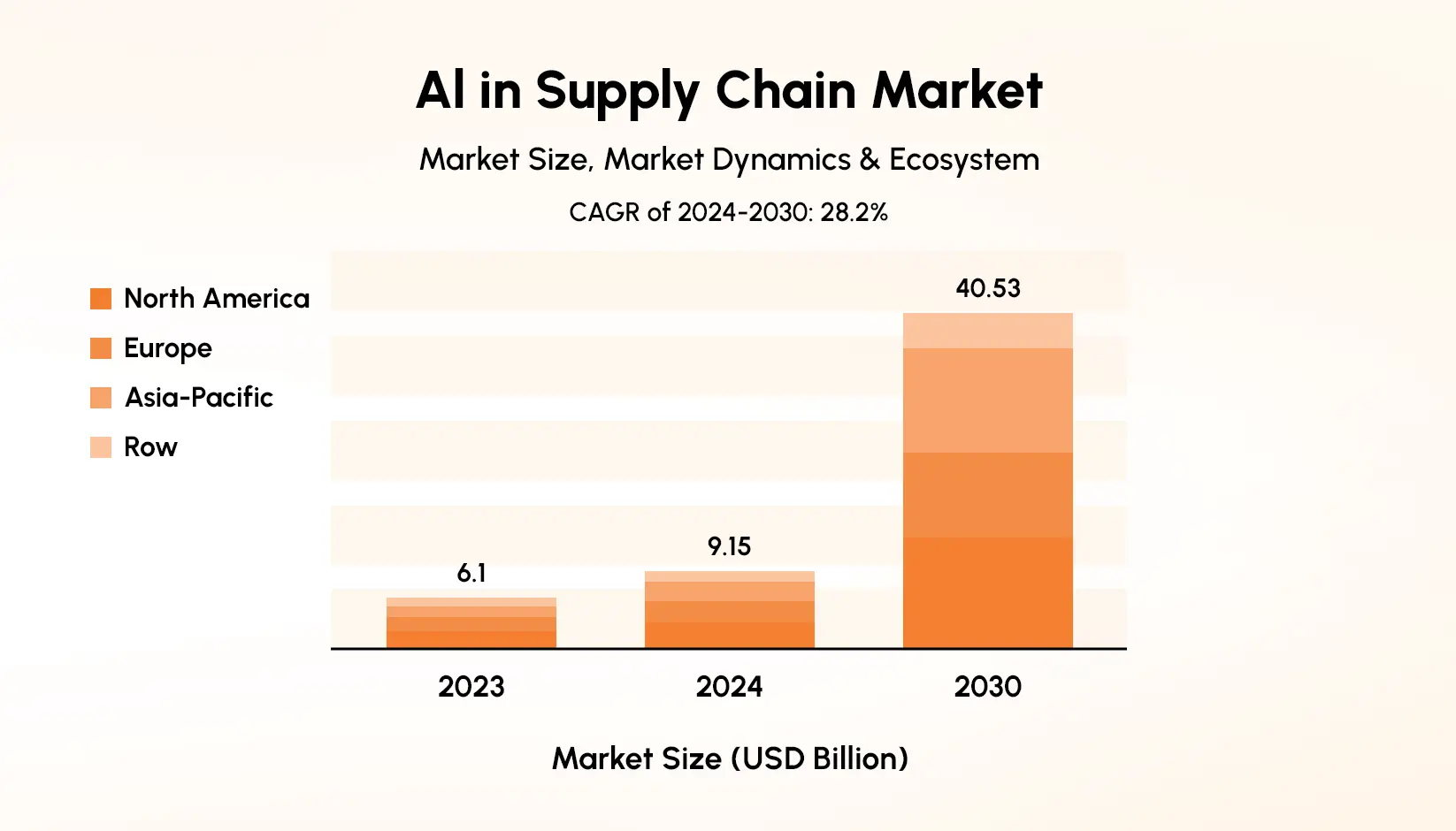
By embedding machine learning models, predictive analytics, and optimization algorithms into logistics workflows, enterprises gain the ability to sense, analyze, and respond in real time.
Key capabilities powering AI logistics solutions 2026 include:
- Continuous data ingestion from vehicles, warehouses, IoT sensors, and ERP systems
- Predictive models that anticipate demand shifts, delays, and risks
- Optimization engines that dynamically adjust routes, inventory, and capacity
- Automation tools that reduce manual planning and human error
Instead of fixed rules, AI-driven systems learn from every shipment, delay, and delivery—improving performance continuously.
Key Benefits of AI in Logistics Operations
AI adoption in logistics is driven by tangible operational gains, not experimentation. When applied across supply chain workflows, AI improves decision quality, execution speed, and cost control simultaneously.
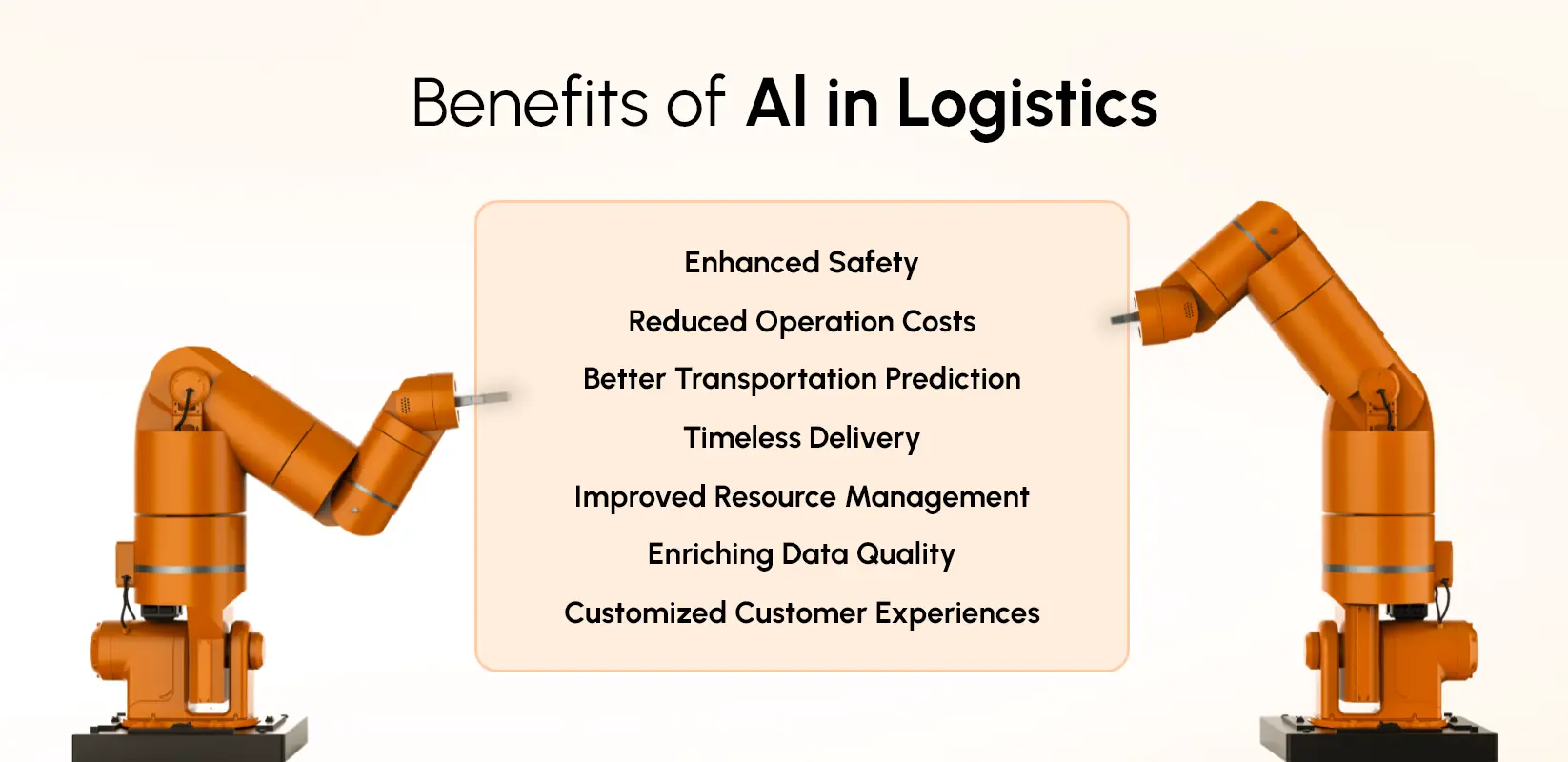
- Enriching data quality across the supply chain: AI cleans, unifies, and continuously updates data from multiple logistics systems, eliminating inconsistencies that lead to poor planning and delayed decisions.
- Enhanced operational and driver safety: AI monitors fleet behavior, equipment health, and risk patterns to reduce accidents, breakdowns, and compliance issues across transportation networks.
- Timely and predictable deliveries: By combining real-time tracking with predictive intelligence, AI improves ETA accuracy and reduces delivery delays even during disruptions.
- Reduced operational costs at scale: Fuel optimization, automation, and better asset utilization help logistics teams control costs without reducing service levels.
- Better transportation and demand prediction: Using generative AI, companies can analyze traffic, weather, demand patterns, and historical shipment data to improve planning accuracy and reduce uncertainty.
- Improved resource and capacity management: Vehicles, warehouses, and workforce capacity are dynamically allocated based on real-time needs, avoiding underuse or overload.
- More consistent customer experiences: Faster resolution, reliable delivery timelines, and proactive communication improve customer satisfaction without increasing overhead.
AI for Supply Chain Automation: Reducing Manual Dependency at Scale
Supply chains involve thousands of daily decisions—many of which are still handled manually. This slows response times, increases error rates, and makes it difficult to scale operations without adding cost.
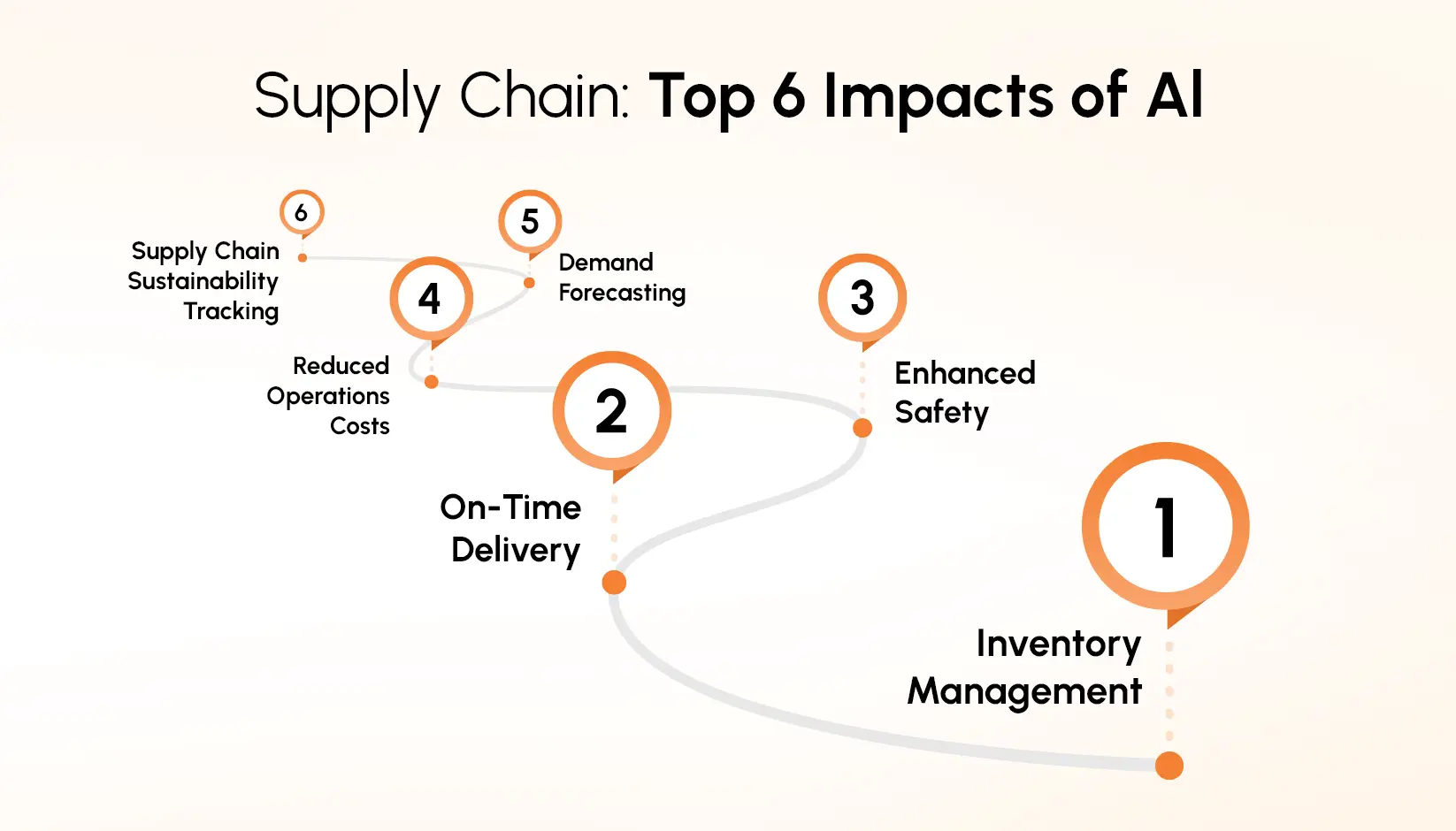
AI for supply chain automation focuses on automating repetitive, high-impact decisions across procurement, planning, inventory, and execution while improving visibility and control.
How AI automates supply chain operations:
- Automatically triggers replenishment and inventory movements using AI-enabled inventory optimization and real-time demand signals.
- Improves on-time delivery by dynamically adjusting shipment plans and routing when disruptions occur.
- Enhances safety by monitoring operational risks across fleets, warehouses, and supplier networks.
- Uses supply chain forecasting AI to predict demand changes and align procurement and distribution accordingly.
- Flags anomalies such as supplier delays, inventory mismatches, or capacity constraints early.
- Reduces dependency on spreadsheets and manual approvals through intelligent workflows.
- Supports supply chain sustainability tracking by optimizing routes, fuel usage, and resource consumption.
Business impact:
- Faster response to disruptions and demand fluctuations.
- Reduced operational costs through automation and smarter resource allocation.
- More accurate demand forecasting and inventory control.
- Improved service reliability and on-time delivery performance.
- Greater safety, compliance, and operational resilience across regions.
Automation allows logistics teams to focus on strategic decisions, while AI manages execution complexity at scale – driving consistent performance without increasing manual workload.
Logistics Predictive Analytics: Anticipating Issues Before They Occur
Traditional analytics tells you what happened. Logistics predictive analytics tells you what is about to happen—and what to do next.
AI models analyze patterns across historical shipments, weather data, fuel prices, supplier performance, and customer demand to predict outcomes with high accuracy.
Predictive analytics use cases in logistics:
- Forecasting shipment delays before they impact delivery SLAs.
- Predicting demand spikes during seasonal or promotional periods.
- Identifying high-risk routes or suppliers.
- Anticipating equipment failures in fleets and warehouses.
Business impact:
- Fewer last-minute firefights.
- Better capacity planning.
- Reduced penalties and service disruptions.
Predictive intelligence transforms logistics from reactive execution to proactive control.
AI-Driven Fleet Management: Smarter Vehicles, Lower Operating Costs
Fleet operations represent one of the highest cost centers in logistics. Fuel inefficiencies, unplanned downtime, and poor route planning directly erode margins.
AI-driven fleet management brings real-time intelligence into vehicle operations.
How AI improves fleet performance:
- Monitors driver behavior, fuel usage, and vehicle health.
- Predicts maintenance needs to prevent breakdowns.
- Optimizes vehicle utilization across routes and shifts.
- Reassigns vehicles dynamically during disruptions.
Business impact:
- Reduced fuel consumption.
- Lower maintenance costs.
- Improved on-time delivery performance.
AI enables fleets to operate leaner, safer, and more predictably at scale.
Route Optimization Using AI: Balancing Speed, Cost, and Reliability
Traditional route planning relies on static maps and predefined rules. In reality, traffic, weather, road closures, and delivery priorities change constantly.
Route optimization using AI dynamically calculates the best routes in real time.
How AI optimizes routes:
- Considers live traffic, weather, fuel costs, and delivery windows.
- Re-routes vehicles automatically during delays or disruptions.
- Balances speed with cost efficiency.
- Optimizes multi-stop and multi-vehicle routes simultaneously.
Business impact:
- Faster deliveries.
- Lower fuel expenses.
- Reduced driver fatigue.
- Improved customer satisfaction.
Route optimization is one of the fastest ways to reduce logistics costs with AI while improving service reliability.
AI for Warehouse Automation: Improving Speed, Accuracy, and Throughput
Warehouses are becoming more complex as order volumes increase and fulfillment timelines shrink. Manual picking, sorting, and inventory tracking struggle to keep up.
AI for warehouse automation introduces intelligence into core warehouse operations.
Key AI-driven warehouse capabilities:
- Computer vision for automated item identification and sorting.
- AI-guided picking systems that reduce errors.
- Smart slotting to optimize product placement.
- RPA solutions coordination for faster order fulfillment.
Business impact:
- Higher order accuracy.
- Faster processing times.
- Reduced labor dependency.
- Better space utilization.
AI-powered warehouses scale efficiently without linear increases in workforce or cost.
Supply Chain Forecasting AI: Improving Demand and Inventory Accuracy
Inaccurate forecasts lead to overstocking, stockouts, and lost revenue. Traditional forecasting models cannot handle volatile demand patterns.
Supply chain forecasting AI continuously adjusts forecasts using real-time data.
How AI improves forecasting:
- Analyzes sales trends, promotions, seasonality, and external signals.
- Updates forecasts dynamically instead of fixed planning cycles.
- Improves accuracy across SKUs, locations, and channels.
Business impact:
- Better inventory planning.
- Reduced carrying costs.
- Higher product availability.
Accurate forecasting is foundational to resilient, cost-efficient supply chains.
AI-Enabled Inventory Optimization: Right Stock, Right Place, Right Time
Inventory inefficiencies tie up working capital and increase storage costs. AI enables continuous optimization across the network.
AI-enabled inventory optimization balances demand, supply, and logistics constraints.
Key capabilities:
- Dynamic safety stock calculation.
- Automated stock rebalancing across warehouses.
- Early identification of slow-moving or aging inventory.
Business impact:
- Reduced excess inventory.
- Fewer stockouts.
- Improved cash flow.
AI-driven inventory decisions are faster, more accurate, and more resilient to demand shocks.
AI for Transportation Management: Smarter Planning and Execution
Transportation management systems generate massive amounts of data—but without intelligence, much of it goes unused.
AI for transportation management transforms data into actionable insights.
AI-powered transportation capabilities:
- Carrier selection based on performance and cost.
- Automated load planning and consolidation.
- Real-time shipment tracking and exception handling.
Business impact:
- Lower freight costs.
- Improved carrier performance.
- Greater operational transparency.
Transportation decisions become data-driven instead of experience-driven.
Smarter Inventory Starts with Better Signals
AI helps align stock with real demand across locations, reducing excess inventory while keeping availability intact.
Last-Mile Delivery AI Technology: Solving the Most Expensive Problem
Last-mile delivery accounts for a disproportionate share of logistics costs and customer complaints.
Last-mile delivery AI technology addresses this challenge with precision.
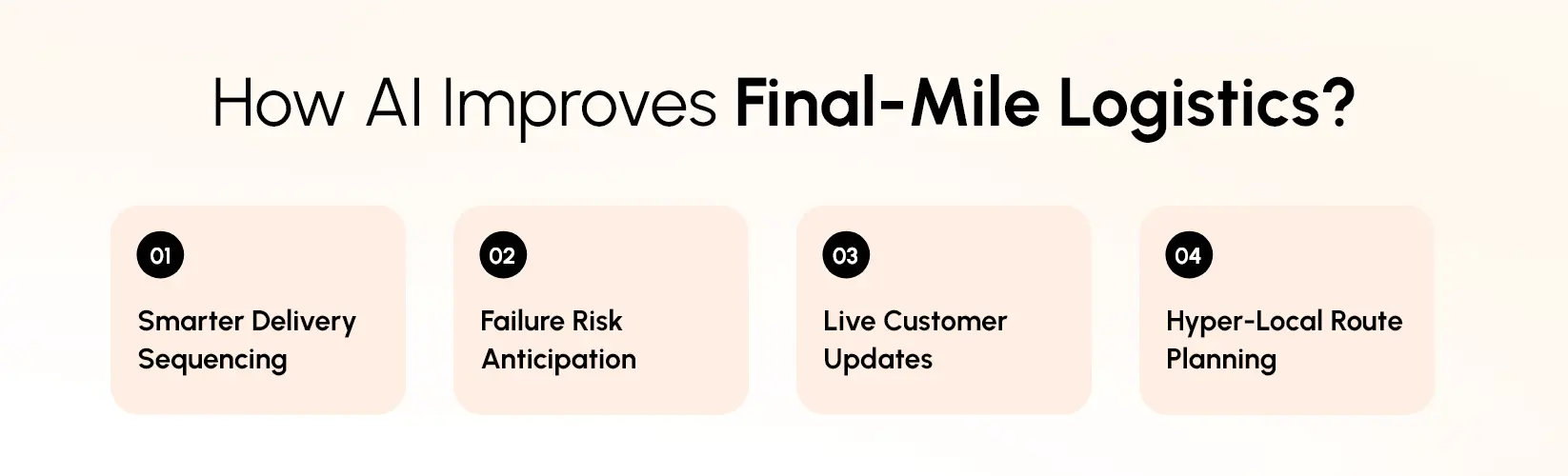
How AI improves last-mile delivery:
- Optimizes delivery sequences and time windows.
- Predicts failed delivery risks.
- Enables real-time customer communication.
- Supports micro-routing and local fulfillment strategies.
Business impact:
- Lower last-mile costs.
- Higher first-attempt delivery success.
- Improved customer experience.
AI makes last-mile operations predictable and scalable.
AI Supply Chain Visibility Tools: From Blind Spots to Real-Time Control
Lack of visibility leads to delayed decisions and costly surprises.
AI supply chain visibility tools unify data across suppliers, warehouses, fleets, and customers.
Visibility powered by AI:
- End-to-end shipment tracking.
- Predictive alerts for delays and risks.
- Unified dashboards for decision-makers.
Business impact:
- Faster issue resolution.
- Improved collaboration.
- Better strategic planning.
Visibility is no longer about reporting – it’s about real-time control.
How AI Helps Reduce Logistics Costs Without Sacrificing Performance
AI-driven cost reduction is not about cutting capacity or compromising service quality. It works by eliminating inefficiencies that are deeply embedded in day-to-day logistics operations.
1. Smarter route planning that reduces fuel spend without slowing deliveries
AI continuously analyzes traffic patterns, delivery windows, weather conditions, and vehicle load data to recommend optimal routes in real time. This reduces unnecessary mileage, fuel consumption, and idle time while maintaining on-time performance.
2. Automation that lowers labor costs while improving operational consistency
Tasks such as dispatching, scheduling, load planning, and exception handling are automated using AI-driven logistics automation tools, often supported by AI-powered DevOps services. This reduces dependency on manual coordination, lowers overtime costs, and minimizes errors that typically lead to rework.
3. Inventory intelligence that prevents waste and excess carrying costs
AI-enabled inventory optimization aligns stock levels with real demand signals instead of static forecasts. By preventing overstocking and aging inventory, logistics teams reduce storage costs, shrinkage, and capital lock-in without risking stockouts.
4. Better asset utilization across fleets, warehouses, and infrastructure
AI-driven fleet management and warehouse analytics ensure vehicles, equipment, and storage space are used at optimal capacity. Underutilized assets are flagged early, improving return on investment without additional capital expenditure.
5. Fewer delays and rework caused by predictive issue detection
Logistics predictive analytics identifies potential delays, route disruptions, and operational bottlenecks before they escalate. By addressing issues proactively, companies avoid costly re-routing, penalties, and repeated handling.
6. Sustainable cost reduction through intelligent resource allocation
Instead of reducing service levels, AI reallocates resources dynamically based on real-time conditions. This allows logistics leaders to reduce logistics costs with AI while maintaining reliability, speed, and customer satisfaction.
Also read: AI in Retail: Boosting Revenue, Reducing Costs, Enhancing Experience
Industry Use Cases: Where AI in Logistics Delivers the Highest ROI
While AI services delivers value across logistics operations, certain industries see especially strong returns due to their scale, complexity, and service expectations.
1. eCommerce and retail logistics
AI-driven demand forecasting, route optimization using AI, and last-mile delivery AI technology help eCommerce businesses manage demand spikes, reduce failed deliveries, and control fulfillment costs during high-volume periods.
2. Manufacturing and industrial supply chains
Manufacturers use AI for supply chain automation and supply chain forecasting AI to stabilize inbound material flow, reduce production downtime, and prevent inventory mismatches that disrupt operations.
3. Healthcare and pharmaceutical logistics
AI supports cold-chain monitoring, time-sensitive routing, and predictive risk management in healthcare. This ensures compliance, minimizes spoilage, and protects high-value shipments without increasing manual oversight.
4. Third-party logistics (3PL) providers
Multi-client logistics operations benefit from AI supply chain visibility tools that provide real-time tracking, predictive alerts, and optimized resource allocation across diverse customer requirements.
5. Freight forwarding and transportation networks
AI for transportation management improves carrier selection, load consolidation, and route planning across long-haul and cross-border operations, reducing freight costs while improving delivery reliability.
6. Food and FMCG distribution
AI-enabled inventory optimization and warehouse automation reduce waste, improve shelf-life management, and maintain service levels across fast-moving distribution networks.
How Logistics Companies Implement AI Quickly and Effectively
Successful AI adoption in logistics is driven by focus, not scale. Companies that see faster results follow a phased, use-case-first approach.
1. Start with high-impact operational use cases
Logistics teams prioritize areas such as route optimization, demand forecasting, AI-driven fleet management, or AI for warehouse automation where AI delivers immediate, measurable ROI.
2. Integrate AI with existing ERP, WMS, and TMS platforms
Rather than replacing core systems, AI layers are integrated into current infrastructure. This reduces implementation time, protects prior investments, and accelerates adoption.
3. Run pilot programs to validate ROI and operational fit
Pilot deployments allow teams to test AI models in real-world conditions, refine algorithms, and establish performance benchmarks before scaling across locations or regions.
4. Ensure data readiness and operational alignment
Clean data pipelines, standardized processes, and cross-team collaboration are essential. AI performs best when operational data is consistent and accessible across the supply chain.
5. Invest in change management and user adoption
Training operations teams and aligning AI insights with day-to-day decision-making ensures AI tools are trusted and actively used rather than ignored.
6. Scale proven AI solutions across the logistics network
Once pilots demonstrate value, AI capabilities are expanded across fleets, warehouses, and transportation networks—enabling rapid digital logistics transformation without disrupting ongoing operations.
How Codiant AI Helps Logistics Companies Turn Intelligence into Impact
Codiant AI works as a technology partner for logistics enterprises looking to move from fragmented operations to intelligent, AI-driven supply chains. We help organizations identify high-impact AI use cases, integrate AI applications seamlessly into existing ERP, WMS, and TMS systems, and deploy scalable solutions without disrupting day-to-day operations.
- AI strategy & use-case mapping aligned with business KPIs, cost targets, and operational realities.
- Custom AI logistics solutions for forecasting, route optimization, fleet intelligence, and warehouse automation.
- Real-time supply chain visibility using predictive analytics and unified dashboards.
- Enterprise-grade deployment & scaling with security, performance, and long-term ROI in focus.
With Codiant AI, logistics teams reduce costs, improve performance, and build future-ready operations with confidence.
Preparing for AI Logistics Solutions 2026: What Enterprises Should Do Now
AI adoption in logistics should be phased and strategic.
A practical roadmap includes:
- Identify high-impact use cases.
- Integrate AI with existing ERP, TMS, and WMS platforms.
- Start with pilots and measurable KPIs.
- Scale successful implementations across the network.
Early adopters will be better positioned as AI becomes the industry standard.
Final Thoughts: AI Is Redefining the Future of Logistics
AI is no longer optional for logistics enterprises aiming to compete in the next decade. From automation and forecasting to fleet optimization and last-mile intelligence, AI is transforming how supply chains operate.
Organizations that invest in AI in logistics industry solutions today are building supply chains that are faster, leaner, and more resilient – readier for the demands of 2026 and beyond.
Build Smarter Logistics with AI That Delivers Real ROI
Transform logistics operations with AI-driven automation, visibility, and optimization designed for scalable, cost-efficient growth.
Frequently Asked Questions
The highest value comes from AI-driven route optimization, demand forecasting, fleet management, warehouse automation, inventory optimization, and supply chain visibility. These applications reduce costs, improve reliability, and scale operations efficiently.
AI analyzes real-time data across transportation, inventory, and demand to automate decisions and predict disruptions early. This reduces manual delays, minimizes errors, and enables faster, more accurate execution across supply chain workflows.
AI systems typically use shipment history, order data, inventory levels, fleet telemetry, warehouse operations data, and external inputs like traffic, weather, and demand signals to deliver accurate insights and predictions.
Yes. AI solutions are designed to integrate with existing ERP, WMS, and TMS platforms through APIs and data pipelines, allowing companies to add intelligence without replacing their current systems.
Over time, AI reduces fuel consumption, labor dependency, inventory holding costs, service failures, and rework. These efficiencies compound, delivering sustainable AI-driven cost savings while maintaining high service levels.
Featured Blogs
Read our thoughts and insights on the latest tech and business trends
Top 15 Machine Learning Development Companies in 2026
- February 26, 2026
- Machine Learning
Machine learning is no longer something only big tech companies use. In 2026, businesses of every size are using machine learning to predict demand, reduce costs, detect risks & make better decisions faster. But here’s... Read more
10 Agentic AI Use Cases Powering Enterprise ROI in 2026
- February 20, 2026
- AI Agent Development
In a Nutshell: Agentic AI goes beyond traditional automation by making goal-driven decisions across complex enterprise workflows. In 2026, enterprises are adopting agentic AI for measurable ROI, not experimentation or pilots. Agentic AI use cases... Read more
AI in Business Intelligence- The 2026 Roadmap to Data Dominance
- February 16, 2026
- AI-Powered Data Analytics
Business intelligence was built to bring clarity to complex businesses. Dashboards, reports, KPIs and scorecards were meant to help leaders see what was happening and make informed choices. In practice, most BI systems still focus... Read more