AI in Retail: Boosting Revenue, Reducing Costs, Enhancing Experience
Table of Contents
Subscribe To Our Newsletter
Retail is under constant pressure to do more with less. Rising operating costs, tighter margins, and unpredictable demand have made traditional planning models unreliable.
Static forecasts, manual inventory decisions, and delayed reporting no longer match how customers shop across online and in-store channels.
This is where AI in the retail industry is changing the approach. Instead of reacting after problems appear, AI helps retailers anticipate demand shifts, adjust inventory early, and make pricing and staffing decisions based on real data patterns.
As part of the broader retail transformation with AI 2026, businesses are starting to treat AI as a practical engine for improving efficiency and driving sustainable growth, rather than an experimental technology or a cost-heavy initiative.
The New Retail Reality: Revenue Pressure, Cost Control, Experience Expectations
Retailers are operating in a far more demanding environment than even a few years ago. Growth is harder to maintain, costs are less predictable, and customers have little patience for friction. These pressures are not isolated problems-they compound each other and expose the limits of traditional retail systems.
Key challenges shaping today’s retail landscape:
- Margin erosion from discounting and overstocking:
Excess inventory forces frequent markdowns, while inaccurate demand planning leads to stockouts on high-performing products. Both outcomes reduce profitability and weaken pricing control. - Rising fulfillment and labor costs:
Faster delivery expectations, higher return volumes, and complex fulfillment networks increase logistics expenses. At the same time, labor costs continue to climb across warehouses, stores, and support teams. - Higher experience expectations across channels:
Customers expect real-time inventory visibility, relevant offers, and consistent experiences across online, mobile, and physical stores. Generic promotions and delayed responses quickly lead to drop-offs.
Together, these pressures create a structural gap between how retail operates and how it needs to perform. AI addresses this gap by helping retailers move from reactive decisions to predictive control – balancing revenue growth, cost efficiency, and personalized customer experiences at scale.
Turn Retail Pressure into Predictable Performance
See how AI helps retailers regain control over margins, operations, and customer experience at scale.
How is AI transforming the retail industry?
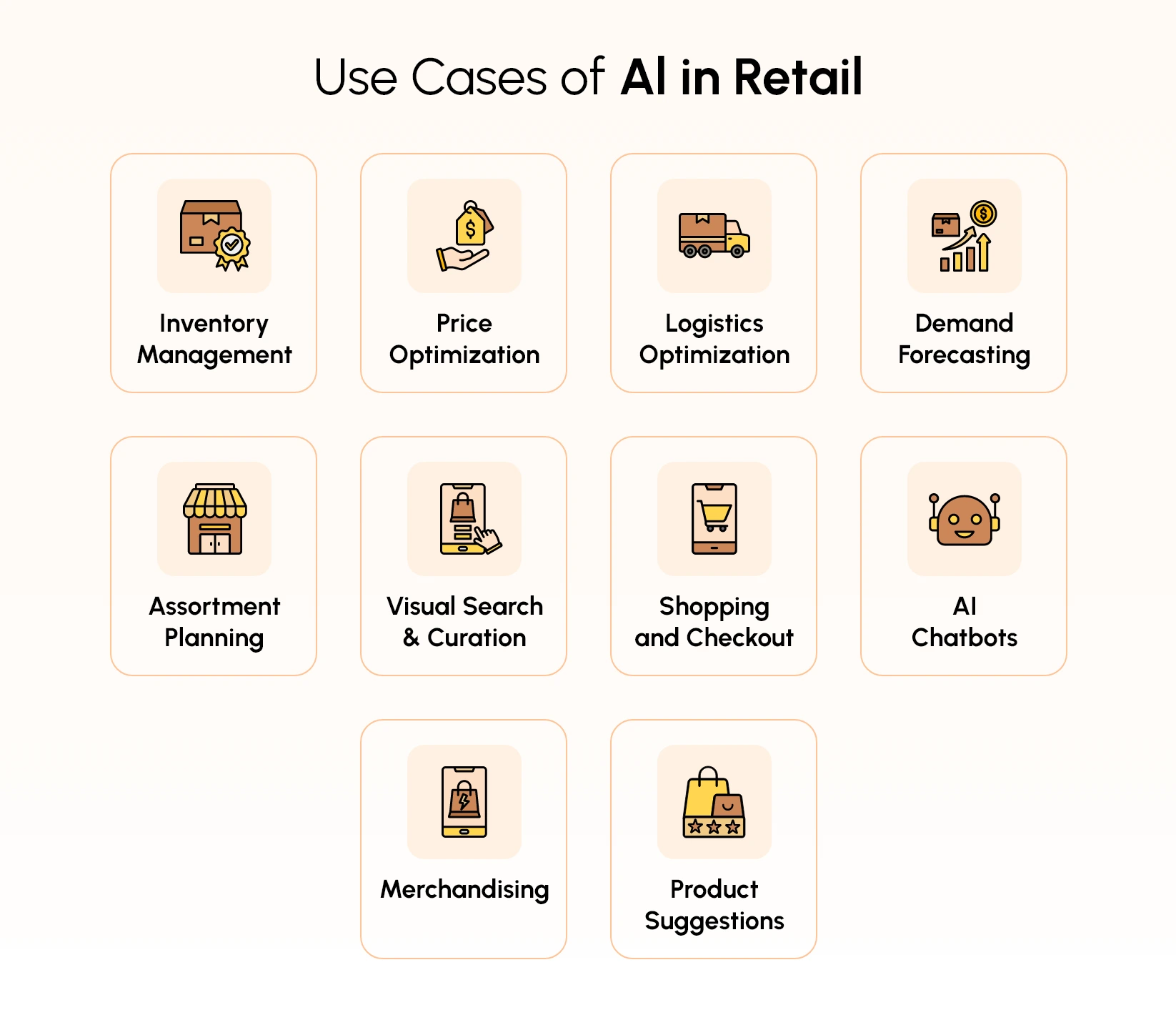
AI is transforming the retail industry by turning disconnected operational processes into a single, data-driven system. Retailers are no longer relying on delayed reports or manual adjustments. Instead, smart retail solutions AI enable decisions to be made continuously across demand planning, inventory, pricing, and customer engagement.
Demand forecasting becomes more accurate as AI analyzes historical sales, seasonality, regional trends, and real-time signals together. This not only improves planning confidence and reduces last-minute corrections but, with AI personalization, also helps retailers tailor inventory and supply chain operations—balancing stock levels, automating replenishment, and responding faster to disruptions.
Operational improvements extend beyond the backend:
- Pricing and promotions adjust dynamically based on demand and inventory position
- Customer experience improves through consistent personalization across online and in-store channels
- In-store operations benefit from smarter workforce scheduling and shelf availability tracking
By connecting these functions, AI shifts retail operations from reactive execution to predictive, end-to-end optimization.
Read more: How eCommerce Brands Can Use AI to Boost Holiday Sales and Reduce Operational Load
Retail Demand Forecasting with AI: Predicting What Sells, When, and Where
Retail profitability starts with knowing demand before it shows up. this stage, many retailers ask a very practical question: can AI actually predict holiday shopping trends, or is it still guesswork?
Retail demand forecasting AI helps retailers move beyond guesswork by reading patterns that traditional systems miss.
Instead of looking at sales history in isolation, AI connects multiple demand signals to build a realistic picture of future buying behavior.
AI-powered forecasting models analyze:
- Seasonality patterns across years, not just last season
- Promotion impact, including discounts, bundles, and campaign timing
- Location-level trends, such as store performance, regional preferences, and local events
- External signals like weather shifts and demand spikes across channels
Traditional rule-based forecasting depends on fixed logic and assumptions. These models break down when demand shifts unexpectedly.
Machine learning–driven forecasting adapts continuously, learning from live sales data and adjusting predictions as conditions change.
The result is more stable operations and predictable growth. Overstock is reduced, stockouts decline, and inventory moves closer to actual demand.
With AI-powered retail analytics, retailers gain clearer revenue visibility, smarter replenishment decisions, and the confidence to plan pricing and promotions without reacting late.
AI for Retail Inventory Management: Cutting Waste Without Losing Sales
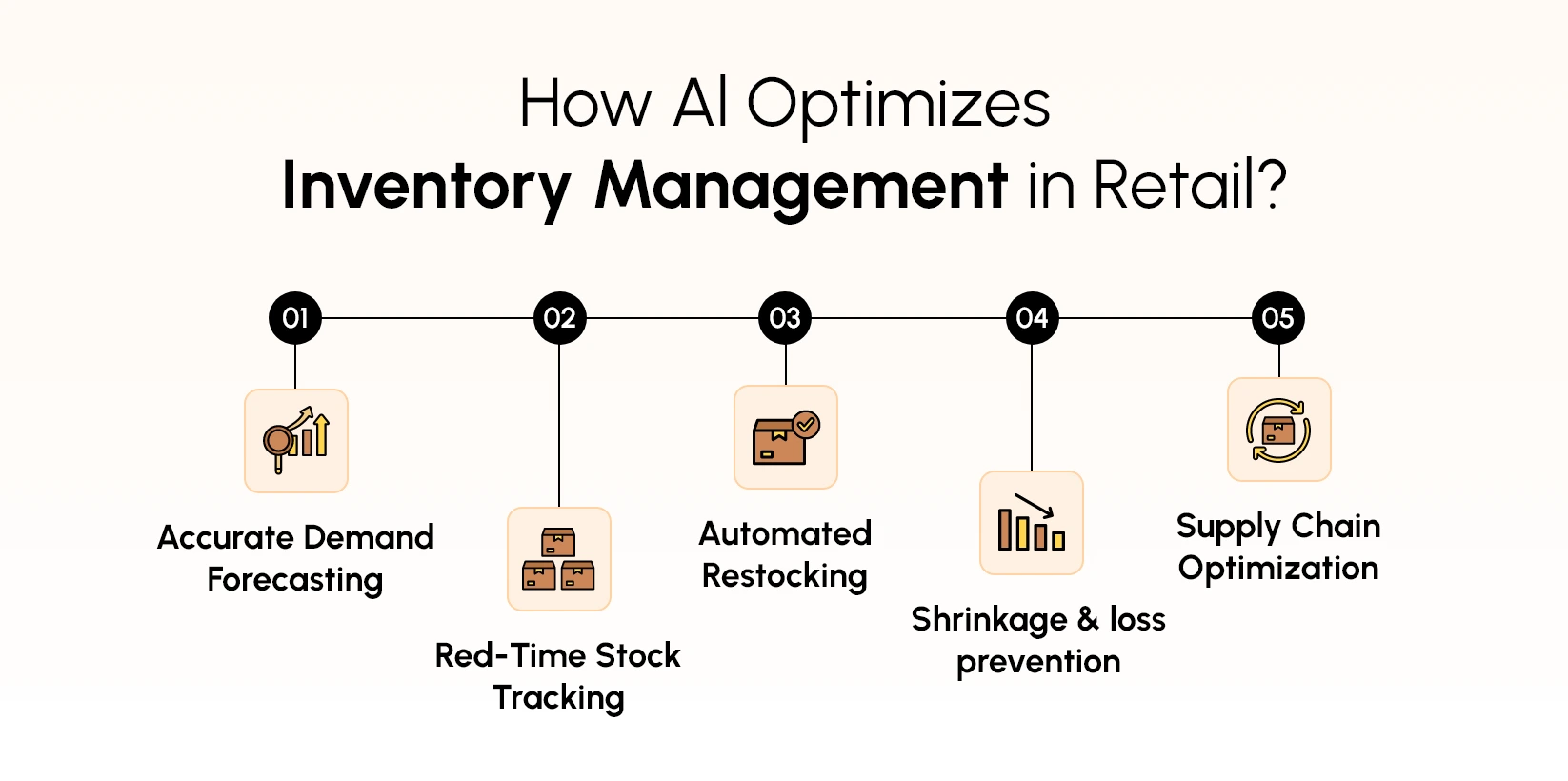
Behind the scenes, AI for retail inventory management works through a set of intelligent, interconnected capabilities designed to balance availability and cost efficiency at scale.
Accurate demand forecasting
AI models analyze historical sales, seasonality, promotions, regional buying patterns, and external signals to forecast demand with higher precision. This allows retailers to plan inventory proactively instead of reacting to shortages or excess stock.
Real-time stock tracking
Inventory movement is monitored continuously across stores, warehouses, and fulfillment centers. Real-time visibility enables fast stock rebalancing, ensuring products reach high-demand locations before stockouts occur.
Automated restocking
Replenishment decisions shift from static rules to adaptive intelligence. AI automatically adjusts reorder quantities and timing based on live sales velocity, helping retailers reduce retail costs using AI by avoiding over-ordering and last-minute emergency replenishment.
Shrinkage and loss prevention
AI identifies abnormal inventory patterns linked to theft, damage, or operational gaps. Early detection limits losses before they escalate, protecting margins without increasing manual audits or operational overhead.
Supply chain optimization
AI aligns inventory planning with supplier performance, lead times, and logistics constraints. Orders become more predictable, transportation costs stabilize, and inventory flows efficiently from supplier to shelf.
Why This Matters for Retail Cost Control?
When implemented effectively, AI for retail inventory management enables retailers to reduce retail costs using AI without sacrificing product availability or customer experience. Lower holding costs, fewer markdowns, and improved inventory turnover become outcomes of smarter systems—not aggressive cost cutting.
Retail Pricing Optimization Using AI: Protecting Margins While Staying Competitive
Pricing pressure is constant in retail. Competitor discounts, seasonal demand swings, and excess inventory often force reactive price cuts that hurt margins.
Retail pricing optimization AI helps retailers respond smarter, not cheaper.
AI pricing engines analyze demand patterns, competitor movements, and inventory positions at the same time.
Prices are adjusted dynamically based on what actually influences conversions, rather than relying on blanket discount strategies.
With AI-driven pricing, retailers can:
- Apply discounts only where price sensitivity exists
- Protect margins on fast-moving or limited-stock products
- Adjust prices in real time across online and physical stores
This approach replaces guesswork with precision. Promotions become targeted, measurable, and short-lived instead of margin-draining campaigns.
By using retail pricing optimization AI, brands unlock a sustainable retail revenue boost with AI – increasing sales without training customers to wait for discounts.
AI-Driven Customer Experience: Personalization at Scale
Customers don’t respond to generic experiences anymore.
During festive and high-traffic sales, experience breaks faster than systems. That’s why retailers often wonder: what AI tools actually improve customer experience during holiday sales, when traffic is high and attention spans are low?
An effective AI-driven customer experience focuses on understanding intent, context, and behavior-then delivering relevance consistently across every interaction.
How AI enables personalization at scale
- Behavioral analysis & intent prediction
AI analyzes browsing behavior, purchase history, search patterns, dwell time, and cart actions to predict what a customer is likely to need next. - Real-time personalization across channels
With AI retail personalization, product recommendations, offers, and content adapt instantly across email campaigns, mobile apps, websites, and in-store digital screens. - Context-aware engagement, not static campaigns
Instead of scheduled promotions, AI triggers messages based on customer intent, timing, and engagement signals-improving relevance and response rates. - Consistent experience across all touchpoints
AI aligns messaging, recommendations, and promotions across online and offline channels, eliminating disconnected journeys and mixed signals. - Faster discovery and higher conversions
Shoppers find relevant products quicker, face fewer decision barriers, and are more likely to complete purchases and return. - Scalable personalization without manual effort
AI delivers individualized experiences to millions of customers simultaneously-without increasing marketing or operational workload.
Result: Personalization becomes a scalable conversion engine, not a one-off campaign.
AI Chatbots and Virtual Assistants in Retail: Always-On Customer Support
Customer support demand spikes sharply during sales events, which raises a common operational question: what role do chatbots actually play in handling holiday customer support?
AI chatbots act as the first line of response during peak traffic. They handle product queries, availability checks, delivery timelines, order tracking, cancellations, and returns instantly—without queues. This prevents customers from dropping off simply because help wasn’t available fast enough.
For retailers, this automation absorbs volume without increasing support headcount. When issues require human intervention, chatbots pass full context forward, allowing agents to step in without restarting conversations.
Retail customers expect answers now-not in business hours. This is why the AI chatbot for retail has quietly become one of the most impactful automation layers in modern commerce.
Instead of waiting in queues, shoppers get instant help during discovery. They can ask about product fit, availability, delivery timelines, or offers and receive clear, contextual responses in seconds.
Once an order is placed, the same chatbot seamlessly shifts into post-purchase mode-handling order tracking, delivery updates, cancellations, and returns without human intervention.
From a business standpoint, this level of AI retail automation dramatically reduces support load.
Repetitive queries that once consumed agents’ time are resolved automatically, with consistent answers across channels.
When a situation genuinely needs a human touch-complex complaints, escalations, or high-value customers-the chatbot transfers the conversation smoothly, carrying full context so customers never have to repeat themselves.
The result isn’t just cost savings. It’s faster resolutions, happier customers, and support teams focused on problems that actually need human judgment.
Omni-Channel Retail Powered by AI: One Experience, Every Touchpoint
Shoppers don’t separate online, mobile, and in-store anymore. They expect everything to just work together. Omni-channel retail AI solutions make that possible.
AI creates a single, intelligent customer view by connecting data from websites, apps, POS systems, loyalty programs, and in-store interactions.
This allows retailers to recognize the same customer everywhere-and respond accordingly.
A product browsed on mobile can trigger relevant recommendations in email, appear again on the website, or be highlighted on an in-store screen.
Behind the scenes, smart retail solutions AI also optimize operations.
Inventory stays visible across all locations, while predictive fulfillment engines decide the fastest and most cost-effective way to deliver-store pickup, local dispatch, or warehouse shipping.
For customers, the experience feels effortless. For retailers, it means fewer drop-offs, smarter fulfillment, and a connected ecosystem that drives both convenience and conversion.
AI for In-Store Retail Automation: Smarter Physical Stores
Physical stores continue to play a critical role in the retail journey, but managing them efficiently at scale is challenging.
AI for in-store retail automation helps retailers bring data-driven control to day-to-day store operations.
Computer vision systems monitor shelves in real time, identifying out-of-stock items, misplaced products, and planogram issues without manual checks.
This ensures better availability while reducing staff time spent on routine audits.
Smart checkout and queue management further improve store efficiency. AI analyzes foot traffic patterns to predict peak hours, trigger dynamic checkout lane openings, and reduce waiting times.
Self-checkout systems supported by AI also help speed up transactions while maintaining accuracy and loss prevention.
Staff optimization is another key area where AI retail automation delivers value. By analyzing historical sales data, footfall trends, and local demand patterns, AI helps retailers schedule the right number of staff at the right times.
This improves service levels during busy periods while preventing overstaffing during slower hours, leading to more efficient store operations without sacrificing customer experience.
Read More: How to Develop an AI-Powered Marketplace App- Complete Guide
Reducing Retail Costs Using AI Without Compromising Experience
Cost reduction in retail often comes with the risk of hurting customer experience, but AI makes it possible to achieve both.
By automating repetitive operational tasks, retailers can reduce dependency on manual effort while keeping service quality intact.
Labor optimization is a major contributor. AI-driven scheduling, task allocation, and workload forecasting ensure staff time is used efficiently across stores and fulfillment centers.
Automated operations also reduce process inefficiencies. From order routing and inventory transfers to returns processing, AI minimizes manual intervention and errors.
This speeds up operations while lowering administrative and operational overhead.
Another critical area is shrinkage and returns. AI systems detect unusual patterns in transactions, returns, and inventory movement, helping retailers identify theft, fraud, or process gaps early.
Better product recommendations and size or fit guidance also reduce avoidable returns. Together, these capabilities help retailers reduce retail costs using AI while maintaining smooth, reliable experiences-making AI retail automation a practical tool for sustainable cost control.
Identify Cost Leaks Before They Become Margin Loss
AI highlights inefficiencies across retail operations and fixes them without adding complexity or operational risk.
Measuring AI ROI in Retail: What Leaders Track in 2026
Measuring the return on AI investments has become a priority for retail leaders as adoption moves from pilots to core operations.
In 2026, ROI is no longer judged by technology deployment alone, but by clear business outcomes across revenue, cost, and customer experience.
Retailers focus on a balanced set of metrics to understand whether AI is delivering measurable value.
Key AI ROI metrics retailers track:
- Revenue uplift: Higher conversion rates, improved sell-through, increased average order value, and fewer lost sales due to stockouts.
- Cost savings: Lower excess inventory, reduced markdowns, optimized labor costs, and improved inventory turnover across stores and warehouses.
- Customer experience impact: Improved retention rates, lower cart abandonment, faster service resolution, and stronger Net Promoter Scores (NPS).
By tracking these indicators together, retailers gain a realistic view of how AI supports growth, efficiency, and experience-making ROI measurable, comparable, and actionable.
How Retailers Can Start Their AI Transformation (Practical Roadmap)
AI adoption in retail doesn’t need a massive overhaul. The most successful brands in 2026 are starting small, proving value fast, and scaling with clarity. Here’s a practical, execution-ready roadmap to begin retail transformation with AI 2026 in a controlled, measurable way.
Start with high-impact, low-risk use cases
Focus first on areas where AI delivers visible ROI quickly-demand forecasting, inventory optimization, pricing insights, or customer support automation. These use cases directly affect revenue, costs, or experience, making business buy-in easier across teams in the AI in retail industry.
Integrate AI into existing retail systems
AI works best when connected to real operational data. Integrate models with your POS, ERP, and CRM systems to create a single source of truth. This avoids data silos and ensures AI insights reflect real customer behavior, sales patterns, and inventory movement.
Pilot, measure, then scale intelligently
Run pilots in select stores, regions, or categories. Track KPIs like forecast accuracy, stockout reduction, margin improvement, or conversion lift. Once results are validated, scale across locations with refined models, automated workflows, and governance in place.
Retail AI success isn’t about speed-it’s about starting smart, proving value, and building momentum that compounds over time.
Read more: How to Build an Intelligent AI Model- A Complete Guide
How Codiant AI Helps Retailers Turn AI Strategy into Real Results?
Codiant AI helps retailers move from AI ideas to measurable outcomes by focusing on execution, integration, and scalability – not experiments.
We work with retail teams to apply AI in the retail industry across high-impact areas such as:
- Retail demand forecasting AI for accurate planning and reduced stock risks
- AI for retail inventory management to cut waste and balance supply
- AI-driven customer experience and AI retail personalization across channels
Our solutions integrate seamlessly with existing POS, ERP, CRM, and eCommerce systems, enabling AI-powered retail analytics without operational disruption.
Built for scale, Codiant AI’s approach supports omni-channel retail AI solutions and long-term retail transformation with AI by 2026, helping retailers boost revenue, reduce costs, and deliver consistent customer experiences.
The Future of Retail: What AI-Powered Stores Will Look Like by 2026
By 2026, AI-powered retail will feel less like technology and more like intuition. Stores-both physical and digital-will adapt in real time, responding to customers, demand, and context without friction or delay.
Hyper-personalized retail will become the default
Every shopper interaction will be shaped by intent, behavior, and preferences. From personalized pricing and offers to AI-curated product recommendations across apps, websites, and in-store screens, retail experiences will feel uniquely tailored at scale.
Predictive operations will replace reactive decisions
AI will anticipate demand shifts, supply disruptions, staffing needs, and inventory risks before they happen. Retail teams will move from firefighting issues to optimizing performance proactively using continuous AI insights.
Experience-led stores will blend physical and digital seamlessly
Smart checkout, computer vision, and connected customer journeys will remove friction while preserving human touchpoints. The winning retailers won’t just sell products-they’ll deliver experiences customers remember and return for.
Conclusion
Retail is no longer driven by intuition alone. Decisions now need to be faster, more accurate, and backed by real data.
AI makes that possible – quietly improving forecasting, tightening inventory control, guiding pricing decisions, and shaping better customer experiences in the background.
What once required large teams and delayed reports can now happen in near real time. Retailers that start using AI today are not chasing trends; they are building operational resilience and future-ready systems.
As the industry moves toward 2026, the gap will widen between retailers who act on insight and those who react too late. AI is simply becoming part of how modern retail works.
Planning AI Adoption for Retail?
Evaluate where AI delivers measurable impact across demand, operations, and customer experience – without disrupting your current workflows.
Frequently Asked Questions
Yes. AI continuously tracks demand, sales velocity, and stock movement across locations, helping retailers rebalance inventory early, reduce overstock, avoid stockouts, and improve overall inventory turnover.
AI will shift from isolated tools to core retail infrastructure, enabling predictive operations, real-time personalization, automated decision-making, and seamless integration across digital and physical retail environments.
Demand forecasting, inventory optimization, pricing intelligence, customer personalization, and AI chatbots deliver the fastest ROI by directly improving revenue, reducing operational costs, and scaling customer experience efficiently.
AI reduces costs by optimizing inventory, automating workflows, improving labor scheduling, minimizing markdowns, and preventing returns and shrinkage—while protecting margins through smarter pricing and demand-based decisions.
Yes. Most retail AI solutions integrate with existing POS, ERP, CRM, and eCommerce platforms using APIs, allowing retailers to add intelligence without replacing their core operational systems.
AI can automate demand forecasting, inventory replenishment, pricing adjustments, order routing, customer support, returns processing, fraud detection, and in-store operations like shelf monitoring and workforce scheduling.
Initial AI use cases like forecasting, chatbots, or inventory insights can be implemented within weeks, while full-scale retail AI transformation typically evolves in phases over several months.
Featured Blogs
Read our thoughts and insights on the latest tech and business trends
Top 15 Machine Learning Development Companies in 2026
- February 26, 2026
- Machine Learning
Machine learning is no longer something only big tech companies use. In 2026, businesses of every size are using machine learning to predict demand, reduce costs, detect risks & make better decisions faster. But here’s... Read more
10 Agentic AI Use Cases Powering Enterprise ROI in 2026
- February 20, 2026
- AI Agent Development
In a Nutshell: Agentic AI goes beyond traditional automation by making goal-driven decisions across complex enterprise workflows. In 2026, enterprises are adopting agentic AI for measurable ROI, not experimentation or pilots. Agentic AI use cases... Read more
AI in Business Intelligence- The 2026 Roadmap to Data Dominance
- February 16, 2026
- AI-Powered Data Analytics
Business intelligence was built to bring clarity to complex businesses. Dashboards, reports, KPIs and scorecards were meant to help leaders see what was happening and make informed choices. In practice, most BI systems still focus... Read more