Why Enterprises Need AI Strategy Consulting in the USA?
Table of Contents
Subscribe To Our Newsletter
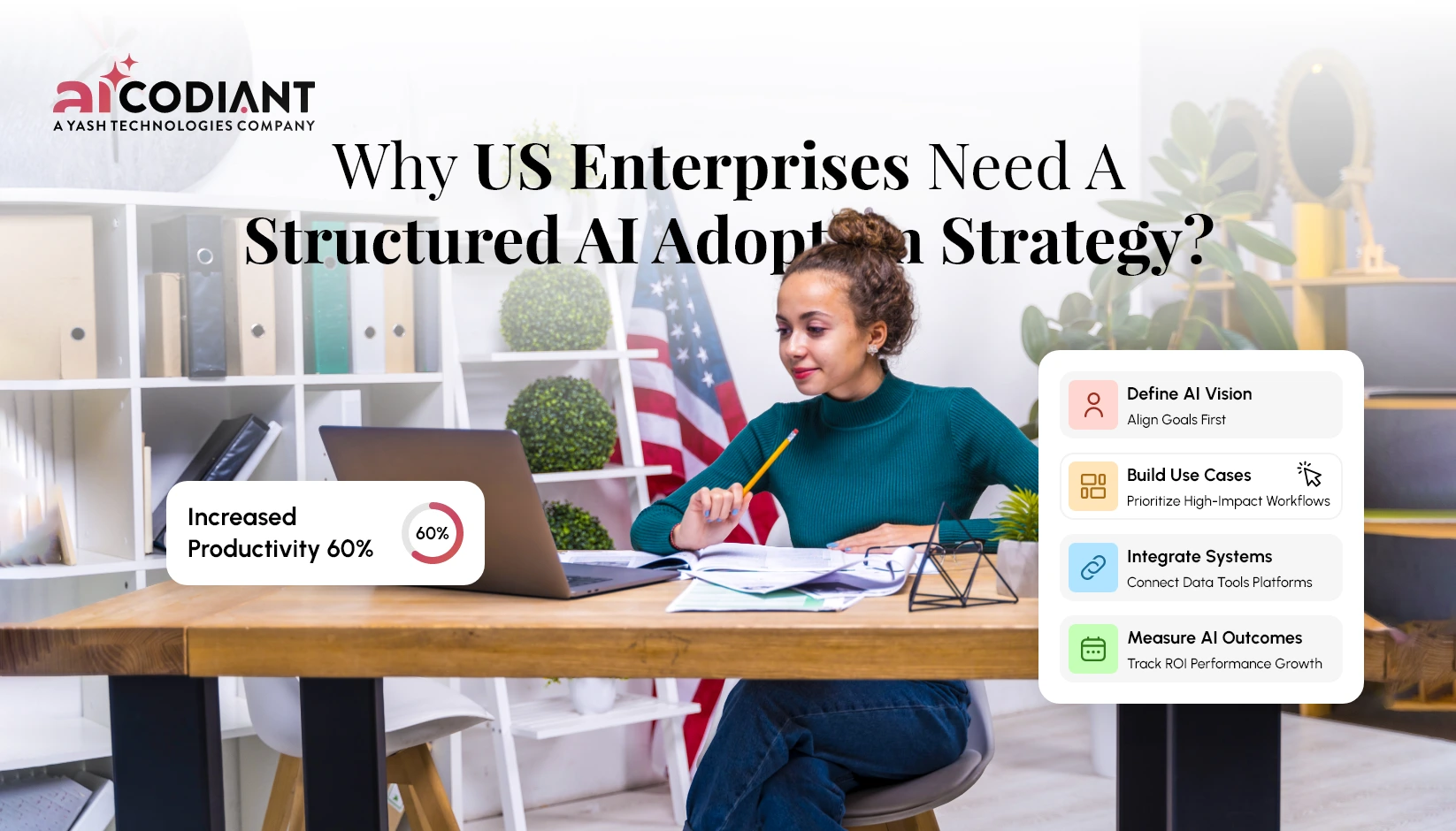
Artificial intelligence is no longer an experimental technology reserved for innovation labs. In the USA, AI has become a boardroom priority for enterprises looking to scale faster, operate smarter, and stay competitive in increasingly data-driven markets.
Yet despite rising AI investments, many large organizations struggle to turn AI ambition into measurable business outcomes. Pilots stall. Models fail to scale. Data teams operate in silos. Compliance concerns slow progress. And leadership often lacks a clear answer to a simple question: How exactly does AI create value for our business?
This is where AI strategy consulting in the USA becomes critical.
Enterprise AI success is not about tools or models alone. It requires a well-defined AI transformation strategy, a practical AI roadmap for enterprises, and expert guidance to align technology decisions with business goals, governance, and long-term scalability.
This blog explores why enterprises increasingly rely on AI consulting firms in the USA, what AI strategy consulting actually delivers, and how organizations can build a sustainable AI adoption strategy that drives real impact.
What Is AI Strategy Consulting for Enterprises?
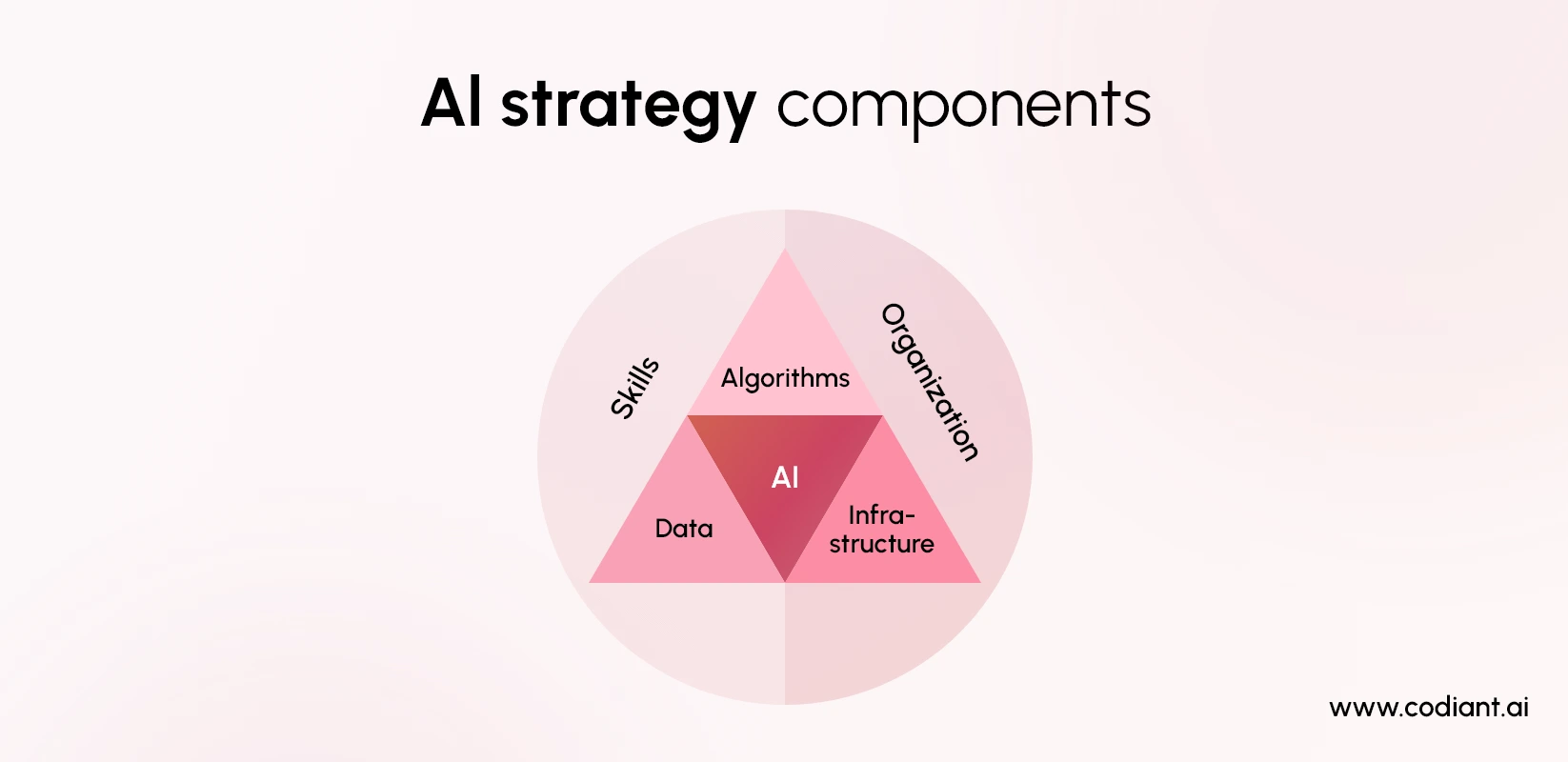
AI strategy consulting focuses on helping organizations design, govern, and execute AI initiatives that align with business objectives, regulatory requirements, and operational realities.
Unlike tactical implementation support, AI advisory services in the USA take a holistic, enterprise-wide view covering business strategy, data readiness, technology architecture, governance models, and change management.
At its core, AI strategy consulting answers five critical enterprise questions:
- Where can AI create the most business value for us?
- What data, systems, and capabilities do we need to support AI?
- How do we prioritize AI initiatives across business units?
- How do we govern AI responsibly, securely, and compliantly?
- How do we scale AI from pilots to enterprise-wide adoption?
Why Enterprises in the USA Specifically Need AI Strategy Consulting?
Complex Regulatory and Compliance Environment
US enterprises operate under strict regulatory frameworks HIPAA, SOC 2, GDPR (for global operations), state-level AI laws, and emerging federal AI guidelines.
AI governance and strategy consulting ensures that:
- AI systems comply with industry-specific regulations
- Data usage follows privacy and security best practices
- Models are auditable, explainable, and accountable
- Risk mitigation is embedded into AI design
Without governance-first planning, AI initiatives can expose enterprises to legal, financial, and reputational risk.
AI Investments Are Too Expensive to Fail
Enterprise AI initiatives require significant investment in data infrastructure, cloud platforms, talent, tools, and integration.
An unclear AI adoption strategy for enterprises often leads to:
- Wasted spend on disconnected tools
- Redundant AI initiatives across teams
- Low adoption of AI-driven solutions
- Failure to demonstrate ROI to leadership
AI works best with a plan.
Discover how a structured AI strategy can drive scale, governance, and measurable business outcomes across your enterprise.
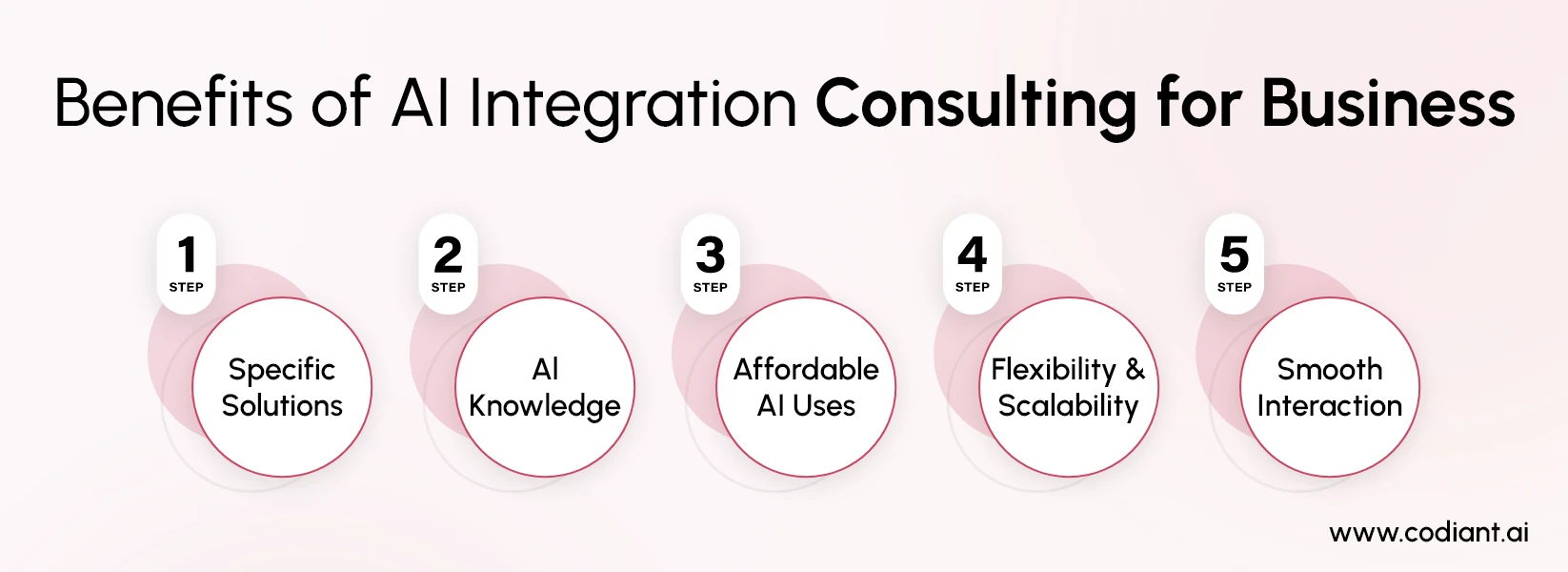
Enterprise AI consulting services help organizations prioritize high-impact use cases, define success metrics, and ensure every AI investment ties back to measurable business outcomes.
Scaling AI Is Harder Than Building Models
Many enterprises can build AI models. Very few can scale them reliably across the organization.
Scaling challenges include:
- Integrating AI into legacy enterprise systems
- Managing data pipelines across multiple sources
- Aligning IT, data, security, and business teams
- Maintaining model performance over time
Enterprise AI implementation consulting bridges the gap between experimentation and production ensuring AI systems are operational, scalable, and embedded into real workflows.
Key Components of an Enterprise AI Transformation Strategy
A successful AI transformation strategy goes far beyond technology selection. It includes multiple interdependent layers.
Business-Led AI Vision
AI strategy should start with business priorities, not algorithms.
Consulting teams help enterprises:
- Identify AI opportunities aligned with revenue growth, cost optimization, risk reduction, or customer experience
- Define AI success metrics tied to KPIs
- Align leadership around a shared AI vision
This prevents AI from becoming a siloed technical initiative.
AI Roadmap for Enterprises
An effective AI roadmap for enterprises defines how AI capabilities evolve over time.
It typically includes:
- Short-term wins that demonstrate value quickly
- Medium-term scaling initiatives across departments
- Long-term investments in advanced AI capabilities
Roadmaps help enterprises balance innovation with operational stability.
Data and Architecture Readiness
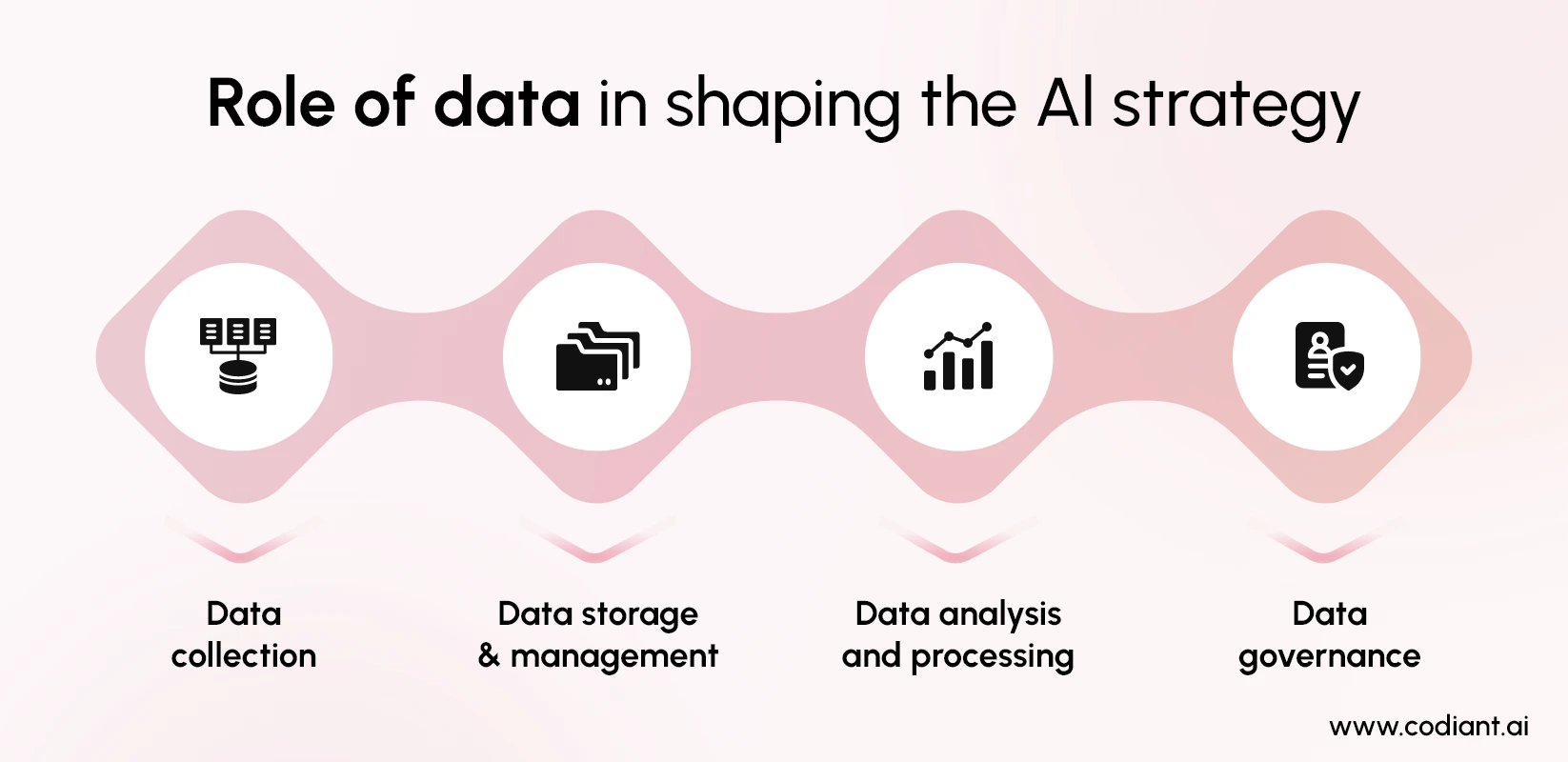
AI strategy consulting assesses whether an enterprise is truly AI-ready by evaluating:
- Data quality, availability, and governance
- Cloud and on-prem infrastructure readiness
- Integration with existing enterprise platforms
Without this foundation, even the best AI models fail to deliver impact.
AI Governance and Responsible AI Frameworks
Responsible AI is no longer optional.
AI governance and strategy consulting establishes:
- Clear accountability for AI decisions
- Ethical AI guidelines and bias mitigation practices
- Model monitoring, auditability, and lifecycle management
This is especially critical for regulated industries like healthcare, finance, insurance, and legal services in the USA.
Change Management and Adoption
AI does not fail because of technology alone. It fails because people do not trust or adopt it.
Enterprise AI consulting services focus on:
- Stakeholder alignment across leadership and teams
- Training and enablement programs
- Redesigning workflows to include AI naturally
Adoption strategy is what turns AI capability into business value.
Read More: How AI Is Cutting Costs & Boosting Business Efficiency
The AI Reality for Enterprises Today
Most US enterprises already recognize the potential of AI. According to industry research, a majority of large organizations have initiated some form of AI adoption ranging from automation and analytics to machine learning and generative AI initiatives.
However, recognition does not equal readiness.
Many enterprises face challenges such as:
- Disconnected AI initiatives across departments
- Lack of enterprise-wide AI governance and standards
- Unclear ROI from AI pilots and proofs of concept
- Legacy systems that limit AI scalability
- Data quality, security, and compliance concerns
- Talent gaps between data science, IT, and business teams
Without a structured approach, AI efforts often remain fragmented, reactive, and difficult to scale. This is why enterprise AI consulting services have shifted from optional support to a strategic necessity.
AI Strategy Consulting Roadmap for Enterprises
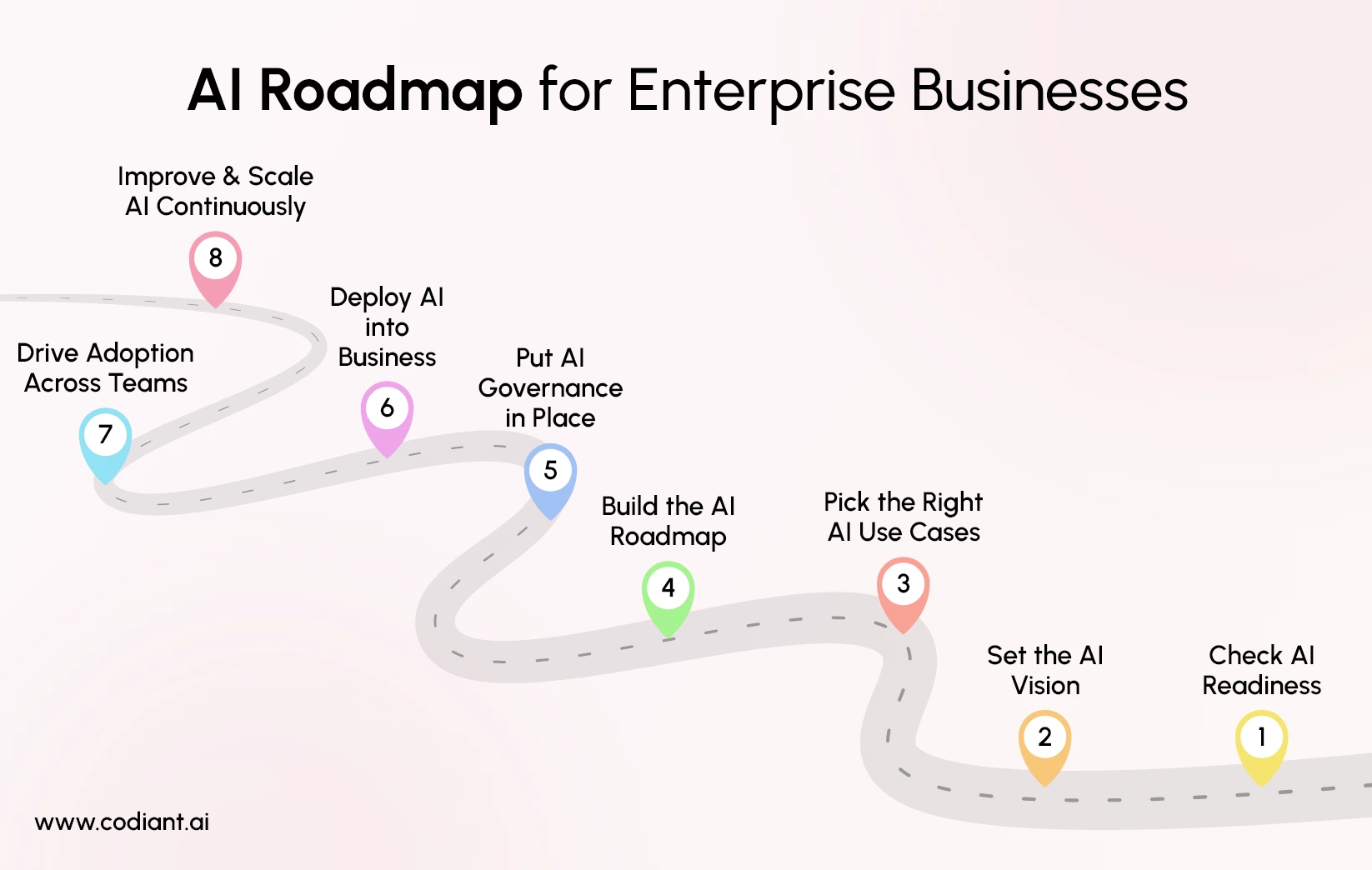
A structured roadmap helps enterprises turn AI ambition into governed, scalable, and measurable business outcomes.
Phase 1: AI Readiness and Maturity Assessment
AI strategy consulting begins by evaluating business priorities, data maturity, technology infrastructure, compliance exposure, and internal capabilities. This assessment establishes a realistic baseline, helping enterprises understand what AI initiatives are feasible today and what foundational gaps must be addressed first.
Phase 2: Enterprise AI Vision and Strategic Alignment
Consultants work with leadership to define a clear enterprise AI vision aligned with growth, efficiency, and risk objectives, often supported by enterprise AI consulting services. This step ensures AI initiatives support measurable business outcomes rather than isolated experiments or disconnected departmental goals.
Phase 3: Use Case Identification and Prioritization
High-impact AI use cases are identified across functions such as operations, customer experience, finance, and compliance. Each opportunity is evaluated based on business value, feasibility, data readiness, and time-to-value to support a focused AI adoption strategy, including Generative AI.
Phase 4: AI Roadmap Design and Investment Planning
This phase translates priorities into a structured AI roadmap outlining short-term wins, mid-term scaling initiatives, and long-term capability development. Enterprises often ask, how long does it take to create an enterprise AI roadmap? Typically, this phase takes 6–10 weeks.
Phase 5: AI Governance, Risk, and Compliance Framework
AI governance and strategy consulting establishes policies for ethical AI use, data privacy, regulatory compliance, accountability, and model oversight. This ensures enterprise AI systems remain transparent, auditable, secure, and aligned with evolving US regulatory expectations.
Phase 6: Enterprise AI Implementation and Integration
Enterprise AI implementation consulting focuses on deploying AI solutions into real business workflows. This includes system integration, data pipeline optimization, model deployment, and coordination across IT, security, and business teams to ensure scalable, production-ready AI systems.
Phase 7: Adoption, Enablement, and Change Management
Successful AI adoption requires structured enablement. Consultants support training, workflow redesign, and stakeholder alignment to help teams trust AI outputs and embed intelligence into daily decision-making across the enterprise.
Phase 8: Continuous Optimization and AI Scaling
AI strategy does not end at deployment. Ongoing AI advisory services help enterprises monitor performance, refine models, scale successful initiatives, and adapt governance frameworks as business needs, regulations, and technologies evolve over time.
AI adoption is easy. AI success isn’t.
Get expert guidance to turn AI investments into real operational and business value.
How AI Consulting Firms in the USA Deliver Enterprise Value?
Top AI consulting firms in the USA combine strategic thinking, deep technical expertise, and industry-specific knowledge to help enterprises move beyond isolated AI experiments. Their role is not limited to recommending tools or building models it is to shape how AI fits into the enterprise’s long-term operating model.
They typically support organizations through:
- AI maturity assessments that evaluate data readiness, infrastructure, governance, and organizational alignment, helping leaders understand where they stand today.
- Opportunity discovery and use-case prioritization, identifying where AI can drive the highest business impact based on feasibility, ROI, and risk.
- AI strategy and roadmap development that outlines phased adoption from quick wins to enterprise-wide capabilities aligned with business goals.
- Governance and compliance planning to ensure AI systems meet regulatory, security, and ethical standards from day one.
- End-to-end AI digital transformation consulting, guiding enterprises from strategy through implementation, integration, and scale.
Most importantly, these firms help enterprises shift from AI curiosity to AI confidence providing clarity, structure, and execution discipline so AI becomes a reliable business capability, not an ongoing experiment.
Read More: How AI Helps Real Estate Companies Reduce Manual Work
AI Strategy Consulting vs. Traditional IT Consulting
Traditional IT consulting focuses on improving systems, selecting platforms, and optimizing processes. While essential, this approach alone is not sufficient for AI-driven transformation.
AI strategy consulting addresses a different layer of complexity how intelligence, data, and automation reshape decision-making across the enterprise.
Key differences include:
- AI strategy is business-outcome driven, starting with value creation rather than technology selection.
- AI systems require continuous learning and adaptation, not one-time implementation.
- Governance, ethics, and accountability are built into AI strategy from the start, especially in regulated US industries.
- Success depends on data quality, organizational culture, and leadership alignment, not just technical execution.
This is why AI advisory services in the USA operate as a specialized discipline. They sit at the intersection of business strategy, data science, risk management, and change leadership rather than functioning as an extension of traditional IT consulting.
When Should Enterprises Seek AI Strategy Consulting?
Enterprises typically benefit from AI strategy consulting when:
- AI initiatives are fragmented across teams
- Leadership lacks visibility into AI ROI
- AI pilots are not scaling into production
- Regulatory or ethical concerns slow adoption
- The organization plans enterprise-wide AI transformation
Engaging early often prevents costly rework later.
The Future of Enterprise AI in the USA
AI adoption in US enterprises is entering a more mature phase. The focus is shifting from experimentation to execution, governance, and long-term value creation.
Enterprises that succeed will not be those with the most AI tools but those with the clearest AI digital transformation consulting strategy, strongest governance models, and most disciplined execution.
AI strategy consulting is no longer about whether to adopt AI.
It is about how to adopt it responsibly, strategically, and at scale.
Read More: How to Build an AI Agent
How Codiant AI Can Help Enterprises Build a Scalable AI Strategy?
Codiant AI partners with US enterprises to turn AI from isolated initiatives into a governed, enterprise-ready capability. Our approach focuses on clarity, execution, and measurable outcomes—without disrupting core operations.
We help enterprises by:
- Defining AI strategy and roadmaps aligned with business priorities, data readiness, and regulatory requirements
- Designing AI governance frameworks that ensure security, compliance, and responsible AI adoption
- Prioritizing high-impact AI use cases with clear ROI and implementation pathways
- Supporting enterprise AI implementation across cloud, data, and application ecosystems
The result is an AI strategy that scales—technically, operationally, and responsibly.
Final Thoughts
AI is reshaping how enterprises in the USA compete, operate, and innovate. But without a clear strategy, even the most advanced AI technologies fall short of their promise.
AI strategy consulting in the USA provides enterprises with the clarity, structure, and guidance needed to turn AI into a sustainable business capability not just a technical experiment.
For organizations focused on long-term AI success, investing in enterprise AI consulting services is not an expense it is a strategic safeguard and a competitive advantage. When combined with insights from leading generative AI development companies USA, businesses can accelerate innovation, reduce implementation risks, and build scalable AI solutions that support growth, efficiency, and market leadership.
Planning AI at enterprise scale requires clarity.
Partner with experts who help you design, govern, and scale AI with confidence.
Frequently Asked Questions
Industries with complex operations and regulatory requirements benefit most, including healthcare, financial services, insurance, manufacturing, retail, logistics, and legal services. AI strategy consulting helps these sectors scale intelligence while managing compliance, risk, and enterprise-wide transformation.
A typical engagement includes AI readiness assessment, use-case prioritization, enterprise AI roadmap creation, governance and compliance planning, technology and data architecture alignment, and change management support to ensure AI initiatives deliver measurable business value.
Enterprises assess AI readiness by evaluating data quality, infrastructure maturity, integration capabilities, governance frameworks, talent availability, and leadership alignment. AI strategy consultants provide structured assessments to identify gaps before significant AI investments begin.
AI strategy consulting starts with business objectives, not technology. Consultants map AI initiatives directly to revenue growth, cost optimization, risk reduction, or customer experience improvements, ensuring every AI investment supports clear enterprise outcomes.
Data governance ensures AI systems use accurate, secure, and compliant data. It defines ownership, access controls, privacy standards, and accountability, helping enterprises maintain trust, regulatory compliance, and long-term reliability of AI-driven decisions.
ROI is measured through business KPIs such as operational efficiency gains, cost reductions, revenue impact, risk mitigation, and adoption rates. A strong AI strategy also delivers long-term value by reducing failed pilots and improving scalability.
Featured Blogs
Read our thoughts and insights on the latest tech and business trends
How AI-Powered Virtual Assistants Automate Enterprise Workflows in 2026?
- April 8, 2026
- Artificial Intelligence
Enterprises are no longer asking if AI should be part of operations. The real question now is how deeply it can be embedded. And in 2026, one answer keeps showing up across industries- AI-powered virtual... Read more
Implementing Agentic RAG in Enterprises: Architecture, Challenges & ROI
- April 2, 2026
- Artificial Intelligence
In 2026, enterprises are no longer satisfied with static AI responses or generic large language model outputs. The demand has shifted toward systems that can think, retrieve, act and refine responses dynamically this is where... Read more
Enterprise AI Development Partner Checklist- What CTOs Should Evaluate Before Hiring
- March 27, 2026
- Artificial Intelligence
AI is no longer an experiment sitting in innovation labs. It’s driving revenue, optimizing operations, and shaping how enterprises compete. But here’s the real challenge choosing the right enterprise AI development partner. Because the difference... Read more