How AI Helps Real Estate Companies Reduce Manual Work by 50% in 2026
Table of Contents
Subscribe To Our Newsletter
Real estate has always been a people-driven business, but behind every deal, lease, inspection, and maintenance request sits a mountain of manual work. Emails are still forwarded back and forth for approvals. Spreadsheets track leads, tenants, payments, and service tickets. Property managers juggle calls, messages, site visits, and paperwork-often all at once.
As portfolios grow and customer expectations rise, this manual operating model is starting to crack.
In 2026, real estate companies in the UAE and USA face a very different reality than they did even a few years ago. Smart cities, large-scale residential developments, mixed-use commercial spaces, and remote property management have become the norm.
Tenants expect instant responses. Investors demand real-time visibility. Teams are stretched thin, not because of lack of effort, but because too much time is spent on repetitive administrative work.
This naturally raises a common question many leaders are asking today: how does AI reduce manual work in real estate companies without disrupting existing operations?
This is where AI for real estate automation is making a measurable difference. Not as a futuristic concept, but as a practical tool that helps companies reduce manual work using AI, streamline operations, and scale without continuously adding headcount.
By 2026, AI-driven systems are helping real estate businesses cut manual workload by up to 50%, while improving service quality at the same time. To understand how, we first need to look at where manual work is hiding today.
What “AI for Real Estate Automation” Actually Means in 2026
When people hear about AI in real estate, they often imagine complex systems or expensive custom solutions. In reality, AI for real estate automation in 2026 is far more practical and accessible.
Modern AI systems combine machine learning, natural language processing, and predictive analytics to handle repetitive tasks intelligently.

Unlike basic automation, which simply follows fixed rules, AI learns from data patterns. It understands tenant queries, predicts maintenance issues, prioritizes leads, and processes documents with context.
This explains what real estate tasks can be automated using AI today. Tasks such as lead screening, tenant communication, inspection reporting, document validation, and maintenance scheduling are no longer dependent on manual effort alone.
For real estate companies in the UAE and USA, AI is increasingly integrated into existing platforms such as CRMs, property management systems, building management software, and customer support tools. These integrations allow teams to automate workflows without disrupting their current operations.
Instead of replacing people, AI acts as a digital assistant that works continuously in the background-reducing manual effort, minimizing errors, and allowing teams to focus on higher-value work.
See What Manual Work You Can Eliminate
Not every process needs AI. The right ones can save weeks of manual effort every quarter.
How AI Reduces 50% Manual Work Across Core Real Estate Functions
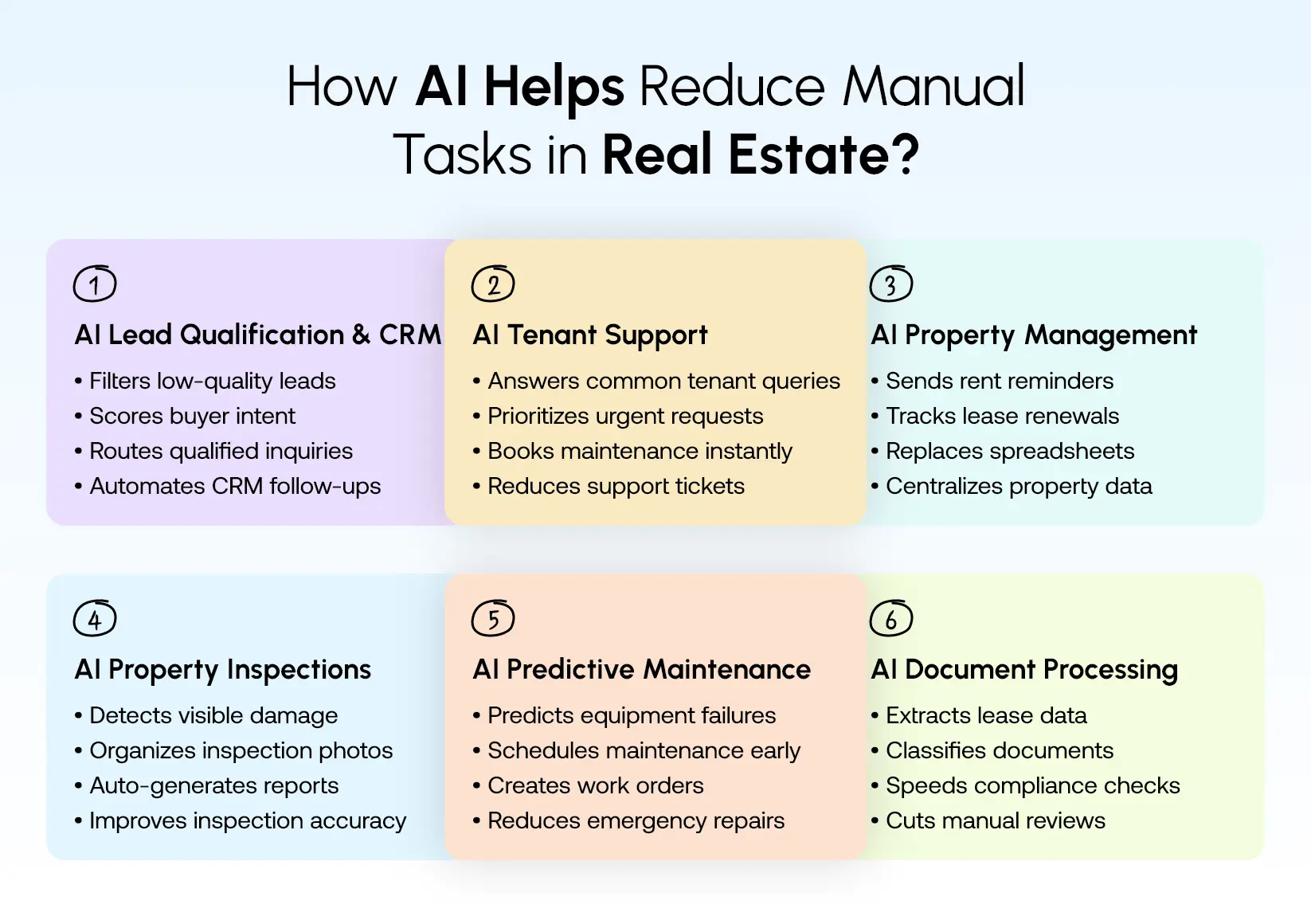
AI Lead Qualification and Real Estate CRM Automation
Lead management is one of the most manual-heavy processes in real estate. Sales and leasing teams often spend hours responding to inquiries that are low intent or poorly timed. This not only wastes effort but also delays responses to high-quality prospects.
With AI lead qualification in real estate, incoming leads are automatically analyzed based on behavior, budget signals, location preferences, and engagement history. AI assigns scores and routes only the most relevant leads to human agents.
Integrated with real estate CRM automation, AI ensures follow-ups are timely, personalized, and consistent.
Automated reminders, smart responses, and predictive insights reduce manual tracking and data entry. As a result, teams spend less time sorting leads and more time closing deals.
AI for Real Estate Customer Service and Tenant Management
Customer service is another area where manual workload quickly escalates. Tenants ask similar questions about payments, maintenance, amenities, and policies across multiple channels.
Using AI for real estate customer service, intelligent chatbots and virtual assistants handle a large percentage of these interactions instantly.
From booking maintenance requests to answering lease-related questions, AI-driven systems provide accurate responses without human intervention.
Advanced AI tenant management tools go a step further by understanding tenant history and preferences. Requests are categorized, prioritized, and routed automatically, reducing back-and-forth communication. This not only cuts manual effort but also improves tenant satisfaction through faster resolution times.
AI Property Management Solutions for Daily Operations
Day-to-day property management involves countless small tasks that add up quickly. Rent reminders, payment tracking, lease renewals, and vendor coordination are often handled manually.
Modern AI property management solutions automate these workflows seamlessly. Rent notifications are triggered automatically.
Renewal alerts are sent based on contract timelines. Dashboards replace spreadsheets, offering real-time visibility into occupancy, revenue, and operational issues.
This is where many teams begin to understand what tools real estate companies use for automation in 2026. AI-driven platforms, supported by AI-Powered data analytics services, work alongside existing systems to help teams automate real estate workflows without needing a complete system overhaul.
AI-Powered Property Inspections and Reporting
Property inspections traditionally require significant manual effort. Inspectors capture photos, take notes, organize data, and prepare reports-often repeating the same process across multiple properties.
With AI-powered property inspections, image recognition technology identifies common issues such as cracks, leaks, or wear and tear automatically. Photos are analyzed, categorized, and matched with historical data.
This directly answers another common query: how does AI help with property inspections? By generating inspection reports instantly, AI reduces documentation time, improves consistency, and minimizes human error across large portfolios.
AI Predictive Maintenance and Smart Building Operations
Maintenance is often reactive, leading to emergency repairs and frustrated tenants. Manual scheduling and monitoring make it difficult to anticipate problems early.
AI predictive maintenance in real estate changes this approach entirely. Sensors and data from building systems are analyzed to predict equipment failures before they happen. AI schedules maintenance proactively and generates work orders automatically.
This makes it clear that AI can manage maintenance requests automatically, without constant human intervention. Combined with smart building operations AI and supported by scalable cloud data engineering, facility teams no longer need to manually monitor systems or respond to unexpected breakdowns.
AI Document Processing for Real Estate Compliance
Document handling remains one of the most time-consuming aspects of real estate operations. Reviewing leases, extracting key clauses, verifying tenant documents, and ensuring compliance often require manual review.
With AI services document processing for real estate, contracts and documents are scanned, classified, and analyzed automatically. AI extracts critical data such as dates, payment terms, and obligations, reducing legal and administrative workload.
Compliance checks become faster and more reliable, particularly for companies operating across jurisdictions in the UAE and USA, where regulatory requirements can vary significantly.
Read more: How to Develop an AI-Powered Marketplace App- Complete Guide
The 50% Reduction: How AI Cuts Manual Work in Real Numbers
Here’s how AI delivers a measurable 40–50% reduction in manual workload across real estate operations by driving cumulative efficiency gains across teams:
- Leasing teams spend less time on low-intent leads, as AI automatically filters, scores, and prioritizes inquiries before human follow-up begins.
- Property managers reduce hours lost to repetitive follow-ups and reporting, with AI handling rent reminders, renewals, and real-time performance tracking.
- Maintenance teams shift from reactive to predictive workflows, as AI anticipates issues early and auto-generates service requests before failures occur.
- Customer service handles higher volumes without additional staff, with AI chatbots resolving routine queries and routing complex issues intelligently.
- Administrative and compliance work becomes faster and more accurate, as AI processes documents, extracts key data, and minimizes manual review effort.
Individually, each automation may save minutes or hours per task. Collectively, these gains compound over time – reducing operational strain, minimizing errors, improving response times, and allowing teams to operate with greater confidence and clarity.
Still Managing Real Estate Work Manually?
If your teams spend hours on follow-ups, reports, inspections, and tenant requests, AI can eliminate that operational drag without disrupting existing systems.
Where Manual Work Hides in Real Estate Operations Today
Manual work in real estate is rarely obvious at first glance. Deals still close, tenants still move in, and buildings continue to operate. Yet beneath the surface, teams spend hours every day on repetitive tasks that could be automated with far greater efficiency.
Much of this manual effort is spread across core operational areas:
- Leasing teams manually review and respond to large volumes of inquiries, many of which never convert into site visits or signed agreements.
- Property managers spend significant time on follow-ups, including rent payments, lease renewals, and maintenance coordination.
- Inspection teams manually document property conditions, organizing photos, notes, and reports after every visit.
- Customer support teams answer the same questions repeatedly, across calls, emails, and WhatsApp, creating unnecessary workload during peak periods.
Document management adds another layer of complexity. Lease agreements, KYC records, compliance forms, and vendor contracts are often scattered across folders, inboxes, and disconnected systems. Searching for the right document, validating information, or updating records becomes increasingly time-consuming as portfolios grow.
This fragmented way of working slows decision-making, increases the risk of errors, and creates heavy dependence on human availability. As real estate portfolios expand, manual workload grows linearly or sometimes exponentially unless workflows are rethought.
This is exactly why real estate workflow automation has become a priority for companies looking to remain efficient, responsive, and competitive in 2026.
Why UAE and USA Real Estate Markets Are Leading AI Adoption
The UAE and USA are uniquely positioned to lead real estate digital transformation in 2026. Large-scale developments, smart city initiatives, and tech-savvy tenants create strong demand for intelligent systems.
In the UAE, smart infrastructure and government-backed digital initiatives accelerate adoption. In the USA, competitive markets and operational scale push companies toward automation to maintain margins.
For both regions, real estate AI technology is no longer experimental-it is becoming a standard requirement to manage complexity efficiently.
How Real Estate Companies Can Start Using AI in 2026
One of the most common concerns is how fast real estate teams can adopt AI automation. The answer is faster than most expect.
Successful AI adoption does not require replacing existing systems overnight. Companies can start by identifying high-volume, repetitive tasks that consume the most time.
Integrating AI with current CRMs, property management platforms, and support tools allows for gradual implementation. Piloting AI in one function-such as customer service or maintenance-helps teams build confidence before scaling.
Training staff alongside automation ensures AI enhances workflows rather than disrupting them. With the right approach, adoption becomes a smooth transition rather than a risky overhaul.
How Codiant AI Helps Real Estate Companies Automate at Scale
Codiant AI works closely with real estate companies in the UAE and USA to turn manual-heavy operations into intelligent, automated workflows. Instead of generic tools, we design AI solutions aligned with real portfolio size, tenant volume, and operational complexity.
Our real estate AI capabilities focus on practical impact:
- AI-powered workflow automation across leasing, maintenance, inspections, and support
- Smart integration with existing CRMs, property management, and building systems
- Predictive analytics for maintenance, occupancy, and tenant behavior
- Secure AI document processing for leases, compliance, and onboarding
With a phased, ROI-driven approach, Codiant AI helps real estate teams reduce manual workload, improve response times, and scale operations confidently in 2026 and beyond.
Final Thoughts: AI Is No Longer Optional for Real Estate Efficiency
By 2026, the question for real estate companies is no longer whether to adopt AI, but how quickly they can do it effectively. Manual processes that once worked at smaller scales are now barriers to growth.
AI enables real estate businesses to operate smarter, respond faster, and scale without proportional increases in staffing. The ability to reduce manual work using AI is not just an operational advantage-it is a competitive one.
Companies that embrace AI today will enter the next phase of real estate with leaner operations, better customer experiences, and stronger long-term resilience. Those that delay may find themselves overwhelmed by manual complexity in a market that no longer waits
Ready to Cut Manual Work by 50% in Your Real Estate Operations?
Discover how AI-driven automation can streamline workflows, improve tenant experiences, and scale property operations efficiently in 2026.
Frequently Asked Questions
AI helps with property inspections by analyzing photos, videos, and sensor data to automatically detect issues like structural damage, leaks, or wear and tear. It generates standardized inspection reports instantly, reducing manual documentation time, improving accuracy, and ensuring consistency across multiple properties or locations.
AI solutions such as lead qualification engines, tenant chatbots, document processing tools, predictive maintenance systems, and workflow automation platforms significantly reduce manual tasks. These tools handle repetitive activities like follow-ups, reporting, scheduling, and data entry, allowing teams to focus on higher-value decision-making.
AI automates property management workflows by connecting leasing, payments, maintenance, and communication into a single intelligent system. Tasks like rent reminders, lease renewals, maintenance ticket routing, and performance reporting are triggered automatically based on data and timelines, minimizing manual coordination and follow-ups.
Yes, modern AI platforms are designed to integrate seamlessly with existing real estate CRMs and property management systems. AI layers sit on top of current tools, enhancing them with automation, insights, and predictive capabilities without requiring full system replacement or major operational disruption.
The ROI of AI automation for real estate firms comes from reduced operational costs, faster response times, fewer errors, and improved team productivity. Many companies see measurable efficiency gains within months, with manual workload reductions of up to 40–50% as AI adoption scales across departments.
AI-powered real estate automation typically uses data such as tenant interactions, lead inquiries, maintenance history, inspection images, lease documents, payment records, and building sensor data. Even partial or historical data can be sufficient to start, with AI models improving accuracy as more data is collected.
Featured Blogs
Read our thoughts and insights on the latest tech and business trends
Top 15 Machine Learning Development Companies in 2026
- February 26, 2026
- Machine Learning
Machine learning is no longer something only big tech companies use. In 2026, businesses of every size are using machine learning to predict demand, reduce costs, detect risks & make better decisions faster. But here’s... Read more
10 Agentic AI Use Cases Powering Enterprise ROI in 2026
- February 20, 2026
- AI Agent Development
In a Nutshell: Agentic AI goes beyond traditional automation by making goal-driven decisions across complex enterprise workflows. In 2026, enterprises are adopting agentic AI for measurable ROI, not experimentation or pilots. Agentic AI use cases... Read more

AI in Business Intelligence- The 2026 Roadmap to Data Dominance
- February 16, 2026
- AI-Powered Data Analytics
Business intelligence was built to bring clarity to complex businesses. Dashboards, reports, KPIs and scorecards were meant to help leaders see what was happening and make informed choices. In practice, most BI systems still focus... Read more