How AI Is Cutting Costs & Boosting Business Efficiency
Table of Contents
Subscribe To Our Newsletter
Rising labor costs, shrinking margins, and growing operational complexity are forcing businesses to rethink how they scale. Growth is no longer just about expanding faster – it’s about operating smarter.
Many organizations are moving away from “growth at any cost” and focusing on efficient growth that protects profitability. Traditional cost-cutting methods often rely on layoffs, budget freezes, or delayed investments, which can hurt long-term performance.
In contrast, AI is helping companies reduce costs by improving how work actually gets done. The AI digital transformation benefits go beyond automation, enabling companies to streamline workflows, optimize labor, and reduce overhead while maintaining quality.
As 2026 approaches, efficiency-first businesses that use AI to improve business operations will be better positioned to stay competitive. Keep reading to see how AI is reshaping cost control across modern enterprises.
How AI Redefines Cost Reduction for Modern Businesses?
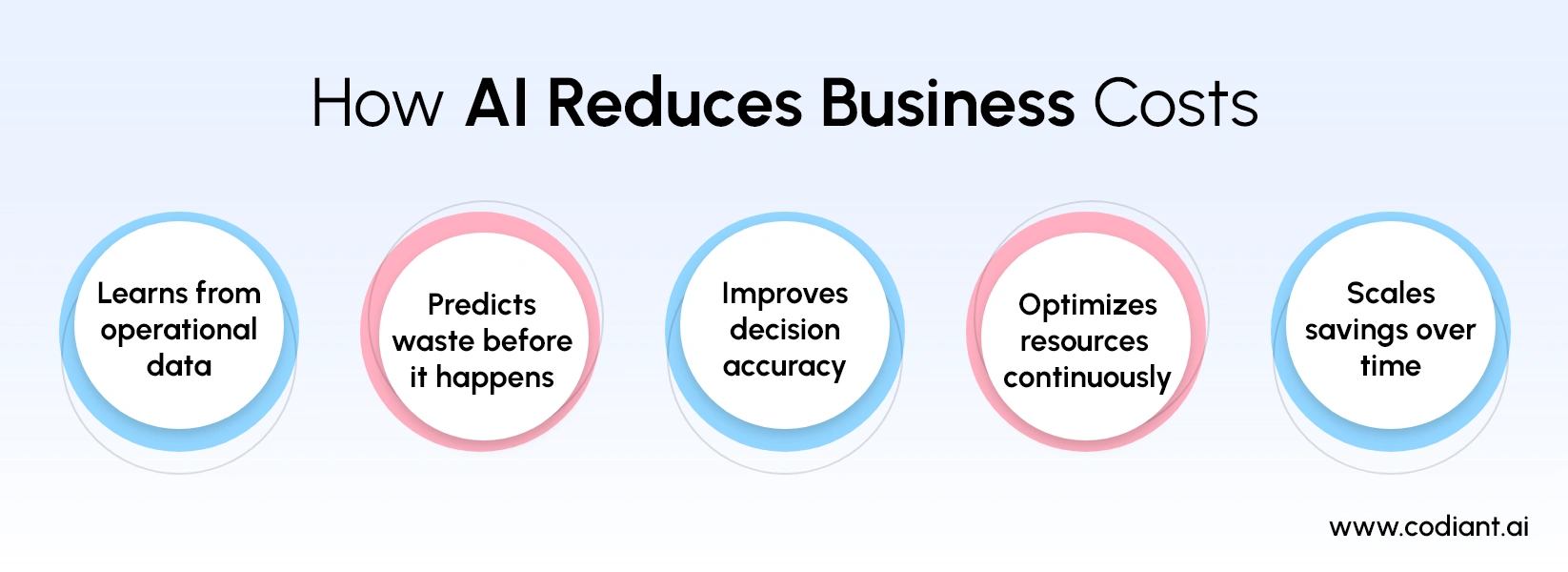
Traditional cost reduction depends on manual reviews and fixed automation rules. Costs are usually addressed only after inefficiencies appear. So how does AI help businesses cut costs? It does this by continuously learning from operational data and improving decisions as conditions change, rather than reacting after losses occur.
What makes AI different from basic automation tools is how it works over time:
- AI learns and improves continuously by analyzing operational patterns, performance data, and outcomes, making systems more accurate with use
- Cost control shifts from reactive to proactive, as AI detects early signals of waste, delays, or resource imbalance before they impact budgets
- Decisions become data-driven at every level, reducing guesswork in planning, forecasting, and execution
As part of modern AI cost reduction strategies, AI acts as a decision-support layer across departments. It highlights inefficiencies, predicts future cost risks, and recommends smarter actions without adding manual effort.
These cost-saving AI technologies including machine learning help organizations plan better, operate leaner, and scale efficiently, making AI for business optimization a practical approach rather than a one-time cost-cutting exercise.
Before Cutting Costs, Redesign the System.
AI helps businesses rework how decisions, workflows, and resources move – so savings come from structure, not shortcuts.
AI Automation for Companies: Eliminating Manual Work at Scale
AI automation for companies is changing how everyday work gets done across departments. Instead of teams spending hours on repetitive actions, AI for process automation allows routine tasks to move forward automatically, with consistency and speed, much like how AI-powered DevOps solutions streamline workflows and reduce manual intervention across development and operations.
Over time, this answers a practical concern most businesses face: what business processes can AI automate without disrupting operations?
In reality, AI fits best wherever work follows clear patterns, rules, and volume.
Here’s how workflow automation using AI replaces manual effort across core areas:
Document processing
AI scans, classifies, and extracts data from invoices, contracts, forms, and emails. Documents are routed automatically for review or storage, reducing manual handling and turnaround time.
Data entry and validation
AI captures and validates data across systems, enabling efficient cloud data engineering services while identifying errors, duplicates, and data gaps early to minimize rework and downstream issues.
Scheduling, approvals, and follow-ups
AI manages calendars, routes approvals based on predefined rules, sends reminders, and tracks pending actions. This removes the need for constant manual follow-ups and status checks.
Customer query handling
AI-powered chat and email automation handles common customer questions, order updates, and service requests instantly. Human teams focus only on complex or high-impact cases.
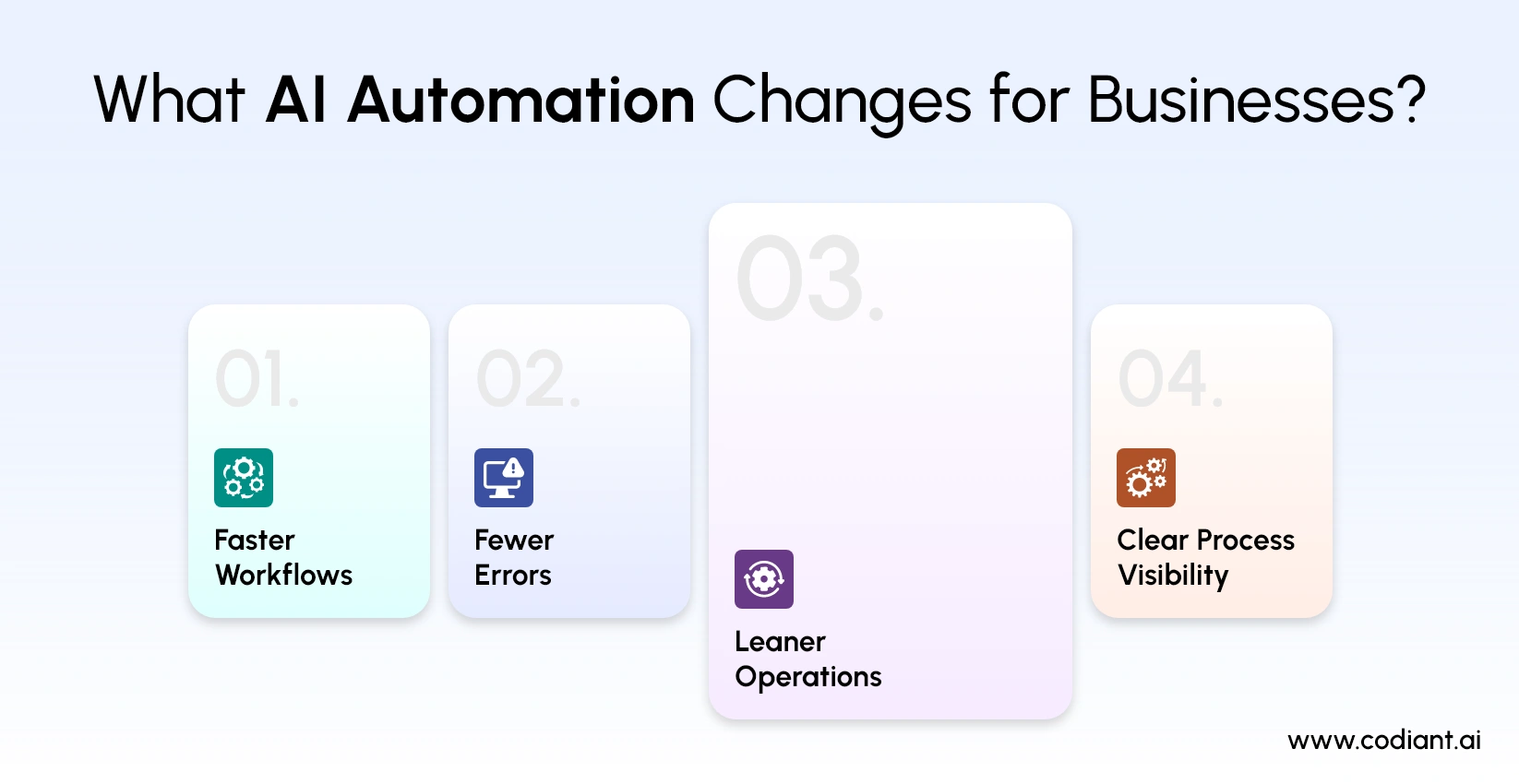
Business impact of AI automation
- Faster execution across daily operational workflows
- Lower error rates due to reduced manual intervention
- Reduced dependency on large operational teams
- Better visibility into process efficiency and bottlenecks
By using AI to reduce labor costs, companies scale operations smoothly while keeping teams focused on work that actually requires human judgement.
Read More: AI in FinTech Explained
Workflow Automation Using AI Across Core Business Functions
Workflow automation using AI is reshaping how companies operate at scale. Instead of relying on manual coordination across departments, AI connects data, decisions, and execution into a continuous flow.
This is where many organizations see a clear answer to how AI improves business productivity: routine work moves faster, errors drop, and teams spend more time on high-value activities.
Applied correctly, AI-driven productivity improvement becomes a structural advantage rather than a short-term efficiency gain.
1. Operations & Supply Chain
AI strengthens operations by analyzing demand signals, historical trends, and real-time inputs. Planning shifts from reactive to predictive, helping teams stay ahead of disruptions.
- Demand forecasting: AI anticipates demand changes more accurately, reducing urgent last-minute adjustments.
- Inventory optimization: Stock is balanced across locations based on usage patterns and lead times, lowering holding costs and shortages.
- Logistics planning: Routes, carriers, and delivery schedules are optimized to reduce delays and transportation expenses using AI efficiency tools 2026.
2. Finance & Accounting
In finance, AI reduces repetitive reconciliation and review work while improving accuracy and control.
- Invoice matching: Invoices are automatically matched with purchase orders and receipts, flagging only exceptions.
- Expense classification: Spending is categorized in real time as AI learns company-specific patterns.
- Fraud detection: Unusual transactions and anomalies are identified early, limiting losses and manual investigation.
3. HR & Workforce Management
HR teams use AI to handle high-volume processes more efficiently while preserving human oversight.
- Resume screening: Applications are filtered based on role requirements and skill relevance.
- Shift planning: Workforce schedules adjust dynamically to demand, availability, and compliance rules.
- Attrition prediction: Early risk indicators help leaders act before productivity is affected.
Across functions, these capabilities help organizations reduce operational costs with AI while sustaining consistent performance and scalable growth.
Using AI to Reduce Labor Costs Without Hurting Productivity
Using AI to reduce labor costs is less about cutting headcount and more about removing unnecessary workload from existing teams. Unlike traditional cost-cutting measures, AI focuses on optimizing how work gets done, not who does it.
AI augments teams by handling repetitive, time-consuming activities that slow productivity and increase fatigue. This allows employees to focus on higher-value work that requires judgment, creativity, and relationship management.
Where AI reduces hidden labor costs:
- Lower overtime: AI assistants manage routine tasks continuously, reducing after-hours work during peak periods.
- Less rework: Automated validation, QA checks, and monitoring catch errors early, minimizing costly fixes.
- Reduced burnout: Teams spend less time on manual follow-ups, status checks, and data cleanup.
Practical examples in action:
- AI assistants draft reports, summarize meetings, and manage internal requests.
- Chatbots handle repetitive customer and internal queries, freeing support teams for complex cases.
- Automated QA and monitoring detect performance issues in real time without manual oversight.
By shifting routine workload to AI business efficiency tools, organizations preserve productivity while improving workforce utilization. The result is controlled labor spending without sacrificing output or morale.
AI Business Efficiency Tools Driving Measurable Productivity Gains
AI business efficiency tools deliver the greatest impact when they operate as connected systems rather than isolated utilities. A key distinction exists between individual AI tools and integrated AI platforms.
Standalone tools solve narrow problems, such as forecasting, scheduling, or reporting but often create data silos. In contrast, integrated AI platforms share insights across functions, enabling coordinated decision-making and smoother operations.
Why integrated AI systems outperform point solutions:
- Data flows seamlessly across departments instead of being manually reconciled
- Insights update in real time, not in delayed reporting cycles
- Automation triggers actions rather than just generating recommendations
Examples of high-impact AI systems:
- AI analytics engines that combine operational, financial, and customer data for faster insights
- Intelligent CRMs that prioritize leads, automate follow-ups, and predict churn risks
- AI scheduling and resource allocation systems that balance workloads and capacity dynamically
- AI monitoring dashboards that track performance, costs, and anomalies in one view
Business value delivered:
- Faster decision cycles with fewer approval layers
- Reduced operational friction across teams
- Better utilization of existing staff, infrastructure, and budgets
By enabling AI-driven productivity improvement, these tools help organizations improve performance without expanding resources – making AI for improving business operations a long-term efficiency advantage rather than a short-term fix.
AI for Reducing Overhead Expenses Across Departments
When businesses think about cost reduction, staffing is usually the first focus. However, a large share of expenses comes from overhead—systems, infrastructure, delays, and inefficiencies that compound quietly over time. This is where AI for reducing overhead expenses becomes especially effective.
Instead of reacting to breakdowns or overspending, AI helps organizations prevent costs before they occur.
Where cost-saving AI technologies reduce overhead most effectively:
- Predictive maintenance:
AI analyzes equipment performance and usage patterns to anticipate failures early. This reduces emergency repairs, downtime, and replacement costs, allowing teams to plan maintenance instead of responding to crises. - Energy optimization:
By monitoring usage patterns across offices, plants, and data centers, AI adjusts energy consumption during low-demand periods. This lowers utility bills without affecting daily operations. - Cloud cost management:
AI tracks real-time cloud usage, identifies idle or oversized resources, and recommends right-sizing. This answers a common concern about which AI tools are most effective for cost savings, as cloud optimization, alongside RPA solutions often delivers fast, visible results. - Reduced compliance penalties:
AI flags missing documentation, anomalies, and policy gaps early, helping organizations avoid fines, rework, and legal expenses.
Across departments, AI reduces overhead by eliminating waste, not productivity.
Measuring AI ROI for Enterprises: Cost Savings That Actually Matter
For enterprise leaders, the real question is not whether AI can be implemented, but what is the ROI of AI implementation and how soon it becomes visible. Adoption without measurement rarely leads to long-term value.
Why ROI matters more than adoption:
AI investments must be tied to financial outcomes. Clear ROI benchmarks help decision-makers determine which initiatives should scale and which should stop.
How fast AI implementation starts saving money:
Many AI initiatives deliver short-term ROI within months by reducing manual processing, lowering error rates, and accelerating workflows. These gains create immediate operational relief.
Short-term vs long-term AI ROI:
- Short-term ROI includes reduced handling costs, faster turnaround times, and lower operational friction.
- Long-term ROI focuses on cost avoidance—preventing future expenses as the business grows.
Cost avoidance vs cost elimination:
AI does not always remove roles or expenses outright. Instead, it prevents costs from rising in proportion to volume, which is often more valuable at enterprise scale.
Key ROI metrics used by enterprises:
- Cost per transaction
- Cost per employee
- Time saved per workflow
- Revenue per operational dollar
This is where AI for business optimization delivers measurable, defensible value.
AI Digital Transformation Benefits Beyond Cost Reduction
While cost savings often justify the initial investment, the long-term AI digital transformation benefits extend far beyond expense control. In many cases, lower costs are simply a side effect of smarter systems.
AI enables organizations to grow without increasing operational complexity at the same pace.
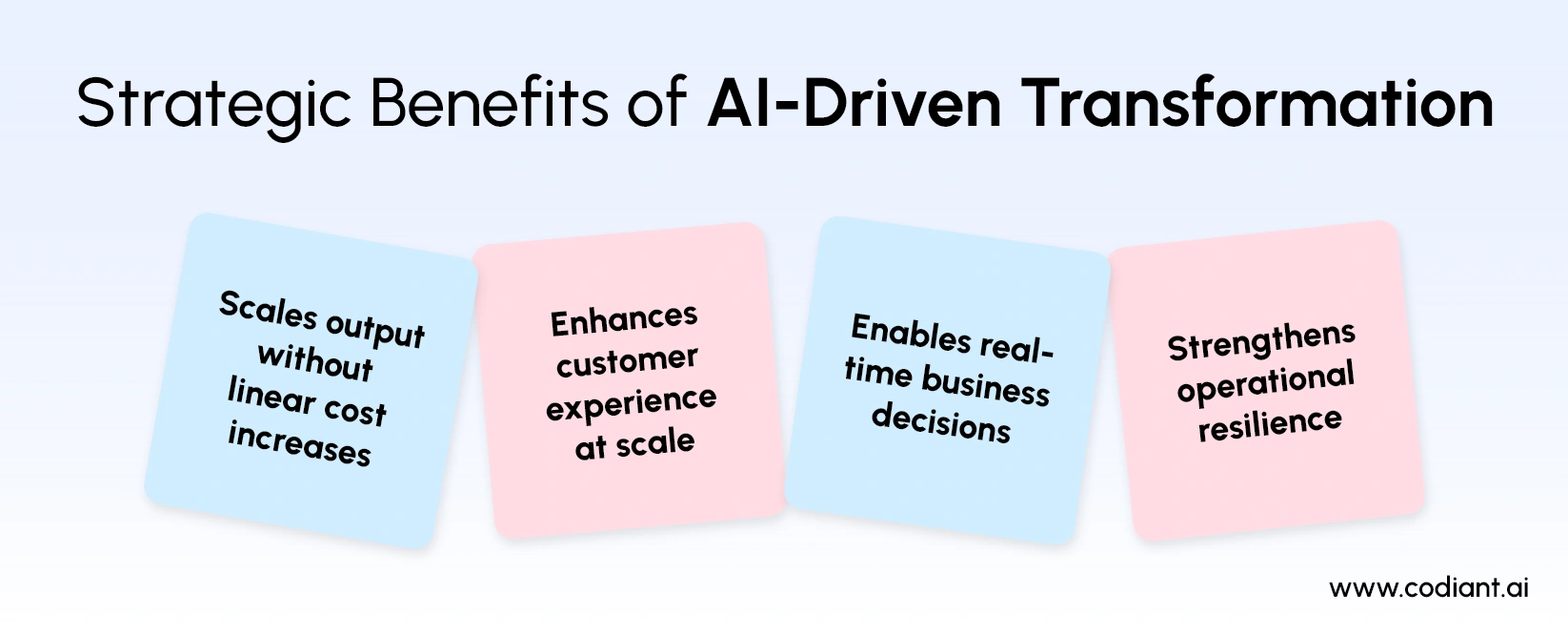
Broader benefits of AI-driven operations:
- Scalability without proportional cost growth:
AI allows teams to manage higher volumes without expanding staff or infrastructure linearly, addressing concerns about whether AI can reduce staffing and labor costs without hurting output. - Better customer experience:
AI-powered systems respond faster, maintain consistency, and anticipate needs, improving service quality while reducing manual effort. - Faster market response:
Real-time insights help businesses adjust pricing, supply, and strategy quickly instead of relying on delayed reports. - More resilient operations:
AI detects risks early and adapts workflows during demand shifts or disruptions.
In this context, AI to improve business operations is not just about saving money—it is about building systems that scale, adapt, and remain stable under pressure.
Turn AI Efficiency into a Competitive Advantage
See how AI-driven transformation helps enterprises scale faster, operate smarter, and unlock long-term efficiency gains.
How Businesses Can Start Implementing AI Cost Reduction Strategies
Implementing AI does not require a full-scale transformation on day one. The most effective AI cost reduction strategies start small, focus on impact, and scale with confidence. Here’s a practical, step-based approach businesses can follow to reduce operational costs with AI without disrupting ongoing operations.
Step 1: Identify Cost-Heavy Processes
Begin by mapping workflows that consume the most time, labor, or resources. These often include manual data entry, repetitive approvals, customer support queries, reporting, and reconciliation tasks. The goal is to spot areas where costs are recurring, errors are common, or productivity slows as volume increases.
Step 2: Start with Automation & Analytics
Once priorities are clear, introduce AI-driven automation and analytics. Automating repetitive steps reduces manual effort, while AI analytics uncover patterns, inefficiencies, and cost leakages that traditional reporting misses. This stage delivers early wins and builds internal confidence.
Step 3: Integrate, Don’t Isolate
AI works best when connected to existing systems like ERP, CRM, HR, or finance tools. Integration ensures data flows seamlessly across departments, preventing silos and maximizing the overall impact of AI initiatives.
Step 4: Measure, Optimize, Expand
Track performance using clear metrics such as cost savings, time reduction, and productivity gains. Continuously optimize models and expand AI use cases across functions, turning initial pilots into enterprise-wide cost efficiency drivers.
Top Industries Seeing the Biggest Efficiency Gains From AI
Industries that benefit the most from AI are those handling high volumes of data, repetitive operational tasks, and decisions that must be made quickly and accurately. In these environments, AI for business optimization and AI efficiency tools 2026 consistently reduce manual effort while improving speed, accuracy, and scalability.
- Retail & eCommerce are among the industries that benefit the most from AI due to constant demand fluctuations and customer interactions. AI automates forecasting, inventory planning, pricing adjustments, and customer support, helping teams operate efficiently during both peak and off-peak periods.
- Manufacturing benefits significantly from AI by improving production planning and equipment reliability. Through predictive maintenance and real-time performance monitoring, AI minimizes downtime, reduces waste, and supports smoother factory operations.
- Healthcare benefits from AI where administrative complexity slows efficiency. AI streamlines scheduling, patient triage, medical documentation, and operational reporting, reducing overhead while allowing staff to focus more on patient care.
- Finance is another industry that benefits the most from AI because of its reliance on accuracy and compliance. AI enhances fraud detection, risk assessment, regulatory checks, and onboarding processes, lowering costs while improving response times.
- Real Estate and Logistics benefit from AI by automating lead management, route optimization, asset tracking, and performance analytics. These AI-driven workflows reduce manual coordination and improve decision-making at scale.
Across sectors, the industries that benefit the most from AI share a common trait: complex workflows that demand speed, precision, and continuous optimization.
How Codiant AI Helps Enterprises Reduce Costs with AI
Codiant AI works with enterprises to turn AI cost reduction strategies into measurable business outcomes. Instead of pushing one-size-fits-all tools, we start by understanding where operational costs, inefficiencies, and manual workloads are actually coming from. This allows us to design AI solutions that improve performance without disrupting existing workflows or teams.
Our approach focuses on practical, scalable impact:
- AI strategy & consulting to identify high-cost processes, automation opportunities, and quick-win efficiency gains aligned with business priorities
- Custom automation solutions that reduce manual work, improve accuracy, and support workflow automation using AI across operations, finance, HR, and customer service
- AI integration with existing systems, including CRMs, ERPs, data platforms, and cloud environments, ensuring smooth adoption without costly system overhauls
- ROI-focused implementation with clear metrics tied to cost savings, productivity improvement, and long-term AI business efficiency tools performance
Codiant AI partners with enterprises beyond implementation – continuously optimizing AI-driven systems to reduce overhead, improve resilience, and support sustainable growth over time.
Read More: How to Build an AI Agent
Future Outlook: AI Efficiency Tools in 2026 and Beyond
By 2026, AI efficiency tools will move far beyond basic automation and analytics, redefining how organizations operate at scale. Businesses will increasingly adopt autonomous workflows capable of executing end-to-end processes with minimal human intervention, ranging from demand forecasting and inventory optimization to order fulfillment and customer support resolution. As enterprises plan long-term digital transformation strategies, understanding the AI development cost becomes essential to balancing innovation, scalability, and ROI, ensuring that advanced AI systems deliver measurable business value without compromising operational efficiency.
Agent-based systems will act as intelligent digital workers, coordinating tasks across departments, systems, and data sources in real time.
At the same time, predictive operations will become standard. AI will anticipate disruptions, cost overruns, and performance bottlenecks before they occur, allowing companies to take corrective action early rather than react late.
The most advanced organizations will evolve into self-optimizing enterprises, where systems continuously learn from operational data and automatically adjust processes to improve speed, accuracy, and cost efficiency.
In this future, efficiency is not a one-time initiative but a living capability embedded into everyday business operations.
Final Thoughts: Cost Efficiency Is the Competitive Advantage
AI is no longer optional for businesses aiming to stay competitive in today’s volatile markets. Rising costs, tighter margins, and increasing complexity demand smarter ways to operate, not just harder work.
Companies that use AI to streamline workflows, reduce waste, and optimize decision-making consistently outperform those relying on traditional processes. Cost-efficient businesses gain the flexibility to reinvest savings into innovation, customer experience, and growth initiatives.
Most importantly, early adopters benefit from compounding advantages as their AI systems learn, improve, and scale over time.
In the coming years, efficiency powered by AI will not just support business success – it will define which organizations lead and which struggle to keep up.
Control Rising Costs with Smarter AI Systems.
Codiant leverages AI to remove hidden costs, streamline operations, and improve ROI without scaling expenses.
Frequently Asked Questions
AI helps businesses cut costs by reducing manual work, minimizing errors, and improving resource utilization. It automates repetitive processes, optimizes workflows, and enables data-driven decisions that prevent waste, delays, and unnecessary operational expenses.
AI automation streamlines workflows by handling tasks faster and more accurately than manual processes. It reduces turnaround time, ensures consistency, and allows teams to focus on higher-value activities instead of routine operational work.
Companies can automate systems such as customer support, finance and accounting, HR operations, inventory management, supply chain planning, and internal reporting. AI integrates with existing tools to improve efficiency across departments.
AI is not always expensive for small businesses. Many AI solutions are modular and scalable, allowing companies to start small, focus on high-impact use cases, and expand gradually based on measurable ROI.
Businesses measure AI impact by tracking metrics like reduced labor hours, lower processing costs, faster cycle times, fewer errors, and overall operational savings. Comparing performance before and after AI adoption helps quantify real cost benefits.
Featured Blogs
Read our thoughts and insights on the latest tech and business trends
Top 15 Machine Learning Development Companies in 2026
- February 26, 2026
- Machine Learning
Machine learning is no longer something only big tech companies use. In 2026, businesses of every size are using machine learning to predict demand, reduce costs, detect risks & make better decisions faster. But here’s... Read more
10 Agentic AI Use Cases Powering Enterprise ROI in 2026
- February 20, 2026
- AI Agent Development
In a Nutshell: Agentic AI goes beyond traditional automation by making goal-driven decisions across complex enterprise workflows. In 2026, enterprises are adopting agentic AI for measurable ROI, not experimentation or pilots. Agentic AI use cases... Read more
AI in Business Intelligence- The 2026 Roadmap to Data Dominance
- February 16, 2026
- AI-Powered Data Analytics
Business intelligence was built to bring clarity to complex businesses. Dashboards, reports, KPIs and scorecards were meant to help leaders see what was happening and make informed choices. In practice, most BI systems still focus... Read more