How to Develop an AI-Powered Marketplace App- Complete Guide
Table of Contents
Subscribe To Our Newsletter
AI is changing online marketplaces very quickly. It helps apps show better product suggestions, answer questions faster and run more smoothly. Because of this, adding AI to a marketplace is no longer optional – it’s something you should plan right from the start. AI helps eCommerce apps grow, work faster and stay strong for the future.
In this guide you’ll learn everything you need to build an AI-powered marketplace app. We’ll cover the important features the tech behind it, the AI models you can use, the steps to build it, the time it takes and the best tips to make your app successful in a competitive market.
Why AI Matters in Modern Marketplace Development
Most online marketplaces grow slowly because they rely on manual workflows, generic product listings & delayed decision-making. AI changes that completely.
Here’s what AI brings to the table-
- Smarter discovery with AI-powered product recommendations
- Faster operations with eCommerce automation with AI
- Better support with AI chatbots for eCommerce
- Real-time stock and order insights using AI inventory management solutions
- Higher conversions through AI-driven customer experience
- Personalization at scale powered by machine learning in eCommerce
In simple words, AI helps eCommerce businesses grow by reducing manual work, improving customer engagement & driving consistent sales.
Core AI Features Every Marketplace App Should Have
An AI-powered marketplace goes beyond basic filters and ratings. Below are the essential AI features that make a real difference.
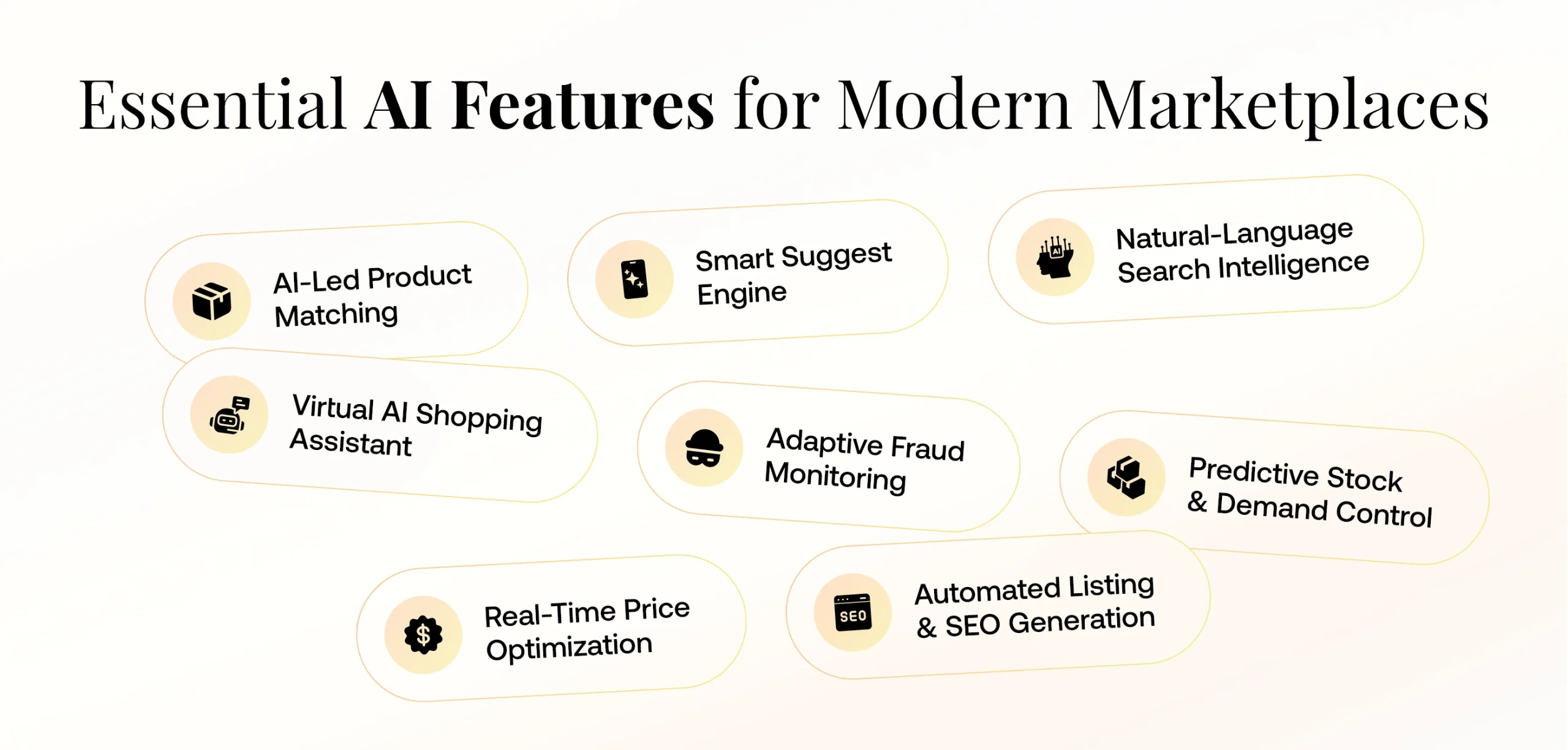
1. Personalized Product Discovery
AI analyzes browsing patterns, past purchases, preferences, demographics & even micro-interactions to show the right product to the right user at the right time.
This boosts-
- Product discoverability
- Time spent on app
- Conversion rates
It’s one of the strongest eCommerce AI strategies used by Amazon, Flipkart & Etsy.
2. AI-Powered Product Recommendations
Recommendation engines use machine learning to-
- Suggest “Frequently Bought Together”
- Highlight “Users Also Viewed”
- Curate “Recommended for You”
- Predict future buying behavior
This is a proven way to drive AI for boosting eCommerce sales, especially for multi-brand marketplaces.
3. Smart Search with NLP
Instead of users typing exact keywords, AI allows natural queries like-
- “Affordable black sneakers under ₹2500”
- “Organic moisturizers for sensitive skin”
- “Laptop for video editing”
NLP improves search relevance and reduces bounce rates – a must-have for any modern marketplace.
4. AI Chatbots for eCommerce
An AI chatbot acts as a 24/7 sales and support assistant. It can-
- Answer product questions
- Suggest items
- Track orders
- Handle returns
- Solve common issues without human intervention
This reduces support tickets and offers instant help, improving overall AI-driven customer experience.
5. AI-Based Fraud Detection
AI models can detect abnormal transactions, fake accounts & suspicious seller activity in real time. This is crucial for marketplaces that manage large volumes of transactions daily.
6. AI Inventory Management Solutions
Using machine learning, your app can-
- Predict which items will run out
- Forecast demand
- Avoid overstocking
- Optimize warehouse operations
These insights remove guesswork from inventory and ensure healthy margins.
Also read: How to Build an Intelligent AI Model: A Complete Guide
7. Dynamic Pricing Optimization
AI models monitor competitor pricing, demand patterns, seasonal spikes & user behavior to adjust product pricing dynamically. This helps marketplace owners stay competitive without compromising margins.
8. Automated Content Creation for Product Listings
AI tools can automatically generate-
- Product titles
- SEO descriptions
- Keywords
- Image tags
- Category suggestions
Great for large inventories or fast-scaling seller onboarding.
Step-by-Step Guide to Developing an AI Marketplace App
Below is a practical, easy-to-understand breakdown of how to build an AI-powered marketplace app from idea to launch.
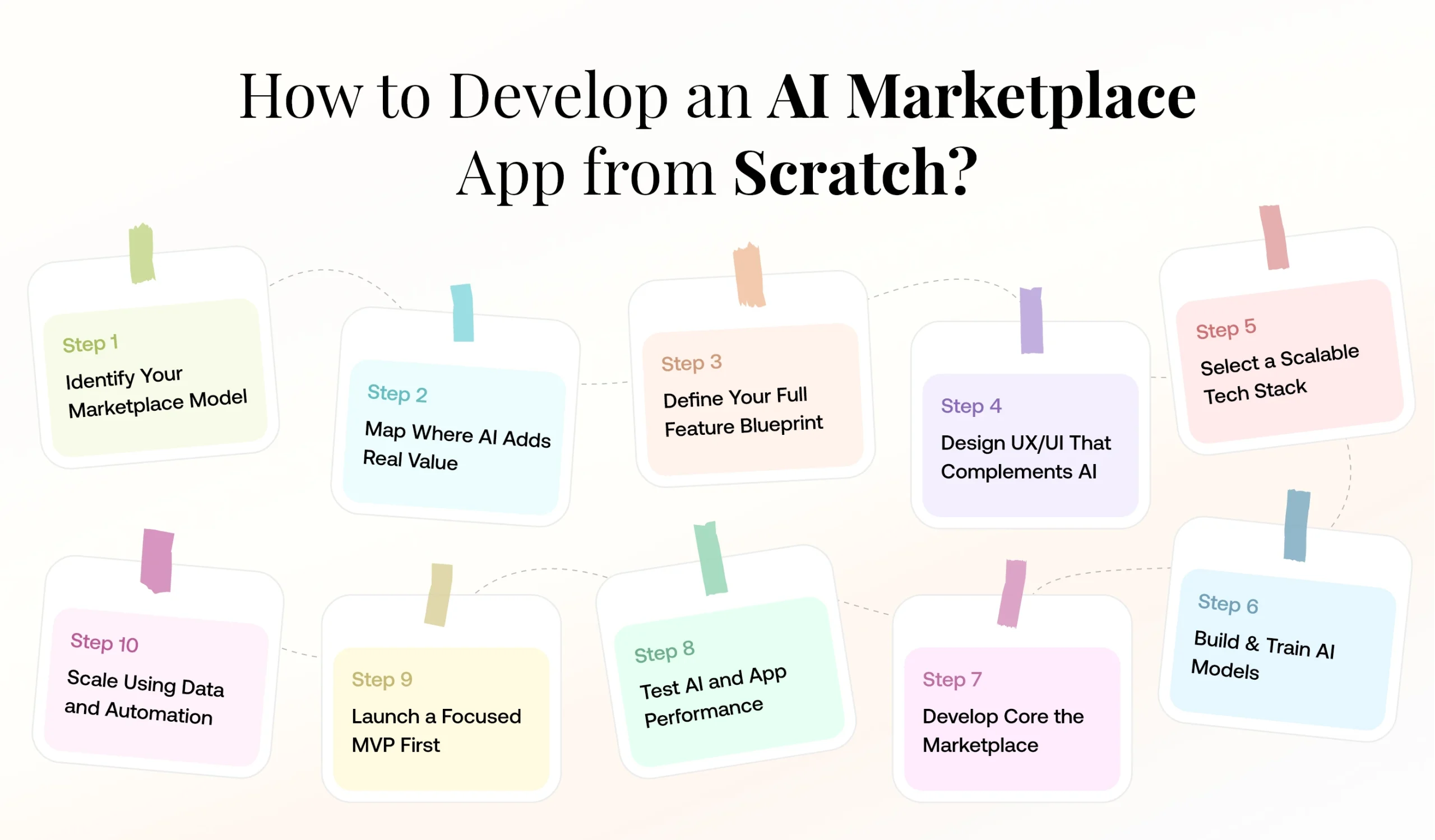
Step 1 – Determine What Kind of Marketplace You Need to Create
Before you dive into building the app itself, you need to know the type of marketplace that will best fit your business. This decision touches everything — the features you add, how users navigate through the app, how sellers operate and even which artificial intelligence tools you’ll use later. Selecting the right model at the beginning can prevent you from making big mistakes and expensive changes further down the line.
Common types of marketplace apps-
- B2C Marketplace- This is when brands sell products directly to customers.
- B2B Marketplace- One company acts as the vendor and another as the consumer.
- C2C Marketplace- Individuals sell to other individuals (similar to used-item apps).
- Hyperlocal Marketplace- Same area local shops and buyers.
- Niche Marketplace- A marketplace based on specific niche such as fashion, electronics, beauty etc.
Choosing the right model from the beginning speeds up the entire development journey.
Step 2 – Find Out Where AI Will Help the Most
AI should not be added everywhere just to make the app look advanced. You should use AI only in places where it makes the app faster, smarter, or more helpful. When used in the right areas, AI supports eCommerce growth and helps your marketplace scale easily.
Useful places to add AI include-
- Product discovery- Helps users find the right products faster.
- Customer support- Answers common questions without a human agent.
- Pricing optimization- Changes prices based on demand and competition.
- Inventory management- Predicts stock levels so items don’t run out.
- Seller productivity- Helps sellers upload products and get smart suggestions.
- Marketing automation- Sends personalized messages to improve sales.
Using AI wisely makes the app easier to use and gives every customer a better experience.
Step 3- Create a Complete Feature List
Once you know your model and AI priorities, outline all the features needed for your marketplace. Think of your product as two different but connected apps- one for users and one for sellers. AI-enhanced features can sit across both sides.
User Module Should Include-
- Account creation and profile
- Search, filters & smart discovery
- AI-driven recommendations
- Wishlist and save-for-later
- Cart, checkout & payments
- Live order tracking
- Product reviews and ratings
- Chat support (AI + human handoff)
Seller Module Should Include-
- Inventory and stock control
- Quick product upload tools
- Order management panel
- AI analytics for pricing and trends
- Automated suggestions for improving sales
Start with the core features, then overlay AI wherever it boosts efficiency, personalization or sales.
Step 4 – Build UX & UI That Supports AI
Even the best AI won’t help if the app looks messy or confusing. Good design makes AI feel natural and easy to use. Your app should gently guide users to the right products and suggestions without crowding the screen.
Your design should focus on-
- Smooth navigation- Let users move between categories without effort.
- Clear filters- Sorting and filtering should be simple to understand.
- Easy categories- Keep product groups neat so users find things quickly.
- Smart AI placement- Put recommendations where users expect to see them.
- Small animations- Add tiny movements that make the app feel alive and helpful.
When the app is clean and simple, your AI upgrades will stand out naturally.
Step 5 – Choose the Right Tech Stack
After designing the app, you need to pick the right tools to build it. These tools must be strong enough to handle AI, live data & a growing marketplace. A good tech stack also makes it easy to add new features later.
Common tools include-
- Frontend tools- React, Flutter or Vue.js
- Backend tools- Node.js, Python (Django or FastAPI) or Laravel
- Databases- PostgreSQL, MongoDB or MySQL
- AI tools- Python, TensorFlow, PyTorch, OpenAI APIs
- Search tools- Elasticsearch or Algolia
- Cloud hosting- AWS, Google Cloud or Azure
Choosing strong tools in the beginning saves time and prevents big fixes later.
Step 6 – Develop the AI Models
This is where your AI features are built. Different AI models do different jobs inside the marketplace. Start with simple models and improve them as you collect more real user data.
Common AI models include-
- Recommendation systems- Suggest products based on user likes and behavior.
- AI search- Understand natural language and show better results.
- Dynamic pricing models- Change prices based on demand and trends.
- Chatbots- Help customers with questions using GPT, Rasa or Dialogflow.
- Inventory prediction- Forecast which items will sell fast or run out.
You can create your own models or use ready-made ones to save time.
Step 7- Build the Core Marketplace Features
While the AI team trains models your development team starts building the core marketplace engine. This parallel approach shortens timelines and keeps development structured.
Core components include-
- Payment gateway setup
- Seller onboarding flow
- Product catalog system
- Order management engine
- Push/email/SMS notification system
- Shipping + logistics integration
Once this foundation is ready, AI outputs are linked to respective modules-for example, the recommendation engine connects to the product feed, chatbot connects to support & so on.
Step 8- Test the App Thoroughly
Testing is critical for any marketplace, but especially for AI features. AI models need accuracy, consistency & refinement based on live data.
Testing areas should include-
- Unit and integration testing
- Load and stress testing for high traffic
- Security testing for data-sensitive transactions
- AI accuracy testing (recommendations, search, pricing)
- Real-world usability tests with sample users
AI will continue improving after launch, but initial testing ensures a stable baseline.
Step 9- Launch the MVP With Focused AI Features
A marketplace doesn’t need all features on day one. Launching a Minimum Viable Product (MVP) helps you reduce risk, gather real data & validate AI performance.
A good MVP includes-
- Limited number of sellers
- Limited categories
- Essential marketplace features
- Only the most impactful AI components
With each new set of users, your AI gets smarter. Real-world data is the fuel that trains your models better than any staged dataset.
Step 10- Scale with Data, Automation & Personalization
Once your MVP gains traction, you move into the growth phase. This is where AI becomes your biggest competitive advantage. Use insights from user interactions to expand features and automate more workflows.
Scaling focuses on-
- Improving recommendation accuracy
- Enhancing chatbot replies
- Automating marketing for higher retention
- Adding advanced personalization
- Introducing new product categories
- Increasing seller-side analytics
This stage strengthens AI for eCommerce personalization and boosts your marketplace’s ability to scale without increasing operational costs.
Key AI Tools for Online Stores and Marketplace Apps
Several ready-made eCommerce automation AI tools can help you speed up development and enhance capabilities-
- Recommendation Engines– Amazon Personalize, Google Recommendations AI
- Search & NLP– Algolia, Elasticsearch with NLP, Cohere, OpenAI
- Chatbots– Dialogflow, Rasa, GPT-based chatbots
- Inventory & Forecasting– SageMaker Forecast, IBM Watson, Snowflake ML
- Marketing Automation– Klaviyo, Mailchimp AI, HubSpot AI tools
- Fraud Detection– Sift, FraudLabs Pro, Stripe Radar
These tools help accelerate development, reduce costs & deliver accurate AI outputs.
How AI Enhances Conversion and Sales?
AI impacts the entire lifecycle of a buyer’s journey-
Before Purchase
- Search relevance
- SEO automation
- Smart ads
- Real-time recommendations
During Purchase
- Dynamic pricing
- Cross-sell and upsell recommendations
- Personalized offers
After Purchase
- Smart support
- Automated feedback workflows
- Retention campaigns
This holistic AI adoption is what drives AI for eCommerce marketing and increases lifetime customer value.
Related reading: How Much Does AI Development Cost 2026? A Complete Guide
Cost & Timeline to Build an AI Marketplace App
Basic AI-powered marketplace MVP-
- USD 20,000 to 40,000
- Timeline- 3 to 4 months
Advanced AI marketplace with deep personalization-
- USD 50,000 to 120,000
- Timeline- 6 to 10 months
Cost depends on custom AI model development, app complexity and number of integrations.
Best Practices for a Future-Ready AI Marketplace
Building a marketplace with AI works best when you follow a few simple rules-
- Start with the most useful AI features. Don’t try to add everything at once.
- Use clean and correct data. AI makes mistakes when the data is wrong.
- Keep the app design simple. Users should find things easily.
- Use a mix of custom AI and ready-made AI tools. This saves time and money.
- Let users choose if they want personalized suggestions. It builds trust.
- Follow data protection laws like GDPR, CCPA & DPDP India so user data stays safe.
- Test your app often. Real user behavior helps make your AI smarter over time.
Final Thoughts
Creating an AI-powered marketplace is one of the best ways to grow an eCommerce business today. With the right tools like smart recommendations, automated inventory updates & AI-powered customer support you can make shopping easier for buyers and selling simpler for businesses.
AI is no longer just a cool feature. It has become a core requirement for any modern marketplace that wants to stay relevant and competitive. By choosing the right technology stack and focusing on solving real user problems, businesses can build intelligent, scalable platforms that adapt to changing market demands. With the right strategy and support from experts in AI consulting services Australia, your marketplace can be future ready, deliver better user experiences, and achieve steady, long term growth.
Turn Your Marketplace Idea into Real Momentum
Move from concept to a working AI marketplace with guidance that speeds development and reduces guesswork.
Frequently Asked Questions
AI makes marketplace apps smarter. It helps users find the right products faster, gives personalized recommendations, answers questions instantly through chatbots & makes buying easier. This leads to a smoother and more enjoyable shopping experience.
Key features include AI-powered search, product recommendations, chatbots, smart filters, fraud detection, dynamic pricing, inventory forecasting & personalized offers. These features help both users and sellers.
Costs vary based on features, design & AI complexity. A basic AI marketplace may cost $20,000–$40,000, while a more advanced one can go up to $100,000 or more.
The process includes planning, designing the UI/UX, choosing the tech stack, developing core features, building AI models, integrating marketplace modules, testing, launching an MVP & improving it using real data.
Yes. AI studies user behavior, browsing patterns & purchase history to suggest products that match each person’s interests – no matter how many sellers are on the platform.
It’s a marketplace that uses artificial intelligence to improve search, recommendations, pricing, support & operations. AI works by learning from user data and making real-time decisions to improve the shopping experience.
Common technologies include machine learning, natural language processing (NLP), recommendation engines, predictive analytics, computer vision, chatbots & demand forecasting models.
A basic version takes around 3 to 4 months, while a full-featured marketplace with advanced AI can take 6 to 10 months, depending on complexity and team size.
Cost depends on design complexity, number of features, AI model development, backend infrastructure, integrations, testing needs & ongoing maintenance.
Industries such as eCommerce, fashion, electronics, home services, travel, real estate, healthcare & B2B trading gain the most because AI improves personalization, automation & efficiency.
Featured Blogs
Read our thoughts and insights on the latest tech and business trends
Top 15 Machine Learning Development Companies in 2026
- February 26, 2026
- Machine Learning
Machine learning is no longer something only big tech companies use. In 2026, businesses of every size are using machine learning to predict demand, reduce costs, detect risks & make better decisions faster. But here’s... Read more
10 Agentic AI Use Cases Powering Enterprise ROI in 2026
- February 20, 2026
- AI Agent Development
In a Nutshell: Agentic AI goes beyond traditional automation by making goal-driven decisions across complex enterprise workflows. In 2026, enterprises are adopting agentic AI for measurable ROI, not experimentation or pilots. Agentic AI use cases... Read more
AI in Business Intelligence- The 2026 Roadmap to Data Dominance
- February 16, 2026
- AI-Powered Data Analytics
Business intelligence was built to bring clarity to complex businesses. Dashboards, reports, KPIs and scorecards were meant to help leaders see what was happening and make informed choices. In practice, most BI systems still focus... Read more