Top 15 Machine Learning Development Companies in 2026
Table of Contents
Subscribe To Our Newsletter
Machine learning is no longer something only big tech companies use. In 2026, businesses of every size are using machine learning to predict demand, reduce costs, detect risks & make better decisions faster.
But here’s the problem.
Most companies don’t fail at machine learning because of bad ideas. They fail because they choose the wrong development partner.
Some vendors build impressive demos that never reach production. Others create models that look accurate but don’t work well with real business data. And many teams struggle to scale machine learning once the first project is live.
That’s why choosing the right machine learning development company matters more than ever.
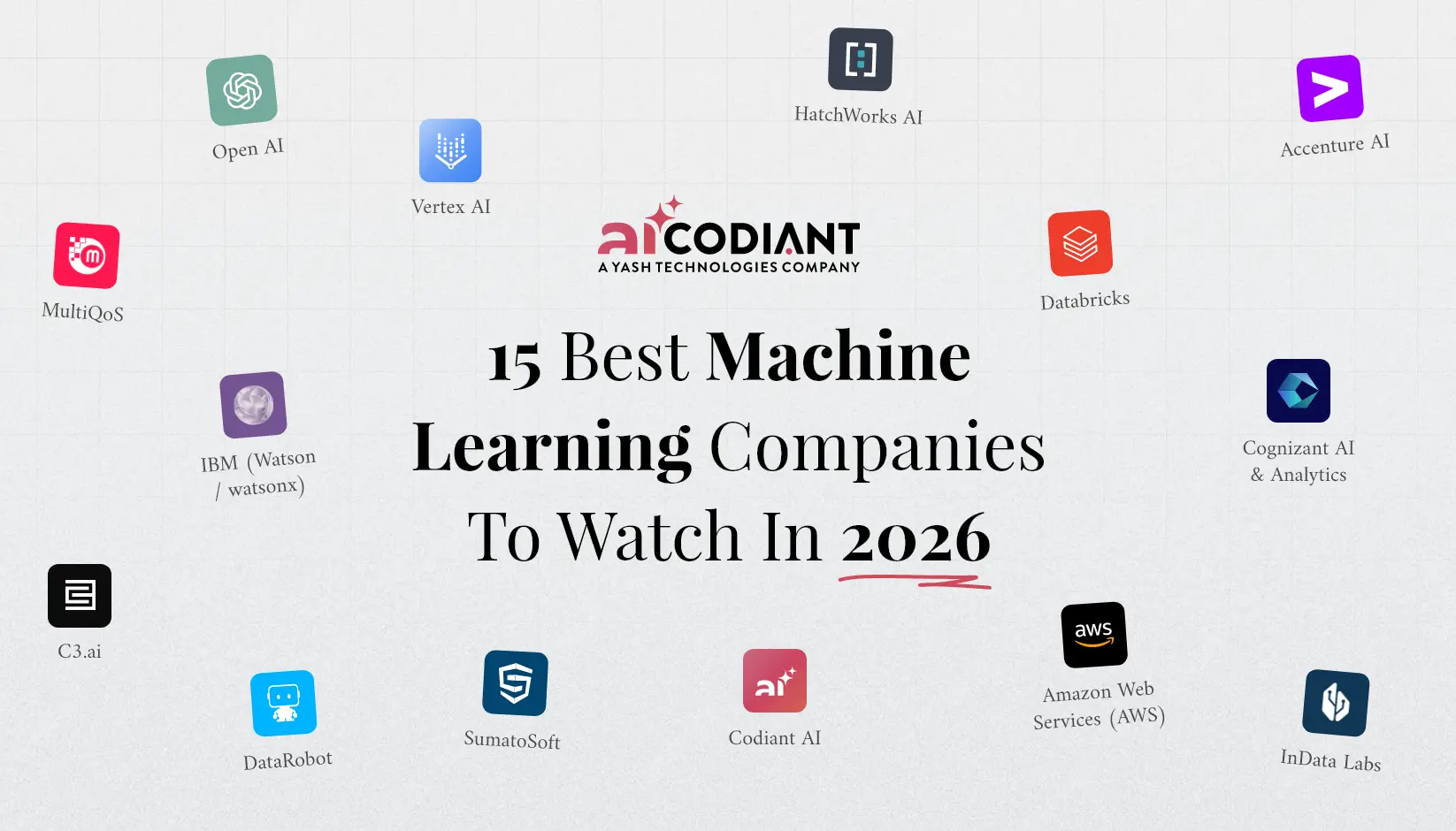
In this blog, we’ve listed the top 15 machine learning development companies in 2026. These companies are not ranked by hype. They are selected based on real-world delivery, enterprise readiness, and the ability to turn machine learning into practical business results.
Whether you want to build custom models, scale enterprise machine learning solutions, or hire machine learning developers, this list will help you make a smarter decision before you invest time and money.
How to Choose the Right Machine Learning Development Company
Choosing the right machine learning company today is not about who talks the most about AI. It is about who can actually make things work for your business. In 2026, the success of machine learning depends more on how well it is built and used, not just how advanced it sounds.
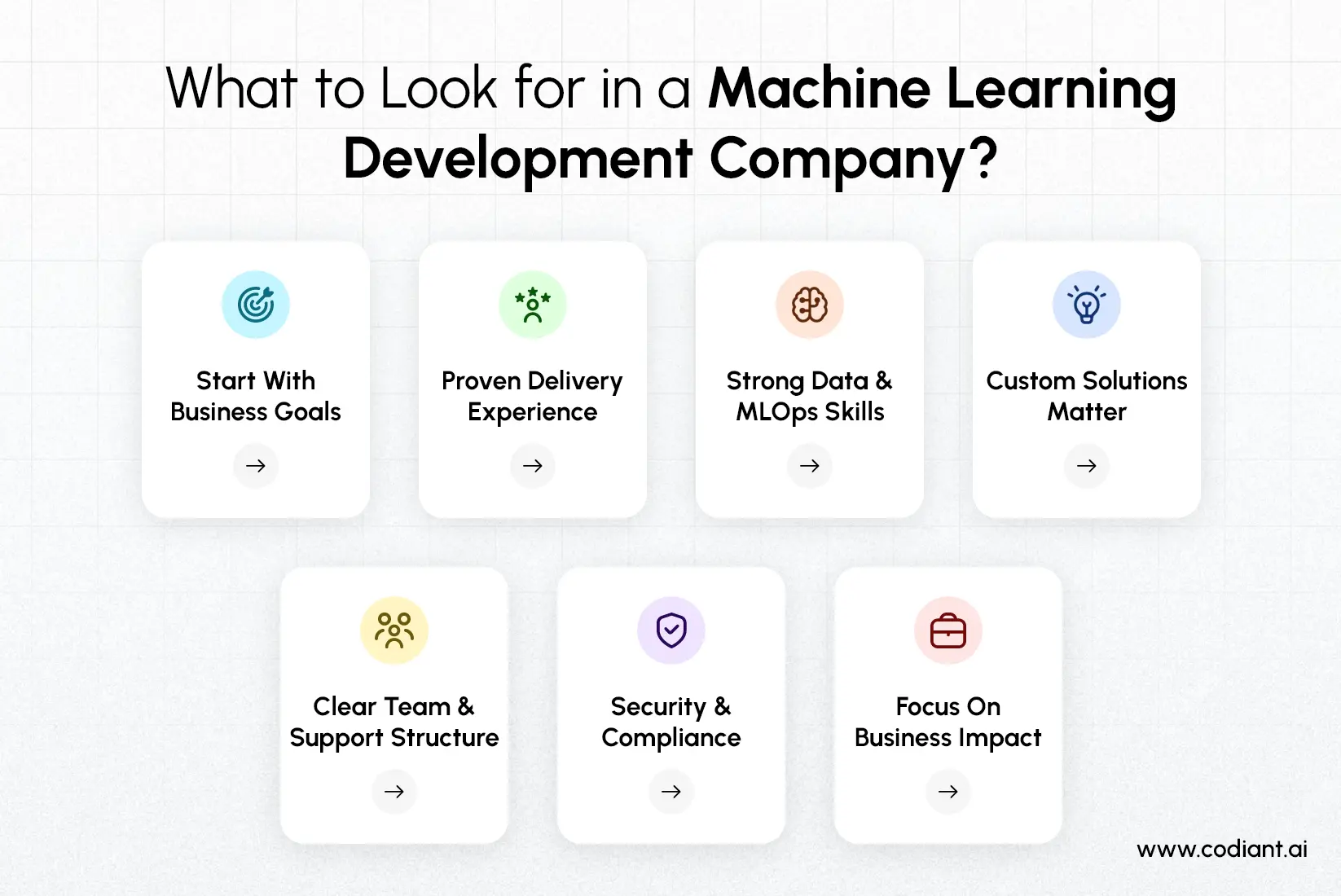
Here are the key factors to evaluate before choosing an ML development company:
1. Start with business alignment, not algorithms
A strong machine learning partner begins by understanding why ML is needed, not which model to use. The right company should help translate business goals cost reduction, risk prediction, personalization, automation into clearly defined ML use cases with measurable success criteria.
If a vendor jumps straight to model selection without clarifying impact, that’s a red flag.
Plan Before You Build
Get clarity on cost, timelines, and feasibility before choosing a machine learning development partner confidently.
2. Evaluate real-world delivery experience
Many AI and machine learning development firms can build proofs of concept. Far fewer can deploy models that stay accurate, stable & useful over time. Ask about:
- Production deployments, not demos
- Model performance after launch
- Handling data drift, retraining & monitoring
- Integration with existing systems
This is especially important for enterprise machine learning solutions, where ML must operate reliably at scale.
3. Assess data and MLOps capabilities
Machine learning success depends more on data pipelines and operations than on model sophistication. A capable partner should demonstrate experience with:
- Data preparation and feature engineering
- Model lifecycle management (training, versioning, rollback)
- Monitoring accuracy, bias & drift
- Secure and compliant deployment
Strong MLOps practices separate mature best ML development companies from experimental vendors.
4. Look for customization, not templates
Every organization’s data, workflows & constraints are different. The right partner should offer custom machine learning development, not one-size-fits-all solutions.
Ask how they:
- Adapt models to your domain
- Handle industry-specific constraints
- Customize outputs for real user workflows
- Balance speed with long-term maintainability
Avoid firms that rely heavily on prebuilt models without customization.
5. Understand team structure and engagement models
If you plan to hire machine learning developers through a partner, clarity on team structure is critical. Look for transparency around:
- Who designs vs who builds models
- Ongoing support after deployment
- Knowledge transfer to internal teams
- Flexible engagement models (project-based vs dedicated teams)
The best machine learning consulting companies act as collaborators, not black boxes.
6. Prioritize governance, security & compliance
In 2026, ML systems are increasingly subject to regulatory, ethical & security requirements. Your ML partner should be able to support:
- Explainability and auditability
- Data privacy and access controls
- Responsible AI practices
- Industry-specific compliance needs
This is especially critical in finance, healthcare, insurance & enterprise SaaS environments.
7. Measure success beyond model accuracy
Finally, the right machine learning development company focuses on business outcomes, not just technical metrics. Success should be measured in:
- Faster decision-making
- Reduced operational costs
- Improved customer experience
- Increased revenue or efficiency
ML that does not change how decisions are made is rarely worth the investment.
Which Are the Top 15 Machine Learning Development Companies in 2026?
1. Google Cloud AI (Vertex AI)
Google Cloud AI’s Vertex AI is a popular choice for big companies in 2026. It helps teams build, train, launch & manage machine learning models in one place. Instead of using many tools, everything works together inside a single platform.
Companies like Vertex AI because it saves time and reduces extra engineering work. It also makes it easier to control who can access models and data. This is very useful for large businesses and industries that follow strict rules, like banking or healthcare.
Vertex AI works closely with Google’s data tools, which helps teams move data smoothly from analysis to real use. It is built for real business needs, not just experiments.
Key strengths
- One platform for training, deploying & managing ML models
- Tools to track, update & control models over time
- Easy connection with Google data and analytics tools
- Works well for large teams and enterprise projects
2. OpenAI
OpenAI is widely used by companies that need strong language-based machine learning. In 2026, many teams use OpenAI as a core part of their ML systems, not just as a chatbot tool.
Its models help businesses understand text, search information & build smart systems that answer questions or support decisions. Teams can train models on their own data, which helps the AI behave in a way that fits their business.
OpenAI is often used to power tools like smart search, document analysis & AI assistants inside apps and internal systems.
Key strengths
- Powerful language models for real business use
- Ability to customize models for specific industries
- Strong support for search and knowledge-based systems
- Commonly used for automation and decision support
3. Codiant AI
Codiant AI is positioned as a delivery-focused ML development company for businesses that want real-world execution rather than experimentation. In 2026, many organizations partner with service-led firms like Codiant AI when they need help translating ML concepts into deployed, measurable solutions.
The company focuses on end-to-end machine learning development services, covering discovery, model development, integration & post-deployment optimization. This makes Codiant AI suitable for enterprises and product companies that want to operationalize ML without building large in-house data science teams.
Key strengths
- End-to-end custom machine learning development
- Industry-specific ML implementations across business workflows
- Strong focus on deployment, adoption & operational impact
- Suitable for companies looking to hire machine learning developers as a managed team
4. Amazon Web Services (AWS)
AWS is still one of the biggest names in machine learning in 2026. Its tool, Amazon SageMaker, helps teams build, train & run machine learning models in one place.
Companies that already use AWS often pick SageMaker because it fits easily into their existing systems. It works well for small experiments and also for very large ML projects used by many teams across different locations.
AWS is known for being secure, flexible & reliable, which makes it a good choice for large businesses running machine learning at scale.
Key strengths
- One platform for building and running ML models
- Strong security and data protection
- Automation tools that save time for teams
- Best for large companies using ML in real products
5. Databricks
Databricks is popular with companies that care a lot about clean data, teamwork & tracking how models are built. It is designed so data teams and ML teams can work together using the same data.
In 2026, Databricks stands out because it helps teams manage many models at once. Tools like MLflow and Unity Catalog make it easier to track changes, control access & follow rules.
This makes Databricks a strong choice for companies with many teams working on machine learning at the same time.
Key strengths
- Easy connection between data work and ML work
- Clear tracking of models and changes
- Built for teamwork across large teams
- Good for companies with strict rules and audits
6. IBM (Watson / Watsonx)
IBM focuses on machine learning that is safe, clear & easy to explain. This is why many banks, healthcare companies & governments still trust IBM in 2026.
Its platform, watsonx, helps teams build and use ML models while keeping full records of how decisions are made. This is important in industries where rules and trust matter a lot.
IBM is a good choice for companies that want long-term stability and strong control over their AI systems.
Key strengths
- Strong focus on rules, safety & fairness
- Clear explanations for how models work
- Trusted by regulated industries
- Built for long-term enterprise use
7. DataRobot
DataRobot focuses on accelerating the journey from model development to production. Its MLOps platform helps enterprises deploy, monitor & manage large numbers of models while maintaining consistent governance standards.
A key differentiator is DataRobot’s emphasis on operational monitoring, including drift detection and challenger models. This enables teams to continuously improve ML performance without disrupting production systems.
Key strengths
- Centralized MLOps and model monitoring
- Automated performance tracking and retraining workflows
- Strong governance and compliance support
- Designed for enterprises managing many production models
Related reading: Top 20 Generative AI Development Companies in the USA
8. C3.ai
C3.ai specializes in enterprise AI applications rather than generic ML tooling. Its platform supports the design, deployment & operation of AI-driven applications across complex industrial and business domains.
Organizations choose C3.ai when they want packaged enterprise AI use cases combined with the flexibility to extend and customize ML models for their specific needs.
Key strengths
- Enterprise-ready AI application development
- Prebuilt AI use cases for industrial domains
- Scalable deployment across large operational systems
- Strong focus on reliability and performance
9. Accenture AI
Accenture AI operates at the intersection of strategy, technology & organizational change. It is often selected for large-scale ML initiatives where success depends not just on models, but on adoption, governance & operating model transformation.
In 2026, Accenture’s AI practice continues to support enterprise clients in embedding ML into core business processes rather than isolated pilots.
Key strengths
- Enterprise-wide AI and ML transformation
- Strong change management and adoption frameworks
- Deep industry and regulatory expertise
- Suitable for large, complex organizations
10. Cognizant AI & Analytics
Cognizant combines ML engineering with broader analytics and data modernization services. This integrated approach appeals to enterprises that want to scale AI solutions while modernizing legacy data systems.
The company emphasizes responsible AI practices and domain-specific execution, making it suitable for organizations running ML across multiple business units.
Key strengths
- Integrated AI, ML & analytics services
- Strong focus on responsible AI adoption
- Enterprise-scale delivery capabilities
- Domain expertise across industries
11. HatchWorks AI
HatchWorks AI positions itself as a partner for organizations transitioning from traditional analytics to machine learning-driven decision-making. The firm focuses heavily on data readiness and foundational architecture, which are common blockers for ML adoption.
This approach helps organizations establish reliable pipelines before scaling ML models across the business.
Key strengths
- Strong focus on data foundations for ML
- AI enablement and modernization services
- ROI-driven ML initiatives
- Suitable for early-to-mid stage ML programs
12. SumatoSoft
SumatoSoft delivers structured machine learning development services with clearly defined phases, from consulting and discovery to model development and deployment. This clarity makes them a practical choice for organizations seeking predictable ML delivery.
They support a wide range of ML use cases and offer custom engagement models depending on project scope.
Key strengths
- Full-cycle custom machine learning development
- Clear execution phases and delivery structure
- Applied ML solutions for business problems
- Suitable for mid-market and enterprise clients
13. InData Labs
InData Labs focuses on applied ML engineering rather than large-scale transformation programs. This makes them appealing to businesses that want specialized ML expertise without the overhead of global consulting firms.
They work across predictive analytics, NLP & computer vision use cases.
Key strengths
- Focused ML engineering and optimization
- Strong applied ML expertise
- Flexible consulting and build engagements
- Suitable for targeted ML initiatives
14. ScienceSoft
ScienceSoft combines ML consulting with implementation services, helping organizations move from strategy to execution. Their long-standing experience in data science makes them suitable for analytics-heavy ML programs.
They often work on forecasting, anomaly detection & operational intelligence use cases.
Key strengths
- End-to-end ML consulting and delivery
- Strong analytics and forecasting expertise
- Enterprise-focused implementation approach
- Suitable for ML modernization projects
15. MultiQoS
MultiQoS provides machine learning development services focused on automation, prediction & efficiency improvements. They also offer flexible engagement models for organizations looking to hire machine learning developers on a dedicated basis.
This makes them suitable for companies augmenting internal teams with ML expertise.
Key strengths
- Applied ML engineering and automation
- Flexible developer hiring models
- Custom ML module development
- Suitable for delivery augmentation and ML support
Conclusion
Machine learning in 2026 is no longer new or experimental. It is something businesses use every day to make better decisions and work faster.
The companies listed in this blog stand out because they help teams actually use machine learning, not just talk about it. They focus on solving real problems and making sure solutions work in the long run.
If you choose the right partner, machine learning becomes easier to manage and more useful for your business. And that is what really matters in the end.
Need Enterprise-Ready ML Solutions?
Design machine learning systems that meet enterprise security, performance, and governance expectations from day one.
Frequently Asked Questions
Look at their experience, real project results, data handling skills, deployment support, and ability to align ML with business goals.
Yes, many companies handle everything from understanding the problem to building, deploying, monitoring, and improving models over time.
They use secure access controls, encryption, audits, and follow industry regulations to protect data and meet legal requirements.
Yes, models are trained using your data and adjusted to match your industry needs, workflows, and business objectives.
Most ML projects take eight to sixteen weeks, depending on data readiness, complexity, integrations, and approval processes.
Featured Blogs
Read our thoughts and insights on the latest tech and business trends
10 Agentic AI Use Cases Powering Enterprise ROI in 2026
- February 20, 2026
- AI Agent Development
In a Nutshell: Agentic AI goes beyond traditional automation by making goal-driven decisions across complex enterprise workflows. In 2026, enterprises are adopting agentic AI for measurable ROI, not experimentation or pilots. Agentic AI use cases... Read more
AI in Business Intelligence- The 2026 Roadmap to Data Dominance
- February 16, 2026
- AI-Powered Data Analytics
Business intelligence was built to bring clarity to complex businesses. Dashboards, reports, KPIs and scorecards were meant to help leaders see what was happening and make informed choices. In practice, most BI systems still focus... Read more

Top 20 Generative AI Development Companies in the USA (2026)
- February 9, 2026
- Generative AI
Generative AI is no longer something companies “try out.” In 2026, it is something they depend on. US businesses now use generative AI to build products faster, automate everyday work, and make better decisions. AI... Read more