AI in Business Intelligence- The 2026 Roadmap to Data Dominance
Table of Contents
Subscribe To Our Newsletter
Business intelligence was built to bring clarity to complex businesses. Dashboards, reports, KPIs and scorecards were meant to help leaders see what was happening and make informed choices. In practice, most BI systems still focus on explaining the past rather than preparing teams for what comes next.
That limitation is becoming harder to ignore.
By 2026 the organizations will no longer have the luxury of slow insight cycles. Data volumes are increasing markets are shifting faster and decisions are being made under tighter time pressure. Static reports struggle to reflect real operational changes. Manual analysis does not scale across growing datasets. And insight teams cannot keep pace when the business moves in hours not weeks.
This is where AI in business intelligence stops being optional.
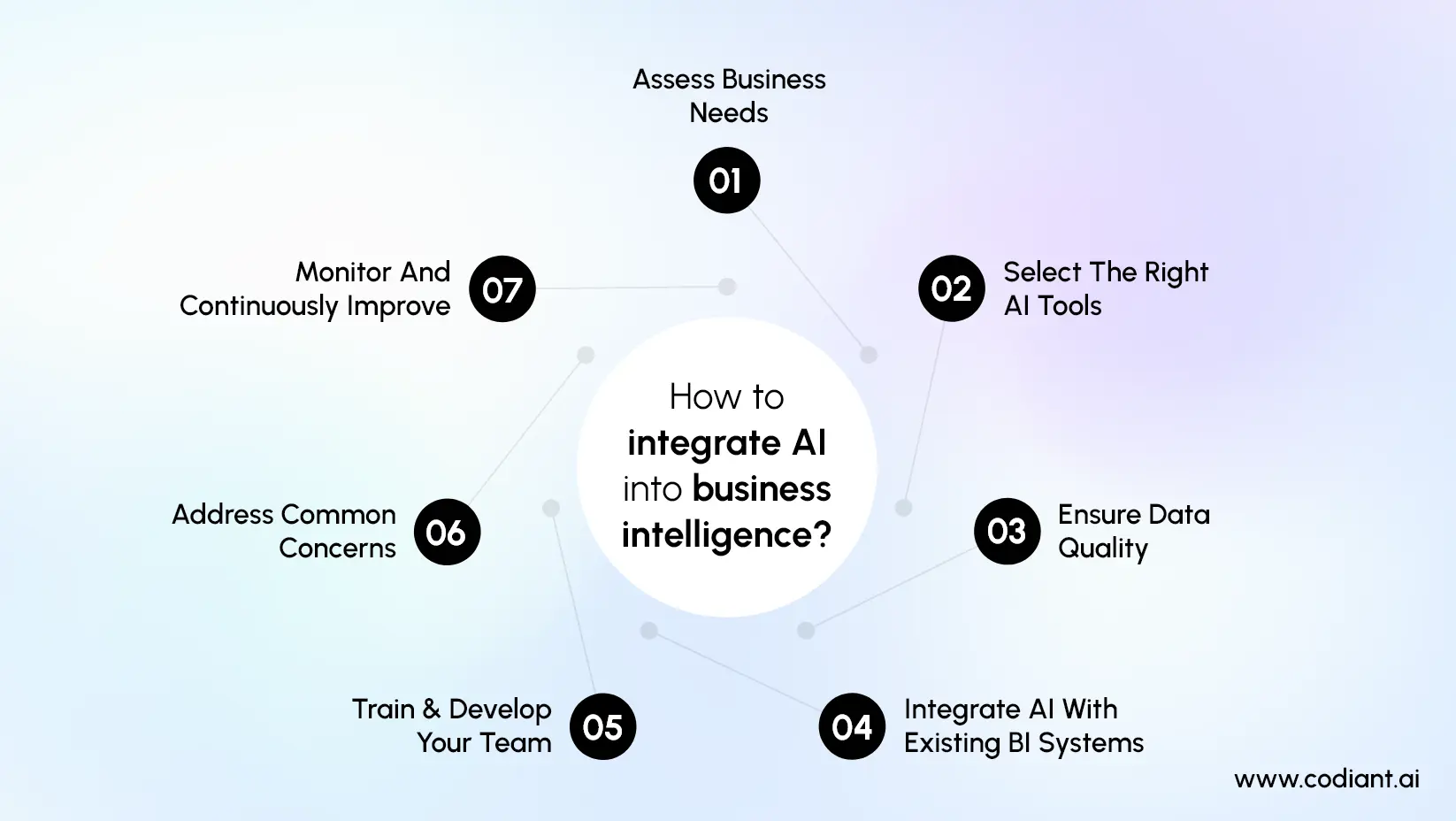
Artificial intelligence does not replace BI tools or human judgment. It changes how insights are generated and delivered. Instead of waiting for questions, modern BI systems can detect patterns, anticipate outcomes and highlight issues as they emerge. The roadmap to data dominance in 2026 is not about better visuals. It is about building intelligence that keeps up with the business.
This blog explains what that shift looks like in practical terms and how organizations can prepare for it.
The 2026 Roadmap to Data Dominance
Data dominance in 2026 will not come from having the most data or the most advanced tools. It will come from how reliably an organization turns data into timely & confident decisions.
For years, business intelligence has focused on visibility. The next phase focuses on control – control over outcomes, risks, timing and trade-offs. Artificial intelligence plays a central role in this shift, but not in the abstract sense most blogs describe. Its value lies in how it reshapes everyday decision-making.
The roadmap to data dominance can be understood as a practical progression. Most organizations are already on this path even if they do not label it this way.
Step 1- Move from Periodic Reports to Always-Available Insight
The first change is subtle but important.
Traditional BI works on a schedule. Reports refresh daily, weekly, or monthly. By the time someone reads them, the situation has already changed.
In 2026, leading organizations will treat insight as something that is continuously available, not periodically delivered. AI systems monitor data streams in the background and surface changes when they matter.
This does not mean flooding teams with alerts. It means-
- Highlighting meaningful shifts, not noise
- Drawing attention to deviations early
- Letting teams respond before issues escalate
Data dominance starts when decision-makers no longer wait for reports to tell them something is wrong.
Turn Insight into Advantage
See how AI-powered business intelligence can help your organization move faster, anticipate risks, and act confidently.
Step 2- Reduce Dependence on Manual Analysis
In many companies, insights still depend heavily on a small group of analysts. When questions change, analysis queues grow. Decisions slow down.
The next stage of the roadmap uses AI-driven BI analytics to reduce this dependence.
Instead of asking analysts to explore every possible angle, AI systems-
- Scan large datasets automatically
- Detect unusual patterns and relationships
- Surface insights humans might not think to look for
This does not replace analysts. It changes their role. They move from producing insights to validating, explaining and applying them.
Organizations gain speed without losing judgment.
Step 3- Shift from Explaining the Past to Anticipating the Future
Most BI today focuses on what already happened. That information is useful, but it arrives too late to influence outcomes.
By 2026, predictive business intelligence becomes a core expectation, not an advanced feature.
This stage of the roadmap enables organizations to-
- Forecast demand, revenue, or risk
- Estimate the likelihood of different outcomes
- Understand which factors are most influential
Instead of asking “Why did this happen?”, leaders start asking-
“What is likely to happen next if nothing changes?”
“What happens if we intervene now?”
Data dominance means decisions are guided by foresight, not hindsight.
Step 4- Embed Intelligence into Day-to-Day Decisions
Insights only create value when they influence action. In many organizations, BI insights still live in dashboards that sit outside operational workflows.
The next step is integration.
In 2026, AI-powered business intelligence will increasingly operate inside-
- Planning tools
- CRM and ERP systems
- Supply chain platforms
- Financial and operational workflows
Instead of checking a dashboard and then deciding what to do, users receive guidance at the moment a decision is being made.
This is where BI starts functioning as a decision-support system rather than a reporting layer.
Step 5- Treat Business Intelligence as Core Infrastructure
The final stage of the roadmap is organizational, not technical.
Data-dominant companies in 2026 will no longer treat BI as a separate function owned by a single team. They will treat enterprise AI data analytics as shared infrastructure, similar to finance systems or core operations platforms.
This involves-
- Consistent definitions of metrics across teams
- Central governance with local flexibility
- Transparent and explainable AI outputs
- Clear ownership of models and decisions
At this stage, intelligence becomes embedded into how the business operates, not how it reports.
How is AI Transforming Business Intelligence in 2026?
AI is changing the face of BI from a reporting layer to an active decision system, by 2026. Industry reports indicate that more than 70% of companies are actively deploying AI-powered analytics into at least one disparate line-of-business.
AI-driven BI analytics continuously analyze live data, flag anomalies and predict outcomes without waiting for manual queries. Organizations using AI-powered business intelligence report 20–30% faster decision cycles and measurable improvements in forecast accuracy.
Instead of reviewing past performance, teams use business intelligence with AI to anticipate risks, adjust strategies early and respond to change in real time.
Why Traditional Business Intelligence Is No Longer Enough
Most BI environments today follow a familiar pattern-
- Data is collected from multiple systems
- Analysts clean, model and transform it
- Dashboards are built around predefined metrics
- Stakeholders review reports on a fixed schedule
This approach worked when data was limited, change was slow and analysis teams had time to react. But modern businesses operate under very different conditions.
The Core Problems with Legacy BI
- Lag between data and decision: By the time reports are generated the business has already moved. Sales trends shift daily, supply chains fluctuate hourly and customer behavior changes in real time.
- Heavy dependence on analysts: Most insights still require SQL queries, manual segmentation, or ad hoc analysis. This creates bottlenecks and delays decision-making.
- Rigid dashboards: Traditional dashboards answer fixed questions. When a new question arises, teams must rebuild reports or wait for the next analysis cycle.
- Descriptive, not predictive: Classic BI explains what happened. It rarely explains why it happened or what will happen next.
These limitations are not tooling issues alone. They are structural limitations of BI without intelligence.
Traditional BI vs AI-Driven BI- Key Differences
The table below highlights how traditional business intelligence differs from AI-driven BI across analysis approach, speed, adaptability and its role in supporting real-world business decisions.
| Aspect | Traditional Business Intelligence | AI-Driven Business Intelligence |
| Primary focus | Reporting and visualization | Insight generation and decision support |
| Analysis type | Descriptive (what happened) | Predictive and prescriptive |
| User interaction | Dashboards and filters | Natural language and automated insights |
| Dependency on analysts | High | Reduced |
| Speed of insight | Periodic | Continuous |
| Adaptability | Static metrics | Self-learning models |
| Role in decisions | Informational | Action-oriented |
The Shift Toward Business Intelligence With AI
Business intelligence with AI introduces a fundamentally different operating model. Instead of relying solely on predefined logic and manual analysis, AI-driven BI systems learn from data continuously. They detect patterns, adapt to new signals and generate insights dynamically.
This does not mean replacing BI platforms. It means embedding intelligence across the BI lifecycle.
What Changes When AI Enters BI
- Analysis becomes continuous instead of periodic
- Insights are generated automatically, not manually
- Questions can be asked in natural language
- Anomalies surface without predefined rules
- Predictions guide decisions, not just reports
At its core, artificial intelligence in BI turns data systems from passive observers into active decision partners.
AI-Powered Business Intelligence- How It Actually Works
To understand the 2026 roadmap, it helps to break down how AI-powered business intelligence operates across different layers.
1. Data Preparation and Modeling
Data preparation consumes a massive portion of analytics effort. AI reduces this burden by-
- Automatically profiling datasets
- Detecting missing or inconsistent values
- Recommending transformations
- Identifying relationships across tables
Machine learning models learn from historical data preparation patterns, reducing manual modeling work over time.
This is the foundation of BI automation with AI removing repetitive data engineering tasks from human workflows.
2. AI-Driven BI Analytics and Pattern Detection
Once data is structured, AI models begin analyzing it continuously.
Instead of waiting for users to define metrics, AI-driven BI analytics can-
- Detect unexpected spikes or drops
- Identify correlations humans may overlook
- Surface outliers across dimensions
- Highlight emerging trends early
This shifts analytics from reactive exploration to proactive insight generation.
The system does not wait to be asked. It flags what matters.
3. Natural Language Query and Explanation
One of the most visible changes in next-generation business intelligence is the way users interact with data.
Instead of navigating filters and charts, users can ask questions like-
- “Why did churn increase in the last two weeks?”
- “Which regions are likely to miss revenue targets?”
- “What factors are impacting delivery delays?”
AI models translate these questions into queries, analyze results and explain outcomes in plain language.
This dramatically expands BI access beyond analysts to business leaders, operations teams and frontline managers.
4. Predictive Business Intelligence
Perhaps the most critical shift on the 2026 roadmap is the rise of predictive business intelligence.
Predictive BI uses machine learning models to forecast future outcomes based on historical and real-time data.
Common use cases include-
- Revenue forecasting
- Demand planning
- Customer churn prediction
- Risk assessment
- Capacity optimization
Instead of asking “What happened?”, leaders ask “What is likely to happen and why?”
This enables earlier intervention and more confident decision-making.
5. Prescriptive Insights and Decision Guidance
The next step beyond prediction is recommendation.
Advanced AI data analytics platforms do not just forecast outcomes. They suggest actions.
For example-
- Adjust pricing based on predicted demand shifts
- Reallocate inventory before shortages occur
- Prioritize customers at highest churn risk
- Optimize staffing based on projected workloads
While final decisions remain human, AI narrows the option space and quantifies trade-offs.
Enterprise AI Analytics- Scaling Intelligence Across the Organization
For large organizations, AI services adoption in BI is not about isolated dashboards. It is about building enterprise AI analytics that operate consistently across teams, systems and regions.
What Makes Enterprise AI Analytics Different
- Centralized data governance
- Secure model deployment
- Role-based insight access
- Explainable outputs for compliance
- Integration with core business systems
In 2026, enterprises will not evaluate BI tools based on visualization alone. They will evaluate how intelligence flows across operations.
The goal is alignment not fragmentation.
BI Automation With AI- Reducing Human Friction
One of the most underappreciated benefits of AI in BI is automation.
BI automation with AI focuses on eliminating manual, repetitive tasks that slow insight delivery.
Examples include-
- Automated report generation
- Scheduled anomaly alerts
- Self-updating dashboards
- Model retraining without manual intervention
- Continuous metric recalibration
This allows analytics teams to spend more time on interpretation and strategy rather than maintenance.
Redesign Business Intelligence for 2026
Move beyond dashboards and reports with predictive, AI-driven intelligence embedded directly into your business operations.
The Role of AI Data Analytics Platforms in 2026
By 2026, most organizations will rely on a unified AI data analytics platform rather than disconnected tools.
These platforms combine-
- Data ingestion and modeling
- Machine learning pipelines
- BI visualization
- Natural language interfaces
- Governance and monitoring
The platform becomes a shared intelligence layer not just a reporting tool.
This shift reduces tool sprawl and ensures insights are consistent across departments.
Benefits of AI-Powered Business Intelligence Tools
Here are the key benefits organizations experience when AI is embedded into business intelligence systems helping teams analyze data faster and make confident decisions.
- Faster insights without waiting for analysts or manual reports enabling teams to respond quickly to changes as they happen.
- Early detection of risks, trends & performance gaps before they impact revenue, operations, or customer experience.
- Reduced dependence on technical teams, allowing business users to explore data independently using natural language and guided insights.
- More accurate forecasts by learning from historical patterns and real-time data instead of relying on static assumptions.
- Consistent decision-making across teams by using shared data definitions, predictive models & performance indicators.
- Scalable analytics that handle growing data volumes without increasing reporting complexity or operational workload.
- Automation of repetitive BI tasks freeing analysts to focus on strategy, validation & high-impact decision support.
Industries That Benefit Most From AI-Enabled Business Intelligence
AI-enabled business intelligence creates the most value in industries where decisions must be made quickly, data sources are complex and small delays or misjudgments can lead to significant financial or operational impact. In these environments, traditional BI struggles to keep pace, while AI-driven systems provide earlier signals and clearer guidance.
Below are the industries seeing the strongest returns from business intelligence with AI.
1. Retail and eCommerce
Retail and eCommerce businesses operate on thin margins and fast-changing customer behavior. AI-powered business intelligence helps these organizations move beyond historical sales reports to understand what customers are likely to do next.
Key applications include-
- Predicting demand at product and location levels
- Identifying early signals of changing customer preferences
- Optimizing pricing, promotions & inventory allocation
- Detecting abnormal drops in conversion or basket size
By using predictive business intelligence, retailers can respond to trends while they are forming, not after revenue is already impacted.
2. Financial Services and Insurance
Financial institutions deal with high data volumes, strict compliance requirements & constant risk exposure. AI-driven BI analytics improve both decision accuracy and speed in this environment.
Common use cases include-
- Risk scoring and early fraud detection
- Forecasting cash flow and liquidity positions
- Identifying unusual transaction patterns
- Segmenting customers based on behavior, not static profiles
Here, artificial intelligence in BI supports faster decisions while maintaining transparency and governance.
3. Healthcare and Life Sciences
Healthcare organizations generate large amounts of clinical, operational & administrative data. AI-enabled business intelligence helps translate this data into actionable insight without overwhelming clinicians or administrators.
Applications include-
- Predicting patient admission volumes and resource needs
- Identifying operational bottlenecks in care delivery
- Monitoring treatment outcomes and risk indicators
- Supporting population health analysis
By embedding BI automation with AI, healthcare systems improve planning and outcomes without adding reporting overhead.
4. Manufacturing and Supply Chain
Manufacturing and supply chain operations depend on coordination, timing & reliability. Small disruptions can cascade across production lines and logistics networks.
AI-powered business intelligence enables-
- Predictive maintenance and failure detection
- Early identification of supply chain delays
- Demand forecasting aligned with production planning
- Quality anomaly detection across batches
In this context, next-generation business intelligence helps organizations move from reactive firefighting to proactive control.
5. Logistics and Transportation
Logistics providers operate in real time, with constant changes in routes, capacity, fuel costs & demand. Traditional BI reports are often outdated before they are reviewed.
AI-enabled BI supports-
- Real-time performance monitoring
- Predictive delivery delay analysis
- Capacity and route optimization
- Cost forecasting based on operational variables
This allows logistics teams to make informed adjustments as conditions change, not after service levels are affected.
6. Telecommunications
Telecom companies manage massive data flows across networks, customers & infrastructure. AI-driven BI analytics help turn this complexity into clarity.
Typical benefits include-
- Monitoring network performance and outages
- Predicting customer churn based on usage patterns
- Optimizing infrastructure investments
- Identifying revenue leakage and service inefficiencies
Here, enterprise AI analytics helps align technical performance with business outcomes.
7. Energy and Utilities
Energy and utility providers operate under high demand variability, regulatory oversight & infrastructure constraints. AI-enabled business intelligence improves both operational efficiency and reliability.
Use cases include-
- Forecasting energy demand and consumption patterns
- Predictive maintenance of critical assets
- Monitoring grid performance and outages
- Supporting regulatory and sustainability reporting
By using AI-powered BI, utilities gain earlier visibility into risks and opportunities across large, distributed systems.
8. SaaS and Digital Platforms
SaaS companies rely heavily on data to understand growth, retention & product performance. AI-enabled BI plays a direct role in revenue and customer experience.
Key applications include-
- Predicting churn and expansion opportunities
- Analyzing feature usage and adoption trends
- Identifying friction points in customer journeys
- Supporting pricing and packaging decisions
For digital platforms, business intelligence with AI becomes a core part of product and growth strategy.
Challenges Organizations Must Address
Despite its potential, AI adoption in BI is not automatic or risk-free.
- Data Quality and Trust: AI models amplify data issues. Poor-quality data leads to misleading insights at scale.
- Explainability: Leaders need to understand why a model makes a recommendation, especially in regulated environments.
- Change Management: Shifting from manual analysis to AI-driven insight requires cultural change, not just technology.
- Governance and Ethics: As artificial intelligence in BI influences decisions, accountability becomes critical.
Successful organizations treat these challenges as design constraints, not afterthoughts.
Final Thoughts- From Insight to Advantage
AI does not make business intelligence smarter by default. It makes it faster, broader & more anticipatory when applied with discipline. The real advantage comes from redesigning how decisions are supported, not from adding another dashboard feature.
In 2026, the question will no longer be whether to adopt AI in BI. It will be whether your intelligence systems are helping you move faster than the market. Those that build this capability early will not just understand their data. They will lead with it.
See What AI Can Change in Your BI
Assess where AI fits into your business intelligence roadmap and where it delivers the fastest impact.
Frequently Asked Questions
AI helps BI platforms analyze data automatically, find patterns, predict outcomes, explain insights & support faster, more confident business decisions.
Enterprises can add AI on top of legacy BI by automating analysis, enabling predictions, integrating models, without replacing existing systems.
Business intelligence uses machine learning, statistical models, forecasting algorithms, anomaly detection, natural language processing & recommendation models for insights generation.
Yes, AI-powered BI can connect with data warehouses, ERP, CRM & cloud systems using APIs and standard integrations secure connectors.
Businesses may face data quality issues, skill gaps, integration complexity, governance concerns, explainability challenges & change management resistance initially adoption.
Featured Blogs
Read our thoughts and insights on the latest tech and business trends
How AI-Powered Virtual Assistants Automate Enterprise Workflows in 2026?
- April 8, 2026
- Artificial Intelligence
Enterprises are no longer asking if AI should be part of operations. The real question now is how deeply it can be embedded. And in 2026, one answer keeps showing up across industries- AI-powered virtual... Read more
Implementing Agentic RAG in Enterprises: Architecture, Challenges & ROI
- April 2, 2026
- Artificial Intelligence
In 2026, enterprises are no longer satisfied with static AI responses or generic large language model outputs. The demand has shifted toward systems that can think, retrieve, act and refine responses dynamically this is where... Read more

Enterprise AI Development Partner Checklist- What CTOs Should Evaluate Before Hiring
- March 27, 2026
- Artificial Intelligence
AI is no longer an experiment sitting in innovation labs. It’s driving revenue, optimizing operations, and shaping how enterprises compete. But here’s the real challenge choosing the right enterprise AI development partner. Because the difference... Read more