AI in Healthcare- How Artificial Intelligence Is Transforming the Healthcare Industry
Table of Contents
Subscribe To Our Newsletter
Healthcare is beginning to transform in tangible, visible ways and AI is becoming part of everyday operations. What began as a small research project is now being deployed in actual clinical settings, from hospitals and clinics to diagnostic centers and digital health platforms.
Today, AI has a range of applications in the field of health and technology including helping to find new treatments for diseases and also adapting operations for patients. So it’s very concerning that these systems are already having an impact on how care teams function, how we make decisions, and on the business of health care.
Healthcare providers are challenged by growing patient counts, and limited staff availability with increasing costs & data. Within this context, AI is being employed as an assistant. It enables health care professionals and administrators to handle complexity better, cut down on redundant work and focus resources where they have learned men need to judge and act.
This blog breaks down where and how artificial intelligence in health care is being utilized today, the areas where it’s providing definite value, and what health care organizations should know as its adoption continues to accelerate.
How Is Artificial Intelligence Transforming the Healthcare Industry?
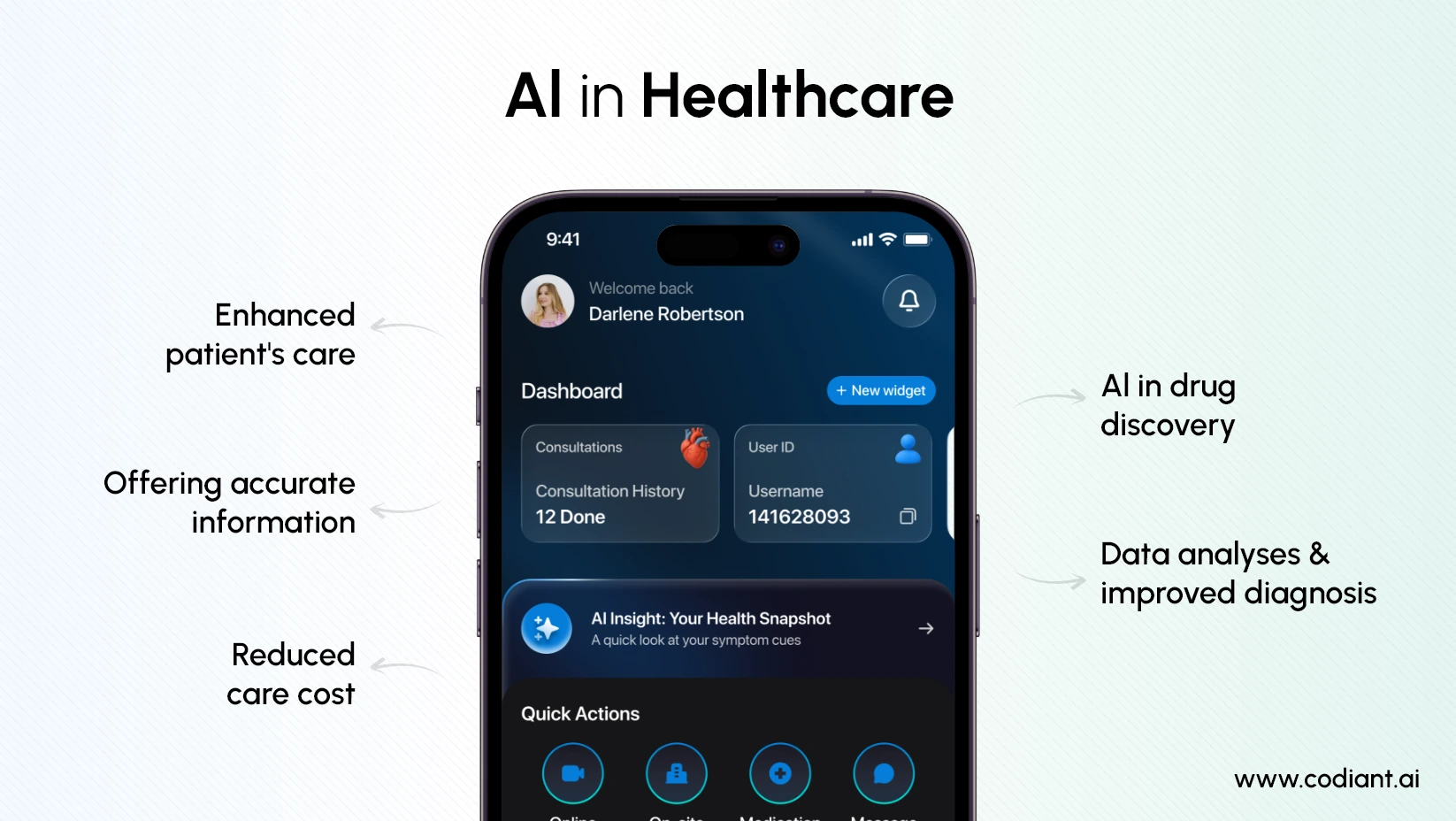
Artificial intelligence is being applied in healthcare industry to process large amounts of medical information and assist with decisions that were previously handled manually. It helps teams review data faster, reduce errors & maintain consistency across clinical and operational tasks.
Many healthcare systems still rely on manual processes, delayed reporting & data spread across multiple platforms. AI tools help bring this information together and support day-to-day decision-making across different parts of the healthcare system.
Some common areas where AI is currently being used include:
- Clinical decision support, where systems help doctors review patient information and identify potential risks or treatment options
- Medical imaging review, assisting specialists in examining scans and reports with greater consistency
- Predictive analysis, helping hospitals plan staffing, manage patient flow & identify patients who may need early attention
- Administrative support, reducing time spent on scheduling, billing, documentation & insurance processing
- Individualized care planning, using patient history and clinical data to support more tailored treatment approaches
Together, these uses are helping healthcare organizations move away from reactive care and heavy manual workloads. The focus is shifting toward more timely decisions, better use of available data & care that is easier for both patients and healthcare teams to manage.
Build AI That Fits Healthcare Workflows
Design AI solutions that align with clinical processes, compliance needs, and real operational challenges.
Why Healthcare Is Ripe for AI Transformation?
Healthcare generates massive volumes of data but has historically struggled to use it effectively.
Every patient interaction creates data across-
- Electronic health records (EHRs)
- Medical imaging
- Lab reports
- Wearable devices
- Claims and billing systems
- Clinical notes and prescriptions
Yet much of this data remains underutilized due to-
- Fragmented systems
- Manual workflows
- Shortage of skilled professionals
- Rising operational costs
- Increasing patient demand
This is where AI-powered healthcare systems excel. AI does not replace clinicians. It augments decision-making, automates repetitive tasks and surfaces insights that humans cannot process at scale.
The result is faster diagnoses, better outcomes, improved efficiency and a more sustainable healthcare system.
Read More: AI-Powered Telemedicine: Must-Know Apps and Cost Breakdown
What Is AI in Healthcare?
AI in healthcare includes the application of artificial intelligence to the diagnosis and treatment process, personalization of patient care, automation of hospital workflows, medical data management as well as drug discovery and genomics analysis.
These systems typically rely on-
- Predictive analytics in healthcare using machine learning
- NLP techniques for clinical text mining
- Computer vision for medical imaging
- A generative AI platform for documentation and patient communication
- AI bots for workflow automation and decisioning
Unlike conventional software, AI systems learn from data and get better over time a huge advantage in complicated, data-rich environments such as health care.
What Are the Main Applications of AI in Healthcare?
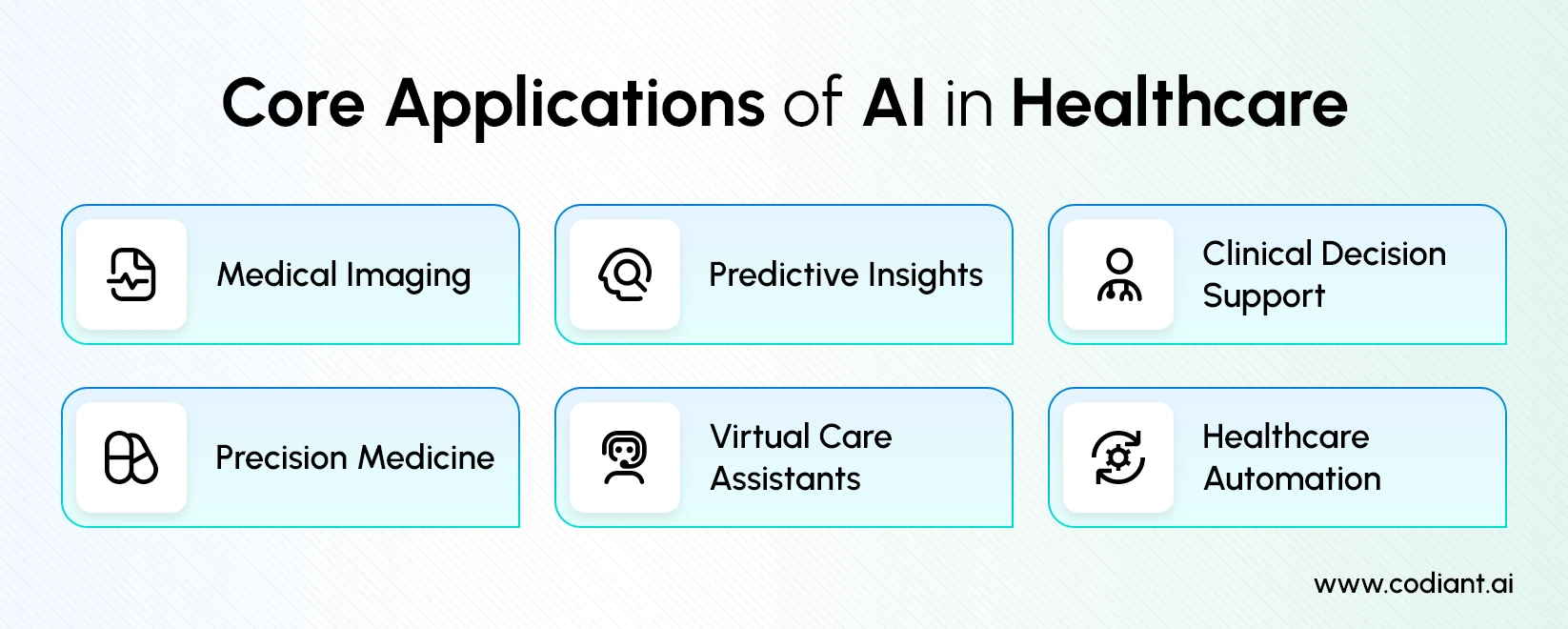
The scope of AI applications in healthcare is broad and expanding. Below are the most impactful areas where AI is already delivering measurable value.
1. Medical Imaging and Diagnostics
AI has shown exceptional performance in analyzing medical images such as X-rays, MRIs, CT scans and pathology slides.
Using deep learning and machine learning in healthcare, AI systems can-
- Detect abnormalities earlier than traditional methods
- Reduce diagnostic errors
- Prioritize urgent cases
- Support radiologists with second-opinion insights
AI-driven imaging tools are now used in cancer detection, cardiovascular disease diagnosis, neurological disorders & orthopedic assessments.
2. Predictive Analytics and Risk Assessment
Predictive models analyze patient data to identify risks before symptoms become severe.
Examples include-
- Predicting hospital readmissions
- Identifying patients at risk of sepsis or complications
- Forecasting disease progression
- Anticipating ICU demand and bed utilization
These insights allow healthcare providers to intervene earlier, improving outcomes while reducing costs.
3. AI in Clinical Decision Support
AI-powered decision support systems assist clinicians by analyzing patient history, lab results & clinical guidelines in real time.
They help with-
- Treatment recommendations
- Drug interaction alerts
- Diagnostic suggestions
- Clinical pathway optimization
Rather than replacing doctors, AI acts as a clinical intelligence layer, supporting faster and more informed decisions.
4. Personalized and Precision Medicine
One of the most promising aspects of digital transformation in healthcare with AI is personalization.
AI enables-
- Genomic data analysis for targeted therapies
- Personalized drug selection and dosage
- Customized care plans based on lifestyle and risk factors
This approach moves healthcare away from one-size-fits-all treatment toward individualized care strategies.
5. Virtual Health Assistants and Chatbots
AI-powered chatbots and virtual assistants are becoming integral to patient engagement.
They are used for-
- Symptom assessment
- Appointment scheduling
- Medication reminders
- Post-treatment follow-ups
- Patient education
These tools improve accessibility while reducing the workload on clinical staff.
6. Healthcare Automation with AI
Administrative tasks consume a significant portion of healthcare professionals’ time. Healthcare AI solutions automate repetitive processes such as-
- Medical coding and billing
- Insurance eligibility checks
- Clinical documentation
- Workflow coordination
Automation improves operational efficiency and reduces human error.
Core Technologies Powering AI Healthcare Solutions
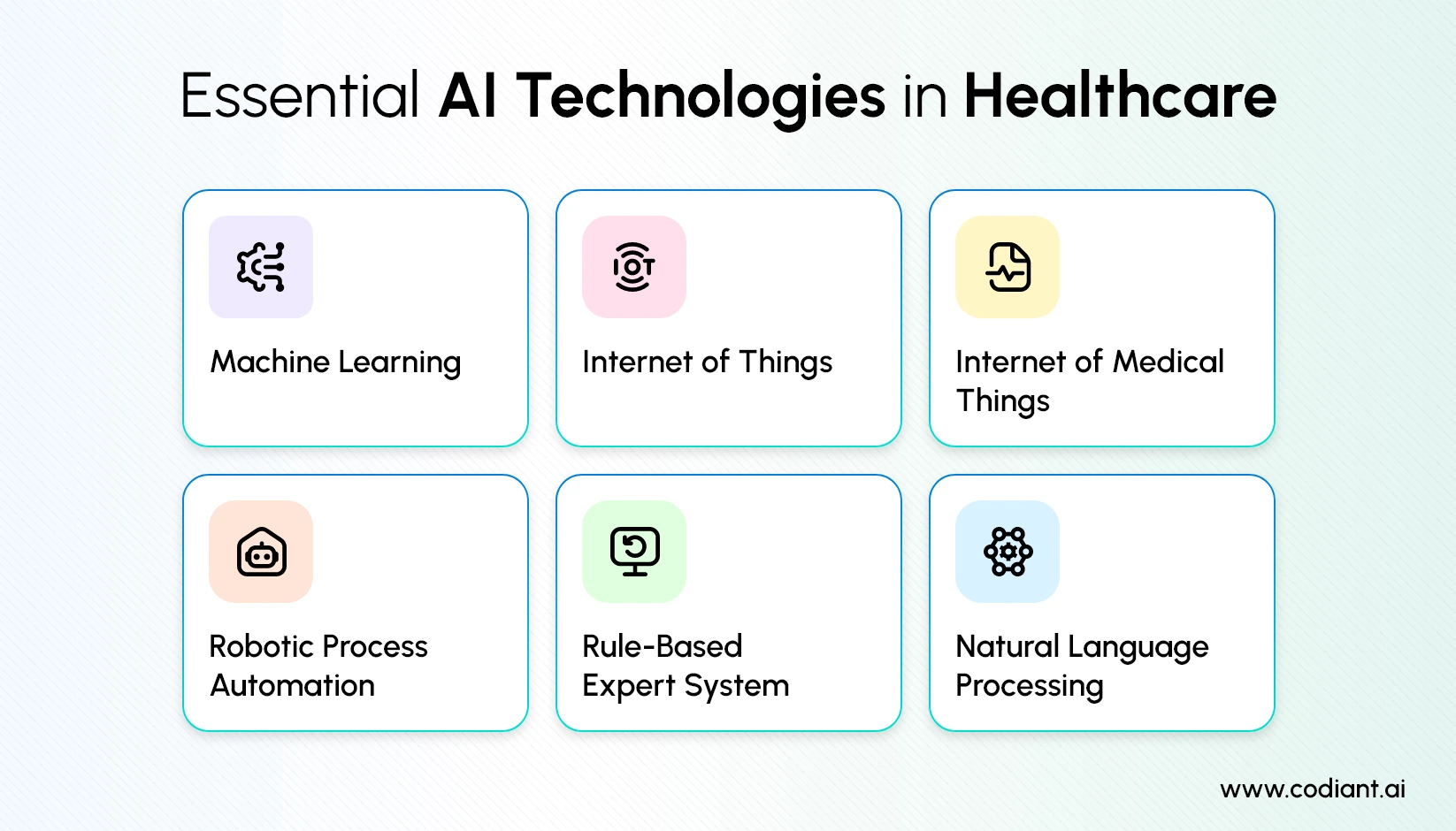
Machine Learning in Healthcare
Machine learning models analyze historical and real-time data to-
- Predict disease risks
- Identify treatment patterns
- Detect anomalies
- Support clinical decisions
ML is widely used in diagnostics, patient monitoring, population health management & hospital operations.
Natural Language Processing (NLP)
NLP enables systems to understand unstructured medical text such as-
- Doctor’s notes
- Discharge summaries
- Clinical reports
- Insurance documentation
NLP plays a major role in healthcare automation with AI, particularly in medical coding, clinical documentation & patient communication.
Computer Vision
Computer vision models interpret medical images such as-
- X-rays
- MRIs
- CT scans
- Pathology slides
These models help radiologists and pathologists detect abnormalities faster and with high accuracy, supporting advanced AI applications in healthcare.
Generative AI
Generative AI is transforming healthcare documentation, patient engagement & education by-
- Creating clinical summaries
- Drafting medical notes
- Generating patient-friendly explanations
- Powering conversational healthcare assistants
Can AI Improve Patient Outcomes and Operational Efficiency?
Yes when implemented correctly, AI significantly improves both patient outcomes and operational performance.
Improving Patient Outcomes
AI contributes to better outcomes by enabling-
- Earlier disease detection
- More accurate diagnoses
- Personalized treatment plans
- Continuous patient monitoring
- Reduced medical errors
Patients benefit from faster care, fewer complications & more proactive interventions.
Enhancing Operational Efficiency
From an operational standpoint, AI helps healthcare organizations-
- Reduce wait times
- Optimize staff allocation
- Lower administrative costs
- Improve capacity planning
- Increase clinician productivity
The combined effect is a healthcare system that is both clinically effective and economically sustainable.
Plan Your Healthcare AI Roadmap
Get guidance on where AI fits in your organization and how to implement it responsibly.
What Are the Benefits of AI Adoption in Healthcare Organizations?
The benefits of adopting AI extend beyond technology they impact care quality, financial performance & long-term scalability.
Key Benefits Include-
- Improved clinical accuracy through data-driven insights
- Cost reduction via automation and efficiency gains
- Enhanced patient experience with faster, more responsive care
- Better workforce utilization and reduced burnout
- Scalable innovation across departments and locations
Healthcare organizations that embrace AI healthcare transformation gain a competitive and operational advantage.
AI Healthcare Use Cases 2026- What’s Coming Next?
By 2026, AI will move from isolated use cases to fully integrated healthcare ecosystems.
Expected trends include-
- AI-powered clinical co-pilots for physicians
- Advanced predictive population health management
- Fully automated revenue cycle management
- AI-driven remote patient monitoring at scale
- Greater use of generative AI for clinical documentation
AI healthcare use cases in 2026 will focus less on experimentation and more on enterprise-wide deployment.
What Challenges Do Healthcare Providers Face When Implementing AI?
Despite its potential, AI adoption in healthcare is not without challenges.
Common Barriers Include-
- Data quality and interoperability issues
- Regulatory and compliance requirements
- Integration with legacy systems
- Clinician trust and adoption resistance
- Ethical concerns and bias mitigation
Successful implementation requires strong governance, transparent algorithms & close collaboration between clinicians, technologists & leadership.
Read More: How Much Does AI App Development Cost? Your Only Guide
The Future of Digital Transformation in Healthcare with AI
AI is not simply a tech upgrade rather it embodies a complete reversal in the way healthcare works.
Healthcare organizations who strategically invest in AI-enabled systems will be better positioned to:
- Deliver value-based care
- Scale services efficiently
- Respond to evolving patient needs
- Navigate workforce and cost pressures
The future of healthcare is smart, connected & data-driven and AI is the engine driving that change.
Final Thoughts
The healthcare sector can no longer afford to do without AI. It’s increasingly becoming necessary to provide sustainable, high-quality & patient-centric care.
AI in healthcare is revolutionizing every layer of the sector, from diagnostics and clinical decision support to automation and personalized medicine. Challenges remain, but the owning of responsibility pays off in spades for organizations that can embrace it intentionally and thoughtfully.
As we move toward 2026, healthcare providers that embrace AI today will define the standards of care tomorrow.
Prepare Your Organization for AI Adoption
Assess readiness, data quality, and compliance before introducing AI into healthcare workflows.
Frequently Asked Questions
AI can automate scheduling, medical coding, billing, clinical documentation, patient follow-ups, insurance checks & routine data entry tasks across healthcare operations.
AI analyzes patient data, medical images & clinical history to highlight risks, support diagnoses & help doctors make faster, more accurate treatment decisions.
Yes, modern AI solutions integrate with EHRs and hospital systems through APIs, enabling seamless data flow without replacing existing clinical or administrative platforms.
AI healthcare systems must follow regulations like HIPAA and GDPR, ensuring patient data security, consent management, audit trails & strict access controls.
Healthcare organizations should begin with high-impact use cases, prepare clean data, involve clinicians early, ensure compliance & gradually scale AI across workflows.
Featured Blogs
Read our thoughts and insights on the latest tech and business trends
How AI-Powered Virtual Assistants Automate Enterprise Workflows in 2026?
- April 8, 2026
- Artificial Intelligence
Enterprises are no longer asking if AI should be part of operations. The real question now is how deeply it can be embedded. And in 2026, one answer keeps showing up across industries- AI-powered virtual... Read more

Implementing Agentic RAG in Enterprises: Architecture, Challenges & ROI
- April 2, 2026
- Artificial Intelligence
In 2026, enterprises are no longer satisfied with static AI responses or generic large language model outputs. The demand has shifted toward systems that can think, retrieve, act and refine responses dynamically this is where... Read more
Enterprise AI Development Partner Checklist- What CTOs Should Evaluate Before Hiring
- March 27, 2026
- Artificial Intelligence
AI is no longer an experiment sitting in innovation labs. It’s driving revenue, optimizing operations, and shaping how enterprises compete. But here’s the real challenge choosing the right enterprise AI development partner. Because the difference... Read more