How to Build an Intelligent AI Model- A Complete Guide
Table of Contents
Subscribe To Our Newsletter
Artificial intelligence (AI) is changing every industry today. It helps businesses predict what customers will do, understand data faster and automate jobs that take a lot of time. Many companies now want to learn how to build an AI model that can work smartly and make better decisions. But AI is not magic – it follows a clear and simple process. It uses data, the right algorithms and constant improvement to get better over time.
In this guide, we will explain the entire AI model development process in very simple words. You will learn how data is collected, how an AI model is trained and what tools developers use to build intelligent systems. Whether you are a student, a business owner or someone new to AI, this guide you’ll understand how real AI models are created step by step.
What Is an AI Model?
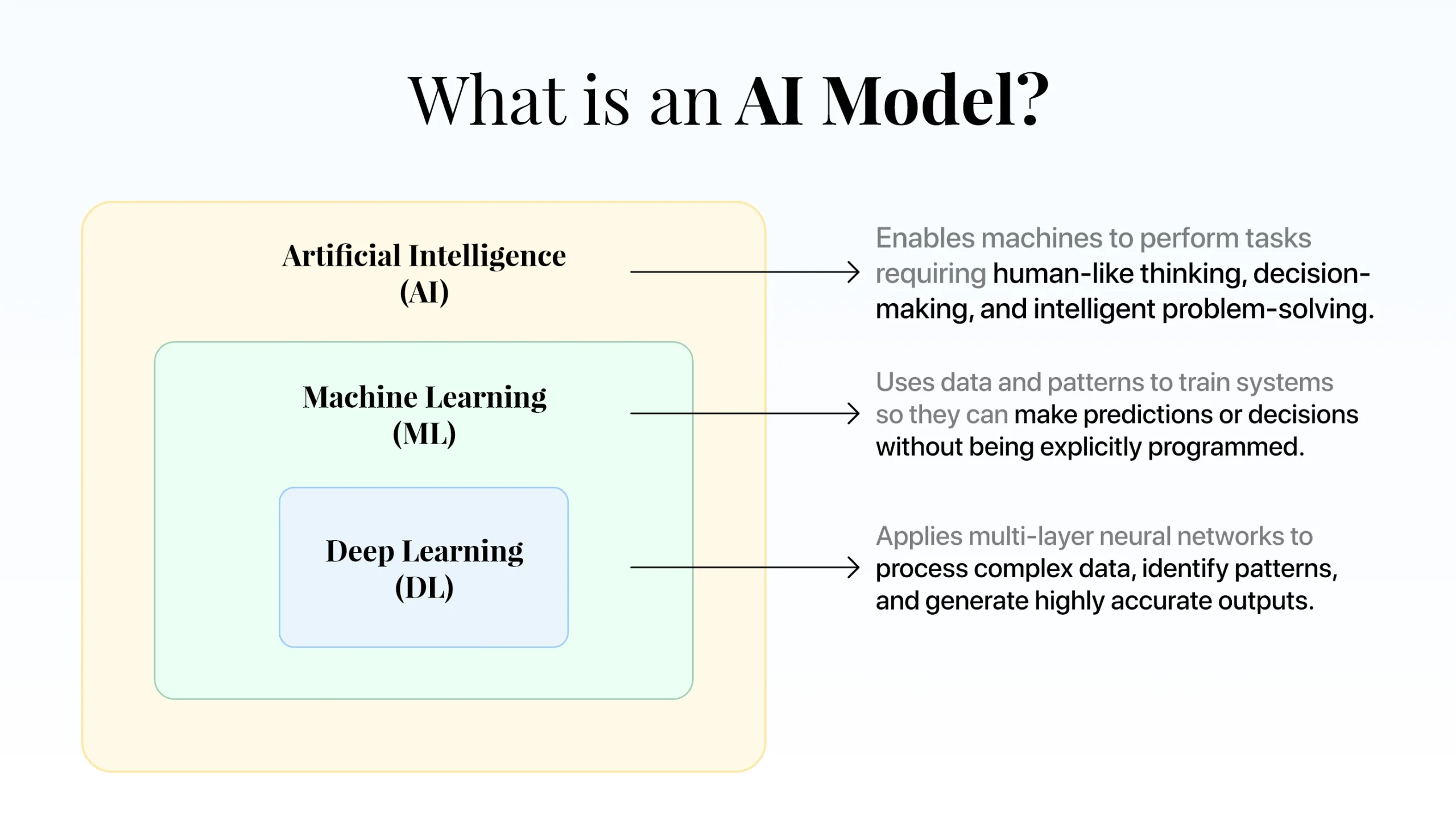
An AI model is a computer system that learns from data. It studies many examples, finds patterns and then uses those patterns to make predictions or decisions. Instead of getting strict rules from a human programmer, the model improves on its own by learning from information. This learning process is called AI model training.
There are different kinds of AI models:
- Supervised learning models that learn from labeled examples
- Unsupervised learning models that find patterns without any labels
- Reinforcement learning models that learn by trial, error and rewards
- Generative AI models that create new content like text, images or audio
Businesses use AI models for many tasks like finding fraud, grouping customers, predicting sales, suggesting products, or automating work. Since companies collect a lot of data today, knowing how AI models work is becoming more and more important.
Why Businesses Need Intelligent AI Models

Every business today creates massive amounts of data—customer behavior, sales history, operational workflows, CRM records, website analytics & more. Making sense of this data manually is impossible. Intelligent AI models solve this problem by turning raw information into useful insights.
Here’s why AI model development for businesses is growing fast-
- Faster decision-making– Models can analyze millions of data points instantly.
- Process automation– AI reduces repetitive tasks and cuts operational effort.
- Higher accuracy– Data-driven predictions decrease human errors.
- Cost efficiency– Automating manual tasks lowers long-term expenses.
- Customer personalization– AI understands customer behavior and tailors experiences.
- Scalability– AI enables companies to handle large workloads without increasing manpower.
From healthcare diagnosis models to logistics route optimization, AI is now the backbone of modern digital transformation.
Understanding the AI Model Development Process
Building an AI model follows a structured pipeline. It starts with identifying the business problem and ends with deploying the model into production.
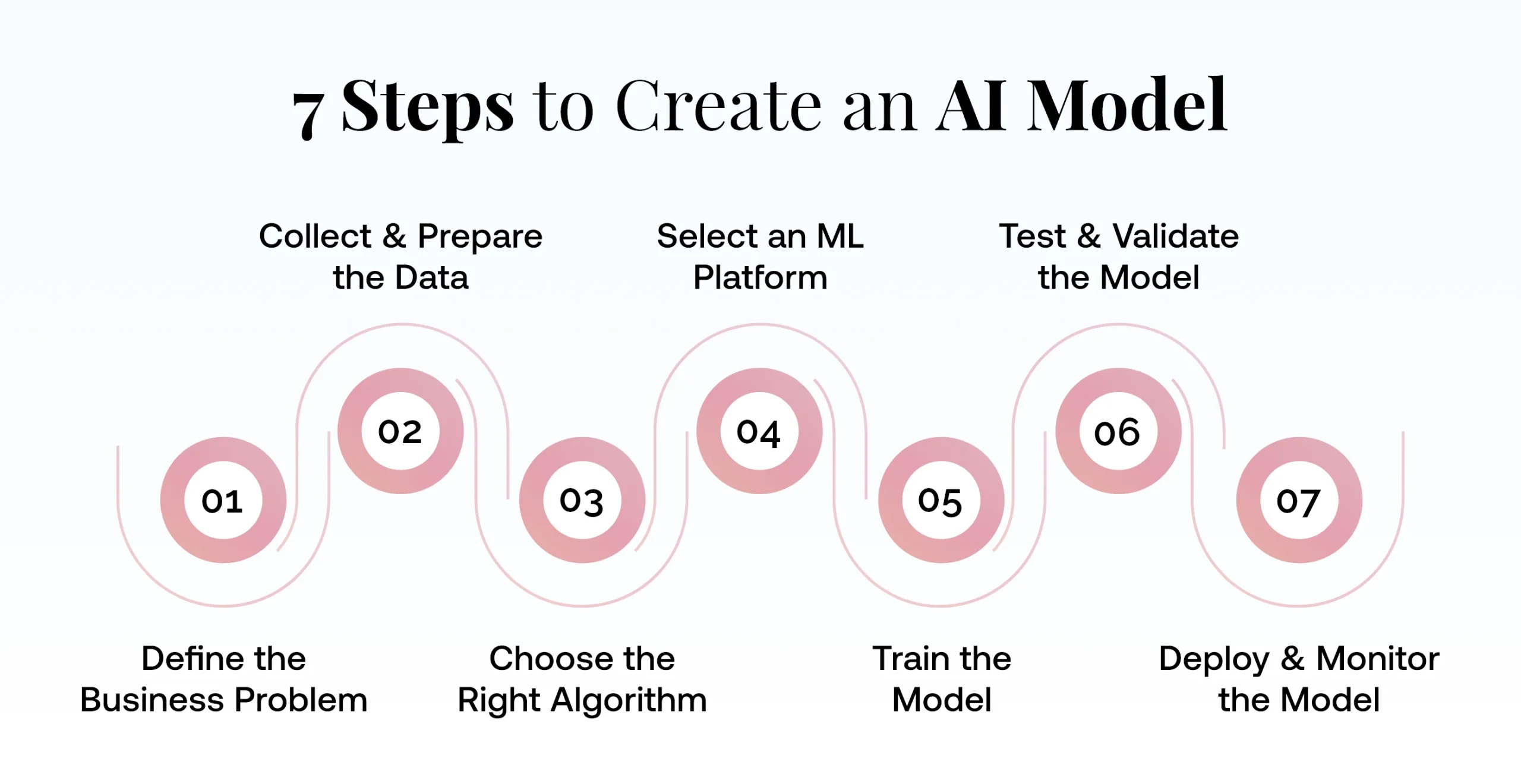
The process includes data gathering, preparation, algorithm selection, model training, testing & continuous monitoring. Let’s break down each step clearly.
Read More: AI in FinTech Explained: Examples, Challenges, Market Growth & Future Opportunities
How to build an AI model – Step-by-Step Process
Step 1- Define the Business Problem
Every successful AI project begins with clarity. Before touching any data or tools, you need to define the exact problem the model should solve. This ensures the model is useful and aligned with business goals.
Questions to ask-
- What issue are we solving?
- What outcomes do we want?
- What metrics define success?
- What decisions will the AI model influence?
- What data do we already have?
Examples-
- A bank wants to predict loan defaults.
- An e-commerce company wants to recommend products.
- A logistics platform wants accurate delivery time predictions.
Defining the problem helps structure the entire AI model development process.
Step 2- Collect and Prepare the Data
Data is the foundation of every AI model. The quality of your data directly determines the quality of your predictions. The next step is collecting, processing & organizing data in a usable format.
Data preparation involves-
- Collecting data from different sources
- Cleaning incorrect, duplicate, or missing values
- Labeling data (for supervised learning)
- Transforming fields into numerical forms
- Selecting the most important features
- Splitting data into training, validation & test sets
Common tools used-
- Pandas and NumPy for data processing
- SQL for database queries
- Apache Spark for large-scale data handling
If the data is weak, the AI model will deliver inaccurate results—no matter how advanced the algorithm is.
Step 3- Choose the Right Algorithms and Techniques
After preparing the data, developers select the algorithm that best fits the problem.
Popular algorithm categories include-
Machine Learning Algorithms
- Linear Regression
- Logistic Regression
- Random Forest
- Support Vector Machines
- Gradient Boosting
Deep Learning Algorithms
- Convolutional Neural Networks (CNNs) for images
- Recurrent Neural Networks (RNNs) for sequences
- Transformers for text, speech & language
Generative AI Models
- GPT-based models
- Variational Autoencoders
- Diffusion models
Choosing the right algorithm ensures your AI learns efficiently and performs accurately.
Step 4- Select a Machine Learning Platform
Before training large or production-grade models, you need the right platform to manage experiments, resources & deployment.
Popular options include-
- Cloud ML platforms like AWS SageMaker, Google Vertex AI & Azure Machine Learning
- Notebook environments such as Jupyter, Google Colab or Databricks
- End-to-end MLOps platforms that handle data pipelines, training, deployment & monitoring in one place
Choosing the right platform helps you-
- Scale training efficiently
- Use GPUs or TPUs when needed
- Automate pipelines and retraining
- Track experiments, versions & metrics
This step makes the rest of AI model development for businesses more organized and production-ready.
Step 5- Train the AI Model
AI model training is where the actual learning happens. The algorithm analyzes the training dataset and learns the relationship between inputs and outputs.
Training involves concepts like-
- Hyperparameter tuning
- Model optimization
- Loss function evaluation
- Regularization
- Validation testing
Developers measure performance using metrics such as-
- Accuracy
- Precision
- Recall
- F1 score
- Mean squared error
- ROC-AUC
The goal of training is simple- help the model learn patterns that generalize well to real-world data.
Step 6- Test and Validate the Model
After training, the model must be tested on unseen data to confirm accuracy and reliability.
Key activities include-
- Running the model on test data
- Checking prediction consistency
- Evaluating performance metrics
- Ensuring the model is not biased or overfitting
- Making refinements based on gaps
Validation ensures the model will perform well when deployed in real-world scenarios.
Step 7- Deploy and Monitor the Model
Once validated, the model is deployed into production. This is where businesses start using it for predictions, decision-making, or automation.
Deployment methods-
- Cloud deployment (AWS Sagemaker, Azure ML, Google Vertex AI)
- API-based integration
- Edge deployment for IoT devices
After deployment, the model must be monitored regularly. Data changes over time & models can lose accuracy—a concept known as model drift. Continuous retraining and monitoring ensure long-term performance.
Read More: How to Build an AI Agent: A Step-by-Step Guide
Tools and Frameworks to Build an AI Model
Developers use different tools depending on the complexity of the model, the type of data & the business requirements. Here are the most widely used frameworks-
| Tool / Framework | What It’s Best For | Why Developers Use It |
| TensorFlow | Deep learning and large-scale neural networks | Powerful, scalable & widely supported for production-grade AI models |
| PyTorch | Research-focused deep learning development | Flexible, intuitive & preferred by researchers and modern AI labs |
| Keras | Rapid deep learning model building | High-level, easy-to-use API that speeds up experimentation |
| Scikit-Learn | Traditional machine learning algorithms | Simple, reliable & perfect for smaller ML tasks and quick prototypes |
| Hugging Face | Pre-trained models and transformers | Gives access to state-of-the-art NLP and generative AI without building from scratch |
| OpenAI APIs | Generative AI and LLM-based applications | Enables advanced text, speech & content generation with minimal coding |
| Vertex AI / AWS SageMaker / Azure ML | End-to-end model training, deployment & monitoring | Cloud-based ML lifecycle platforms that simplify scaling and MLOps |
Best Practices for Building Intelligent AI Models
Creating a good AI model requires more than just data and algorithms. Here are the practices followed by top engineering teams-
- Ensure strong data governance and quality management
- Track data lineage and maintain transparency
- Use explainable AI methods to avoid black-box risks
- Prevent bias by balancing datasets
- Continuously monitor model drift
- Maintain version control for experiments
- Document the development process clearly
- Use MLOps frameworks for deployment and automation
Following these practices results in models that are reliable, ethical, scalable & easier to maintain.
Real-World Examples of AI Model Development for Businesses
- Retail stores use AI to study what people like to buy. The model suggests products that each shopper might enjoy based on their past choices.
- Healthcare teams create AI models using NLP that look at medical records, test results & scans to spot early signs of illnesses and help doctors diagnose faster.
- Logistics and delivery companies use AI to guess delivery times, choose the best routes & handle delays caused by traffic or weather.
- Marketing teams use AI to group customers into different categories based on their behavior and interests. This helps them send the right message or offer to the right people.
Read More: How Much Does AI App Development Cost? Your Only Guide
Challenges in AI Model Development
Despite its advantages, building AI models comes with challenges-
- Poor data quality leads to weak predictions
- Bias in data affects fairness
- High computational cost for training large models
- Model complexity makes it hard to interpret results
- Integration issues when connecting AI to existing systems
- Model drift when data trends change
Recognizing these challenges early helps teams build better solutions.
Conclusion
Building an intelligent AI model is easier when you follow a clear step-by-step plan. You must understand the business problem gather the right data, choose a good algorithm & train the model properly. With the right tools and a well-planned AI model development process, companies can make systems that can predict results, automate work & support smart decisions.
Today, businesses that invest in AI keep their models updated & use strong deployment methods will stay ahead of others. AI is not just a future idea it is already helping companies work faster, smarter & better.
Your Next Competitive Advantage Starts with the Right AI Model
Get a custom-built, production-ready model designed around your data, workflows and business objectives.
Frequently Asked Questions
You don’t always need a huge amount of data. What matters most is that the data is clean, correct and useful. Sometimes a few thousand good examples are enough.
The best algorithm depends on your goal and the type of data you have. Usually, teams try many models first then pick the one that gives the most accurate and steady results.
AI models can fail because real-world data changes over time. If you don’t check the model often or retrain it its accuracy drops and predictions become wrong.
A simple model may take a few weeks. But a full business-ready AI system, including data setup, testing & deployment usually takes 2 to 6 months based on how complex it is.
Yes. Cloud tools, automated ML platforms & AI service partners make it easy for small teams. Starting with a simple, clear problem also helps a lot.
Featured Blogs
Read our thoughts and insights on the latest tech and business trends
How AI-Powered Virtual Assistants Automate Enterprise Workflows in 2026?
- April 8, 2026
- Artificial Intelligence
Enterprises are no longer asking if AI should be part of operations. The real question now is how deeply it can be embedded. And in 2026, one answer keeps showing up across industries- AI-powered virtual... Read more

Implementing Agentic RAG in Enterprises: Architecture, Challenges & ROI
- April 2, 2026
- Artificial Intelligence
In 2026, enterprises are no longer satisfied with static AI responses or generic large language model outputs. The demand has shifted toward systems that can think, retrieve, act and refine responses dynamically this is where... Read more

Enterprise AI Development Partner Checklist- What CTOs Should Evaluate Before Hiring
- March 27, 2026
- Artificial Intelligence
AI is no longer an experiment sitting in innovation labs. It’s driving revenue, optimizing operations, and shaping how enterprises compete. But here’s the real challenge choosing the right enterprise AI development partner. Because the difference... Read more