How to Choose the Right AI Consulting Company in Australia
Table of Contents
Subscribe To Our Newsletter
For many Australian businesses, AI has moved from “interesting” to unavoidable. Boards are asking about it. Competitors are deploying it. Customers are beginning to expect smarter, faster, more personalized experiences.
But here’s the uncomfortable truth: Most AI initiatives don’t fail because of technology. They fail because of poor consulting decisions.
Choosing the wrong AI partner often leads to:
- Proofs of concept that never become real systems
- Models that look impressive but don’t fit operations
- High costs with unclear ROI
- Internal teams that don’t trust or adopt the solution
This article is written to help you avoid those outcomes and choose an AI consulting company in Australia that can deliver real business value, not just demos.
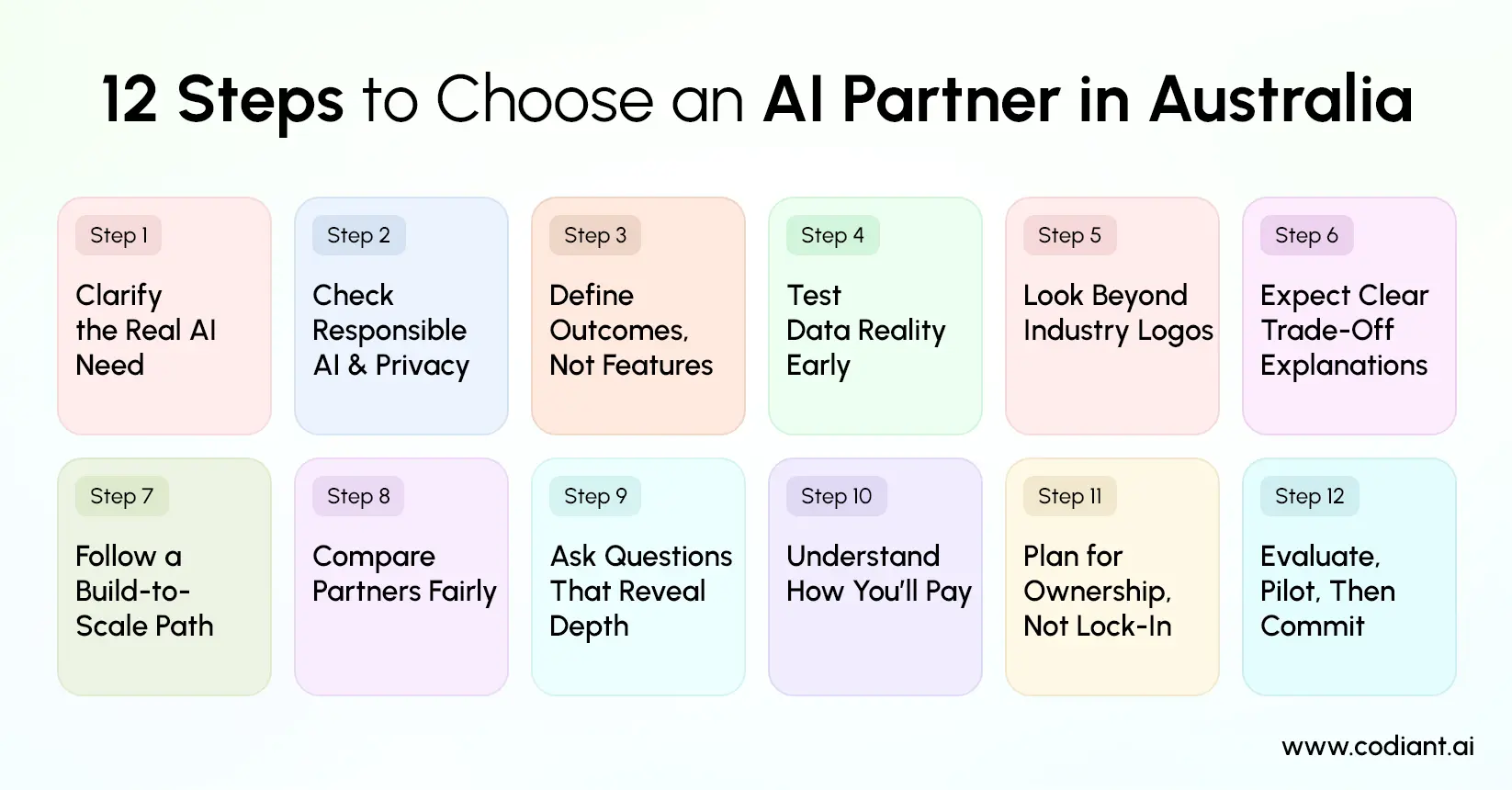
Step 1: Be Clear on What You’re Actually Hiring for
The first mistake many teams make is using one label for different needs. An AI Development Company Australia and an AI consulting services Australia provider may overlap but they’re not the same thing.
Here are the common “AI partner types” you’ll see:
1) AI Strategy + Advisory Partner
Best when you need direction and alignment before building:
- Opportunity discovery and prioritization
- Data readiness assessment
- Business case + ROI model
- Responsible AI governance setup
This is closer to AI advisory services Australia and AI strategy consulting Australia.
2) AI Implementation + Delivery Partner
Best when you already know what you want to build:
- Data engineering, MLOps, model integration
- RAG/LLM apps, forecasting models, automation
- Security, monitoring, rollout and training
This is what most people mean by AI implementation consulting Australia plus delivery.
3) Enterprise AI Transformation Partner
Best for large organisations where AI needs to work across teams and systems:
- Operating model design (people/process/tools)
- Governance, risk controls, model lifecycle ownership
- Platform approach (not one-off use cases)
This is enterprise AI consulting Australia and AI transformation consulting Australia.
Actionable takeaway: Before you shortlist, write a one-paragraph brief:
- What decision is AI helping people make?
- What workflow is changing?
- Who will use it weekly?
- What system will it connect to?
- What metric improves in 90 days?
Not Sure Where AI Fits Your Business?
Get clarity on high-impact AI opportunities aligned with your data, goals, and compliance requirements.
Step 2: Check Alignment With Australia’s Responsible AI and Privacy Expectations
In Australia, “responsible AI” isn’t just a slogan. There are specific reference points your partner should be comfortable discussing.
What Good Looks Like
A serious AI consulting firm in Australia should be able to map your project to:
- Australia’s voluntary AI Ethics Principles (fairness, transparency, privacy/security, contestability, etc.).
- OAIC privacy expectations when using AI tools that process personal information (including guidance for commercial AI products).
- Responsible AI practices and risk reduction approaches commonly promoted by Australian research bodies like CSIRO.
Red Flags to Watch
Be cautious if a vendor:
- Can’t explain where your data will be stored, processed, and logged
- Avoids discussing model risk, bias testing, or human review workflows
- Pushes a single tool for every problem
- Treats privacy/security as “later”
Practical question to ask: “Show me how you handle privacy and governance in AI projects in Australia templates, checklists, or examples.”
Step 3: Decide what “success” means before you discuss models or tools
A strong partner will push you to define outcomes, not features.
Better Success Metrics Than “We Built an AI Chatbot”
Pick measurable indicators such as:
- Reduced handling time in service workflows
- Higher accuracy or earlier detection in risk/quality processes
- Faster turnaround for approvals/reviews
- Fewer manual steps in operations
- Reduced cost-to-serve or improved conversion
If you’re evaluating AI Development services Australia, insist on:
- A baseline (current performance)
- A target (improvement range)
- A measurement plan (how you’ll prove it)
Reality check: If your organisation can’t measure the current workflow, the first milestone should be instrumentation and data capture not model selection.
Step 4: Verify They Can Work With Your Data Reality (Not an Ideal Dataset)
Most AI projects don’t fail because the model is “not advanced enough.” They fail because:
- Data is inconsistent across systems
- Definitions differ between teams
- Access and permissions are unclear
- Data quality issues appear mid-build
Ask for a Data Readiness Approach
A credible AI consulting company Australia should offer a structured process like:
- Data source mapping (systems, owners, sensitivity levels)
- Data quality profiling (completeness, drift, duplicates)
- Governance checkpoints (who approves what)
- A plan for ongoing data maintenance
Look for MLOps + Operational Ownership
Even if you’re building an LLM solution, you still need:
- Monitoring (quality, latency, cost, safety)
- Change control (prompts, retrieval, policies, versioning)
- Incident handling
- Audit trails (especially in regulated environments)
If a partner only talks about “building the first version,” you’re likely buying a demo not an operational system.
Step 5: Evaluate Industry Experience but Don’t Overvalue Logo Slides
Local context matters. Australia has distinct realities across sectors (health, finance, mining, public services, education). But “we’ve worked with X industry” isn’t enough.
What to Ask Instead of “Do You Have Experience in My Industry?”
Ask:
- “What are the top 3 AI use cases you’ve seen actually adopted in my industry?”
- “Where do projects get blocked legal, security, data access, change management?”
- “Show how you designed human review and escalation in the workflow.”
If they can’t talk about adoption blockers, the experience may be surface-level.
Read more: How Much Does AI Development Cost 2026? A Complete Guide
Step 6: Choose a Partner Who Can Explain Trade-offs in Plain Language
A good AI consulting partner Australia should be able to explain:
- Why a rules-based automation might beat ML for a specific workflow
- When to use a smaller model vs a larger model
- When retrieval (knowledge search) is safer than fine-tuning
- What you gain/lose with different hosting choices
This matters for budget and risk.
You want a partner who says: “Here are three options, with cost, complexity, and risk pick what fits your business constraints.”
Not: “Trust us, this is the future.”
Step 7: Look for a Structured Delivery Method (Discovery → Pilot → Production)
A reliable path for AI implementation consulting Australia typically looks like:
Phase 1: Discovery (2–4 weeks)
- Use case selection + prioritization
- Data readiness + risk assessment
- ROI hypothesis + success metrics
- Architecture options and plan
Phase 2: Prototype / Pilot (4–10 weeks)
- Build a small but real workflow
- Test with real users
- Evaluate accuracy, safety, adoption, performance
- Make go/no-go decision based on evidence
Phase 3: Production Rollout (8–16 weeks)
- Security hardening, monitoring, access controls
- Integration into business systems
- Training, documentation, change management
- Ownership handover + runbooks
If a company can’t explain their process clearly, it often means the process changes depending on who you talk to which becomes messy mid-project.
Step 8: Use an “AI Partner Scorecard” to Compare Vendors Fairly
Here’s a simple scorecard you can use in vendor calls. Rate each 1–5.
Strategy + Value
- Can they translate business goals into prioritized AI use cases?
- Do they provide ROI logic and measurement planning?
Data + Engineering
- Can they assess data readiness quickly and realistically?
- Do they have strong integration + MLOps capability?
Responsible AI + Privacy
- Do they align with Australia’s AI Ethics Principles?
- Do they understand OAIC guidance for AI tools handling personal data?
Delivery + Adoption
- Do they design for user adoption, training, and change management?
- Do they provide post-launch monitoring, governance, and support?
Team Quality
- Who will actually work on your project?
- Do you get senior involvement beyond sales?
Tip: Ask for resumes/roles of the delivery team not just a capability deck.
Step 9: Ask These 12 Questions Before You Hire AI Consultants in Australia
If your goal is to hire AI consultants Australia, use these questions to separate confident teams from vague ones:
- What’s your approach to selecting use cases and proving ROI?
- How do you assess data readiness in the first 2–3 weeks?
- How do you handle privacy and security when AI uses personal or sensitive data?
- Do you provide a governance framework aligned to Australia’s AI Ethics Principles?
- What’s your plan for model monitoring and quality drift?
- What’s your approach to human review, escalation, and contestability?
- Which parts will you build vs integrate from third-party tools?
- What’s your cost-control strategy for AI usage in production?
- Can you show one example where you moved from pilot to production (and what changed)?
- How do you document and handover ownership to internal teams?
- What risks do you expect in our environment and how do you mitigate them?
- Who is responsible for outcomes, not just deliverables?
Related reading: Top 20 Generative AI Development Companies in the USA (2026)
Step 10: Understand Pricing Models So You Don’t Pay for Confusion
Most AI consulting firms in Australia will propose one of these:
1. Fixed-scope Discovery
Good for clarity and early alignment. You get:
- use case shortlist, architecture, risk plan, ROI model, roadmap
2. Time-and-material Delivery
Good when scope will evolve. Requires:
- strong weekly governance, clear milestones, transparent burn rate
3. Outcome-tied Engagement (Rare but Valuable)
Some partners will align fees to specific delivery milestones or adoption metrics.
What to avoid: paying for months of “research” without a production path.
Step 11: Make Sure You’re Not Buying Vendor Lock-in
Lock-in happens when:
- only the vendor understands the prompt flows / retrieval design
- tooling is proprietary without documentation
- deployments are configured in a way your team can’t run
A strong AI Development Company Australia should offer:
- clear documentation
- reproducible environments
- runbooks + handover
- training for internal teams
This is especially important if you’re pursuing enterprise AI consulting Australia, where long-term ownership matters.
Step 12: Shortlist, Run a Structured Evaluation, Then Choose
A clean way to choose an AI consulting partner Australia:
- Create a shortlist (3–5 vendors) based on relevant experience + capability fit
- Run the same 60–90-minute discovery call agenda for each vendor
- Ask each to submit a short proposal covering: approach, timeline, team, risks, assumptions, success metrics
- Pick 1 vendor for a paid discovery
- Decide on pilot only after discovery outputs are strong
This keeps the decision evidence-based, not slide-based.
Evaluate Your AI Readiness Before You Invest
Identify data gaps, risks, and realistic AI use cases with an expert-led readiness assessment.
What Services Do AI Consulting Firms in Australia Offer?
AI consulting firms in Australia typically provide services across the entire AI lifecycle, not just model development. The strongest firms combine advisory, engineering, and operational support to ensure AI systems are usable, compliant, and scalable in real business environments.
Here are the core AI services categories you should expect from a reliable AI consulting company Australia:
AI Strategy and Advisory Services
This is the foundation of most successful engagements and falls under AI strategy consulting Australia and AI advisory services Australia.
Services usually include:
- AI opportunity identification and prioritization
- Business case development and ROI modelling
- Data readiness and maturity assessments
- AI governance, risk, and ethics framework design
- Roadmap creation aligned with business objectives
This phase ensures AI initiatives are grounded in operational reality, not experimentation.
AI Design, Development, and Engineering
These services are commonly delivered by an AI Development Company Australia and focus on building production-ready solutions.
Typical offerings include:
- Machine learning and predictive analytics solutions
- Large language model (LLM) applications, AI-Powered DevOps, and RAG systems
- Intelligent automation and workflow optimization
- Data engineering and pipeline development
- AI model integration with existing enterprise systems
This is where AI Development services Australia move from concept to deployment.
AI Implementation and Integration Consulting
Often referred to as AI implementation consulting Australia, this phase ensures AI systems work within existing environments.
Key services include:
- System integration (CRM, ERP, data warehouses)
- Model deployment and infrastructure setup
- Monitoring, logging, and performance optimization
- Security, access control, and compliance configuration
- User training and operational handover
Without this layer, many AI projects stall after pilots.
Enterprise AI Transformation Services
Large organisations often engage firms for enterprise AI consulting Australia or AI transformation consulting Australia.
These services focus on:
- Organisation-wide AI operating models
- Change management and adoption planning
- AI governance committees and review workflows
- Cross-department AI enablement
- Long-term AI capability building
This approach treats AI as a business capability, not a one-off project.
How Much Does AI Consulting Cost in Australia?
AI consulting costs in Australia vary based on the project scope, technical complexity, industry regulations, and engagement model. Instead of a fixed price, most AI consulting services Australia follow structured cost bands tied to delivery stages and outcomes.
The table below outlines realistic market ranges to help you budget and evaluate proposals with clarity.
| AI Consulting Engagement Type | Typical Cost Range (AUD) | What’s Included |
| AI Strategy & Discovery Phase | 20,000 – 60,000 | Use-case identification, data readiness assessment, ROI modelling, AI roadmap, and governance planning |
| AI Prototype or Pilot Development | 40,000 – 150,000 | Model development, limited data integration, validation, performance evaluation, and stakeholder testing |
| Production-Grade AI Implementation | 120,000 – 500,000+ | Full engineering, system integration, security controls, monitoring setup, deployment, and rollout support |
| Enterprise AI Transformation Programs | 250,000 – 1M+ | Organisation-wide AI strategy, governance frameworks, multi-team enablement, change management, and long-term platform adoption |
How Long Does an AI Consulting Engagement Typically Take?
AI consulting engagements in Australia depend on project scope, data readiness, and organizational scale. Most successful engagements follow a structured timeline to ensure clarity, accuracy, and long-term adoption.
| Engagement Phase | Typical Duration | Key Focus |
| Discovery and Strategy Phase | 2–4 weeks | Problem definition, data assessment, feasibility, AI roadmap |
| Pilot or Proof of Concept | 4–10 weeks | Build, test, validate value, user feedback |
| Production Implementation | 8–16 weeks | Deployment, integration, security, training |
| Enterprise AI Transformation Programs | 6–18 months | Phased rollout, governance, organisation-wide adoption |
What Industries in Australia Benefit Most from AI Consulting?
AI adoption in Australia is strongest where data volume, decision complexity, and operational scale intersect. While AI can add value across sectors, certain industries see faster and more measurable returns.
Here’s where AI consulting firms in Australia are delivering the most impact today:
Healthcare and Life Sciences
AI helps healthcare teams improve clinical decisions, assess patient risks earlier, analyse medical images faster, and streamline workflows while meeting strict privacy, safety, and compliance requirements.
Financial Services and Insurance
AI supports fraud detection, risk assessment, credit decisions, automated customer support, and compliance monitoring, making it essential for financial organisations that operate under complex regulatory and governance frameworks.
Retail and E-Commerce
AI enables better demand forecasting, inventory planning, personalized shopping experiences, pricing optimization, and churn prediction, helping retailers test ideas quickly and measure results clearly across digital and physical channels.
Mining, Energy, and Utilities
AI improves predictive maintenance, safety monitoring, resource planning, and operational forecasting, especially in environments with large data volumes, connected equipment, and complex operational systems.
Government and Public Sector
AI enhances service delivery, policy analysis, document processing, and citizen engagement while maintaining transparency, accountability, and responsible use standards required in public-sector environments.
Related reading: Why Enterprises Need AI Strategy Consulting in the USA?
Choosing the Right AI Consulting Company in Australia is a Governance Decision, Not Just a Vendor Decision
The right AI consulting company Australia will help you make smart choices early about use cases, data, risk controls, and operational ownership so you end up with AI that people actually use.
If you want a simple rule: Choose the team that can explain trade-offs clearly, proves value with measurement, and treats privacy, ethics, and governance as part of delivery not an afterthought. Australia’s direction on responsible AI is increasingly explicit, and your partner should be fluent in it.
Choose the Right AI Partner with Confidence
Work with experienced AI consultants who build secure, scalable, and outcome-driven AI solutions for Australia.
Frequently Asked Questions
Evaluate experience, industry knowledge, data expertise, delivery approach, governance practices, transparency, communication quality, and ability to deliver measurable business outcomes.
Assess data quality, system integration, team skills, governance maturity, security controls, and clarity of business problems AI is expected to solve.
The partner should understand industry workflows, regulations, data challenges, adoption barriers, and real-world AI use cases beyond theoretical models.
AI consulting reduces risk by validating use cases, improving data readiness, ensuring governance, monitoring performance, and preventing costly implementation mistakes.
Businesses should expect clearer strategy, validated use cases, improved decision-making, operational efficiency, measurable ROI, and scalable AI systems ready for production.
Featured Blogs
Read our thoughts and insights on the latest tech and business trends
10 Agentic AI Use Cases Powering Enterprise ROI in 2026
- February 20, 2026
- AI Agent Development
In a Nutshell: Agentic AI goes beyond traditional automation by making goal-driven decisions across complex enterprise workflows. In 2026, enterprises are adopting agentic AI for measurable ROI, not experimentation or pilots. Agentic AI use cases... Read more
AI in Business Intelligence- The 2026 Roadmap to Data Dominance
- February 16, 2026
- AI-Powered Data Analytics
Business intelligence was built to bring clarity to complex businesses. Dashboards, reports, KPIs and scorecards were meant to help leaders see what was happening and make informed choices. In practice, most BI systems still focus... Read more
Top 20 Generative AI Development Companies in the USA (2026)
- February 9, 2026
- Generative AI
Generative AI is no longer something companies “try out.” In 2026, it is something they depend on. US businesses now use generative AI to build products faster, automate everyday work, and make better decisions. AI... Read more