10 Agentic AI Use Cases Powering Enterprise ROI in 2026
Table of Contents
Subscribe To Our Newsletter
In a Nutshell:
- Agentic AI goes beyond traditional automation by making goal-driven decisions across complex enterprise workflows.
- In 2026, enterprises are adopting agentic AI for measurable ROI, not experimentation or pilots.
- Agentic AI use cases span healthcare, finance, HR, DevOps, supply chain, sales, security, and marketing.
- These systems reduce decision delays, operational friction, and coordination overhead at scale.
- The biggest ROI comes from embedding agentic AI into core workflows, not treating it as a standalone tool.
- Enterprises that pair agentic AI with strong governance and clear KPIs see faster, more sustainable business impact.
Enterprise leaders are no longer questioning whether AI is useful. That part is clear. What has changed in 2026 is the focus. The real question now is: which AI approaches actually deliver results in complex, day-to-day business operations?
This is where agentic AI is getting real attention. It’s no longer something tested in labs or limited to pilots. It’s becoming part of how modern enterprises manage work, make decisions, and keep operations moving.
Agentic AI systems go beyond basic automation. They don’t just follow rules or wait for instructions. They understand goals, look at context, and decide what to do next across different systems and processes. This makes them well suited for work that changes often, involves many teams, or needs quick decisions.
In this guide, we’ll explore 10 agentic AI use cases that are driving measurable enterprise ROI in 2026, explain how agent-based AI systems work inside large organizations, and show why many enterprises are rethinking automation with an agentic approach.
What Is Agentic AI and How Does It Work in Enterprises?
At its core, agentic AI refers to AI systems composed of one or more autonomous agents that can-
- Understand goals instead of fixed instructions
- Reason across multiple steps
- Decide which tools or systems to use
- Take action without constant human intervention
- Learn from outcomes and adjust behavior
In enterprise environments, these agents are typically deployed as modular, role-based components. Each agent has a defined responsibility such as forecasting demand, validating compliance, or resolving tickets but they collaborate through shared context and enterprise data.
This architecture allows enterprise agentic AI systems to operate across departments, platforms and workflows without becoming brittle or overly customized.
The result is not just faster execution, but better decision quality at scale, which is where ROI begins to compound.
Turn Agentic AI into Real Enterprise ROI
Discover how autonomous AI agents can streamline operations, reduce decision delays, and deliver measurable business impact across complex enterprise workflows.
10 Best Agentic AI Use Cases Powering Enterprise Transformation in 2026
Agentic AI represents a shift from rule-based automation to goal-driven, autonomous systems. These AI agents can observe environments, make decisions, execute actions and continuously learn with minimal human intervention. In 2026, enterprises are adopting agentic AI not for experimentation, but for measurable business outcomes.
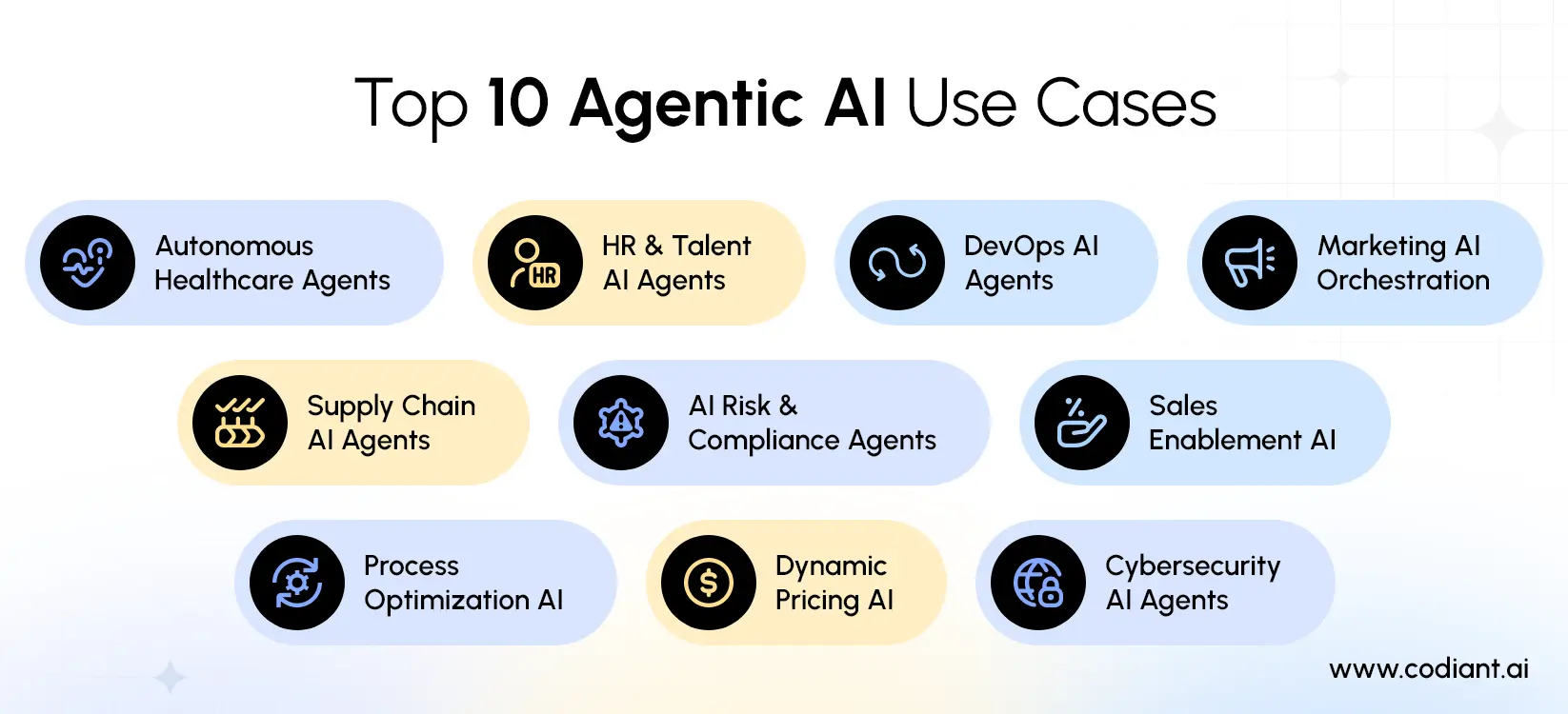
Here’s how agentic AI is creating impact across core business functions.
1. Agentic AI for Healthcare & Life Sciences
Agentic AI in healthcare works as a digital care coordinator that never sleeps. These agents continuously monitor patient records, diagnostic data, wearable inputs and clinical workflows to identify risks and gaps in care.
Instead of reacting to events, AI agents proactively manage outcomes by-
- Flagging abnormal vitals and test results in real time
- Scheduling follow-ups, diagnostics & care pathways automatically
- Assisting clinicians with treatment recommendations and documentation
In life sciences, agentic AI accelerates research by coordinating data analysis, trial monitoring and regulatory documentation. This reduces development timelines while improving compliance and patient safety.
2. Agentic AI for Finance, Risk & Compliance
Financial operations involve constant exposure to fraud, regulatory violations and market fluctuations. Agentic AI functions as an autonomous risk analyst that continuously evaluates financial activity.
These AI agents-
- Monitor transactions and user behavior for fraud patterns
- Validate compliance against evolving regulatory frameworks
- Generate audit trails and compliance reports automatically
When risks are detected, agents can pause transactions, escalate issues, or trigger corrective actions. This reduces manual reviews, improves regulatory confidence and strengthens financial resilience.
3. Agentic AI for HR Operations & Talent Management
HR teams are increasingly using agentic AI to move from administrative work to strategic workforce planning. AI agents track workforce data across recruitment, engagement, performance & learning systems.
Key capabilities include-
- Predicting attrition risks using behavioral and performance signals
- Automating candidate screening, interview coordination and evaluations
- Recommending personalized upskilling and internal mobility paths
The result is faster hiring, better retention and a more adaptive workforce aligned with business goals.
Read more: How Much Does AI App Development Cost?
4. Agentic AI for Software Development & DevOps
In engineering environments, agentic AI acts as an autonomous DevOps partner. These agents continuously observe code repositories, deployment pipelines, system performance & incident logs.
They can-
- Detect anomalies in builds and deployments
- Roll back releases or trigger automated fixes
- Optimize infrastructure usage and deployment schedules
By learning from past incidents and releases, agentic AI improves system reliability while allowing developers to focus on innovation rather than operational firefighting.
5. Agentic AI for Logistics & Supply Chain
Supply chains are highly sensitive to disruptions. Agentic AI introduces real-time adaptability by monitoring demand signals, inventory levels, supplier performance and logistics constraints.
AI agents autonomously-
- Adjust inventory allocation based on demand changes
- Reroute shipments during delays or disruptions
- Identify alternate suppliers and optimize fulfillment paths
This leads to lower operational costs, reduced delays and improved customer satisfaction across global supply networks.
6. Agentic AI for Sales Enablement & Lead Management
Agentic AI transforms sales from reactive follow-ups to intelligent deal orchestration. These agents analyze buyer intent signals across emails, websites, CRM systems & engagement tools.
They help sales teams by-
- Scoring and prioritizing leads automatically
- Triggering timely follow-ups and personalized outreach
- Forecasting pipeline health and deal conversion probabilities
Sales teams gain clarity on where to focus, while AI agents ensure no opportunity is missed.
7. Agentic AI for Cybersecurity Operations
Cybersecurity threats evolve faster than human response times. Agentic AI delivers continuous, autonomous protection across enterprise systems.
Security-focused AI agents-
- Monitor network traffic, access logs and user behavior
- Detect threats using behavioral and anomaly-based models
- Isolate compromised systems and initiate remediation
Over time, these agents learn from attack patterns, making enterprise security more proactive and resilient.
8. Agentic AI for Process Mining & Optimization
Most organizations struggle with hidden inefficiencies. Agentic AI agents analyze process data across systems to uncover how workflows actually function.
They enable-
- Identification of bottlenecks and redundant steps
- Simulation of process improvements before AI implementation
- Continuous optimization based on performance metrics
This creates a self-improving operational environment where efficiency gains compound automatically.
9. Agentic AI for Content Marketing & Campaign Orchestration
Marketing execution requires coordination across channels, content types & audiences. Agentic AI acts as a campaign manager that adapts in real time.
AI agents can-
- Plan content calendars and personalize messaging
- Launch and optimize campaigns across channels
- Reallocate budgets based on live performance data
Marketers move from manual execution to strategic oversight, while AI ensures campaigns stay relevant and effective.
10. Agentic AI for Dynamic Pricing & Yield Management
Pricing decisions are increasingly data-driven and time-sensitive. Agentic AI agents continuously analyze demand, competition, customer behavior & inventory levels.
They support businesses by-
- Adjusting prices dynamically in real time
- Testing pricing strategies and learning elasticity patterns
- Maximizing revenue while maintaining competitiveness
This is especially valuable in eCommerce, travel, energy & SaaS industries where pricing agility directly impacts profitability.
How Agentic AI Systems Differ from Traditional Automation
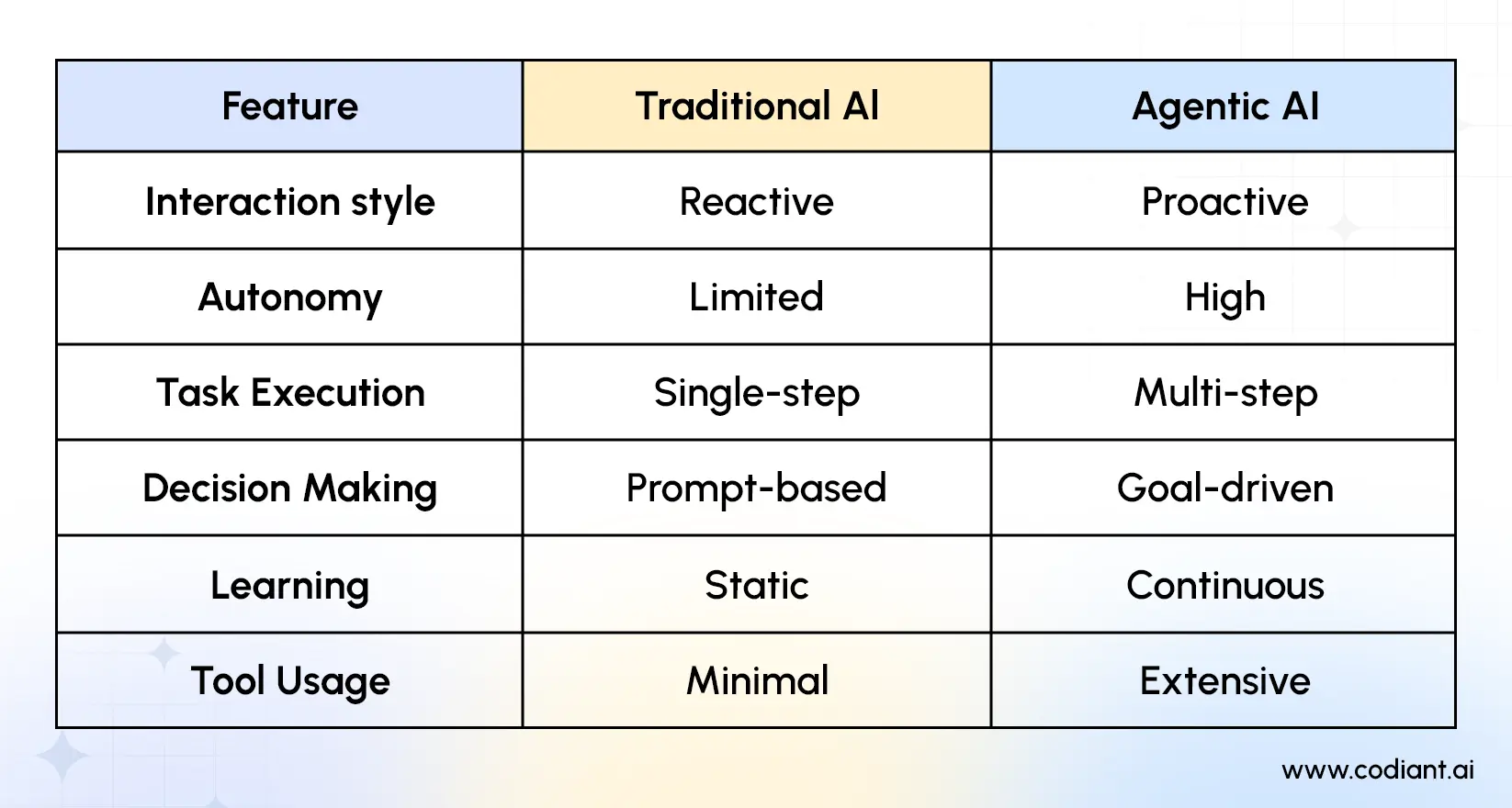
Traditional automation follows predefined rules. When conditions change, systems break.
Agentic AI systems, by contrast, operate with goals and constraints rather than fixed scripts. They evaluate context, make decisions & adjust actions dynamically.
This is why enterprise agentic AI scales better in complex environments. It doesn’t require constant reconfiguration to remain useful.
Build Agentic AI That Works Inside Real Enterprise Systems
Move beyond pilots with agent-based AI systems designed to integrate seamlessly with your ERP, CRM, and core platforms.
Which Industries Benefit Most from Agentic AI Adoption?
While agentic AI can be applied across sectors, industries with high complexity and operational scale see the fastest returns.
These include-
- Financial services
- Healthcare and life sciences
- Manufacturing and logistics
- Retail and eCommerce
- Telecommunications
- Energy and utilities
In each case, the value comes from managing variability, risk & coordination not just task execution.
Why Agentic AI Is Driving Enterprise ROI in 2026
Traditional automation delivered value by reducing manual effort. Agentic AI goes further by reducing decision latency, operational friction & coordination costs.
Large organizations generate massive amounts of signals data from ERP systems, customer interactions, supply chains, compliance logs & internal communications. Human teams struggle to process these signals in real time.
AI agents for enterprise ROI step into this gap by continuously interpreting signals, prioritizing actions & executing decisions that would otherwise stall or escalate.
Enterprises adopting autonomous AI agents report ROI in four primary ways-
- Lower operational costs
- Faster cycle times
- Reduced risk and error rates
- Improved customer and employee experience
Related reading: How to Build an Intelligent AI Model
How Codiant AI Helps Enterprises Turn Agentic AI into Measurable ROI?
Codiant AI works with enterprises that are past experimentation and ready to operationalize agentic AI systems across real business workflows. Our approach focuses on outcome-driven design, not standalone models. We help organizations identify high-ROI agentic AI use cases, architect secure agent-based systems & integrate them seamlessly into existing enterprise platforms.
Our teams bring deep experience in building enterprise agentic AI solutions that balance autonomy with governance, ensuring AI agents act with accountability, auditability & business alignment.
How Codiant AI supports your agentic AI journey:
- Identify and prioritize agentic AI use cases aligned with operational and financial KPIs
- Design agent-based AI systems that coordinate across ERP, CRM, data platforms & internal tools
- Build autonomous AI agents for enterprise workflows with human-in-the-loop controls
- Enable AI agents for operational efficiency through real-time decision orchestration
- Measure and optimize agentic AI ROI strategies with continuous performance monitoring
With Codiant AI, agentic AI becomes a scalable enterprise capability driving efficiency, resilience & sustained business value in 2026 and beyond.
Final Thoughts- Agentic AI as an Enterprise Capability, Not a Tool
Agentic AI is not another software layer. It is an operating capability.
Organizations that treat agentic systems as isolated tools will see limited results. Those that embed them into workflows, governance models & decision structures will unlock sustained enterprise ROI.
As we move deeper into 2026, autonomous AI agents in enterprise environments will increasingly define which organizations move faster, operate smarter & adapt better than their competitors.
The question is no longer if agentic AI belongs in the enterprise. It’s where it delivers the most value first.
Operationalize Agentic AI Without Disrupting Your Business
Deploy autonomous AI agents that improve decision-making, efficiency, and scale—while fitting cleanly into your existing enterprise workflows.
Frequently Asked Questions
Agentic AI works best for complex workflows with many decisions, frequent changes, cross-team coordination & ongoing data inputs, such as operations, finance, support & supply chains.
ROI is measured by tracking cost savings, faster cycle times, reduced errors, productivity gains, improved customer outcomes & operational stability before and after deploying agentic AI systems.
Enterprises need cloud or hybrid infrastructure, secure data access, APIs, monitoring tools, governance layers & integration with existing enterprise systems and workflows.
Agentic AI integrates through APIs, event triggers & data pipelines, allowing agents to read, act & coordinate across ERP, CRM, cloud & internal tools.
Strong governance includes role-based access, audit logs, human-in-the-loop controls, data privacy safeguards, compliance monitoring & clear accountability for AI-driven decisions.
Featured Blogs
Read our thoughts and insights on the latest tech and business trends
AI in Business Intelligence- The 2026 Roadmap to Data Dominance
- February 16, 2026
- AI-Powered Data Analytics
Business intelligence was built to bring clarity to complex businesses. Dashboards, reports, KPIs and scorecards were meant to help leaders see what was happening and make informed choices. In practice, most BI systems still focus... Read more

Top 20 Generative AI Development Companies in the USA (2026)
- February 9, 2026
- Generative AI
Generative AI is no longer something companies “try out.” In 2026, it is something they depend on. US businesses now use generative AI to build products faster, automate everyday work, and make better decisions. AI... Read more
How to Choose the Right AI Consulting Company in Australia
- February 5, 2026
- Artificial Intelligence
For many Australian businesses, AI has moved from “interesting” to unavoidable. Boards are asking about it. Competitors are deploying it. Customers are beginning to expect smarter, faster, more personalized experiences. But here’s the uncomfortable truth:... Read more