Agentic AI vs Generative AI- The Detailed Comparison Guide
Table of Contents
Subscribe To Our Newsletter
In the past several years artificial intelligence has grown rapidly. Initially, the bulk of conversations was always about Generative AI tools that could write content, create images, summarize reports or generate code within seconds.
But a new term is gaining traction throughout the enterprise AI ecosystem.
It’s called Agentic AI.
Companies that once used A.I. to supplement humans are now investigating systems that can take actions, make decisions and execute multi-step tasks without human help.
This change has sparked a new discussion in the field of AI:
The Difference Between Agentic AI and Generative AI – Why It Matters for Businesses
Both technologies are powerful. Both are transforming industries. But they fulfill very different roles.
Generative AI concerned itself with information production. Agentic AI, on the other hand, is about execution and decision-making.
Understanding the difference is critical for companies planning their AI strategy.
In this guide, we will explore:
- Agentic AI explained in simple terms
- Generative AI vs AI agents
- Key differences between the two technologies
- Real-world enterprise applications
- How businesses are combining them
- And why enterprise agentic AI systems may define the future of automation
Let’s break it down.
Generative AI vs AI Agents- The Core Difference
When comparing generative AI vs AI agents, the difference becomes clear when we look at their fundamental capabilities.
| Capability | Generative AI | Agentic AI |
| Main Function | Creates content and insights | Executes tasks and decisions |
| User Interaction | Prompt-based responses | Goal-driven autonomous actions |
| Workflow Management | Limited | Multi-step workflow automation |
| Decision Making | Minimal | Context-aware decisions |
| Enterprise Usage | Content generation and knowledge support | Operational automation |
In simple terms:
Generative AI produces information.
Agentic AI performs actions.
This distinction explains the growing interest in enterprise AI automation solutions built around AI agents.
Organizations are moving beyond content generation toward AI-driven operations.
Build Intelligent AI Systems for Your Business
Discover how agentic AI and generative AI can automate workflows, improve decisions, and accelerate enterprise innovation.
Difference Between Agentic AI and Generative AI in Enterprise Systems
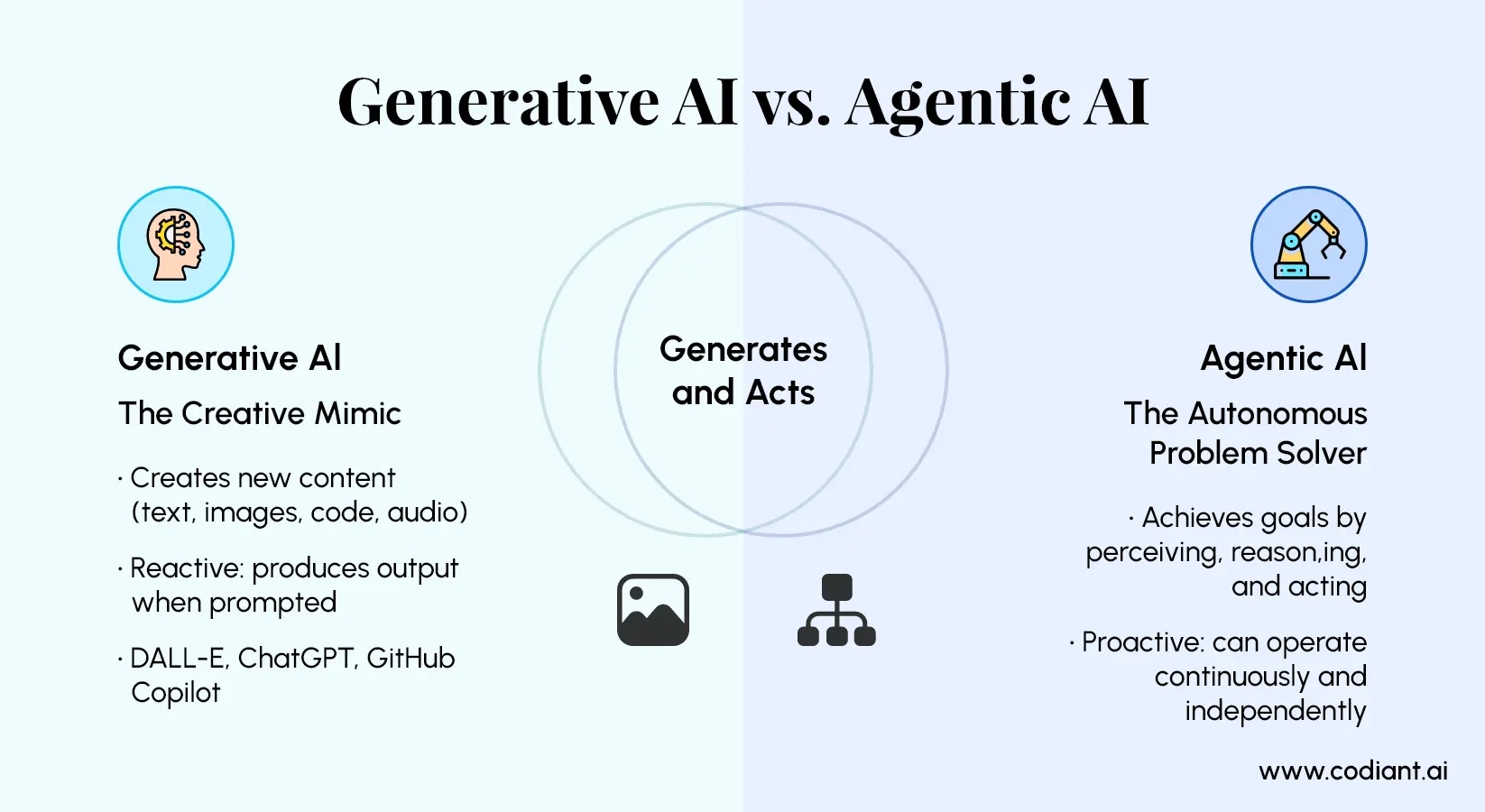
To understand the difference between agentic AI and generative AI, it helps to look at how enterprises deploy them.
Generative AI in Enterprises
Generative AI acts as a productivity accelerator.
It helps employees work faster and smarter by generating information.
Examples include:
- Marketing teams using AI to draft campaign content
- Developers generating code snippets
- Analysts summarizing financial reports
- Customer support teams drafting responses
These generative AI applications in enterprises improve efficiency but still require human oversight and decision-making.
Agentic AI in Enterprises
Agentic AI takes a different role.
Instead of assisting humans, it automates entire workflows.
For example:
An enterprise AI agent might-
- Monitor sales data
- Detect declining conversion rates
- Run A/B test experiments
- Adjust campaign targeting
- Generate performance reports
Without constant human involvement.
This is why enterprise agentic AI systems are increasingly used for-
- Operational automation
- Intelligent process management
- Autonomous digital assistants
- AI-driven decision support systems
Agentic AI Explained – What It Really Means
Before comparing the two, it’s important to understand agentic AI explained in simple terms.
Agentic AI refers to AI systems that act as autonomous agents capable of planning, decision-making & executing tasks with minimal human intervention.
Unlike traditional AI tools that respond to prompts, agentic systems operate with goals and workflows.
Think of it like this.
A generative AI tool might help write an email.
An AI agent, on the other hand, could:
- Read incoming emails
- Analyze intent
- Draft a response
- Send the reply
- Update CRM records
- Schedule meetings
All automatically.
That’s why many experts describe agentic AI as AI that doesn’t just think it acts.
Enterprise organizations are already experimenting with enterprise agentic AI systems to automate operations such as:
- Customer support workflows
- Sales pipeline management
- IT incident response
- Logistics planning
- Data analysis and reporting
In short, agentic AI moves artificial intelligence from assistance to execution.
What Is Generative AI?
Generative AI became mainstream with tools like large language models and AI image generators.
These systems are trained on massive datasets and can produce new content based on patterns learned during training.
Common outputs include:
- Written content
- Images and graphics
- Code
- Music
- Product descriptions
- Reports
- Marketing copy
Today, generative AI applications in enterprises are expanding rapidly.
Companies use generative AI to:
- Draft emails and documents
- Generate marketing content
- Summarize long reports
- Create product descriptions
- Assist software developers with code
- Build customer chatbots
Unlike agentic systems, generative AI does not autonomously execute tasks.
It responds to prompts.
You ask. It generates.
This makes generative AI incredibly useful for content creation, research, and productivity assistance.
But it does not manage workflows or perform actions independently.
Read more: 10 Agentic AI Use Cases Powering Enterprise ROI in 2026
Industries Where Agentic AI Is Used
1. Healthcare
Healthcare organizations are exploring enterprise agentic AI systems to streamline clinical workflows, administrative tasks, and patient management processes.
- Automating appointment scheduling and patient triage
- Monitoring medical data for anomaly detection
- Supporting diagnostic decision workflows
These systems help hospitals reduce operational burden while improving patient care efficiency and response time.
2. Financial Services
Banks and financial institutions use agentic AI use cases in business to automate risk management, compliance monitoring, and transaction analysis.
- Fraud detection and anomaly monitoring
- Automated loan assessment workflows
- Real-time financial reporting automation
Agentic systems help financial teams manage high-volume data while improving accuracy and regulatory compliance.
3. Retail & E-commerce
Retail companies are deploying enterprise AI automation solutions to optimize inventory management, pricing strategies, and customer engagement.
- Automated inventory forecasting
- Dynamic pricing adjustments
- AI-driven order fulfillment coordination
Agentic AI helps retailers manage large product catalogs, customer demand patterns, and operational workflows with greater speed and efficiency.
4. Manufacturing
Manufacturing companies benefit from agentic systems that monitor production environments and automate operational decisions.
- Predictive maintenance scheduling
- Supply chain coordination
- Production planning optimization
These AI systems analyze real-time operational data and trigger actions that prevent downtime and improve overall manufacturing productivity.
5. Logistics & Supply Chain
Logistics firms use enterprise agentic AI systems to manage shipping operations, warehouse coordination, and route optimization.
- Autonomous shipment tracking workflows
- Intelligent route planning and fuel optimization
- Warehouse inventory automation
Agentic AI enables logistics companies to handle complex global supply chains with faster decision-making and operational visibility.
6. Customer Service & Support
Customer experience teams deploy AI agents vs generative AI tools to manage high volumes of support interactions efficiently.
- Automated ticket resolution workflows
- Intelligent query classification and routing
- Self-service support systems
Agentic AI helps businesses respond faster to customer inquiries while reducing support team workload.
7. Human Resources & Recruitment
HR departments are implementing agentic AI use cases in business to improve hiring workflows and workforce management.
- Resume screening and candidate evaluation
- Automated interview scheduling
- Workforce analytics and reporting
Agentic AI helps HR teams streamline recruitment processes and identify top talent faster in high-volume hiring environments.
8. IT Operations & Cybersecurity
IT teams deploy enterprise AI automation solutions powered by agentic systems to monitor infrastructure and manage incidents.
- Automated anomaly detection in systems
- Real-time threat response and mitigation
- Intelligent infrastructure monitoring
Agentic AI strengthens cybersecurity and ensures enterprise platforms remain reliable and secure.
Ready to Deploy AI Agents in Your Business?
See how enterprise agentic AI systems automate operations, reduce manual work, and unlock new productivity levels.
AI Agents vs Generative AI Tools
Another way to frame the comparison is AI agents vs generative AI tools.
Generative AI tools are like creative assistants.
They help you write, design, brainstorm, or analyze information.
Examples include:
- AI writing tools
- Image generation platforms
- Code generation assistants
- AI research assistants
AI agents, however, behave more like digital employees.
They are designed to complete tasks, interact with systems & execute workflows.
For example:
An AI agent could-
- Process invoices automatically
- Manage inventory updates
- Handle customer ticket resolution
- Trigger alerts when anomalies occur
That’s a major leap from traditional AI tools.
Agentic AI Use Cases in Business
The number of agentic AI use cases in business is expanding rapidly as companies experiment with autonomous systems.
Some of the most promising applications include:
1. Intelligent Customer Support
AI agents can manage customer inquiries end-to-end. They can understand issues, retrieve information, generate responses, and escalate cases when needed. This reduces support workload and improves response times.
2. Autonomous IT Operations
In IT environments, agentic systems monitor infrastructure, detect anomalies, and resolve incidents automatically. These capabilities are becoming essential for enterprise AI automation solutions that support large digital platforms.
3. AI-Powered Sales Operations
Sales teams are using AI agents to:
- Qualify leads
- Schedule meetings
- Send follow-up emails
- Track pipeline changes
This allows sales representatives to focus on relationship building rather than administrative tasks.
4. Supply Chain Optimization
AI agents can analyze inventory data, shipping delays, and demand forecasts to adjust logistics operations automatically. Large retailers and logistics firms are already exploring these systems.
5. Financial Operations Automation
Finance teams can deploy agentic AI systems to monitor transactions, detect anomalies, and generate compliance reports. This reduces manual work and improves operational visibility.
Generative AI Applications in Enterprises
While agentic systems automate operations, generative AI applications in enterprises remain essential for knowledge work.
Here are some of the most common enterprise uses.
1. Marketing Content Creation
Generative AI helps marketing teams produce-
- Blog posts
- Ad copy
- social media captions
- product descriptions
This significantly accelerates content production.
2. Software Development Assistance
Developers increasingly rely on generative AI tools to-
- Generate code snippets
- Debug issues
- Document software functions
This improves productivity across engineering teams.
3. Business Intelligence and Reporting
Generative AI can summarize complex datasets and generate insights in plain language. Executives can quickly understand performance trends without manually analyzing spreadsheets.
4. Knowledge Management
Organizations use generative AI to search internal documents and generate contextual answers from knowledge bases. This improves internal productivity and decision-making.
Enterprise AI Automation Solutions – Combining Both Technologies
The most powerful enterprise AI systems are not choosing between these technologies.
They combine them.
Modern enterprise AI automation solutions often integrate-
- Generative AI for reasoning and content creation
- Agentic AI for decision-making and execution
For example:
A marketing AI system could-
- Use generative AI to draft campaign copy
- Deploy AI agents to schedule posts
- Monitor engagement analytics
- Automatically optimize campaign targeting
Similarly, a customer support system might use generative AI to write responses while agentic AI manages ticket workflows. This hybrid model is quickly becoming the standard architecture for advanced AI platforms.
The Future of Agentic AI Systems
Many experts believe the future of agentic AI systems will reshape how organizations operate. Instead of employees manually managing every workflow, companies will deploy networks of AI agents capable of handling large parts of business operations.
These agents will collaborate with humans and other AI systems to complete tasks efficiently.
Key developments expected in the coming years include:
- Multi-agent collaboration frameworks
- AI agents that learn from feedback
- Autonomous business operations platforms
- Real-time decision-making systems
Large enterprises are already investing heavily in these capabilities. In many ways, agentic AI represents the next stage of AI evolution.
Related reading: Top 20 Generative AI Development Companies in the USA for 2026
Agentic AI vs Generative AI- Final Thoughts
The debate around agentic AI vs generative AI is not about which technology is better. It’s about understanding their roles.
Generative AI excels at creating information.
Agentic AI excels at executing workflows and automating tasks.
Together, they form the foundation of modern enterprise AI systems.
Companies that combine these technologies effectively will unlock:
- faster decision making
- smarter automation
- improved operational efficiency
- scalable digital transformation
The future of AI is not just intelligent tools. It’s intelligent systems that think, act & collaborate with humans. And that future is already taking shape.
Turn AI Ideas into Real Enterprise Solutions
Explore enterprise AI automation solutions built with AI agents, generative AI models, and scalable infrastructure.
Frequently Asked Questions
Agentic AI systems are designed to plan, make decisions & execute tasks autonomously. They can analyze context, manage workflows, interact with software systems & perform multi-step operations without constant human guidance.
Generative AI models are trained on massive datasets and learn patterns in language, images & code. When prompted, they generate new content by predicting the most relevant outputs based on those patterns.
Businesses should deploy agentic AI when the goal is to automate workflows or manage complex processes. Generative AI is better suited for tasks like writing, summarizing information, or generating ideas.
Organizations typically require cloud infrastructure, data pipelines, workflow orchestration systems, APIs & secure AI models. Integration with enterprise software such as CRM, ERP & analytics platforms is also essential.
Companies can integrate generative AI for reasoning, content creation & analysis, while agentic AI manages automation and task execution. Together they enable intelligent enterprise automation platforms capable of both thinking and acting.
Featured Blogs
Read our thoughts and insights on the latest tech and business trends
Implementing Agentic RAG in Enterprises: Architecture, Challenges & ROI
- April 2, 2026
- Artificial Intelligence
In 2026, enterprises are no longer satisfied with static AI responses or generic large language model outputs. The demand has shifted toward systems that can think, retrieve, act and refine responses dynamically this is where... Read more
Enterprise AI Development Partner Checklist- What CTOs Should Evaluate Before Hiring
- March 27, 2026
- Artificial Intelligence
AI is no longer an experiment sitting in innovation labs. It’s driving revenue, optimizing operations, and shaping how enterprises compete. But here’s the real challenge choosing the right enterprise AI development partner. Because the difference... Read more
How to Use AI for Predictive Analytics- A Complete Practical Guide
- March 6, 2026
- AI-Powered Data Analytics
Predictive analytics is not new, it’s been around for decades, however its capabilities have changed very fundamentally with the arrival of AI. Classical statistical models were based on small data, assumptions that could not be altered, and... Read more