How to Use AI for Predictive Analytics: A Complete Practical Guide
Table of Contents
Subscribe To Our Newsletter
Predictive analytics is not new, it’s been around for decades, however its capabilities have changed very fundamentally with the arrival of AI.
Classical statistical models were based on small data, assumptions that could not be altered, and manual interpretation. Fast forward to the present and AI predictive analytics enables organisations to process huge datasets, unpick subtle trends and produce predictions that only get better with time.
Whether you’re predicting demand, detecting fraud, forecasting customer attrition, or planning and scheduling a workforce of analysts that are working towards these end goals, AI-based predictive analytics is a mission critical decision-making tool from one industry to the next.
This blog describes how AI is applied for predictive analytics, what kind of data is necessary, accuracy of AI powered prediction and how organization can apply such systems responsibly and smartly.
What Is AI Predictive Analytics?
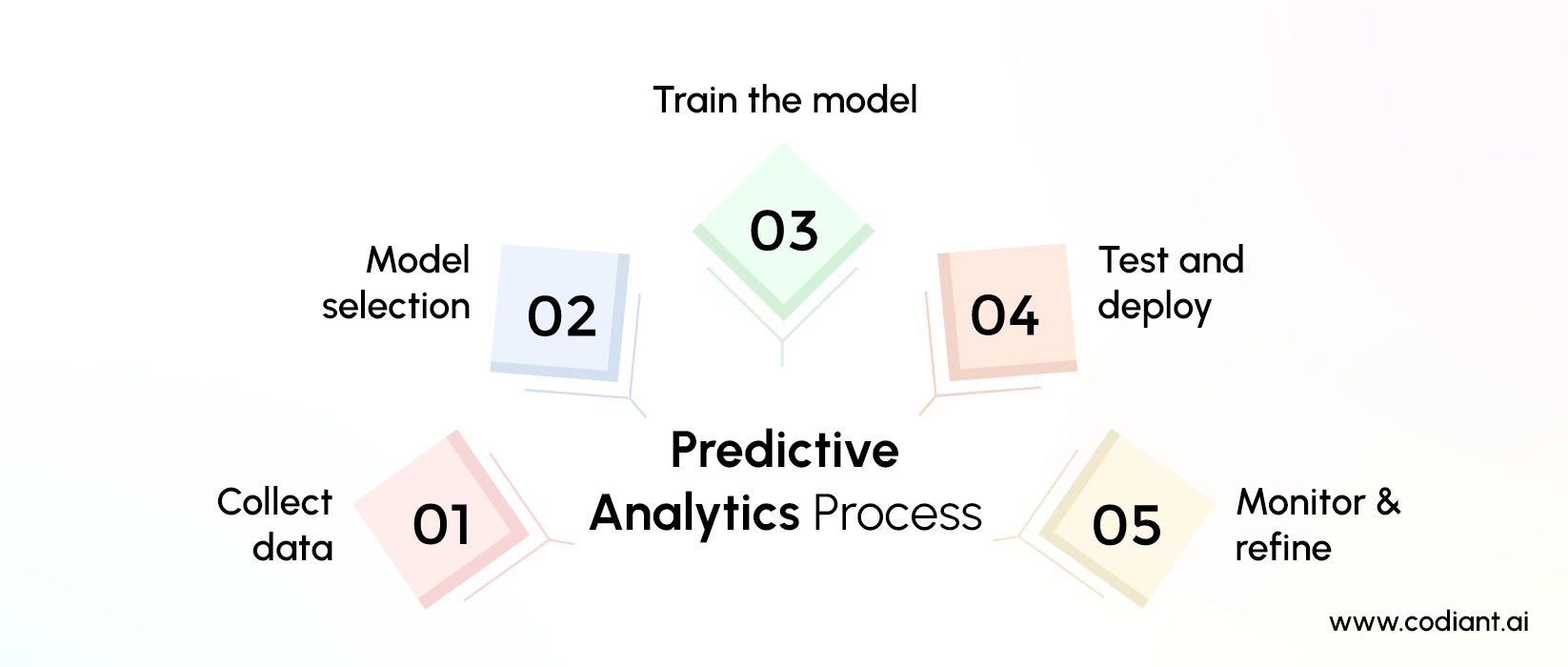
AI predictive analytics is the practice of using artificial intelligence and machine learning algorithms to analyze historical & real-time data in order to predict future outcomes. Unlike traditional analytics which focuses on describing what already happened, predictive analytics looks ahead.
What makes AI-driven approaches different is their ability to:
- Learn patterns automatically without fixed rules
- Adapt when data trends shift
- Process large, complex datasets
- Improve accuracy over time
In simple terms, predictive modeling with AI allows systems to answer forward-looking questions such as:
- What will demand look like next quarter?
- Which customers are most likely to churn?
- Where are operational risks likely to appear?
Rather than relying on assumptions AI models’ base predictions on data-driven evidence.
Turn Predictive Insights into Business Advantage
Discover how AI-driven predictive analytics can improve forecasts, reduce risk, and strengthen smarter decision-making across operations.
How Is AI Used in Predictive Analytics?
Understanding how AI works in predictive analytics helps businesses use it the right way. Instead of using fixed rules or one-time reports, AI brings automation, learning, and flexibility to every step.
AI systems do not just analyze data once. They keep learning from new information and improve predictions over time. This makes predictive analytics more useful in real business situations.
1. Data Collection and Integration
AI is first used to collect and combine data automatically. AI data analytics systems pull information from many sources at the same time.
These sources include:
- Sales and billing systems
- Customer records and support data
- Financial and operational systems
- External data like market trends, weather, or population data
AI-powered data pipelines:
- Collect data continuously, not just once
- Handle both text and numbers
- Reduce manual work and human errors
By doing this, AI creates one clean and updated data base that predictive models can trust.
2. Data Preparation and Feature Engineering
Raw data is often messy. It can have missing values, repeated records, or unnecessary details. AI helps clean and organize this data automatically.
AI tools:
- Fix missing or incorrect values
- Remove duplicate data
- Standardize formats
AI also helps find the most important information, called features. Instead of choosing these manually, AI studies patterns to decide what matters most.
Examples include:
- How often customers buy
- How users interact across apps or websites
- Seasonal changes in demand
Better features help machine learning predictive analytics produce more accurate results.
3. Model Training and Learning
AI is used to train machine learning models using past data. The model learns how different data points are connected to outcomes.
During training, AI models learn things like:
- Which customer actions show a risk of leaving
- Early signs of machine or system failure
- How demand changes by location or time
The model studies large amounts of data and slowly improves its understanding, making predictions more accurate over time.
4. Prediction Generation and Scoring
Once trained, the AI model can make predictions using new data. This is where predictive analytics becomes useful in daily work.
Predictions can include:
- Risk scores that show how likely something is to happen
- Number forecasts such as expected sales
- Yes or no decisions like approval or rejection
Because AI works fast, these predictions can be shown in dashboards, sent as alerts, or used in automated systems.
5. Continuous Model Improvement
One of the biggest strengths of AI in predictive analytics is continuous learning. AI models do not stay the same forever.
As new data comes in:
- Models retrain automatically
- Predictions stay accurate
- Systems adjust to new behavior and trends
This ability to learn and adapt makes AI-based forecasting more reliable than traditional analytics methods.
Benefits of AI-Powered Predictive Analytics for Businesses
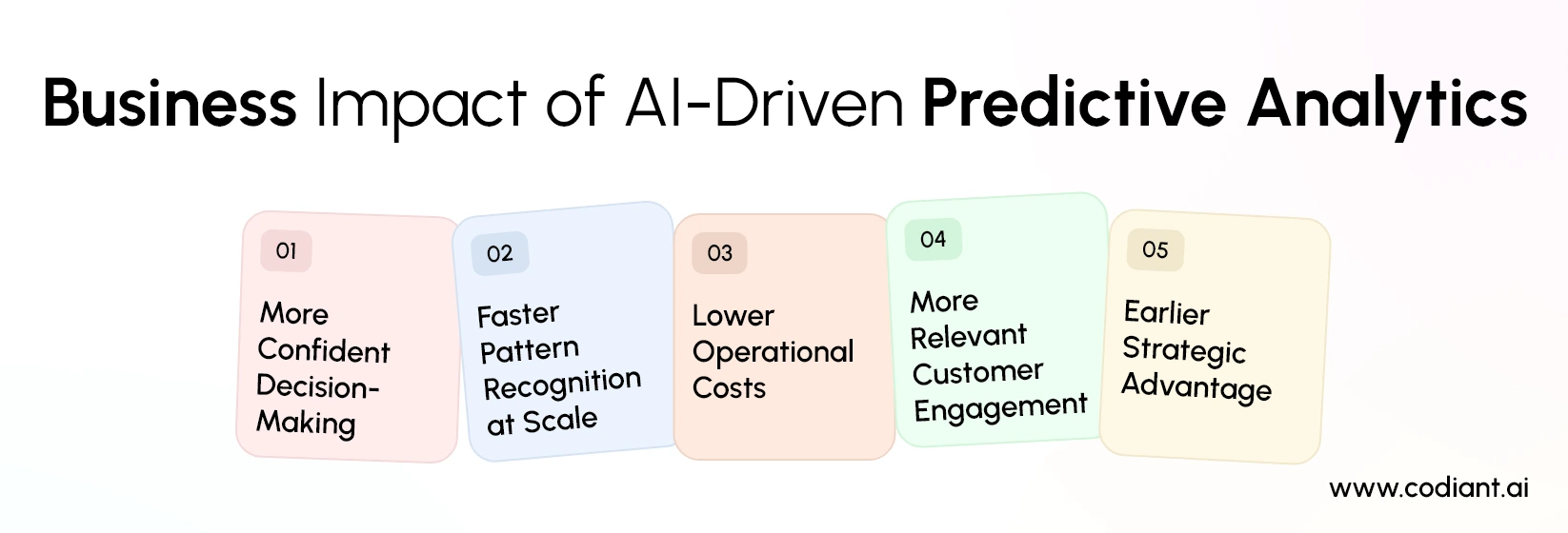
Businesses use predictive analytics not only to be accurate, but to make smarter decisions ahead of time. Here are the main benefits.
- Better Decision-Making: AI studies large amounts of data that people cannot review manually. This helps businesses make decisions based on facts, not guesses.
- Faster Insights: AI systems analyze data quickly, even when the data is very large. This allows businesses to react faster to changes and risks.
- Lower Costs and Better Efficiency: By predicting problems early, AI helps reduce waste, avoid breakdowns, and save money across operations.
- Improved Customer Experience: AI predicts what customers may need or want. This helps businesses offer more personalized services and keep customers engaged.
- Stronger Competitive Advantage: Businesses using AI forecasting can spot opportunities and risks early, helping them stay ahead of competitors.
How to Implement Predictive Analytics Using AI- Step-by-Step?
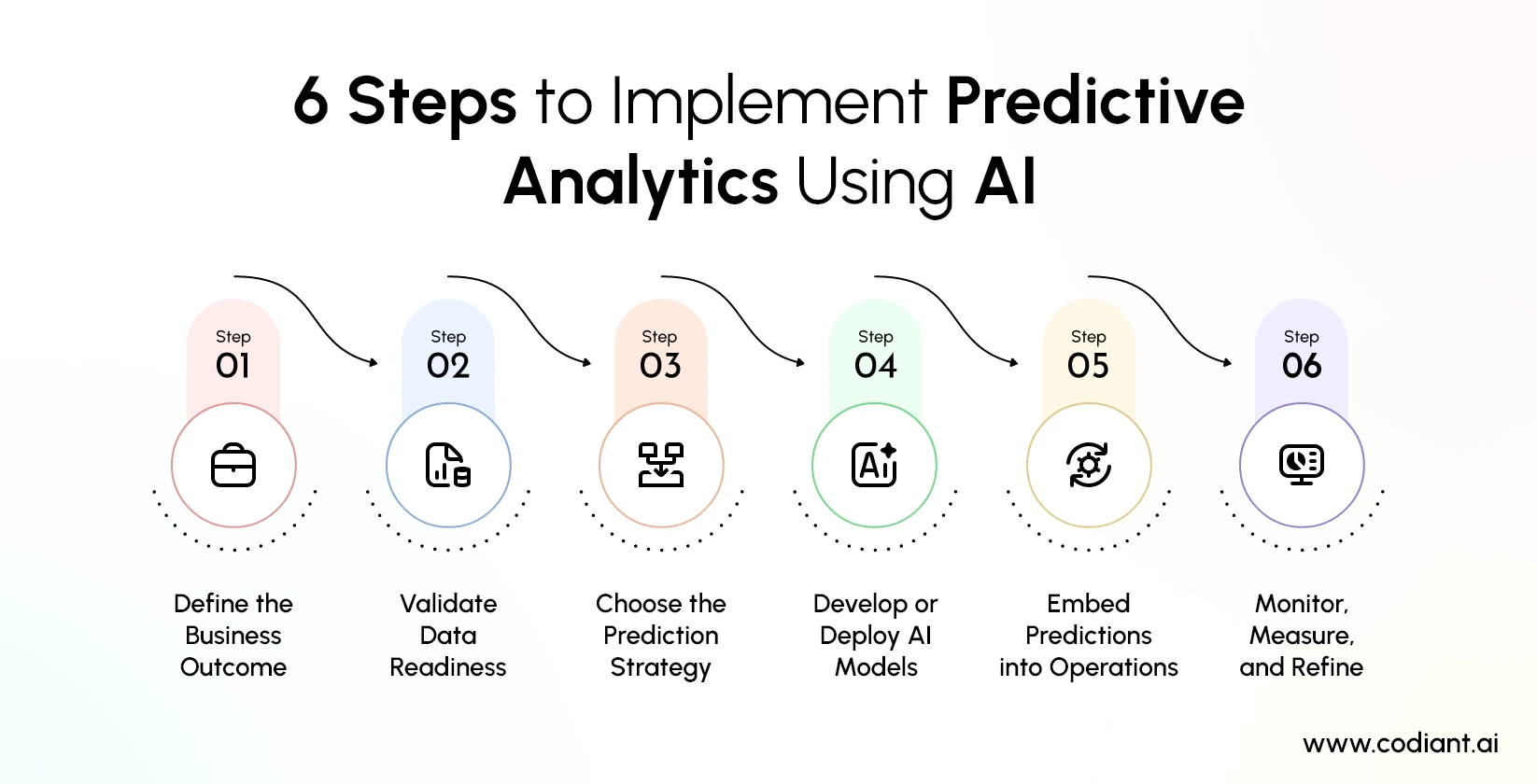
Using AI for predictive analytics is not just about technology. It is a step-by-step process that connects business goals, data quality, model choice, and daily use. When each step is done properly, predictions become useful for real business decisions.
Step 1: Define Clear Business Objectives
Every AI predictive analytics project should start with a clear goal. Avoid vague goals like “use AI for insights.” Instead, focus on what you want to improve or fix.
Examples include:
- Reduce customer churn by a set percentage
- Improve how accurately you predict demand
- Find risky transactions earlier
- Plan inventory or staff more effectively
Clear goals define the required data, model, and success metrics while helping teams align on AI data analytics for businesses.
Step 2: Assess Data Readiness
AI learns from data, so good data is very important. Before building any model, check if your data is ready.
Things to review include:
- Is data available from all needed systems?
- Is the data complete and consistent?
- Do you have enough past data for training?
- Are there rules for data access and usage?
Fixing data issues early helps avoid wrong or confusing predictions later.
Step 3: Select the Right Prediction Approach
Different problems need different types of predictions. Choosing the right method helps the model give useful results.
Common approaches include:
- Forecasting, to predict future numbers like sales or demand
- Classification, to group outcomes like churn or fraud
- Risk scoring, to estimate how likely something is to happen
The right approach makes models easier to build and understand.
Step 4: Build or Deploy Models
Companies can use ready-made models or create their own, depending on the problem.
Pre-built models work well for common needs like predicting churn or demand. Custom models are better when business rules or data are unique.
At this stage, teams work on:
- Training and testing models
- Choosing the right data features
- Checking accuracy and performance
The aim is to build models that are accurate, stable, and easy to maintain.
Step 5: Operationalize Predictions
Predictions are useful only when people act on them. This step focuses on using predictions in daily work.
Common ways include:
- Dashboards for teams to view results
- Alerts for high-risk situations
- Automatic actions like system triggers or recommendations
This helps turn predictions into real actions.
Step 6: Monitor Performance and Improve Continuously
AI models must be checked often to make sure they stay accurate over time.
Ongoing checks include:
- Watching prediction accuracy
- Finding errors or bias in results
- Measuring if business goals are being met
Regular updates and retraining help keep predictive analytics useful as data changes.
Build Predictive Analytics That Actually Works
Get expert guidance to design, deploy and scale AI-powered predictive models tailored to real business needs.
What Data Is Needed for AI Predictive Analytics?
The quality of predictions depends heavily on the quality and relevance of data. AI predictive analytics does not require “perfect” data, but it does require the right types of data.
- Historical Data: Past records are essential for training models. This can include sales data, user behavior logs, operational metrics, or historical outcomes relevant to the prediction goal.
- Real-Time or Near Real-Time Data: Streaming data enables models to update predictions dynamically, especially in industries like finance, logistics and healthcare.
- Structured Data: Examples include databases, spreadsheets and transaction systems with consistent formats.
- Unstructured Data: Text, images, audio & sensor data can also be used when supported by appropriate AI techniques.
- Contextual and External Data: Market trends, economic indicators, weather data, or demographic information often enhance prediction accuracy.
The key is data relevance. More data is not always better; the data must reflect the problem being predicted.
How Accurate Is AI-Based Predictive Analytics?
Accuracy is one of the most common concerns surrounding AI predictive analytics. While AI models often outperform traditional methods, accuracy depends on several factors.
- Data Quality: Incomplete, biased, or outdated data reduces predictive reliability.
- Model Selection: Different algorithms perform better for different use cases. Choosing the wrong model can distort results.
- Feature Engineering: The variables selected for training significantly impact outcomes. AI assists with feature discovery, but human oversight remains critical.
- Environmental Stability: Predictions are more accurate in stable environments. Rapidly changing conditions require frequent retraining.
- Evaluation and Validation: Regular testing against real outcomes ensures predictions remain aligned with reality.
In practice, artificial intelligence for forecasting should be viewed as probabilistic guidance, not absolute certainty. Its strength lies in improving decision confidence, not eliminating uncertainty.
Which Industries Use AI Predictive Analytics the Most?
AI predictive analytics is industry-agnostic, but some sectors have adopted it more aggressively due to data availability and operational complexity.
1. Finance and Banking
Used for fraud detection, credit risk assessment, market forecasting & customer behavior analysis.
2. Healthcare
Applied to patient risk prediction, disease progression modeling, resource allocation & preventive care planning.
3. Retail and E-Commerce
Enables demand forecasting, inventory optimization, price prediction & personalized recommendations.
4. Manufacturing
Supports predictive maintenance, quality control, supply chain forecasting & production optimization.
5. Logistics and Transportation
Used to predict delivery times, route optimization, fuel consumption & fleet maintenance needs.
6. Marketing and Sales
Drives lead scoring, churn prediction, campaign performance forecasting & customer lifetime value modeling.
Common Predictive Analytics Tools and Technologies
Modern predictive analytics tools combine AI frameworks, data platforms & visualization layers. These tools typically include-
- Machine learning libraries and frameworks
- Data processing and analytics platforms
- Model training and deployment environments
- Monitoring and performance tracking systems
- Visualization and reporting dashboards
Businesses often build custom solutions tailored to their data and workflows, rather than relying solely on off-the-shelf tools.
Challenges and Limitations of AI Predictive Analytics
AI predictive analytics offers many benefits, but it also has some limits that businesses must understand.
- Data Bias: If the data used to train the AI is biased, the predictions will also be biased. This can lead to unfair or incorrect results.
- Hard to Explain Results: Some AI models work like black boxes. This means it can be difficult to explain why a certain prediction was made.
- Overfitting Problems: Sometimes models perform very well on old data but fail when used in real situations. This happens if they are not tested properly.
- System Integration Issues: Adding predictive insights into existing systems takes planning. Tools must work well with current software and processes.
- Ethical and Legal Concerns: Data privacy, transparency, and responsibility are important, especially in industries with strict rules and regulations.
AI predictive analytics is not a one-time setup. It needs regular updates, monitoring, and improvement over time.
Final Thoughts
Predictive analytics using AI has shifted forecasting from static reports to dynamic intelligence systems. When implemented responsibly, it enables businesses to anticipate change, reduce risk & make informed decisions grounded in real data.
Rather than replacing human judgment, predictive modeling with AI strengthens it by revealing patterns that would otherwise remain hidden. For organizations willing to invest in data, governance & long-term learning, AI predictive analytics is no longer optional—it is foundational to sustainable growth.
Make Predictive Analytics Enterprise-Ready
Design scalable, secure and explainable AI-powered predictive analytics built for enterprise data and governance needs.
Frequently Asked Questions
Traditional analytics explains past data, while AI predictive analytics learns patterns automatically to forecast future outcomes with higher accuracy reliably.
Implementation time depends on data readiness and scope, but most AI predictive analytics solutions take a few weeks to months.
Common machine learning models include regression, decision trees, random forests, gradient boosting & neural networks for predictive analytics use cases.
Yes, AI predictive analytics can integrate with existing business systems like CRM, ERP, data warehouses & operational platforms securely easily.
Key challenges include poor data quality, lack of skills, model explainability issues, integration complexity & organizational resistance to change adoption.
Featured Blogs
Read our thoughts and insights on the latest tech and business trends
RAG vs Fine-Tuning: Which Approach Is Right for Your Enterprise AI Knowledge System?
- September 24, 2026
- Artificial Intelligence
Retrieval-Augmented Generation (RAG) and fine-tuning are the two primary methods for customizing a Large Language Model (LLM) with an enterprise's own knowledge. RAG connects a general-purpose LLM to an external knowledge base at query time,... Read more
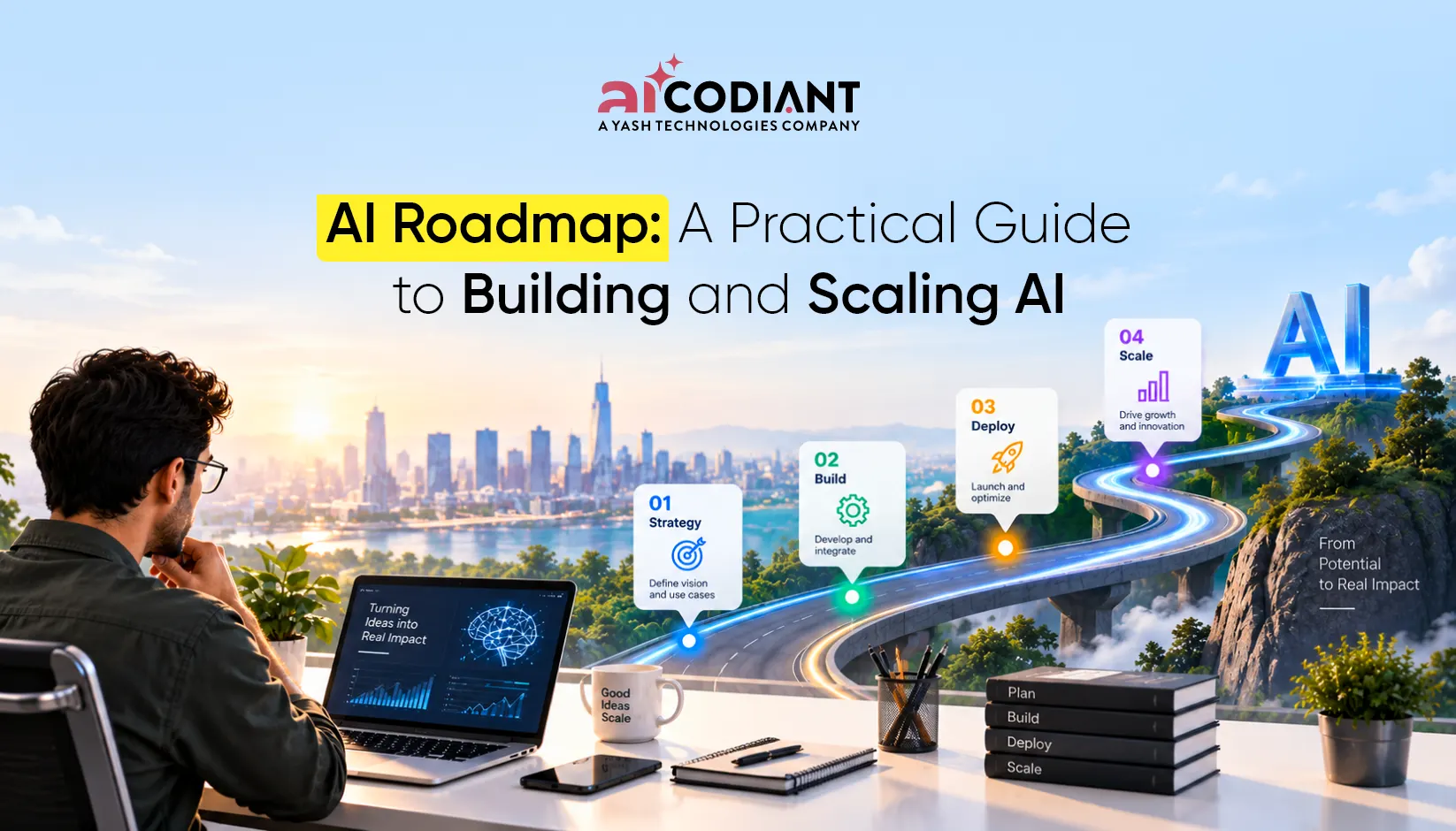
AI Roadmap: How to Build and Scale AI Across the Enterprise
- September 17, 2026
- Artificial Intelligence
An AI roadmap is a structured plan that connects business priorities with AI use cases, data, technology, governance, people, implementation, and measurable outcomes. For enterprises, it provides the sequence for moving from AI opportunities and... Read more

Top Predictive Analytics Models and Algorithms to Know
- September 11, 2026
- Artificial Intelligence
Predictive analytics models are statistical and machine learning systems that use historical data to forecast future outcomes, such as customer churn, equipment failure, demand spikes, or credit risk. The most widely used categories are regression... Read more