What is NLP? Use Cases & Applications (2026 Guide)
Table of Contents
Subscribe To Our Newsletter
You’ve already used NLP today. Maybe you asked Google a question. Maybe you dictated a WhatsApp message. Maybe a chatbot solved your issue faster than a human ever could.
None of that works without Natural Language Processing (NLP).
And in 2026, NLP is no longer a “feature” sitting inside AI. It’s the layer that decides whether your product feels intelligent… or frustrating.
Let’s unpack what NLP really is, how it works, and why businesses are quietly reorganizing around it.
What is NLP? (Natural Language Processing Explained)
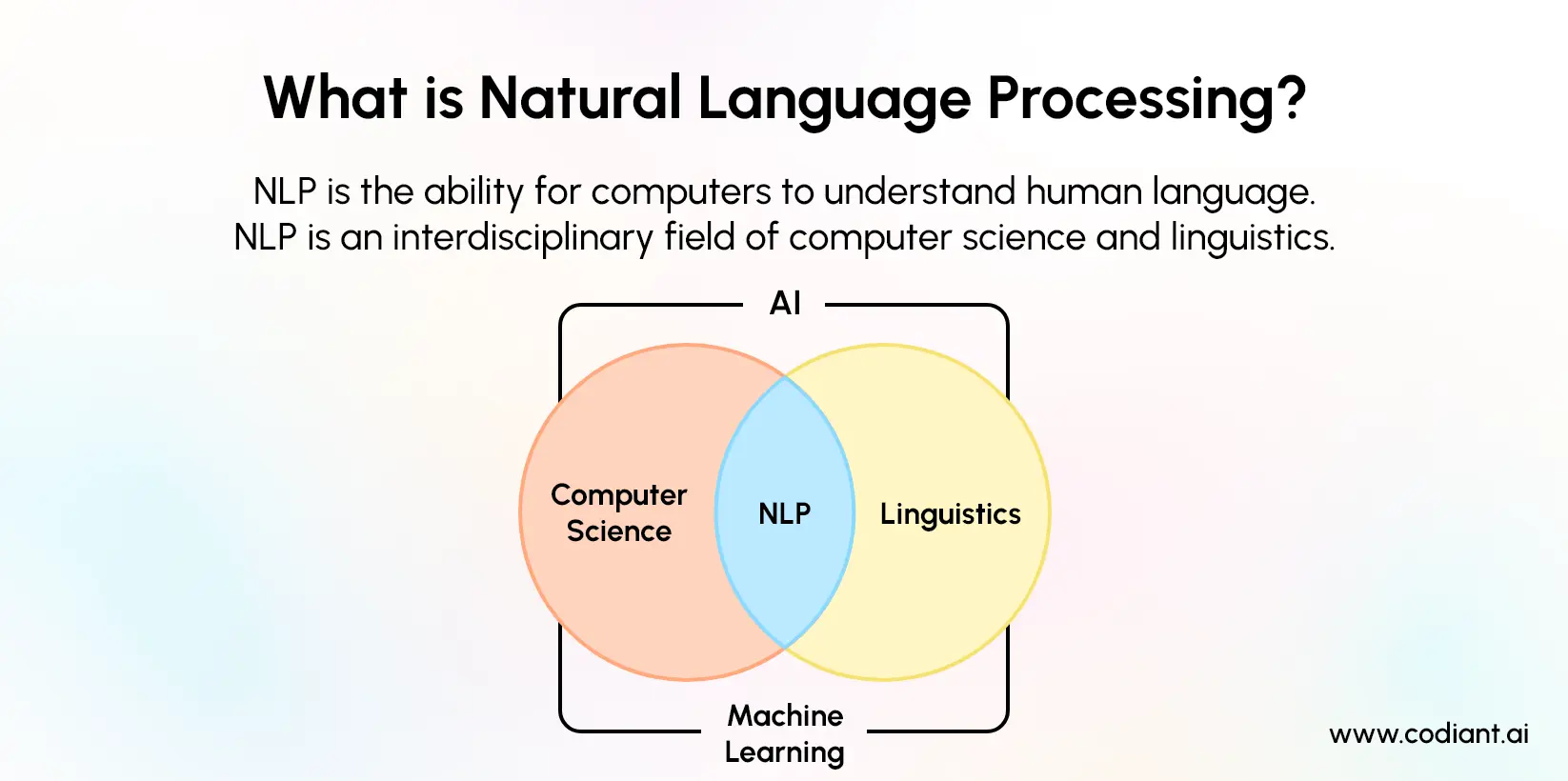
It’s the technology that helps machines understand human language. Not just words, but meaning.
Because language is messy.
People don’t speak in structured commands. They interrupt themselves. They mix languages. They imply more than they say.
For example:
“Can you check this?”
Check what? For what? Why?
A human understands context instantly. A machine doesn’t. NLP exists to close that gap.
Natural language processing explained properly It’s a branch of AI that allows systems to read, interpret, and generate language in a way that actually makes sense.
Not perfectly. Not always elegantly. But increasingly well.
And that shift, from keyword matching to intent understanding, is where things get interesting.
Turn Conversations into Business Intelligence Today
Unlock insights from customer data using advanced NLP solutions
NLP vs AI vs ML: Clearing the Confusion
These terms get thrown around like they mean the same thing. They don’t.
- AI is the big umbrella. Machines doing things that feel intelligent
- Machine Learning is how systems learn patterns from data
- NLP is focused on language specifically
So when someone asks, “Is NLP part of AI?”
Yes. It’s one of the most visible parts.
Think of it like this: AI is the brain. ML is how the brain learns. NLP is how the brain communicates.
Without NLP, AI doesn’t talk. It just sits there.
How NLP Actually Works?
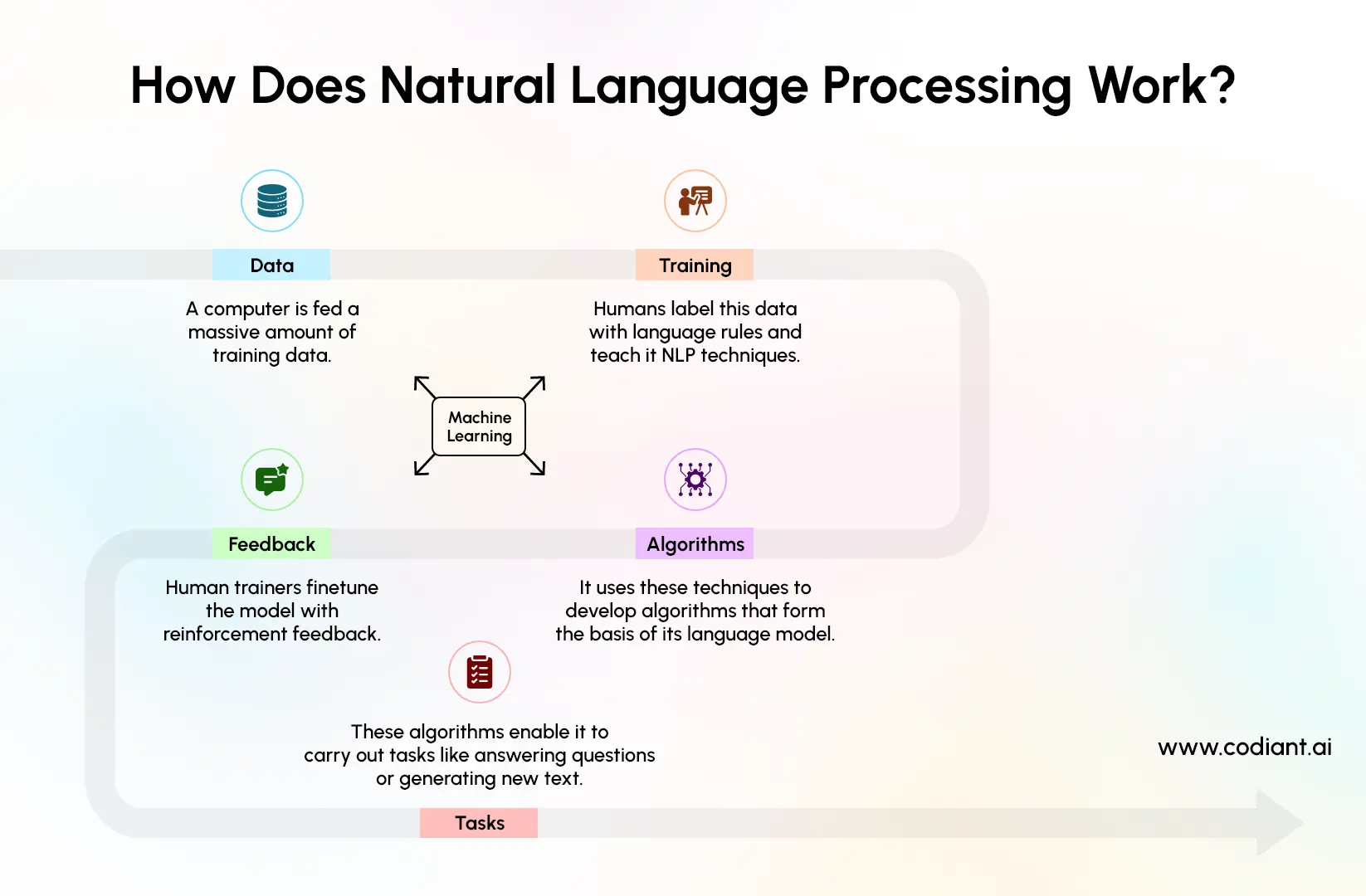
Natural Language Processing works through a step-by-step process that combines data, machine learning, and continuous improvement to understand human language.
1. Data Collection
It starts with large amounts of language data. This includes text from emails, chats, documents, websites, and even voice converted into text.
The more diverse and high-quality the data, the better the system can learn language patterns.
2. Training the Model
Once the data is collected, it is labeled and structured by humans or automated systems. This helps the model understand grammar, sentence structure, context, and meaning.
At this stage, machine learning models are trained using NLP techniques so they can recognize patterns in language.
3. Algorithms & Language Models
The trained data is then used to build algorithms and language models. These models learn how words relate to each other, how sentences are formed, and how meaning changes based on context.
This is what allows NLP systems to go beyond keywords and actually understand intent.
4. Feedback & Improvement
After deployment, NLP systems don’t stop learning. They are continuously improved using human feedback and real-world interactions.
This feedback loop helps refine accuracy, fix errors, and improve responses over time.
5. Performing Tasks
Finally, the trained NLP system performs real-world tasks such as:
- Answering questions
- Generating text
- Translating languages
- Analyzing sentiment
- Powering chatbots and voice assistants
Earlier systems looked for keywords. Modern systems look for intent.
That’s the difference between a chatbot that frustrates users and one that actually helps.
Natural Language Processing Examples You Already Use
NLP isn’t hidden. It’s everywhere.
You just don’t notice it unless it breaks.
Some everyday natural language processing examples:
- Google understanding “best phone under 20k”
- Gmail suggesting replies before you finish typing
- Voice assistants responding to casual speech
- Customer support bots resolving queries instantly
- Translation tools converting languages in real time
Here’s a useful mental shortcut:
If a system understands what you meant instead of what you typed, NLP is involved.
And when it fails, you notice immediately.
Build Smarter AI Systems That Understand Users
Create intelligent applications that process language and automate workflows.
Where NLP Actually Delivers: Real Use Cases
This is where things shift from theory to impact.
1. Customer Support Automation
Chatbots used to follow scripts. Now they understand intent. The difference shows up in response time, resolution rate, and customer satisfaction.
2. Sentiment Analysis
Companies track how customers feel at scale. Reviews, tweets, feedback forms. Not just what people say, but how they feel when they say it.
3. Document Processing
Contracts, invoices, reports. Traditionally manual, slow, error-prone. NLP extracts key data instantly.
4. Voice Interfaces
Call centers are changing fast. Voice bots handle queries that once required teams.
5. Personalization Engines
Content, products, recommendations. NLP helps systems understand user behavior through language.
These NLP solutions use cases aren’t experimental anymore. They’re operational.
NLP Applications in Business: Where Money Gets Made
This is where adoption accelerates.
1. Marketing and Sales
NLP analyzes conversations, segments audiences, and generates content that actually resonates. Less guesswork. More precision.
2. Finance
Fraud detection, compliance monitoring, automated reporting. Unstructured data becomes usable data.
3. Healthcare
Doctors spend less time typing and more time diagnosing. Clinical notes turn into structured insights.
4. HR and Recruitment
Resume screening, interview analysis, candidate matching. Hiring moves faster without sacrificing quality.
The business use of NLP is less about novelty and more about efficiency.
Companies aren’t adopting NLP because it’s interesting.
They’re adopting it because it removes friction.
NLP in Healthcare and Finance: High-Impact Zones
Two industries stand out.
1. Healthcare
Doctors deal with massive amounts of unstructured data. Notes, reports, patient histories.
NLP converts that into structured, usable information in healthcare.
Faster documentation. Better diagnosis support. Reduced administrative burden.
2. Finance
Banks and financial institutions process huge volumes of text. Transactions, communications, reports.
NLP helps detect fraud, monitor compliance, and analyze market sentiment in Finance.
Speed matters here. Accuracy matters more.
In both cases, NLP isn’t just helpful. It’s becoming essential.
NLP Applications 2026: What’s Changing
The shift happening now is subtle but important.
NLP is moving from reactive to proactive.
- Systems understand context across longer conversations
- Multilingual capabilities are becoming standard
- Real-time processing is expected, not impressive
- NLP is integrating with AI agents that don’t just respond, but act
That last one matters.
Understanding language is step one.
Acting on it is where the real value sits.
NLP Tools and Techniques That Power Everything
Behind every NLP application, there’s a stack.
Tools
- Libraries like spaCy and NLTK for text processing
- Transformer models like BERT and GPT for deep understanding
- Frameworks like TensorFlow and PyTorch for building models
Techniques
- Text classification to organize content
- Sentiment analysis to understand tone
- Named entity recognition to extract key information
- Topic modeling to identify themes
- Language generation to create responses
These NLP tools and techniques don’t operate in isolation. They work together to create systems that feel seamless.
Why Businesses Are Betting on NLP?
Simple reason: data.
Most business data isn’t structured. It’s buried in emails, chats, documents, conversations.
NLP makes that data usable.
The benefits show up quickly:
- Faster customer response times
- Lower operational costs
- Better insights from existing data
- More natural user experiences
This is less about adding AI.
More about making existing systems smarter.
How Codiant.AI Helps Businesses Apply NLP in the Real World?
Building NLP systems is one thing. Making them work in production is another.
Codiant.AI focuses on practical implementation:
- Custom NLP models aligned with business workflows
- Conversational AI systems that actually resolve queries
- Document processing solutions that reduce manual effort
- Integration with existing enterprise systems
The emphasis is clear.
Not experimentation. Execution.
Because in most organizations, the challenge isn’t understanding NLP. It’s applying it where it matters.
Conclusion
NLP is becoming an important part of how modern systems work. It helps businesses understand customer conversations, automate tasks, and make better use of everyday data.
From chatbots and voice assistants to document analysis and customer feedback, NLP is being used across industries to improve efficiency and decision-making.
As more business data comes in the form of text and speech, the role of NLP will continue to grow. Companies that adopt it effectively can respond faster, reduce manual work, and deliver better user experiences.
The focus now is not just understanding NLP but applying it where it solves real business problems.
Make Your Applications Understand Human Language Better
Enhance user experience with intelligent NLP-driven communication systems today.
Frequently Asked Questions
It’s an AI technology that helps machines understand human language using steps like text analysis, tokenization, and machine learning-based interpretation.
Chatbots, sentiment analysis, document automation, customer insights, and communication workflows are among the most common business applications.
Healthcare, finance, retail, e-commerce, and customer service see the highest impact due to heavy reliance on communication and data.
Tokenization, sentiment analysis, named entity recognition, topic modeling, and language generation are widely used techniques.
Machine learning enables systems to learn from data, while NLP specifically focuses on understanding and processing human language.
Featured Blogs
Read our thoughts and insights on the latest tech and business trends

RAG vs Fine-Tuning: Which Approach Is Right for Your Enterprise AI Knowledge System?
- September 24, 2026
- Artificial Intelligence
Retrieval-Augmented Generation (RAG) and fine-tuning are the two primary methods for customizing a Large Language Model (LLM) with an enterprise's own knowledge. RAG connects a general-purpose LLM to an external knowledge base at query time,... Read more

AI Roadmap: How to Build and Scale AI Across the Enterprise
- September 17, 2026
- Artificial Intelligence
An AI roadmap is a structured plan that connects business priorities with AI use cases, data, technology, governance, people, implementation, and measurable outcomes. For enterprises, it provides the sequence for moving from AI opportunities and... Read more

Top Predictive Analytics Models and Algorithms to Know
- September 11, 2026
- Artificial Intelligence
Predictive analytics models are statistical and machine learning systems that use historical data to forecast future outcomes, such as customer churn, equipment failure, demand spikes, or credit risk. The most widely used categories are regression... Read more