How to Build an AI Chatbot Using NLP?
Table of Contents
Subscribe To Our Newsletter
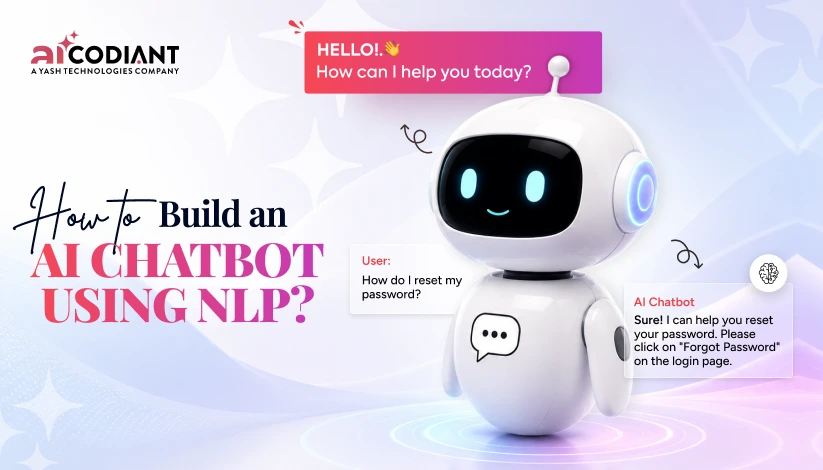
The majority of businesses nowadays are looking to shorten response time, manage more queries than ever before and be available for customers without the need to increase team size. Chatbots are one of the practical means to do just that.
However, just inserting a chatbot is not sufficient.
Standard bots that depend on static scripts tend to flounder when people ask anything other than the set questions. Resulting in subpar experiences and broken conversations.
The second great challenge, if we want chatbots to actually be useful, is to make them reflect what it is that users are attempting to communicate and respond. Natural Language Processing (NLP) comes in here to address this need.
If you want to create an AI chatbot that relies on NLP, this and more is covered in a complete guide that takes you through the entire process of how it works, what tools to choose, how to make your conversations work, and finally building a system that gets things done.
What Is NLP in Chatbot Development?
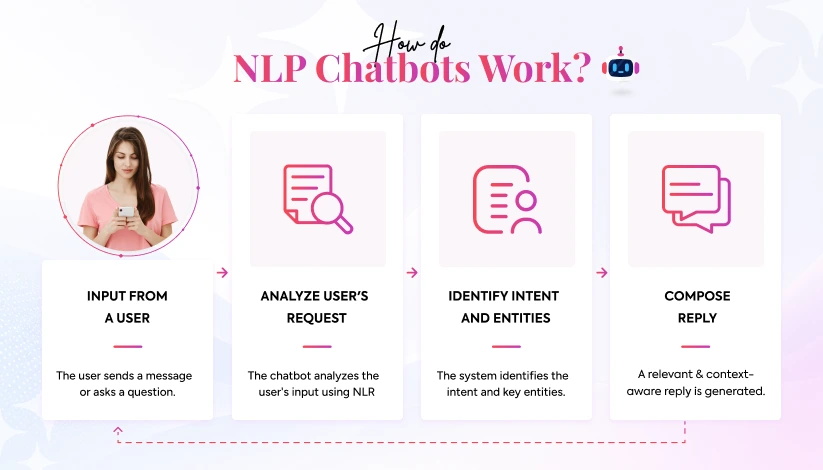
At the core of every intelligent chatbot is Natural Language Processing (NLP) the technology that allows machines to understand, interpret, and respond to human language.
Instead of relying on predefined keywords, NLP enables chatbots to:
- Understand user intent
- Extract meaningful data (entities)
- Respond contextually
- Learn from interactions over time
For example, when a user types:
“I need to reschedule my appointment for tomorrow”
An NLP-powered chatbot doesn’t just detect keywords like reschedule it understands:
- Intent– Modify appointment
- Entity– Tomorrow (date)
This is what separates basic bots from true conversational AI development systems.
Turn Conversations into Intelligent Business Automation
Build AI chatbots that understand users, automate workflows, and scale customer interactions effortlessly across every digital touchpoint.
Why Businesses Are Investing in NLP Chatbots?
The shift toward enterprise AI automation is being driven by real outcomes not hype.
Here’s what NLP-powered chatbots bring to the table:
- 24/7 Customer Support without human dependency
- Instant Query Resolution across multiple channels
- Scalable Conversations handling thousands of users simultaneously
- Cost Reduction by minimizing support team workload
- Personalized User Experience using context and history
In simple terms, NLP transforms chatbots from tools into digital assistants that actually understand users.
Step-by-Step- How to Build an AI Chatbot Using NLP
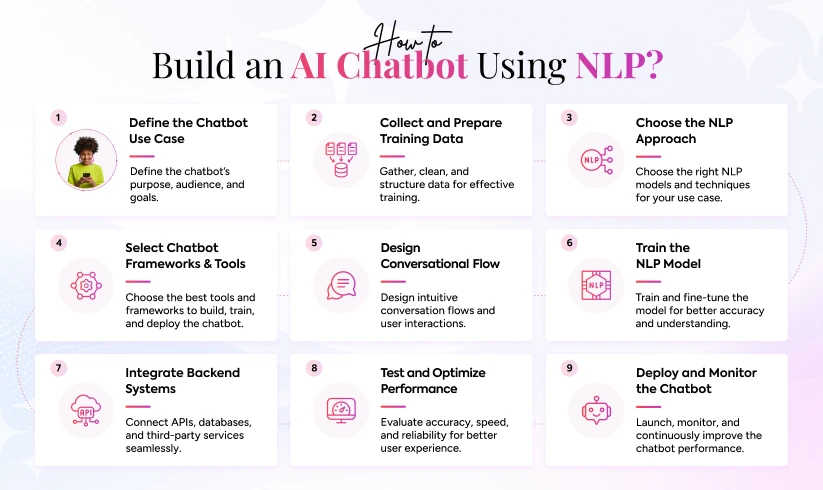
Now let’s break down the actual AI agent development process for chatbots.
Step 1- Define the Use Case
Start with clarity.
Are you building a chatbot for:
- Customer support?
- Lead generation?
- Appointment booking?
- Internal automation?
A focused use case ensures better accuracy and faster deployment.
Step 2- Collect and Prepare Data
Your chatbot is only as good as the data it learns from.
You need:
- Sample conversations
- FAQs
- Historical chat logs
- Customer queries
Clean and structure this data to train your NLP model effectively.
Step 3- Choose the Right NLP Approach
There are two main approaches:
Rule-Based NLP
- Simple logic-based systems
- Limited flexibility
Machine Learning / AI-Based NLP
- Uses models like transformers
- Learns from data
- Handles complex queries
For modern applications, AI-driven NLP is the standard.
Step 4- Select Chatbot Frameworks & Tools
Choosing the right stack is critical for success.
Popular chatbot frameworks include:
- Rasa – Open-source, customizable NLP chatbot framework
- Dialogflow – Google-powered conversational AI platform
- Microsoft Bot Framework – Enterprise-grade bot development
- OpenAI / LLM APIs – Advanced conversational capabilities
For chatbot using Python NLP, libraries like:
- NLTK
- spaCy
- Transformers (Hugging Face)
are widely used.
The tools you choose depend on:
- Complexity
- Budget
- Scalability needs
Step 5- Design Conversation Flow
Even the smartest chatbot fails without good conversation design.
Focus on:
- Natural conversation paths
- Fallback responses
- Error handling
- Multi-turn dialogues
Think like a user, not a developer.
Step 6- Train the NLP Model
Now comes the intelligence layer.
Train your model to:
- Identify intents
- Extract entities
- Improve accuracy
The more diverse your training data, the better your chatbot performs.
Step 7- Integrate Backend Systems
To make your chatbot useful, integrate it with:
- CRM systems
- Booking engines
- Payment gateways
- Internal tools
This is where AI chatbot integration turns conversations into actions.
Step 8- Test and Optimize
Testing is not optional it’s continuous.
Check for:
- Misunderstood queries
- Incorrect responses
- Broken flows
Improve based on real user interactions.
Step 9- Deploy and Monitor
Once ready, deploy your chatbot across:
- Website
- Mobile apps
- Messaging platforms
Track performance using:
- Response accuracy
- User engagement
- Resolution rates
AI Chatbot Architecture: How It Works
Before you jump into development, it’s important to understand the AI chatbot architecture.
A typical NLP chatbot consists of these layers:
- User Interface Layer
This is where users interact website chat, mobile apps, WhatsApp, or voice assistants.
- NLP Engine
The brain of the chatbot:
- Intent recognition
- Entity extraction
- Context understanding
- Dialogue Management System
Controls conversation flow:
- Decides next response
- Maintains conversation context
- Handles multi-turn interactions
- Backend Integration Layer
Connects chatbot with systems like:
- CRM
- Databases
- APIs
- Payment systems
- Response Generation
The chatbot replies using:
- Predefined responses
- AI-generated text (LLMs)
This layered architecture is what enables enterprise chatbot development at scale.
Best Tools for NLP Chatbot Development
If you’re wondering what tools are best, here’s a practical breakdown:
| Category | Tools |
| NLP Libraries | spaCy, NLTK, Hugging Face |
| Chatbot Platforms | Rasa, Dialogflow, Botpress |
| LLM APIs | OpenAI, Anthropic |
| Backend | Python, Node.js |
| Integration | REST APIs, Webhooks |
For enterprise use, combining LLMs with structured NLP pipelines delivers the best results.
Real-World NLP Chatbot Examples
To understand impact, let’s look at practical NLP chatbot examples-
- E-commerce: Product recommendations, order tracking, abandoned cart recovery, personalized offers based on browsing behaviour.
- Healthcare: Appointment scheduling, symptom checking, patient triage, medication reminders, post-treatment follow-ups.
- Banking & FinTech: Account queries, fraud alerts, transaction summaries, loan eligibility checks, financial advice.
- HR Automation: Employee onboarding, policy FAQs, leave management, internal helpdesk support, payroll queries.
- Travel & Hospitality: Booking assistance, itinerary planning, real-time travel updates, cancellations, and customer support.
- Education & EdTech: Student support, course recommendations, doubt resolution, exam preparation guidance, enrollment assistance.
- Customer Support (Cross-Industry): Ticket resolution, complaint handling, escalation management, multilingual support across channels.
- Real Estate: Property recommendations, virtual tour scheduling, lead qualification, pricing insights, follow-ups.
- Insurance: Policy recommendations, claims processing assistance, premium calculations, document verification.
- Retail & Q-Commerce: Instant product discovery, order status updates, delivery tracking, hyper-personalized promotions.
- SaaS & IT Services: User onboarding, troubleshooting, product guidance, feature walkthroughs, support automation.
- Logistics & Supply Chain: Shipment tracking, delivery updates, route optimization queries, vendor coordination support.
These bots are not just answering questions they’re automating workflows.
Launch Your NLP Chatbot Faster Than You Think
Design, train, and deploy powerful AI chatbots using modern NLP frameworks tailored to your business goals and user journeys.
How Long Does It Take to Build a Chatbot?
The timeline depends on complexity:
- Basic chatbot- 2–4 weeks
- Mid-level NLP chatbot- 1–3 months
- Enterprise chatbot- 3–6 months
Factors affecting time:
- Data availability
- Integration complexity
- Customization level
What Is the Cost of Chatbot Development?
Cost varies widely based on requirements:
- Simple chatbot- $5,000 – $15,000
- NLP chatbot- $15,000 – $50,000
- Enterprise-grade chatbot- $50,000+
Key cost drivers:
- AI model complexity
- Integration scope
- Maintenance & updates
Think of it as an investment in long-term automation and efficiency.
Common Challenges in NLP Chatbot Development
Building a chatbot is not just a technical task it’s a strategic initiative that directly impacts user experience, automation efficiency, and business outcomes.
Common challenges include:
- Poor training data
If your chatbot is trained on limited, unstructured, or biased data, it will struggle to understand user intent accurately, leading to irrelevant or incorrect responses. - Lack of context understanding
Many chatbots fail to retain conversation context across multiple interactions, making responses feel disconnected and frustrating for users during complex or multi-step queries. - Integration issues
Connecting chatbots with CRMs, APIs, databases, or internal systems can be complex, often resulting in delays, data mismatches, or broken workflows. - Overcomplicated flows
Designing overly complex conversation paths can confuse users and reduce chatbot effectiveness instead of simplifying interactions.
The solution:
Start with a focused use case and high-quality training data, design simple conversational flows, and follow a guide to hiring experienced AI chatbot developers to ensure the right expertise for your project. Integrate systems in phases, continuously test with real users, and refine the chatbot regularly using feedback, analytics, and iterative improvements.
The Future of Conversational AI Development
Chatbots are evolving into AI agents.
Instead of just answering queries, they now:
- Perform tasks
- Make decisions
- Automate workflows
This shift toward agentic AI development is redefining how businesses operate.
Soon, chatbots won’t just assist they’ll act on behalf of users.
How Codiant.AI Helps You Build Smarter NLP Chatbots?
Building an NLP chatbot is not just about models it’s about delivering real business outcomes. That’s where CodiantAI steps in.
We help enterprises design, develop, and scale intelligent chatbot solutions that go beyond basic automation.
- Build custom AI chatbot architecture tailored to your workflows
- Integrate NLP chatbots with CRM, APIs, and enterprise systems
- Use advanced LLMs for human-like conversational experiences
- Ensure scalability, security, and continuous optimization
From idea to deployment, CodiantAI turns chatbot concepts into production-ready AI systems that drive efficiency, engagement, and measurable business growth.
Read more: How to Build AI Agents for Enterprise Automation?
Conclusion
Developing an AI-powered chatbot based on NLP is easier than ever before. With the right approach, tools and data, organizations can build systems that deal with real conversations not just canned responses.
With a solid structure, a chatbot should be able to interpret user requests, respond with clarity and assist with routine jobs like answering questions, booking services or directing users. Gradually, it cuts down on manual work and increases response time.
The big trick, then, is to have a reason to design something, design it very simply and iterate based on actual use. When developed mindfully, a chatbot becomes an integral portion of your operations not merely an added on functionality.
Upgrade Support with Smart AI Chatbots Today
Replace manual responses with intelligent chatbots that resolve queries instantly, improve engagement, and reduce operational costs significantly.
Frequently Asked Questions
NLP enables chatbots to understand human language, identify intent, and generate relevant responses, making conversations more natural and effective.
The process includes defining use cases, collecting data, choosing tools, designing flows, training models, integrating systems, testing, and deployment.
Popular frameworks include Rasa, Dialogflow, Microsoft Bot Framework, and OpenAI APIs depending on customization and scalability needs.
Accuracy depends on training data and model quality, but well-trained NLP chatbots can achieve 85–95% accuracy in understanding user queries.
Costs range from $5,000 for basic bots to over $50,000 for enterprise-grade NLP chatbots with advanced integrations.
Featured Blogs
Read our thoughts and insights on the latest tech and business trends
RAG vs Fine-Tuning: Which Approach Is Right for Your Enterprise AI Knowledge System?
- September 24, 2026
- Artificial Intelligence
Retrieval-Augmented Generation (RAG) and fine-tuning are the two primary methods for customizing a Large Language Model (LLM) with an enterprise's own knowledge. RAG connects a general-purpose LLM to an external knowledge base at query time,... Read more
AI Roadmap: How to Build and Scale AI Across the Enterprise
- September 17, 2026
- Artificial Intelligence
An AI roadmap is a structured plan that connects business priorities with AI use cases, data, technology, governance, people, implementation, and measurable outcomes. For enterprises, it provides the sequence for moving from AI opportunities and... Read more

Top Predictive Analytics Models and Algorithms to Know
- September 11, 2026
- Artificial Intelligence
Predictive analytics models are statistical and machine learning systems that use historical data to forecast future outcomes, such as customer churn, equipment failure, demand spikes, or credit risk. The most widely used categories are regression... Read more