What Are AI Agents? A Complete Enterprise Guide
Table of Contents
Subscribe To Our Newsletter
AI is no longer just about generating text or answering queries. It’s evolving into something far more powerful systems that can think, decide and act independently.
That’s where AI agents come in.
From automating customer support workflows to managing complex enterprise operations, AI agents are redefining how businesses operate in 2026. They don’t just assist they execute.
If you’ve been hearing terms like agentic AI, automation agents, or enterprise AI agents and wondering what they really mean, this guide will break it down clearly.
Let’s start with the basics.
What Are AI Agents?
In the simplest terms, AI agents are intelligent systems designed to perform tasks autonomously by observing their environment, making decisions & taking actions to achieve specific goals.
Unlike traditional AI tools that wait for input, AI agents:
- Understand context
- Plan actions
- Execute tasks
- Learn from outcomes
Think of them as digital employees, not just tools.
For example, instead of asking an AI to “write an email,” an AI agent can:
- Analyze incoming messages
- Decide which ones need responses
- Draft replies
- Send them automatically
That’s a shift from assistance to execution.
How AI Agents Work in Enterprise Environments?
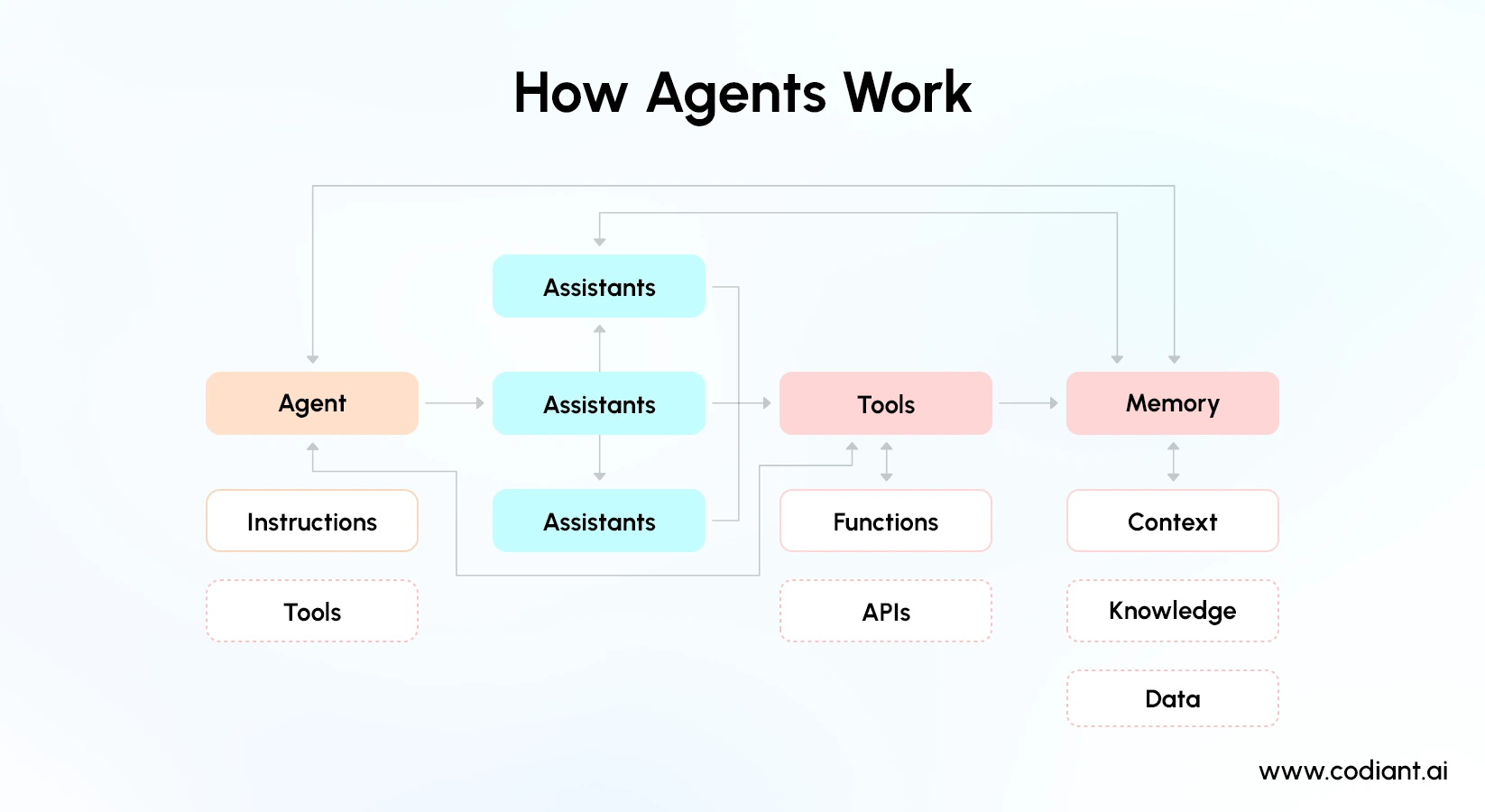
At their core, AI agents operate through a structured loop:
- Perception: They collect data from inputs like APIs, databases, user queries, or systems.
- Reasoning: Using large language models and logic frameworks, they interpret the situation and decide what to do.
- Planning: They break tasks into smaller steps and determine execution sequences.
- Action: They perform tasks trigger workflows, send responses, update systems.
- Learning: Over time, they improve using feedback and historical data.
In enterprise environments, this entire process is integrated with:
- CRMs
- ERPs
- Internal tools
- APIs
- Data warehouses
This is why enterprise AI agents are far more powerful than standalone AI tools they operate within your business ecosystem.
Types of AI Agents
Not all AI agents are the same. Depending on complexity and capability, they fall into different categories.
- Reactive Agents
These respond to immediate inputs without memory or learning.
Example- Rule-based automation systems.
- Model-Based Agents
They use internal models to understand the environment and make decisions.
Example- AI systems predicting customer churn.
- Goal-Based Agents
These focus on achieving specific outcomes by evaluating different approaches.
Example- Sales optimization agents.
- Utility-Based Agents
They optimize decisions based on performance metrics like cost, time, or efficiency.
- Learning Agents
The most advanced type these continuously improve using feedback and data.
In enterprise use cases, most modern systems combine multiple types, forming what we now call agentic AI systems.
Agentic AI Explained (Why It Matters)
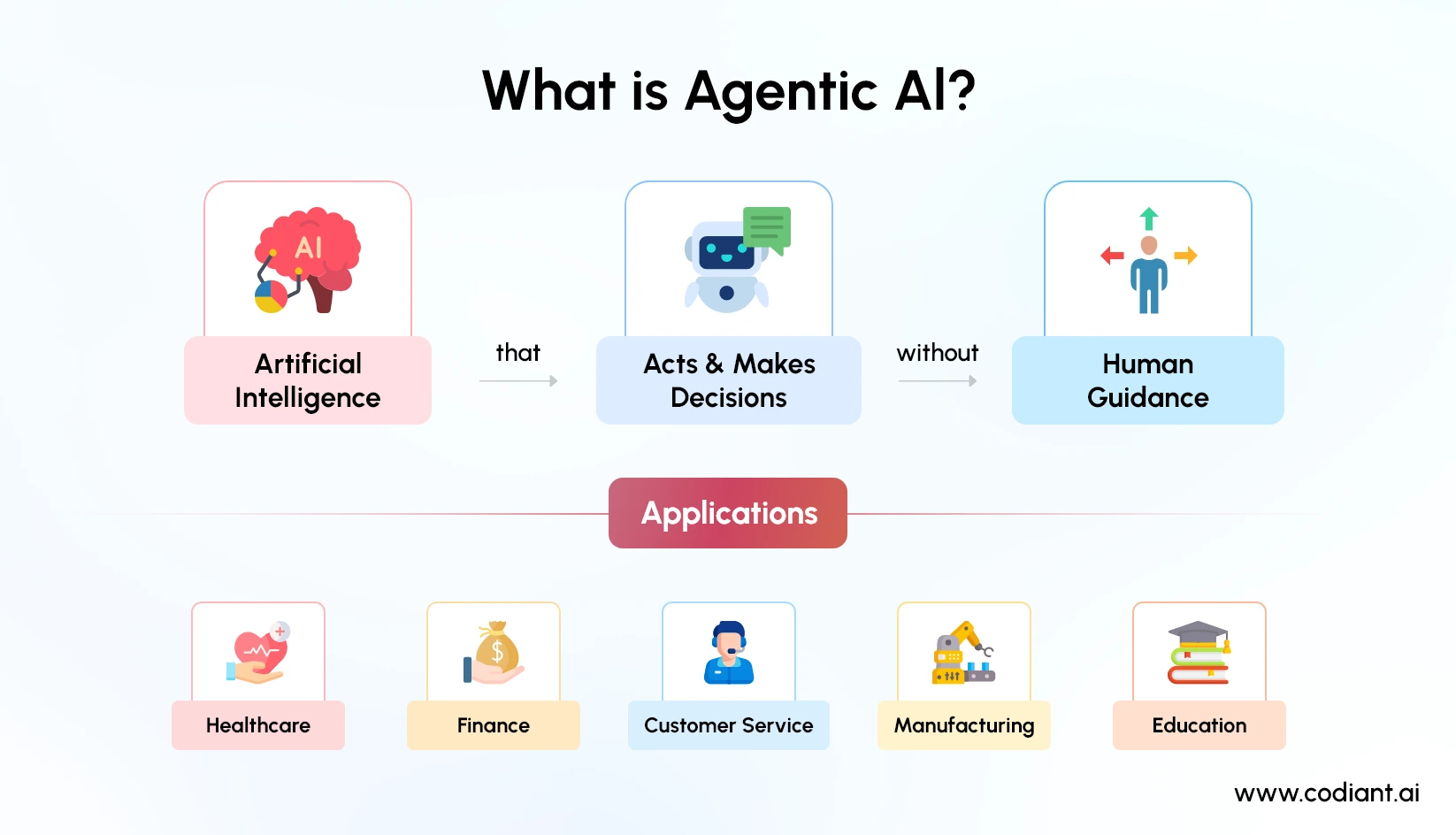
“Agentic AI” refers to AI systems that can operate independently with minimal human intervention.
This is the key difference between:
- Traditional AI → Responds
- Agentic AI → Acts
Agentic AI enables:
- Multi-step decision-making
- Autonomous execution
- Cross-system integration
For enterprises, this means moving from:
👉 Task automation → End-to-end workflow automation
For example:
Instead of automating invoice generation, an AI agent can:
- Detect billing triggers
- Generate invoices
- Send them
- Track payments
- Follow up automatically
All without manual intervention.
AI Agents vs Chatbots: What’s the Real Difference?
This is where most confusion happens.
At a glance, both interact with users but their capabilities are fundamentally different.
Chatbots:
- Reactive
- Scripted or prompt-based
- Handle conversations only
- Limited decision-making
AI Agents:
- Autonomous
- Goal-driven
- Perform actions beyond conversations
- Integrate with systems and workflows
A chatbot answers:
👉 “What is my order status?”
An AI agent:
👉 Checks order status → updates system → sends notification → initiates escalation if delayed
That’s a massive leap in capability.
Real-World AI Agents Use Cases in Enterprise
Let’s move from theory to application. Here’s where AI agents in enterprise are creating real impact.
- Customer Support Automation
AI agents resolve queries, escalate issues & even handle refunds automatically reducing support costs significantly.
- Sales & Lead Qualification
They analyze leads, score prospects, schedule meetings, and nurture pipelines without human involvement.
- HR & Recruitment
From screening resumes to conducting AI interviews and shortlisting candidates, AI agents streamline hiring workflows.
- Finance & Accounting
They automate invoice processing, fraud detection, expense categorization, and financial reporting.
- IT Operations
AI agents monitor systems, detect anomalies, and resolve incidents proactively.
- Healthcare Workflows
From patient triaging to documentation (like AI scribes), agents improve efficiency and reduce administrative burden.
Across industries, the value is clear:
👉 Faster operations
👉 Lower costs
👉 Higher accuracy
AI Agents Examples You Already Interact With
Even if you don’t realize it, you’re already interacting with AI agents.
- Smart email assistants that auto-reply
- Recommendation engines suggesting products
- AI copilots managing workflows
- Autonomous trading systems
- AI-powered hiring platforms
In enterprise settings, tools like:
- AI recruitment platforms
- AI workflow automation systems
- AI-powered CRM assistants
are all examples of intelligent agents in AI.
Are AI Agents the Future of Automation?
Yes, but not just automation intelligent automation.
Traditional automation follows rules.
AI agents adapt.
This shift is critical because businesses today deal with-
- Unstructured data
- Dynamic workflows
- Real-time decisions
AI agents bring-
- Flexibility
- Context awareness
- Continuous learning
This is why many enterprises are moving toward:
👉 AI automation agents instead of rigid automation tools
Enterprise AI Agents: Why Businesses Are Adopting Them
Enterprises are not adopting AI agents for hype they’re doing it for measurable outcomes.
Key Benefits:
- Operational Efficiency: AI agents help businesses automate repetitive and complex tasks, reducing manual effort, minimizing errors & allowing teams to focus on more strategic, high-value activities daily.
- Scalability: AI agents can manage thousands of tasks at the same time without slowing down, helping businesses grow faster while maintaining performance, consistency & service quality across operations.
- Cost Reduction: By automating routine processes and reducing manual dependency, AI agents help cut operational costs, optimize resource usage & improve overall efficiency without increasing workforce expenses significantly.
- Improved Decision-Making: AI agents analyze large amounts of real-time data to provide insights, helping businesses make faster, smarter & more accurate decisions that improve outcomes and reduce risks effectively.
- 24/7 Execution: AI agents work continuously without breaks, ensuring tasks are completed on time, processes run smoothly & customer needs are addressed instantly, regardless of time or business hours.
For leadership teams, this translates to:
👉 Faster growth with fewer operational bottlenecks
Build Smarter Workflows with AI Agents Today
Transform manual processes into intelligent, self-operating systems that scale effortlessly across your enterprise operations.
How AI Agents Are Different from Traditional Automation
Traditional automation tools (like RPA) follow predefined rules.
AI agents, on the other hand:
- Understand context
- Adapt to changes
- Make decisions dynamically
Traditional Automation:
- Fixed workflows
- Rule-based
- Limited flexibility
AI Agents:
- Dynamic workflows
- Learning-driven
- Context-aware
This is why AI agents are considered the next evolution of enterprise automation.
Industries That Benefit the Most from AI Agents
While almost every industry can benefit, some are adopting AI agents faster due to their need for automation, real-time decisions & scalable operations.
Healthcare
AI agents help doctors with faster diagnosis, automate medical documentation, manage patient records & improve care coordination, reducing workload while ensuring better accuracy and patient outcomes.
Finance
AI agents detect fraud patterns, automate financial analysis, assist in trading decisions & manage risks efficiently, helping financial institutions make faster, data-driven & secure decisions.
Retail & E-commerce
AI agents personalize shopping experiences, manage inventory in real time, recommend products & improve customer engagement, helping businesses increase sales and customer satisfaction.
Logistics
AI agents optimize delivery routes, forecast demand, manage supply chains & reduce delays, helping logistics companies improve efficiency, lower costs & ensure timely deliveries.
Education
AI agents act as virtual tutors, personalize learning experiences, automate administrative tasks & help educators track student performance, making education more accessible, efficient & engaging.
Challenges to Consider Before Implementing AI Agents
AI agents are powerful but not plug-and-play.
Enterprises need to address-
- Data quality and integration
- Security and compliance
- Model accuracy and bias
- Infrastructure readiness
The key is not just adopting AI but implementing it strategically.
How Codiant.AI Helps Enterprises Build AI Agents?
At Codiant.AI, we help businesses move beyond experimentation to real-world implementation of enterprise AI agents that deliver measurable outcomes. Our approach focuses on building scalable, production-ready systems tailored to your workflows and data ecosystem.
- Design custom AI agents aligned with business goals
- Integrate seamlessly with CRMs, ERPs & internal tools
- Build secure, scalable & compliant AI architectures
- Enable end-to-end workflow automation, not just task automation
- Continuously optimize models for accuracy and performance
We don’t just build AI we build systems that work, adapt & grow with your business.
Final Thoughts
AI agents are not just another technology trend; they represent a fundamental shift in how modern businesses operate and scale.
They are transforming traditional workflows with AI agents for enterprises, moving organizations from manual execution to autonomous operations and from static systems to intelligent, adaptive ecosystems.
This transition is accelerating rapidly & companies that adopt enterprise AI agents early will gain a significant competitive edge. They will operate faster, scale more efficiently & respond to market changes with greater agility.
In the future of business, success will not depend on simply using AI it will depend on deploying intelligent systems that can act, decide & execute on your behalf.
Turn AI Potential into Business Outcomes
Design, build, and deploy enterprise-grade AI agents tailored to your workflows, data systems & growth goals.
Frequently Asked Questions
AI agents are intelligent systems that observe data, make decisions, and execute actions autonomously to achieve defined goals within a digital environment.
Enterprises use AI agents for automation across customer support, sales, HR, finance & operations to improve efficiency, reduce costs, and scale processes.
AI agents include reactive, model-based, goal-based, utility-based, and learning agents, each designed for different levels of intelligence and decision-making complexity.
Industries like healthcare, finance, retail, logistics & education benefit the most due to their need for automation, decision-making & real-time data processing.
Unlike traditional automation, AI agents can adapt, learn, and make decisions dynamically, making them more flexible and suitable for complex business environments.
Featured Blogs
Read our thoughts and insights on the latest tech and business trends
RAG vs Fine-Tuning: Which Approach Is Right for Your Enterprise AI Knowledge System?
- September 24, 2026
- Artificial Intelligence
Retrieval-Augmented Generation (RAG) and fine-tuning are the two primary methods for customizing a Large Language Model (LLM) with an enterprise's own knowledge. RAG connects a general-purpose LLM to an external knowledge base at query time,... Read more
AI Roadmap: How to Build and Scale AI Across the Enterprise
- September 17, 2026
- Artificial Intelligence
An AI roadmap is a structured plan that connects business priorities with AI use cases, data, technology, governance, people, implementation, and measurable outcomes. For enterprises, it provides the sequence for moving from AI opportunities and... Read more

Top Predictive Analytics Models and Algorithms to Know
- September 11, 2026
- Artificial Intelligence
Predictive analytics models are statistical and machine learning systems that use historical data to forecast future outcomes, such as customer churn, equipment failure, demand spikes, or credit risk. The most widely used categories are regression... Read more