Generative AI Tech Stack: Tools, Models & Frameworks Explained
Table of Contents
Subscribe To Our Newsletter

Generative AI has quickly moved from experimental labs into real business environments. What started as curiosity-driven tools is now powering enterprise workflows, customer experiences, and even core product offerings. But behind every AI chatbot, content generator, or intelligent assistant lies something far more important than the interface itself the generative AI tech stack.
Most conversations around AI still revolve around models. People talk about GPT, LLaMA, or Claude as if choosing a model is the entire solution. In reality, that’s just one layer. The real strength of any AI system comes from how well the entire stack is designed, integrated, and scaled.
If you’re building or planning to build AI-driven products in 2026, understanding the full stack isn’t optional anymore. It’s the difference between a demo and a deployable system.
Let’s break this down in a way that actually reflects how modern AI systems are built.
What Is a Generative AI Tech Stack?
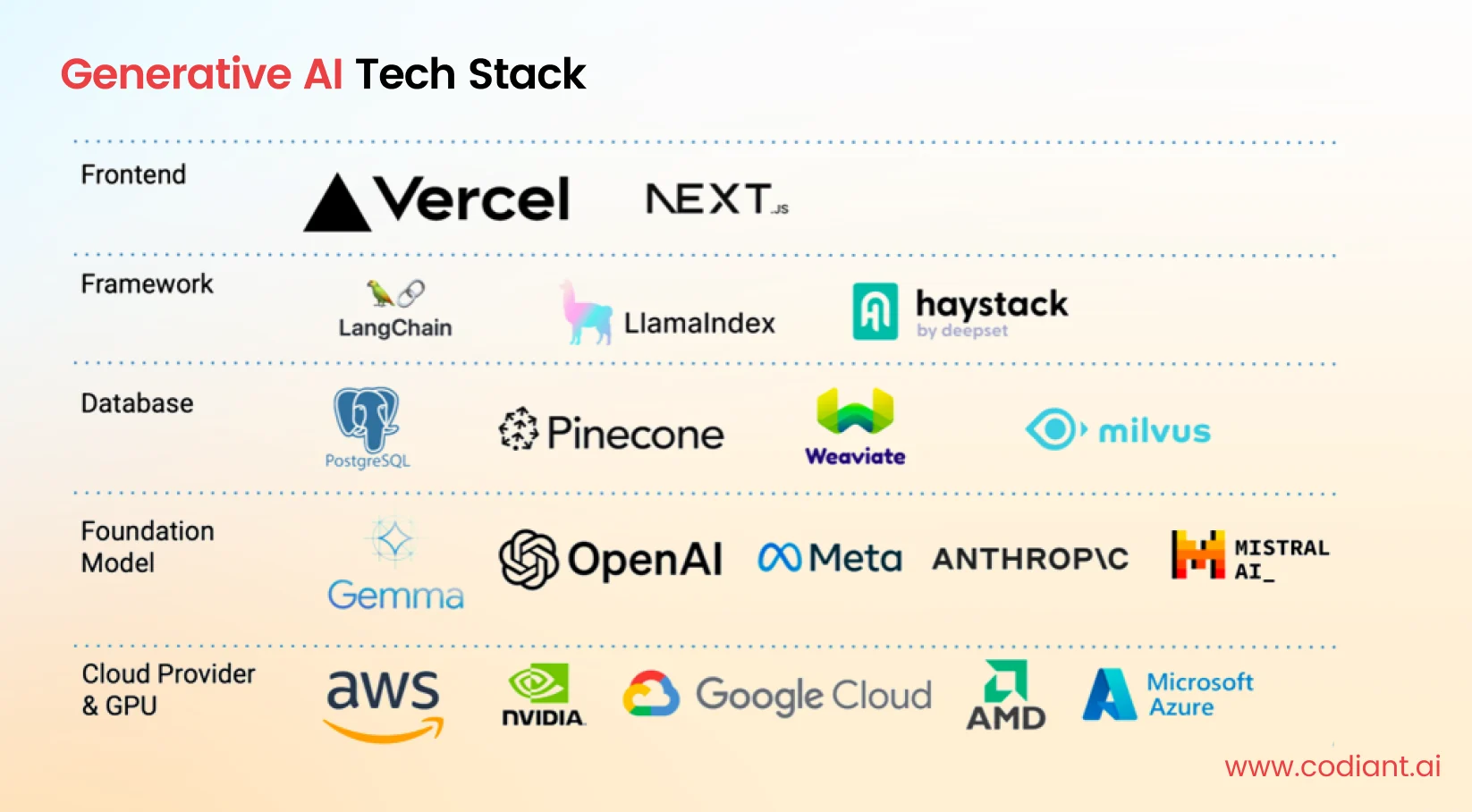
At a practical level, the generative AI tech stack is a structured combination of technologies that work together to create, process, and deliver AI-generated outputs.
Instead of thinking about it as one tool, think of it as a pipeline:
- Data flows in
- Models process it
- Frameworks structure it
- Applications deliver it
- Infrastructure supports it
This layered system is what enables AI to move beyond isolated experiments into scalable business solutions.
For businesses, this stack directly influences:
- How accurate and relevant outputs are
- How fast systems respond
- How expensive it is to run AI workloads
- How easily the system can scale
That’s why companies investing in enterprise generative AI solutions are now focusing more on architecture than just models.
Build AI That Actually Works at Scale
Design a production-ready generative AI stack tailored for your business.
What are the Layers of the Generative AI Technology Stack?
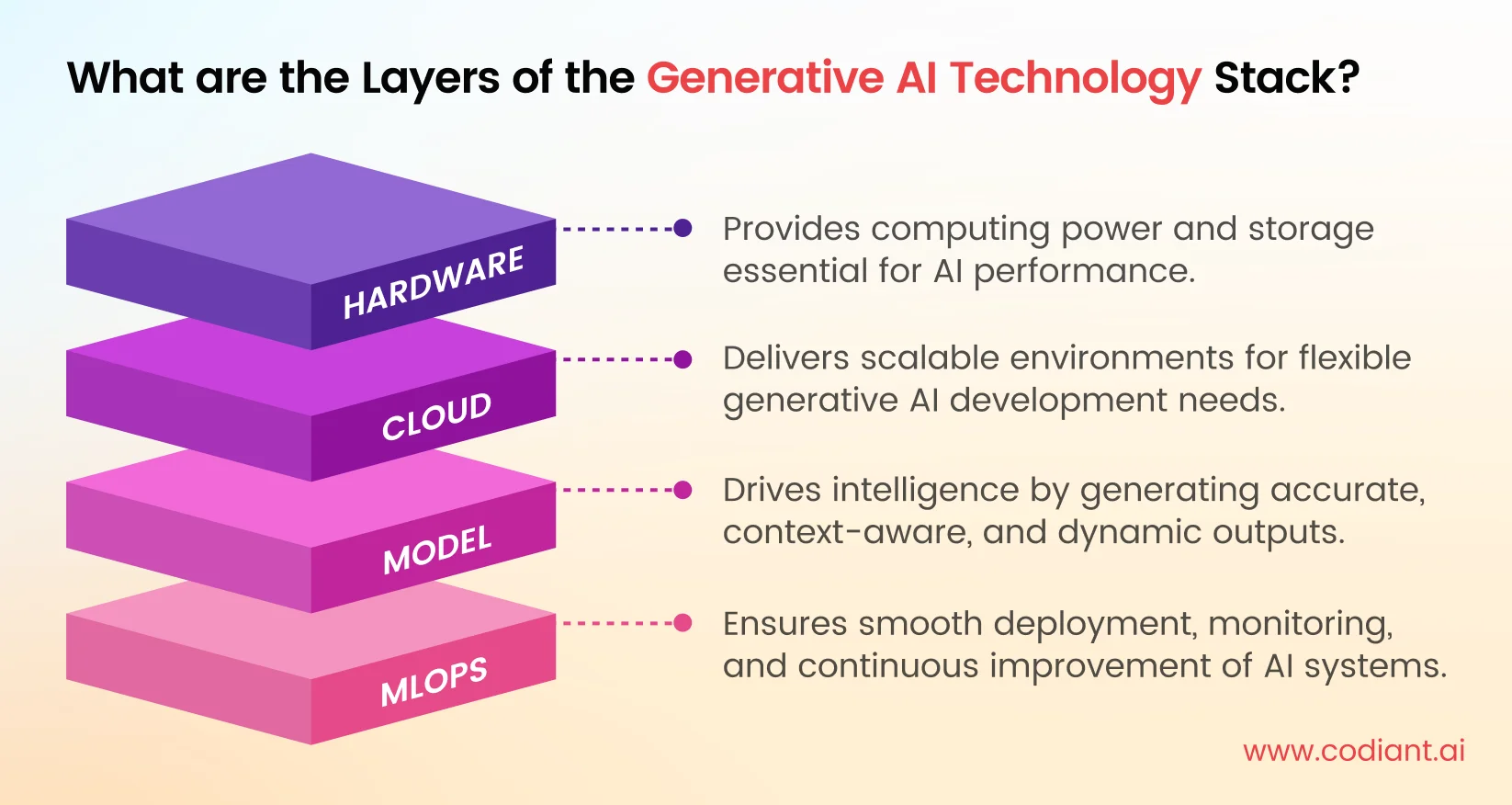
- Hardware: Hardware forms the base of generative AI systems, providing processing power through GPUs and servers that handle large computations, training models, and running AI applications efficiently.
- Cloud: Cloud platforms provide scalable environments where AI systems are built, deployed, and managed, allowing businesses to access computing resources without investing heavily in physical infrastructure.
- Model: Models are the core intelligence of generative AI, trained on large datasets to understand patterns and generate outputs like text, images, or code based on given inputs.
- MLOps: MLOps manages the lifecycle of AI models, ensuring smooth deployment, monitoring, updates, and performance tracking, so systems remain reliable, accurate, and continuously improve over time.
The Architecture Behind Generative AI Systems
To understand how everything connects, you need to look at the generative AI architecture itself.
Modern AI systems are not monolithic. They are modular by design, which allows flexibility and scalability.
1. Data Layer: The Starting Point
Everything begins with data. Without structured and meaningful data, even the most advanced models fail to perform.
This layer includes:
- Raw data collection (documents, text, images, logs)
- Data cleaning and preprocessing
- Annotation and labeling
In enterprise environments, this often includes internal knowledge bases, CRM data, and operational datasets. The quality of this layer directly impacts output quality.
2. Model Layer: The Intelligence Core
This is where transformation happens. Models take input and generate meaningful output.
Examples include:
- Large Language Models (LLMs) for text
- Diffusion models for images
- Speech models for audio
This is where comparisons like OpenAI vs HuggingFace vs LLaMA become important.
Each model ecosystem represents a different philosophy:
- OpenAI focuses on simplicity and performance through APIs
- Hugging Face provides flexibility and open experimentation
- LLaMA offers control and cost-efficiency through self-hosting
Choosing the right model isn’t about popularity. It’s about alignment with your business needs.
3. Framework Layer: The Real Enabler
This is one of the most underestimated parts of the stack.
Frameworks are what turn raw models into usable systems. Without them, AI developers would have to manually handle prompts, context, memory, and workflows.
Popular AI model frameworks include:
- LangChain
- LlamaIndex
- Haystack
- Semantic Kernel
These frameworks help with:
- Managing multi-step reasoning
- Connecting models with external data
- Structuring prompt flows
- Handling memory and context
When teams evaluate LLM frameworks comparison, they’re not just comparing features they’re deciding how complex their development process will be.
4. Application Layer: Where Users Interact
This is the visible part of the system.
It includes:
- Chat interfaces
- AI copilots
- Content generation platforms
- Automation dashboards
At this layer, the focus shifts from technology to user experience. The best AI systems are not the ones with the most powerful models, but the ones that deliver intuitive, fast, and reliable interactions.
5. Infrastructure Layer: The Backbone
Everything runs on infrastructure.
This includes:
- Cloud providers (AWS, Azure, GCP)
- GPUs and compute clusters
- APIs and deployment systems
- Containerization tools like Docker
A poorly designed generative AI infrastructure leads to high costs, slow performance, and scaling issues. That’s why enterprises invest heavily in optimizing this layer.
Tools That Power the Generative AI Ecosystem
When people ask about a generative AI tools list, they’re often expecting a simple set of tools. But in reality, tools are distributed across multiple functions.
1. Development Tools
These are used to build and interact with models:
- OpenAI API
- Hugging Face Transformers
- Cohere
- Replicate
They allow developers to quickly integrate AI capabilities without building models from scratch.
2. Orchestration Tools
These tools structure workflows:
- LangChain
- LlamaIndex
They help connect models with data sources, APIs, and external systems.
3. Vector Databases
One of the most critical components in modern AI systems.
Tools like:
- Pinecone
- Weaviate
- FAISS
These databases store embeddings and enable semantic search. This is what allows AI systems to retrieve relevant context instead of generating generic responses.
4. Monitoring and Evaluation Tools
AI systems are not static. They require continuous monitoring.
Tools include:
- Weights & Biases
- Arize AI
These help track performance, detect issues, and improve outputs over time.
5. Experimentation Environments
For testing and prototyping:
- Jupyter Notebook
- Google Colab
These environments allow teams to quickly iterate and test ideas before production deployment.
Read more: Top 20 Generative AI Development Companies in the USA (2026)
OpenAI vs HuggingFace vs LLaMA: A Practical Perspective
This comparison is less about “which is better” and more about “which fits your use case.”
OpenAI
- Best for fast deployment
- Minimal setup
- Reliable outputs
- Limited customization
Hugging Face
- Ideal for experimentation
- Wide range of models
- Requires technical expertise
LLaMA
- Open-weight models
- Full control over deployment
- Cost-effective at scale
For startups, API-first solutions like OpenAI often make sense. For enterprises, hybrid or self-hosted approaches using LLaMA are becoming more common.
How a Generative AI System Is Built (Real Workflow)
Understanding how systems are built gives clarity on how the stack fits together.
It usually starts with a business problem:
- Automating customer support
- Generating content
- Building AI assistants
Once the use case is clear, teams select a model based on performance and cost. Then comes the data layer feeding the system with relevant knowledge.
Frameworks are used to structure interactions, while vector databases enable context-aware responses. The system is then deployed on cloud infrastructure and continuously monitored.
This is how modern generative AI applications move from idea to production.
Turn AI Ideas into Real-World Applications
From models to deployment, build scalable generative AI solutions faster.
What Makes a Strong AI Development Stack?
There is no universal stack, but strong systems share common characteristics.
A typical high-performing AI development stack includes:
- A reliable model (GPT, LLaMA)
- A framework for orchestration (LangChain)
- A vector database (Pinecone)
- A backend system (Python APIs)
- A frontend interface (React)
- Scalable infrastructure (cloud platforms)
What matters is not the tools themselves, but how well they integrate.
Enterprise-Level Generative AI Stack
For enterprises, the stakes are higher.
A typical LLM tech stack enterprise setup includes:
- Fine-tuned or custom models
- Private data pipelines
- Secure APIs
- Compliance and governance layers
- Advanced monitoring systems
Enterprises prioritize:
- Data security
- Regulatory compliance
- Scalability
- Reliability
Because even minor failures can have large-scale impact.
Models vs Frameworks: Clearing the Confusion
This is one of the most misunderstood areas in AI.
A simple way to understand it:
- Models generate outputs
- Frameworks help build systems around those models
For example:
- GPT generates text
- LangChain helps structure how that text is generated
Both are essential, but they serve completely different roles.
Read More: Guide to Hire Generative AI Developers
Choosing the Right Stack: What Businesses Actually Consider
When businesses evaluate their generative AI tech stack, they’re not just looking at features.
They consider:
- Cost of deployment and scaling
- Speed of development
- Data sensitivity
- Long-term flexibility
For example:
- A startup might prioritize speed and choose API-based solutions
- A large enterprise might prioritize control and choose self-hosted models
The “right” stack is always context-driven.
Where Generative AI Tech Stacks Are Headed
The evolution of AI stacks is happening fast.
Some clear trends in 2026 include:
- Smaller, optimized models replacing large ones
- Increasing adoption of open-source ecosystems
- Rise of multi-modal AI systems
- Growing use of AI agents for autonomous workflows
The focus is shifting from isolated tools to integrated ecosystems.
Related reading: AI Strategy for CTOs- When to Invest in Machine Learning, NLP & Computer Vision
Conclusion
Generative AI is not just about models anymore. It’s about how everything connects from data pipelines to infrastructure, from frameworks to applications.
A well-designed generative AI tech stack doesn’t just improve performance. It defines how scalable, efficient, and reliable your AI solution will be.
If you’re building AI systems today, the real question isn’t:
“Which model should we use?”
It’s:
“How do we design a stack that actually works in the real world?”
Because that’s where long-term value is created.
Choose the Right AI Stack Without Guesswork
Get expert guidance on tools, models, and frameworks for success.
Frequently Asked Questions
It includes data pipelines, AI models, frameworks, vector databases, infrastructure, and application layers working together to build scalable AI systems.
LangChain, LlamaIndex, Haystack, and Semantic Kernel are widely used for building structured and scalable AI applications.
Common tools include OpenAI APIs, Hugging Face, LangChain, vector databases like Pinecone, and monitoring platforms like Weights & Biases.
They evaluate use case complexity, cost, scalability, data privacy, and internal expertise before selecting the most suitable stack.
Models generate outputs, while frameworks help developers build workflows, manage logic, and integrate models into applications.
Featured Blogs
Read our thoughts and insights on the latest tech and business trends
AI Roadmap: How to Build and Scale AI Across the Enterprise
- September 17, 2026
- Artificial Intelligence
An AI roadmap is a structured plan that connects business priorities with AI use cases, data, technology, governance, people, implementation, and measurable outcomes. For enterprises, it provides the sequence for moving from AI opportunities and... Read more

Top Predictive Analytics Models and Algorithms to Know
- September 11, 2026
- Artificial Intelligence
Predictive analytics models are statistical and machine learning systems that use historical data to forecast future outcomes, such as customer churn, equipment failure, demand spikes, or credit risk. The most widely used categories are regression... Read more

AI Data Analytics: What It Is, Why It Matters, and Business Use Cases
- September 4, 2026
- AI-Powered Data Analytics
AI data analytics uses artificial intelligence to examine data and turn it into useful insights. It helps businesses identify patterns, predict what may happen next, and decide what actions to take. It can analyze numbers,... Read more