AI Strategy for CTOs- When to Invest in Machine Learning, NLP & Computer Vision
Table of Contents
Subscribe To Our Newsletter

AI is no longer a “future investment.” It’s an operational decision.
For CTOs, the real challenge isn’t whether to adopt AI. It’s deciding where it fits, when it delivers value and which technology actually solves the problem.
This is where most AI strategy for enterprises fails. Teams jump into tools before defining outcomes. Budgets get allocated without clarity. Expectations rise faster than results.
A strong enterprise AI strategy guide starts with one simple rule- Match the right AI capability to the right business problem.
Let’s break this down clearly.
Why CTOs Need a Clear Enterprise AI Strategy First?
AI adoption without structure creates chaos.
You might have data science teams experimenting with models, product teams pushing automation ideas & leadership expecting measurable ROI. Without alignment, these efforts stay disconnected.
A well-defined AI adoption strategy for CTOs ensures-
- AI investments align with business goals
- Use cases are prioritized based on impact
- Teams build scalable, reusable solutions
- ROI is measurable from day one
This is the foundation of any effective enterprise AI roadmap.
Because here’s the reality- AI is not one technology. It’s a combination of capabilities.
And that’s where confusion starts.
Turn AI Ideas into Business Outcomes
Build scalable enterprise AI solutions that actually deliver measurable ROI, not just experimentation.
Machine Learning vs NLP vs Computer Vision- What Actually Matters
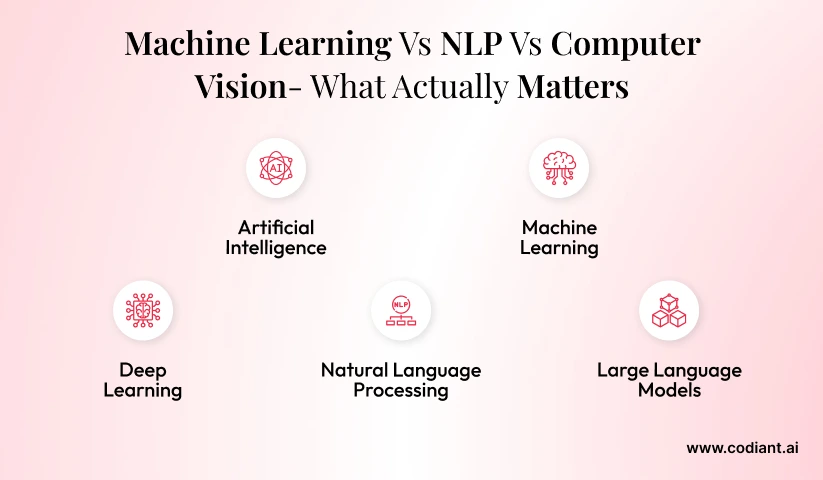
Understanding the difference between these technologies is not academic. It directly impacts where you invest.
Machine Learning (ML)
This is your prediction engine.
Machine learning identifies patterns in data and makes predictions. Think demand forecasting, fraud detection, recommendation systems.
If your business depends on-
- Forecasting trends
- Detecting anomalies
- Personalizing experiences
Then enterprise machine learning solutions are your starting point.
Natural Language Processing (NLP)
This is your communication layer.
NLP helps machines understand and respond to human language. It powers chatbots, document processing, sentiment analysis.
If your operations involve-
- Customer conversations
- Large volumes of text data
- Support automation
Then NLP solutions for businesses make sense.
Computer Vision
This is your visual intelligence system.
Computer vision interprets images and videos. It enables automation where human inspection was once required.
If your workflows involve-
- Visual quality checks
- Surveillance or monitoring
- Medical or industrial imaging
Then computer vision enterprise applications become critical.
The key takeaway in the machine learning vs NLP vs computer vision debate is simple-
👉 ML predicts
👉 NLP understands language
👉 Computer Vision understands visuals
Your investment decision should follow your business bottleneck.
When Should Companies Invest in Machine Learning?
Timing matters.
Machine learning delivers value when-
- You have large volumes of structured or historical data
- Decisions rely on patterns, not rules
- Manual analysis is too slow or inaccurate
For example-
- E-commerce companies use ML for recommendations
- FinTech firms use it for fraud detection
- Logistics companies optimize routes and demand forecasting
Without sufficient data, ML struggles. With the right data, it becomes a competitive advantage.
This is why AI investment strategy enterprises should always begin with a data audit.
Where NLP Delivers the Highest Business Impact?
NLP is often the fastest entry point into AI.
Why? Because most businesses already deal with language-heavy processes.
You’ll see strong ROI when-
- Customer support volumes are high
- Documents need classification or extraction
- Communication workflows are repetitive
Examples-
- Automated customer support with conversational AI
- Contract analysis in legal teams
- Email triaging in operations
Modern conversational AI for enterprises has moved far beyond basic chatbots. As businesses explore how to hire AI chatbot developers, they increasingly seek expertise in solutions that can handle multi-step workflows, understand context, and integrate seamlessly with internal systems.
This makes NLP a powerful tool in enterprise workflow automation AI.
What Business Problems Can Computer Vision Solve?
Computer vision is transforming industries where “seeing” is part of the workflow.
It shines in environments where-
- Human inspection is slow or inconsistent
- Safety monitoring is critical
- Image-based decisions impact outcomes
Common use cases-
- Manufacturing- defect detection on assembly lines
- Healthcare- medical image analysis
- Retail- shelf monitoring and inventory tracking
- Security- facial recognition and surveillance
These computer vision enterprise applications reduce errors, improve speed & enable real-time decision-making.
For CTOs, the question is not “Do we need computer vision?”
It’s “Where are we still relying on human eyes unnecessarily?”
How CTOs Can Build a Practical AI Adoption Strategy?
This is where strategy turns into execution.
A strong enterprise AI roadmap typically follows this path-
- Identify High-Impact Use Cases
Focus on areas where AI can-
- Reduce costs
- Increase revenue
- Improve customer experience
Avoid broad experimentation. Start with focused problems.
- Assess Data Readiness
No data, no AI.
Evaluate-
- Data availability
- Data quality
- Data accessibility
Most failed AI projects fail here, not in modeling.
- Choose the Right AI Capability
Map use cases to-
- ML for prediction
- NLP for language
- Computer vision for images
This ensures alignment between problem and solution.
- Start with Pilot Projects
Don’t scale immediately.
Run controlled pilots to-
- Validate outcomes
- Measure ROI
- Identify bottlenecks
- Scale with Infrastructure
Once validated-
- Integrate into workflows
- Automate pipelines
- Monitor performance continuously
This is where enterprise AI automation tools come into play.
Industries Seeing the Biggest AI Impact Right Now
AI is not industry-specific. But some sectors are accelerating faster.
- Healthcare– diagnostics, patient data analysis, medical imaging
- Finance– fraud detection, risk scoring, automation
- Retail & E-commerce– personalization, inventory prediction
- Manufacturing– quality control, predictive maintenance
- Logistics– route optimization, demand forecasting
These industries benefit because they generate high volumes of data and operate at scale.
That’s where AI thrives.
How to Choose the Right AI Investment Strategy?
Not every business needs all three technologies at once.
A smart AI investment strategy enterprise follows this order-
- Start with the biggest operational bottleneck
- Match it to the right AI capability
- Validate ROI quickly
- Expand gradually
For example-
- Start with NLP for support automation
- Add ML for predictive insights
- Introduce computer vision for operational efficiency
This phased approach reduces risk and improves adoption.
Challenges CTOs Must Prepare For
AI adoption is not frictionless.
Common challenges include-
- Data silos across departments
- Lack of skilled AI talent
- Integration with legacy systems
- Unrealistic expectations from leadership
- Difficulty measuring ROI early
This is where AI consulting for enterprises often plays a critical role, helping organizations avoid costly missteps.
How CodiantAI Helps CTOs Build Scalable AI Strategies?
Building AI internally is possible. Scaling it efficiently is harder.
CodiantAI supports enterprises by combining strategy, development & deployment into a unified approach.
- Identify high-impact AI opportunities aligned with business goals
- Build custom ML, NLP & computer vision solutions
- Integrate AI seamlessly into existing enterprise systems
- Ensure scalability, compliance & long-term performance
Accelerate your digital transformation with CodiantAI’s enterprise AI automation solutions designed to solve real business challenges. By combining advanced AI capabilities with RPA for businesses, we help CTOs automate repetitive processes, improve operational efficiency, reduce costs, and turn innovative ideas into measurable business outcomes, without adding unnecessary complexity.
Conclusion- AI Strategy Is About Precision, Not Hype
AI is powerful, but only when applied correctly.
CTOs don’t need more tools. They need clarity.
- Use machine learning operations when prediction drives value
- Use NLP when communication is the bottleneck
- Use computer vision when visual data holds insights
The goal is not to adopt AI everywhere.
The goal is to apply it where it matters most.
That’s what defines a successful enterprise AI strategy in 2026.
Ready to Build Your Enterprise AI Roadmap?
Get a tailored AI strategy aligned with your business goals, data readiness, and long-term growth plans.
Frequently Asked Questions
The nature of the problem, type of data available, expected outcomes & scalability requirements determine whether ML, NLP, or computer vision fits best.
Start with departments where inefficiencies directly impact revenue or costs, then expand based on measurable success and scalability potential.
Enterprises need cloud computing, data pipelines, storage systems, APIs & monitoring tools to support scalable and reliable AI deployment.
Track metrics like cost reduction, process efficiency, revenue growth & customer satisfaction improvements tied directly to AI implementation outcomes.
Common challenges include poor data quality, integration issues, talent shortages, unclear strategy & difficulty aligning AI outcomes with business goals.
Featured Blogs
Read our thoughts and insights on the latest tech and business trends
RAG vs Fine-Tuning: Which Approach Is Right for Your Enterprise AI Knowledge System?
- September 24, 2026
- Artificial Intelligence
Retrieval-Augmented Generation (RAG) and fine-tuning are the two primary methods for customizing a Large Language Model (LLM) with an enterprise's own knowledge. RAG connects a general-purpose LLM to an external knowledge base at query time,... Read more
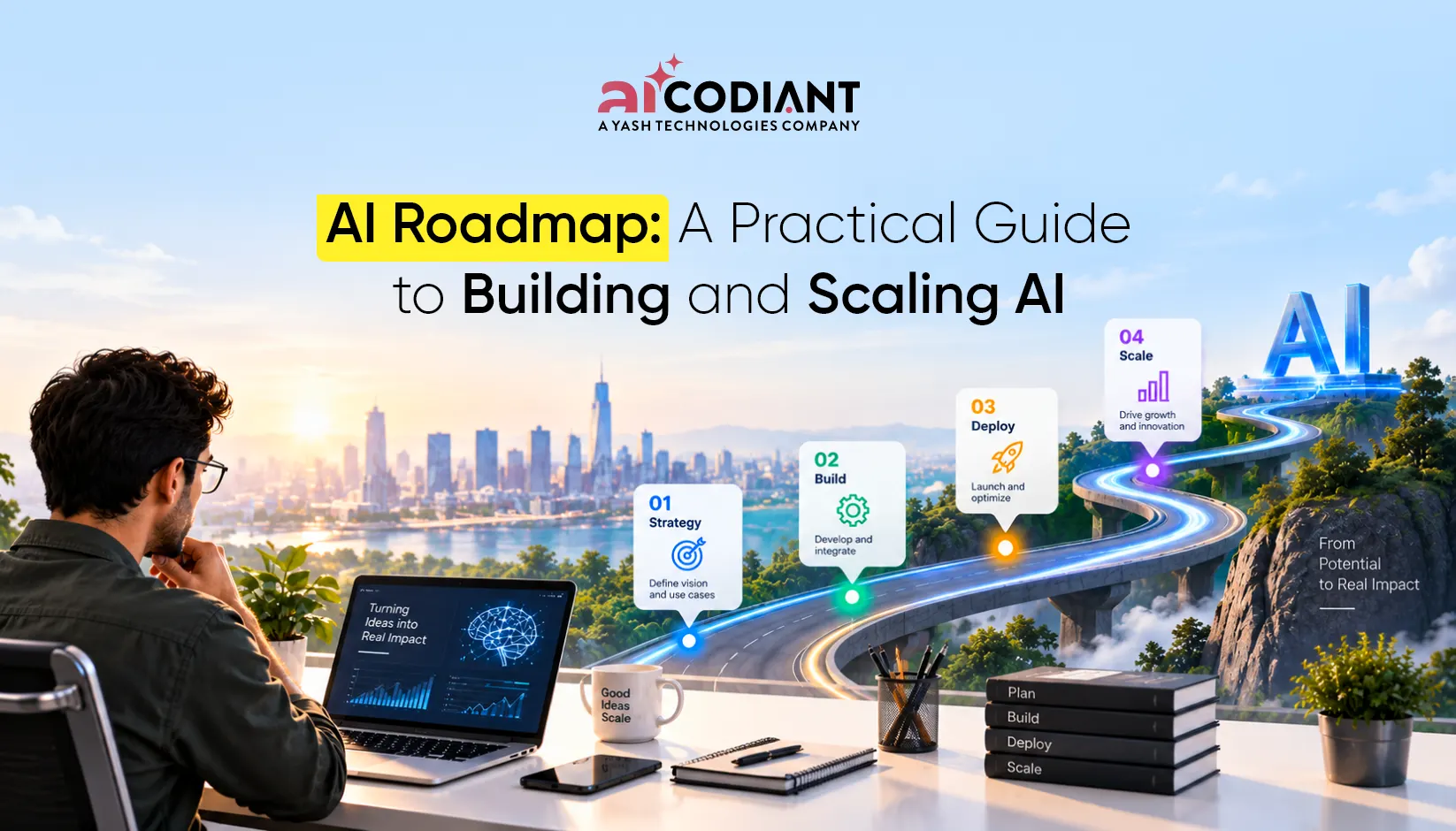
AI Roadmap: How to Build and Scale AI Across the Enterprise
- September 17, 2026
- Artificial Intelligence
An AI roadmap is a structured plan that connects business priorities with AI use cases, data, technology, governance, people, implementation, and measurable outcomes. For enterprises, it provides the sequence for moving from AI opportunities and... Read more

Top Predictive Analytics Models and Algorithms to Know
- September 11, 2026
- Artificial Intelligence
Predictive analytics models are statistical and machine learning systems that use historical data to forecast future outcomes, such as customer churn, equipment failure, demand spikes, or credit risk. The most widely used categories are regression... Read more