What is Generative AI? Complete Guide for Businesses (2026)
Table of Contents
Subscribe To Our Newsletter
A couple of years ago AI was primarily focused on prediction forecasting demand, flagging fraud and analyzing trends. It was quietly in the backend helping businesses in making better decisions.
Today, that’s changed.
AI doesn’t simply analyze anymore; it creates.
The latest generation of artificial intelligence has gone from experimental tech to an everyday business tool which is moving from writing product descriptions and generating blocks of code to designing visuals and even talking. And by 2026 it’s not optional anymore. It’s actually becoming a competitive necessity.
If you’re seeking to understand what generative AI actually is, how it works and where it fits in your business, this guide breaks it down straight without the jargon.
What is Generative AI in Simple Terms?
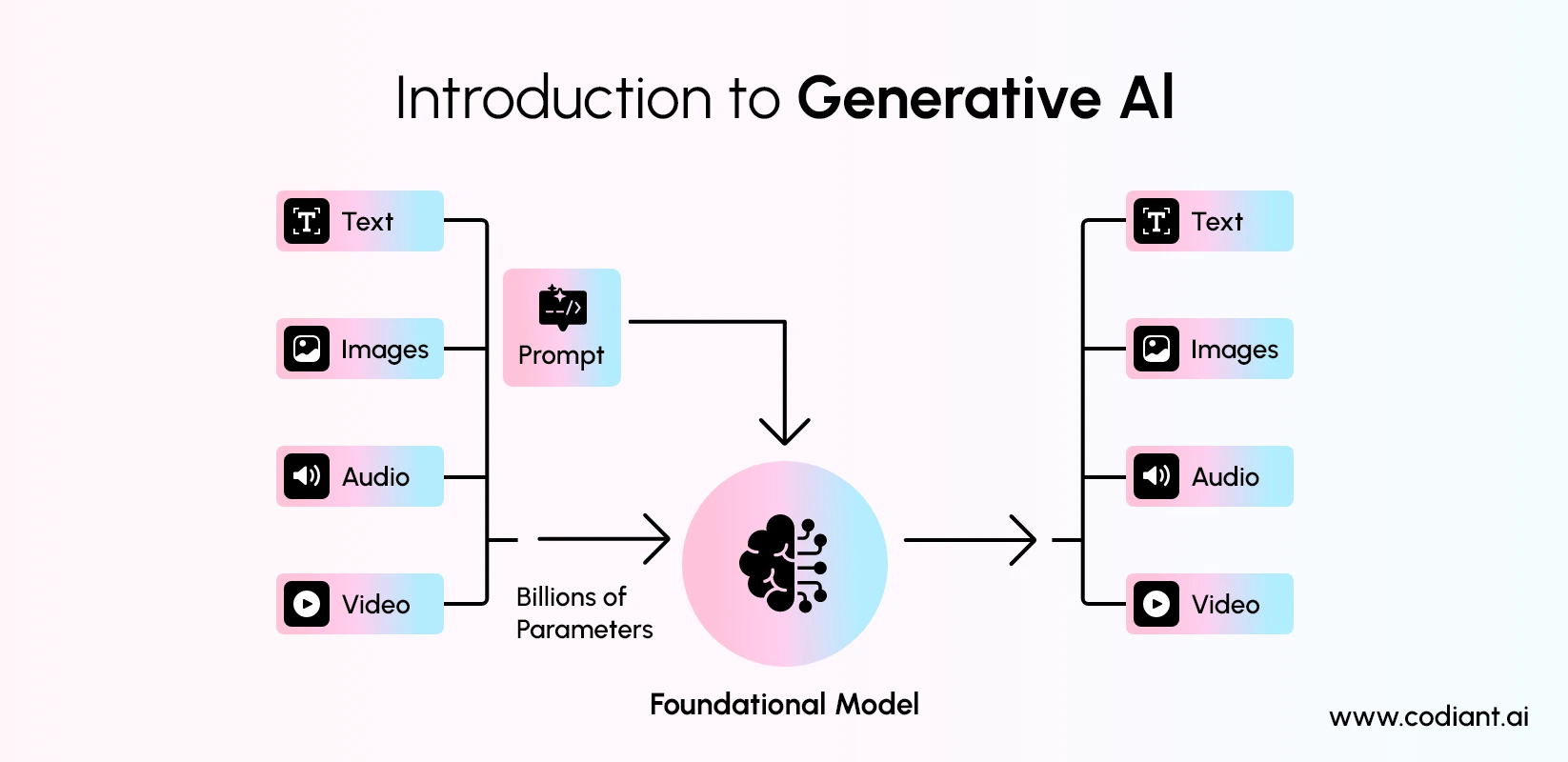
At its core, generative AI is a type of artificial intelligence that can create new content instead of just analyzing existing data.
Think of it like this-
- Traditional AI → Finds patterns
- Generative AI → Produces something new using those patterns
It can generate-
- Text (blogs, emails, reports)
- Images (designs, product visuals)
- Code (software scripts, automation logic)
- Audio & video (voiceovers, media content)
This is why tools like ChatGPT feel different they don’t just respond, they compose.
So when people ask, “Is ChatGPT generative AI?” the answer is yes. It’s one of the most widely used examples of generative AI in action.
Turn AI Curiosity into Business Impact
Stop exploring AI passively and start building real use cases that improve workflows, reduce costs, and drive measurable business outcomes today.
How Generative AI Actually Works?
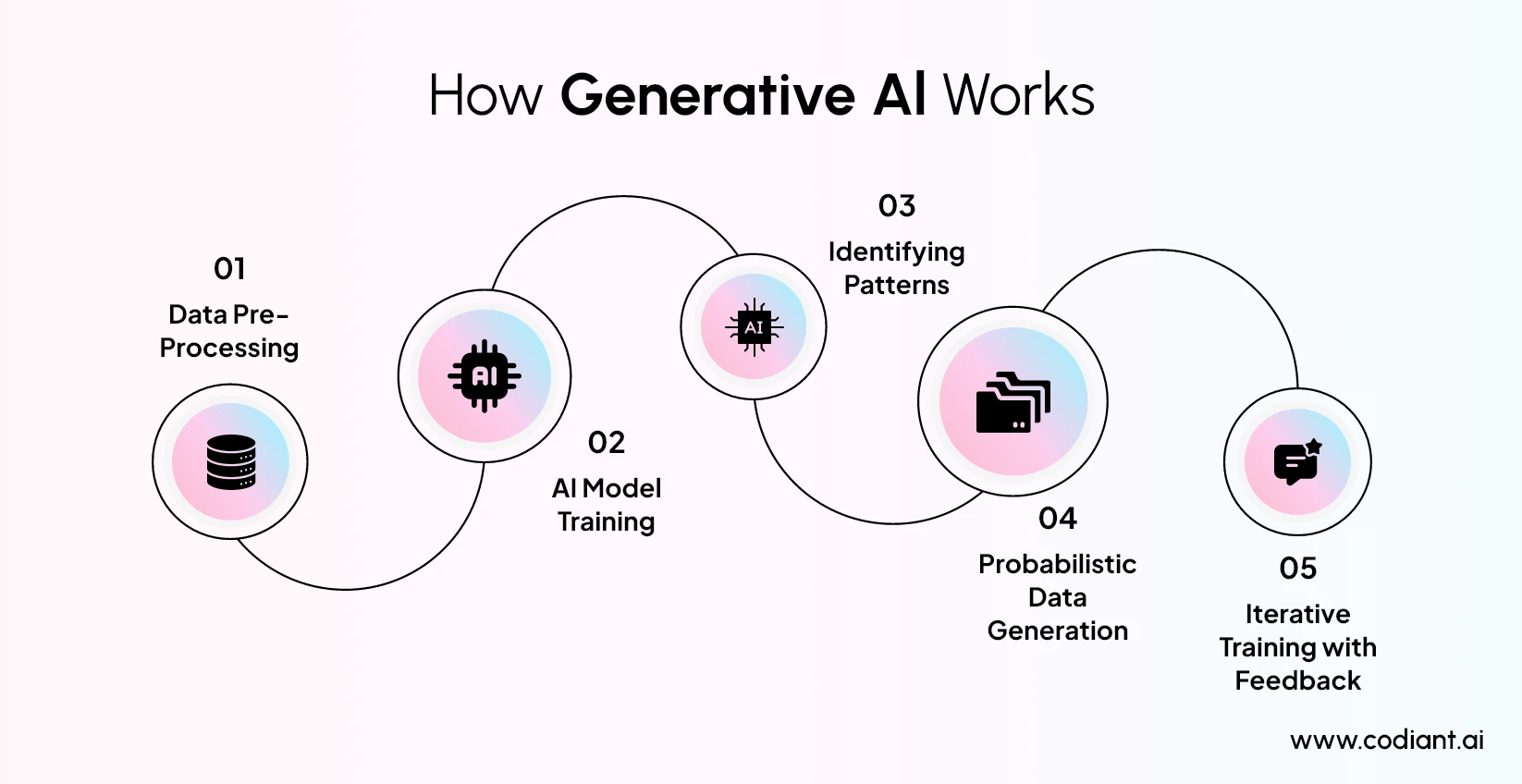
Behind the scenes, generative AI is powered by advanced models trained on massive datasets.
Here’s a simplified flow-
- Training Phase
The model learns from large amounts of text, images, or code. - Pattern Recognition
It identifies relationships, structures and context within that data. - Generation Phase
When given a prompt, it predicts and creates new output based on learned patterns.
For example-
- Input- “Write a product description for running shoes”
- Output- A fully structured, human-like description
This is what makes generative AI so powerful it doesn’t just retrieve answers, it builds them.
Generative AI vs Traditional AI- What’s the Real Difference?
Most businesses have already interacted with traditional AI analytics dashboards, recommendation engines, fraud detection systems.
But generative AI takes things further.
| Traditional AI | Generative AI |
| Focuses on prediction | Focuses on creation |
| Works on structured data | Works on unstructured data |
| Outputs insights | Outputs content |
| Rule-based or statistical | Context-aware and creative |
In simple terms-
- Traditional AI tells you what might happen
- Generative AI helps you create what’s needed next
Read Also: Difference Between Generative AI and Traditional AI
The Role of Generative AI in Modern Business Growth
Generative AI is not just another tool it’s reshaping how work gets done.
Here’s what’s driving adoption-
1. Speed at Scale
Tasks that once required hours of manual effort are now completed in minutes, enabling faster execution across content creation, coding, reporting and operations.
2. Cost Optimization
Businesses are minimizing operational costs by reducing reliance on large teams for repetitive tasks, while maintaining quality and improving overall efficiency.
3. Personalization at Depth
AI enables businesses to deliver highly tailored experiences by generating personalized emails, recommendations and user interfaces based on individual customer behavior.
4. Smarter Decision Support
Generative AI analyzes vast datasets, summarizes insights & recommends actionable steps, helping teams make faster more informed decisions in dynamic environments.
5. Always-On Productivity
Unlike human teams, generative AI systems operate continuously, handling tasks around the clock and ensuring uninterrupted workflows, faster responses & consistent output.
This is why generative AI for business is no longer experimental it’s operational.
Real Generative AI Use Cases Across Business Functions
Generative AI is not limited to one department. It’s being used across the entire organization.
Marketing & Content
- Blog writing and SEO content generation
- Ad copy and campaign ideas
- Social media content planning
Sales & Customer Engagement
- AI-powered chatbots and assistants
- Personalized outreach emails
- Proposal and pitch generation
Product & Design
- UI/UX design suggestions
- Product mockups and prototypes
- Image generation for catalogs
Engineering & Development
- Code generation and debugging
- Documentation creation
- Test case generation
Operations & Support
- Automated reports and summaries
- Knowledge base generation
- Workflow automation
These are practical generative AI applications already being used not future predictions.
Generative AI Examples in Business You Already See
Even if you don’t realize it, generative AI is already part of many business tools.
Some common examples-
- AI writing assistants used by marketing teams
- Design tools generating visual concepts instantly
- AI copilots helping generative AI developers write code faster
- Customer support bots handling complex queries
- AI-powered analytics tools summarizing dashboards
This is how generative AI quietly integrates into workflows enhancing productivity without replacing entire systems.
Industries Adopting Generative AI the Fastest
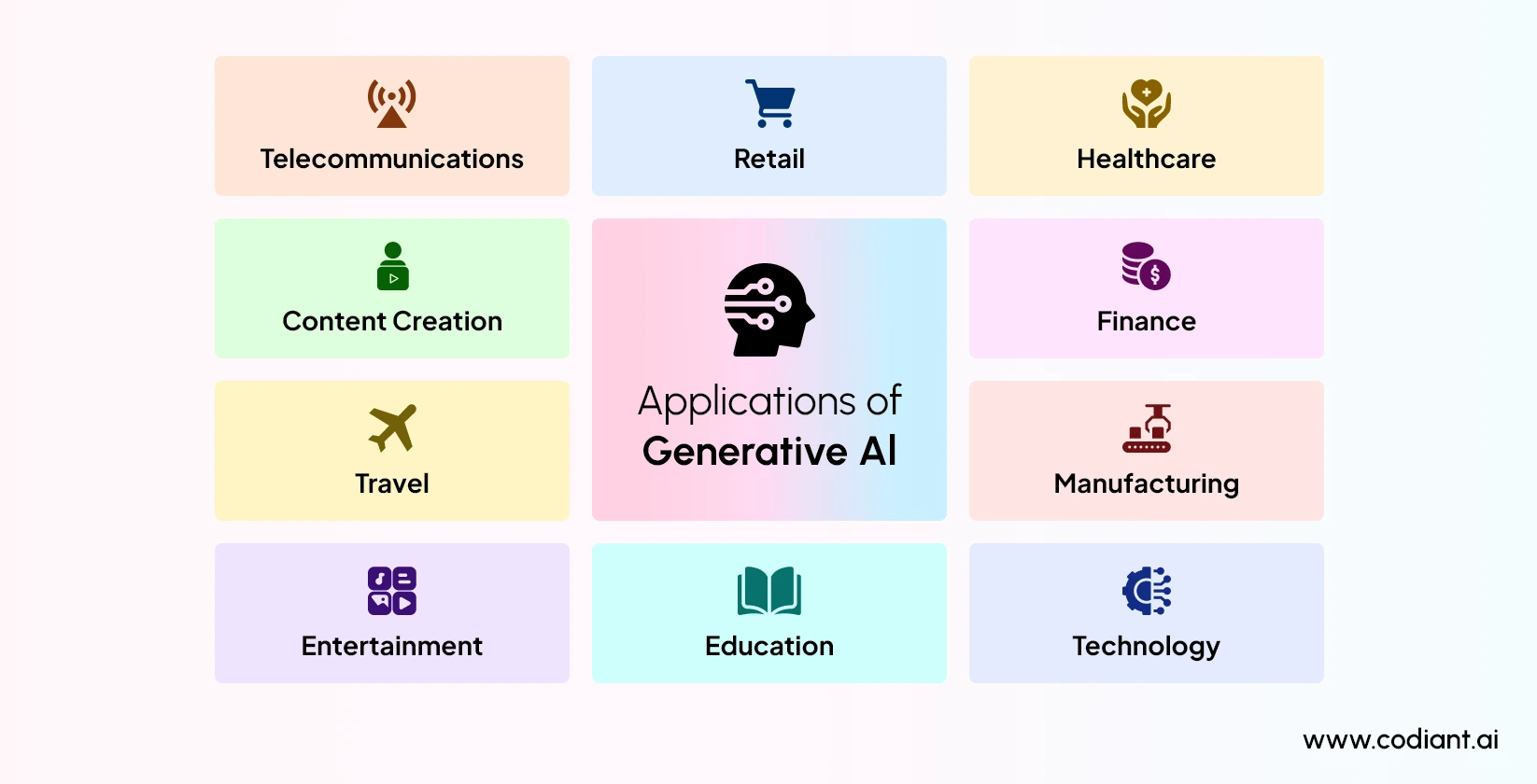
While adoption is widespread, some industries are moving faster due to clear ROI.
Telecommunications
Telecom companies leverage generative AI for automating customer support, generating responses, network planning optimization and personalizing communication at large scale with high efficiency.
Retail
Retailers leverage generative AI in all aspects of product descriptions to recommendations to visual merchandising, demand forecasting & inventory decisions that drive conversions.
Healthcare
Generative AI is employed by healthcare providers to create clinical documentation, summarize reports and communication with patients; assist in diagnostics & dramatically lower administrative burden throughout medical workflows.
Content Creation
Content teams rely on generative AI to produce blogs, ads, scripts, visuals & campaigns faster, maintaining consistency without stretching creative resources thin.
Finance
Financial institutions use generative AI for risk analysis summaries, fraud explanations, automated reporting, customer communication & improving decision-making clarity across complex datasets.
Manufacturing
In the manufacturing industry, generative AI can be leveraged to optimize designs, provide insights into predictive maintenance, document and automate processes & streamline production without adversely affecting existing systems.
Travel
Travel platforms leverage generative AI for itinerary generation, dynamic pricing content, customer support automation & relevant recommendations that actually address a traveller’s needs.
Entertainment
Entertainment industries leverage generative AI for scriptwriting, music composition, video generation, content personalization & faster creative experimentation across digital media platforms.
Education
Educational platforms use generative AI to create learning materials, summaries, personalized tutoring experiences, assessments & scalable content delivery tailored to individual student needs.
Technology
Technology companies integrate generative AI into products, copilots, automation tools & platforms, accelerating development cycles while redefining how software itself gets built.
Benefits of Generative AI for Enterprises
For enterprises, the impact goes beyond efficiency it reshapes operations.
1. Productivity Gains
Generative AI propels reduction of manual work across content, coding and analysis while allowing teams to dedicate time on strategic work significantly improving the opportunity without proportionally increasing workforce size.
2. Faster Time-to-Market
Generative AI expedites ideation, prototyping & execution which enables businesses to bring products, campaigns & solutions to market at a much faster pace reducing lead time and capturing market opportunities.
3. Enhanced Customer Experience
AI enables hyper-personalized communication, recommendations & support, allowing businesses to deliver tailored interactions at scale, improving engagement, satisfaction & long-term customer loyalty.
4. Reduced Operational Load
Repetitive tasks like documentation, reporting & communication are automated, freeing teams from routine workloads and allowing them to focus on innovation and high-value business activities.
5. Better Knowledge Utilization
Generative AI organizes and retrieves insights from large internal datasets, helping teams access relevant information quickly and make informed decisions without manually searching through scattered knowledge sources.
This is why many organizations are investing in enterprise generative AI solutions rather than standalone tools.
Build AI Solutions That Actually Solve Business Problems
From content automation to enterprise workflows, design generative AI solutions aligned with your goals, systems, and long-term growth roadmap effectively.
Popular Generative AI Tools in 2026
The ecosystem has grown rapidly & businesses now have access to a wide range of tools.
Content & Communication
- Chat-based AI assistants
- AI writing platforms
- Automated email generators
Design & Creativity
- AI image generators
- Video creation tools
- Brand design assistants
Development & Engineering
- AI coding copilots
- Debugging assistants
- Documentation generators
Business Intelligence
- AI-powered dashboards
- Insight summarization tools
- Predictive + generative hybrid systems
Choosing the right tool depends on your workflow, not just features.
Risks and Challenges Businesses Should Not Ignore
While generative AI offers major advantages, it also comes with risks.
- Accuracy Issues
AI can generate incorrect or misleading information.
- Data Privacy Concerns
Sensitive business data must be handled carefully.
- Over-Reliance on Automation
Human judgment is still essential.
- Bias in Outputs
AI models can reflect biases present in training data.
- Compliance & Governance
Regulations around AI usage are evolving quickly.
Businesses need a clear strategy not just adoption for long-term success.
How Businesses Are Using Generative AI in 2026
In 2026, companies are moving beyond experimentation and focusing on integration.
Instead of using isolated tools, they are-
- Embedding AI into internal systems
- Building custom AI workflows
- Integrating AI with CRM, ERP & analytics platforms
- Creating domain-specific AI assistants
This shift marks the move from tools → to AI-powered business ecosystems
Getting Started with Generative AI in Your Business
If you’re planning to adopt generative AI, start with clarity not complexity.
Step 1- Identify High-Impact Areas
Begin by identifying tasks that consume time and resources. Focus on repetitive workflows, content-heavy operations & decision-intensive processes where AI can deliver immediate, measurable efficiency gains.
Step 2- Start Small
Avoid large-scale implementation initially. Start with a focused pilot in one department, measure outcomes, gather feedback & refine the approach before expanding AI adoption across business functions.
Step 3- Choose the Right Tools
Select tools that align with your existing systems. Prioritize seamless integration, scalability & usability instead of chasing advanced features that may not fit your workflows or team capabilities.
Step 4- Build Governance
Establish clear guidelines for AI usage within your organization. Define data access rules, content validation processes, compliance standards & accountability frameworks to ensure responsible and secure implementation.
Step 5- Train Teams
Equip your teams with the knowledge to use AI effectively. Provide training, encourage experimentation & build confidence so employees see AI as an enabler, not a replacement.
The Future of Generative AI in Business
Generative AI is evolving quickly.
What we’re seeing now is just the beginning.
In the next few years, expect-
- More autonomous AI agents handling workflows
- Real-time personalization across platforms
- Industry-specific AI models
- Seamless integration into everyday tools
The businesses that win won’t be the ones using AI occasionally.
They’ll be the ones building around it.
How CodiantAI Helps Businesses Leverage Generative AI?
Adopting generative AI is not just about tools it’s about building solutions that align with your business goals. That’s where CodiantAI steps in.
We help organizations move from experimentation to real, production-ready AI systems through:
- Custom enterprise generative AI solutions tailored to your workflows
- Integration with existing platforms like CRM, ERP & internal tools
- Development of AI agents, copilots & automation pipelines
- Secure, scalable deployment with governance and compliance in place
From strategy to execution, CodiantAI ensures your AI initiatives deliver measurable business impact not just innovation for the sake of it.
Conclusion
Generative AI is not just a hype, it is revolutionizing the way businesses operate, create and scale. It reduces complexity, saves time and increases efficiency.
However, the true value is not in using AI tools but rather how wisely you apply them to your daily operations.
Firms that take AI as a strategy not just a tool will move more quickly. In 2026, there are no longer decisions about whether to use generative AI.
The real question is how quickly you can bring it into your processes and make it part of everything you do.
Move from AI Experiments to Scalable Implementation
Transform scattered AI tools into structured, scalable solutions that integrate seamlessly with your operations and deliver consistent performance across departments.
Frequently Asked Questions
Generative AI is not just analyzing data, it is creating new content by understanding patterns learned from massive datasets and generating everything from text to images based on prompts.
Businesses are leveraging it for content generation, automation, customer engagement, coding and analytics & also; building intelligent workflows across departments.
This results in increased productivity, lower costs, greater personalization, faster execution & better decision-making.
Key risks include inaccurate outputs, data privacy concerns, bias, compliance issues & over-reliance on automation.
E-commerce, healthcare, finance, real estate, education & media are leading adoption due to high content and operational demands.
Featured Blogs
Read our thoughts and insights on the latest tech and business trends
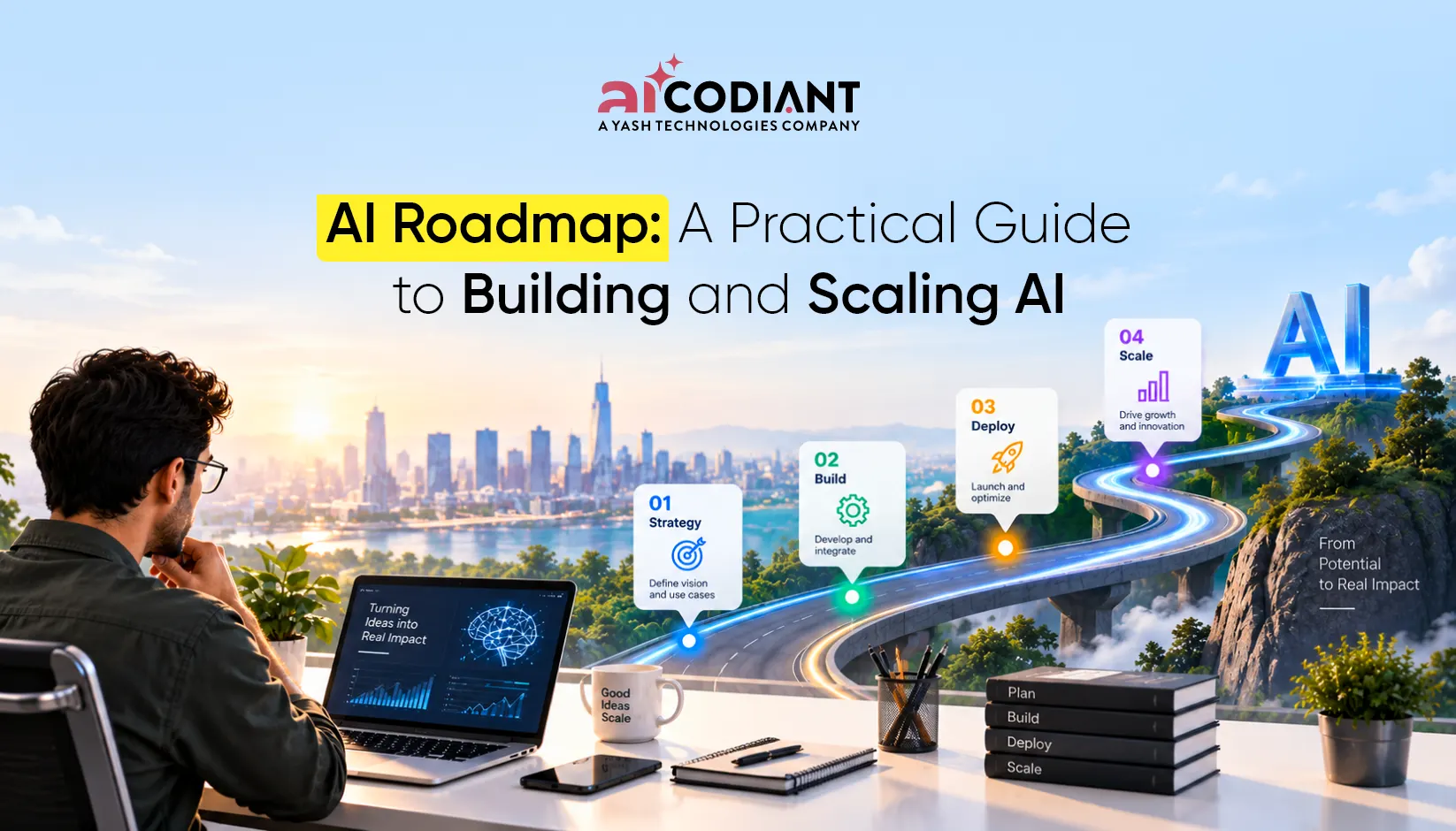
AI Roadmap: How to Build and Scale AI Across the Enterprise
- September 17, 2026
- Artificial Intelligence
An AI roadmap is a structured plan that connects business priorities with AI use cases, data, technology, governance, people, implementation, and measurable outcomes. For enterprises, it provides the sequence for moving from AI opportunities and... Read more

Top Predictive Analytics Models and Algorithms to Know
- September 11, 2026
- Artificial Intelligence
Predictive analytics models are statistical and machine learning systems that use historical data to forecast future outcomes, such as customer churn, equipment failure, demand spikes, or credit risk. The most widely used categories are regression... Read more

AI Data Analytics: What It Is, Why It Matters, and Business Use Cases
- September 4, 2026
- AI-Powered Data Analytics
AI data analytics uses artificial intelligence to examine data and turn it into useful insights. It helps businesses identify patterns, predict what may happen next, and decide what actions to take. It can analyze numbers,... Read more