How Generative AI is Transforming Enterprises Across Industries?
Table of Contents
Subscribe To Our Newsletter

Generative AI is fundamentally reshaping how enterprises operate, compete, and deliver value automating complex workflows, accelerating decision-making, and unlocking new revenue streams across every major industry. Organizations that deploy enterprise generative AI solutions are reporting 30–40% productivity gains within 12 months, making AI transformation in business the defining strategic priority of 2026.
From financial services and healthcare to manufacturing and retail, generative AI for enterprises is no longer a future consideration it is today’s competitive advantage.
This guide covers the industries leading adoption, the highest-impact use cases, and how your organization can build a winning enterprise AI strategy.
Key Takeaways:
- Generative AI is moving from isolated experiments into customer service, software development, finance, operations, marketing, research, and internal knowledge management.
- Healthcare, financial services, manufacturing, and retail are among the industries exploring high-value enterprise applications.
- The strongest use cases address specific business problems instead of introducing AI without a clear operational purpose.
- Secure enterprise AI requires governed data access, human review, continuous monitoring, and protection against inaccurate or manipulated outputs.
- AI ROI should be measured through time savings, quality improvements, cost reduction, employee capacity, and revenue impact.
How is Generative AI Transforming Enterprises?
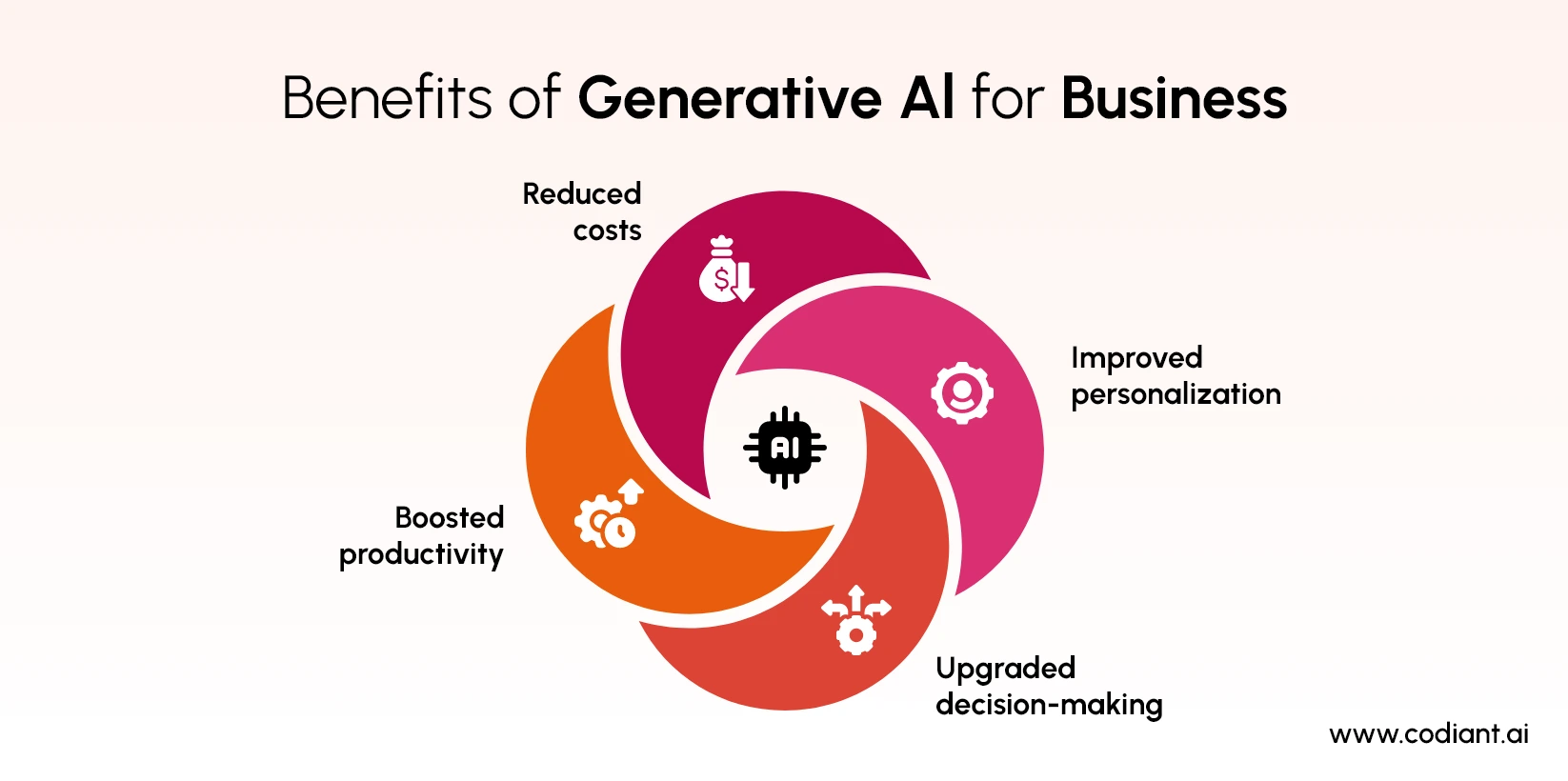
Generative AI is transforming enterprises by automating knowledge-intensive work, improving decision-making, and helping teams create new products and services faster. Instead of replacing entire roles, it supports employees by handling repetitive tasks, summarizing large volumes of information, drafting content, generating code, and assisting with customer interactions.
The transformation generally occurs across three enterprise areas:
- Process automation: Generative AI can support report creation, document review, data extraction, knowledge search, and routine communication. This reduces manual effort and allows employees to focus on complex, strategic work.
- Decision support: AI systems can organize internal data, summarize findings, identify patterns, and present relevant information for human review. Final decisions should still involve appropriate oversight, especially in regulated or high-risk environments.
- Product and service innovation: Enterprises can use generative AI to build intelligent assistants, personalized digital experiences, automated content tools, and AI-enabled workflows.
The strongest results come when generative AI is connected to reliable business data, clear governance, human approval, measurable operational goals, and controls.
Turn Generative AI into Measurable Enterprise Business Value
Identify high-impact use cases, reduce implementation risks, and build an AI roadmap aligned with business goals.
What Industries Benefit Most from Generative AI?
Healthcare, financial services, manufacturing, and retail are among the industries gaining the clearest value from generative AI. These sectors manage large volumes of data, documents, customer interactions, and complex workflows, making them strong candidates for responsible AI automation.
Healthcare and Life Sciences
Generative AI helps healthcare organizations reduce administrative work, summarize clinical information, support medical documentation, improve patient communication, and accelerate research. Life sciences companies also use it to review scientific literature, support drug discovery, prepare regulatory content, and organize complex research data. Human oversight remains essential for clinical decisions, diagnoses, and patient safety.
Financial Services and Banking
Banks, insurers, and financial institutions use generative AI to summarize documents, assist compliance teams, support fraud investigations, personalize customer communication, and improve employee access to internal knowledge. It can also help review loan files, insurance claims, policies, and regulatory updates. Strong governance, data protection, and explainability are necessary because financial decisions can directly affect customers.
Manufacturing and Supply Chain
In manufacturing, generative AI supports product design, maintenance guidance, quality analysis, technical documentation, procurement, and supply chain planning. Engineers can use AI to explore design alternatives, summarize equipment data, and identify possible operational issues. However, generative AI should complement predictive analytics and industrial systems rather than replace validated engineering controls.
Retail and E-Commerce
Retailers use generative AI to create product content, personalize recommendations, power shopping assistants, summarize customer feedback, support service teams, and improve merchandising decisions. It can also help marketing teams adapt campaigns for different audiences and channels.
Which industry gains the most depends on data quality, workflow suitability, governance, integration, and measurable business goals. Enterprises should begin with a focused, low-risk use case before scaling generative AI across operations and continuously monitor output quality.
What Are the Top Business Use Cases of Generative AI?
The highest-ROI generative AI use cases in 2026 span every major enterprise function. Here are the applications delivering measurable business value today:
| Function | AI Application | Reported Impact |
| Customer Support | AI chatbots, ticket routing, sentiment analysis | 40–60% reduction in resolution time |
| Marketing & Content | Automated copy generation, A/B testing, SEO content | 3–5x content output with same headcount |
| Software Development | AI code generation, automated testing, documentation | 30–40% faster development cycles |
| HR & Talent | Resume screening, onboarding content, L&D personalization | 50% reduction in time-to-hire screening |
| Legal & Compliance | Contract review, regulatory monitoring, policy drafting | 70–80% reduction in manual review hours |
| Finance & Accounting | Report generation, anomaly detection, forecasting | 25–35% faster close cycles |
How Can Enterprises Implement Generative AI?
Enterprises can implement generative AI successfully by starting with clearly defined business problems, establishing governance early, and scaling only after measurable pilot results. A phased approach reduces implementation risk and helps teams align AI investments with operational priorities.
- Phase 1: Identify high-value use cases
Review existing workflows to find repetitive, time-consuming, data-heavy, or language-based tasks. Prioritize use cases where generative AI can improve speed, accuracy, employee productivity, or customer experience. - Phase 2: Run controlled pilots
Test generative AI in a limited business function before enterprise-wide deployment. Define measurable KPIs such as processing time, response quality, error reduction, adoption rate, or cost per task. - Phase 3: Establish AI governance
Create policies for data privacy, access controls, cybersecurity, model accuracy, bias monitoring, regulatory compliance, and human oversight. Sensitive or high-impact decisions should always include appropriate review and accountability. - Phase 4: Integrate and scale
Expand successful pilots by connecting AI tools with existing CRM, ERP, knowledge management, and analytics systems. Continuously monitor performance, user feedback, data quality, and security risks to ensure the solution remains accurate, reliable, and aligned with business objectives.
Move from AI Experiments to Scalable Business Impact
Build secure, integrated generative AI solutions that improve workflows, employee productivity, and customer experiences efficiently.
What Are the Benefits of Generative AI for Organizations?
Generative AI helps organizations improve productivity, decision-making, customer experience, and innovation by automating knowledge-intensive work and providing faster access to relevant information.
Key benefits include:
- Faster analysis: Generative AI can summarize documents, reports, and customer data, helping teams identify patterns and make informed decisions quickly.
- Personalized experiences: It can tailor content, recommendations, responses, and communications for different customers and audience segments at scale.
- Higher employee productivity: AI assistants support drafting, research, coding, documentation, and administrative work, giving employees more time for strategic and creative tasks.
- Faster innovation: Teams can use generative AI to explore ideas, develop prototypes, test concepts, and refine products more efficiently.
- Improved operational efficiency: Automating repetitive workflows can reduce manual effort, improve consistency, and accelerate service delivery.
Organizations achieve stronger results when generative AI is connected to reliable data, supported by human oversight, governed through clear policies, and aligned with measurable business objectives.
What Challenges Do Organizations Face When Adopting Generative AI?
Organizations adopting generative AI commonly face challenges involving data quality, security, output reliability, workforce readiness, system integration, and regulatory compliance. These barriers can prevent AI pilots from delivering measurable business value at scale.
- Data quality and governance: Generative AI requires accurate, accessible, and properly governed enterprise data. Fragmented records, outdated information, unclear ownership, and inconsistent data formats can produce incomplete or unreliable responses.
- Security and privacy: Employees may unintentionally expose confidential information through public AI tools. Organizations need access controls, approved-use policies, data encryption, vendor assessments, and monitoring before connecting AI systems to sensitive business data.
- Hallucinations and inaccurate outputs: Generative AI can produce plausible but incorrect information. NIST identifies confabulation, commonly called hallucination, as a key generative AI risk. High-impact workflows therefore require testing, source validation, human review, and clearly defined escalation processes.
- Skills and change management: Employees need training to use AI responsibly, evaluate generated answers, redesign workflows, and understand when human judgment remains necessary.
- Integration and scalability: Connecting AI with existing databases, CRMs, applications, and security systems can be complex and costly.
- Regulatory uncertainty: AI requirements continue to evolve across jurisdictions. Organizations should maintain AI inventories, risk classifications, documentation, oversight controls, and audit trails instead of relying on a single compliance deadline.
How Secure Are Enterprise Generative AI Solutions?
Enterprise generative AI solutions can be secure when they are designed with strong data protection, access control, monitoring, and governance from the start.
Security does not depend only on the AI model. It depends on how the solution is deployed, integrated, and controlled within the enterprise environment.
The most secure generative AI systems use private or controlled deployment models, such as private cloud, virtual private environments, or on-premise infrastructure, to reduce exposure of sensitive business data.
They also apply role-based access controls, so users and AI agents can only access the data they are authorized to use.
For regulated industries, audit logs are essential. Every prompt, response, data source, and action should be traceable for review, accountability, and compliance support.
Enterprises should also test AI systems regularly for risks such as prompt injection, unauthorized data access, data leakage, and unsafe outputs.
In short, enterprise generative AI is secure when it is governed like any critical business system.
How Can Enterprises Measure ROI from Generative AI Initiatives?
Enterprises can measure generative AI ROI by connecting AI performance to clear business outcomes, including cost savings, productivity gains, quality improvements, and revenue growth. The most reliable approach is to establish baseline metrics before deployment and compare them with post-implementation results.
- Time savings: Track the reduction in hours required to complete specific tasks and calculate the associated labour cost savings.
- Quality improvement: Measure changes in error rates, rework, compliance issues, response accuracy, and output consistency.
- Revenue impact: Compare conversion rates, average order value, lead qualification, retention, or customer engagement before and after AI adoption.
- Cost reduction: Monitor decreases in operational expenses, support costs, and manual processing requirements.
- Payback period: Calculate how long it takes for measurable financial benefits to recover implementation, integration, training, and maintenance costs.
Read Also: Agentic AI vs Generative AI
How Codiant.AI Helps Enterprises Implement Generative AI?
Codiant.AI helps enterprises turn generative AI opportunities into secure, practical, and measurable business solutions. The process begins by identifying suitable workflows, assessing data readiness, and defining expected outcomes before selecting models or platforms.
Enterprise support can include:
- AI strategy and use-case prioritization
- Custom generative AI application development
- Retrieval-augmented generation and knowledge assistants
- Workflow automation and enterprise system integration
- Data governance, security, and human-review controls
- Performance monitoring and continuous improvement
Each solution is aligned with existing processes, technology environments, compliance requirements, and user needs. This structured approach helps businesses move from isolated pilots to scalable AI systems supporting customer service, operations, software development, knowledge management, and decision support while maintaining accuracy, accountability, and measurable performance.
The Bottom Line
Generative AI for enterprises has moved beyond experimentation and is becoming a practical part of business operations. Organizations are using it to automate workflows, improve decision-making, enhance customer experiences, and support employees with faster access to information.
Successful enterprise AI adoption starts with focused, measurable use cases rather than large-scale transformation. Businesses also need reliable data, strong governance, security controls, human oversight, and clear performance metrics.
The key question is no longer whether enterprises should explore generative AI, but where it can create measurable value. Organizations building responsible, scalable AI foundations today will be better prepared for future growth.
Create a Responsible Enterprise AI Foundation for Growth
Connect trusted data, governance, and automation to scale generative AI securely across complex enterprise operations.
Frequently Asked Questions
Generative AI is artificial intelligence that creates new content, such as text, code, images, audio, and structured data, from user instructions and learned data patterns. Enterprises use it by connecting AI models to approved business data, applications, and workflows through APIs, private infrastructure, or retrieval-augmented generation. For example, a company may connect a generative AI assistant to its internal knowledge base to answer employee questions using verified company documents. (NIST)
Enterprises measure generative AI ROI by comparing implementation and operating costs with improvements in time saved, productivity, error reduction, operating expenses, and revenue. A clear baseline should be recorded before deployment, such as average handling time, cost per transaction, or employee hours required for a workflow. BCG reported a median ROI of 10% among surveyed finance teams using AI and generative AI, showing that measurable returns depend heavily on implementation quality and workflow integration. (BCG Global)
The main challenges of enterprise generative AI adoption include poor data quality, security risks, unclear governance, employee skill gaps, and difficulty scaling pilots into production. Organizations can address these challenges by preparing their data, defining accountability, training employees, monitoring outputs, and keeping humans involved in high-risk decisions. McKinsey’s 2025 research found that workflow redesign, governance, talent, data, and adoption practices are closely linked to achieving measurable AI value. (McKinsey & Company)
Generative AI delivers the greatest value in business functions that manage large volumes of text, documents, software code, or customer interactions. Common high-value areas include customer service, software engineering, marketing, sales, legal operations, knowledge management, and human resources. McKinsey estimates that sales and marketing represent 28% of generative AI’s potential workplace value, followed by software engineering at 25%. (McKinsey & Company)
Enterprise generative AI solutions can be secure when they include access controls, data encryption, audit logs, output monitoring, risk testing, and restrictions on sensitive information. Security depends on the complete system architecture, including the model provider, hosting environment, connected data sources, user permissions, and governance processes. NIST recommends managing generative AI risks throughout the design, development, deployment, and evaluation lifecycle rather than relying on the model alone. (NIST)
Featured Blogs
Read our thoughts and insights on the latest tech and business trends
AI Roadmap: How to Build and Scale AI Across the Enterprise
- September 17, 2026
- Artificial Intelligence
An AI roadmap is a structured plan that connects business priorities with AI use cases, data, technology, governance, people, implementation, and measurable outcomes. For enterprises, it provides the sequence for moving from AI opportunities and... Read more

Top Predictive Analytics Models and Algorithms to Know
- September 11, 2026
- Artificial Intelligence
Predictive analytics models are statistical and machine learning systems that use historical data to forecast future outcomes, such as customer churn, equipment failure, demand spikes, or credit risk. The most widely used categories are regression... Read more

AI Data Analytics: What It Is, Why It Matters, and Business Use Cases
- September 4, 2026
- AI-Powered Data Analytics
AI data analytics uses artificial intelligence to examine data and turn it into useful insights. It helps businesses identify patterns, predict what may happen next, and decide what actions to take. It can analyze numbers,... Read more