NLP vs LLM vs Generative AI Explained: Enterprise AI Terminology Guide You Actually Need
Table of Contents
Subscribe To Our Newsletter
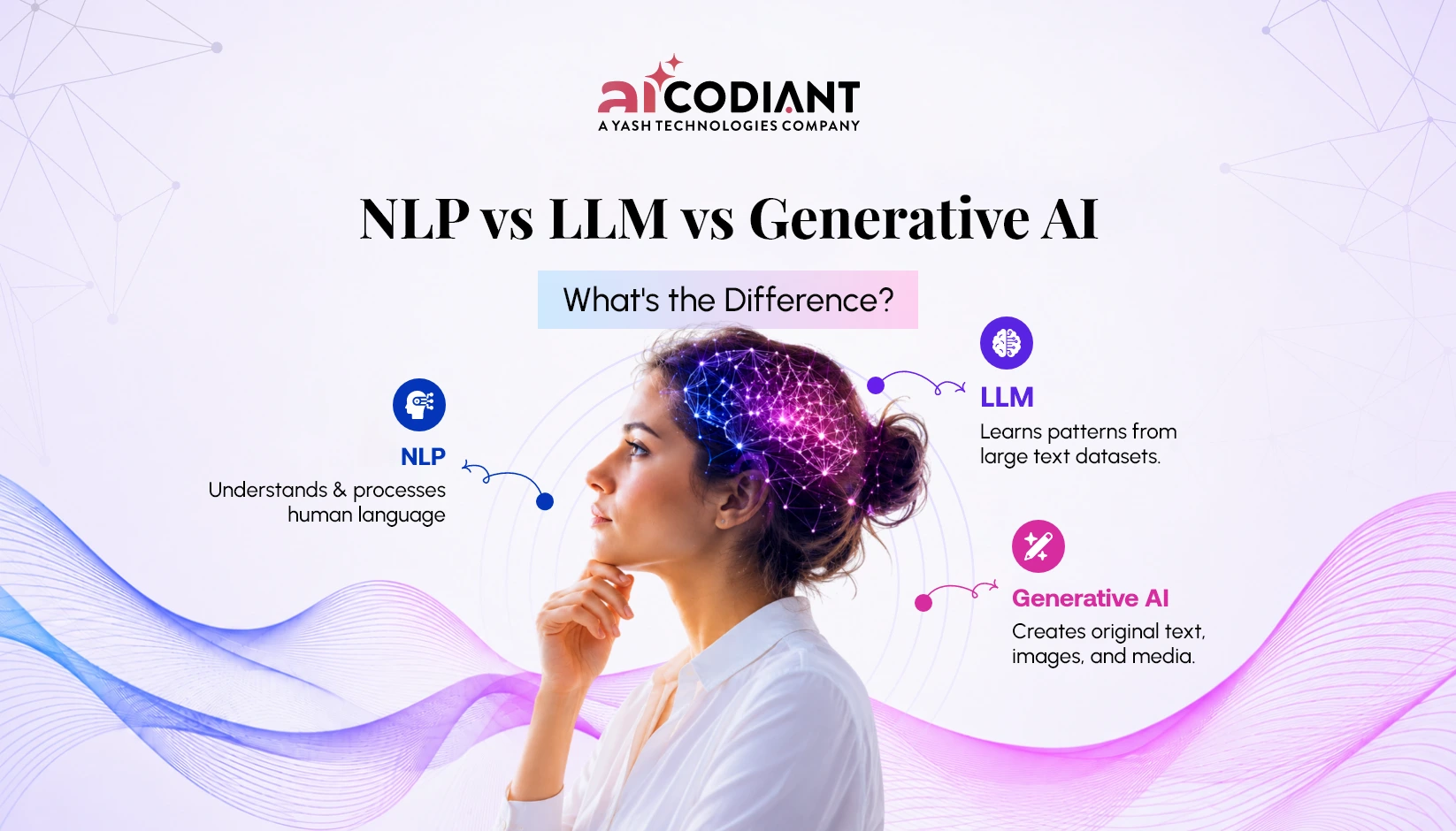
Natural Language Processing (NLP), Large Language Models (LLMs), and Generative AI are three distinct but deeply connected AI technologies and confusing them leads to costly enterprise decisions. NLP processes and understands language. LLMs are powerful neural networks trained on massive text data that can generate human-like responses. Generative AI is the broader capability umbrella that uses models like LLMs to create new content text, images, code, and more.
Understanding the difference between NLP and LLM, and where Generative AI fits in, is now a core competency for any business evaluating AI investments. This guide breaks down each technology, how they relate, where they diverge, and which one fits your use case.
Key Takeaways:
- NLP is the foundation it teaches machines to understand language.
- LLMs are a modern, large-scale evolution of NLP trained on billions of tokens.
- Generative AI uses LLMs (and other models) to create new content from prompts.
- Each has distinct enterprise use cases choosing the wrong one wastes budget.
- Most enterprise AI products today combine all three layers.
NLP vs LLM vs Generative AI: Quick Comparison
Before diving into each technology, here is a side-by-side comparison to orient your understanding:
| Feature | NLP | LLM | Generative AI |
| Definition | Language understanding & processing | Large-scale language model trained on massive data | AI that creates new content from prompts |
| Core Function | Classify, extract, translate, analyze | Understand & generate human-like text | Generate text, images, code, audio, video |
| Training Data | Task-specific labeled datasets | Billions of tokens from web & books | Large multimodal or text datasets |
| Output Type | Labels, scores, summaries, entities | Coherent long-form text | Novel creative or functional content |
| Business Use | Sentiment, NER, translation | Chatbots, search, summarization | Content creation, code gen, design |
| Examples | spaCy, NLTK, BERT | GPT-4, Claude, Gemini, LLaMA | ChatGPT, Midjourney, Copilot |
What Is the Difference Between NLP, LLM, and Generative AI?
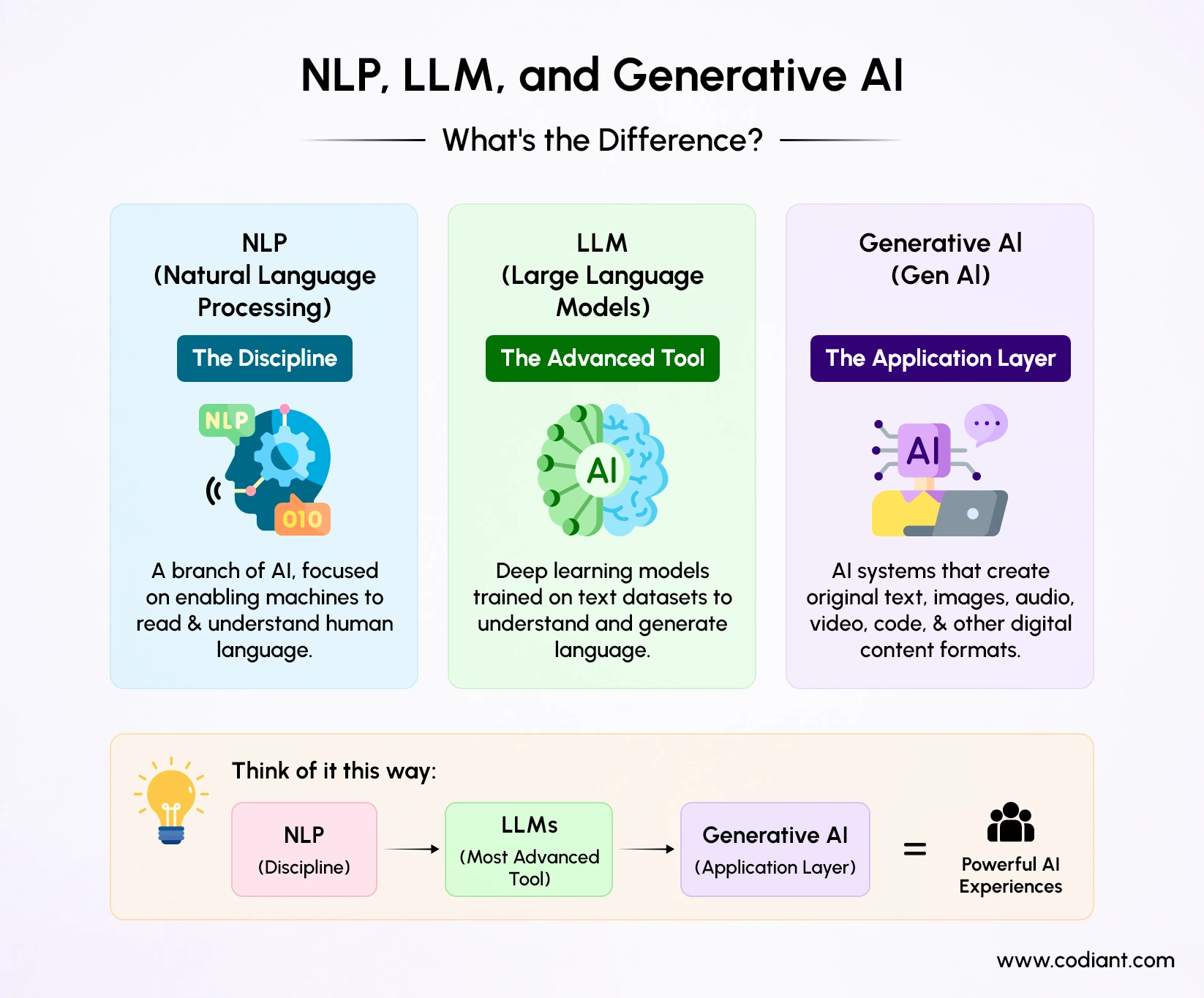
NLP (Natural Language Processing) is a branch of AI focused on enabling machines to read, understand, and derive meaning from human language. LLMs (Large Language Models) are a specific class of deep learning model trained on vast text data that can understand and generate language at a human-like level. Generative AI is the broader category of AI systems that generate new content, and most modern generative AI systems are powered by LLMs.
Think of it this way: NLP is the discipline, LLMs are the most advanced tool within that discipline, and Generative AI is the application layer built on top of LLMs. A business deploying an AI chatbot is likely using all three simultaneously NLP to parse intent, an LLM to generate the response, and a generative AI framework to deliver the experience.
What Is Natural Language Processing (NLP)?
Natural Language Processing is the field of AI that gives machines the ability to understand, interpret, and work with human language both written and spoken. NLP has been in active development since the 1950s and powers a wide range of enterprise applications that most businesses already use today.
Core NLP Tasks in Enterprise Use
- Text classification: Labeling documents, emails, or support tickets by topic or priority
- Sentiment analysis: Detecting positive, negative, or neutral tone in customer feedback
- Named Entity Recognition (NER): Identifying people, locations, dates, and organizations in text
- Machine translation: Converting content between languages automatically
- Text summarization: Condensing long documents into key points
- Speech-to-text: Transcribing spoken language into structured text
Traditional NLP systems rely on rule-based logic, statistical models, or smaller supervised machine learning models trained on labeled datasets. Tools like spaCy, NLTK, and early BERT variants represent this category. They are fast, explainable, cost-efficient, and well-suited to narrow, well-defined language tasks.
Is an LLM a Type of NLP?
Yes, Large Language Models are a subcategory of NLP, but they represent a fundamentally different generation of the technology. Traditional NLP models are trained on smaller, task-specific datasets and optimized for one function at a time. LLMs are trained on billions of tokens of text from across the internet, books, and code, which gives them general-purpose language capability that earlier NLP systems could not achieve.
The key distinction is scale and generalization. A traditional NLP model trained to detect sentiment cannot summarize a legal document. An LLM like GPT-4 or Claude can do both and thousands of other language tasks without task-specific retraining. This makes LLMs far more flexible but also significantly more resource-intensive to build and operate.
What Are Large Language Models (LLMs) and How Do They Work?
Large Language Models are deep learning systems specifically transformer-based neural networks trained on massive corpora of text data to predict, understand, and generate human language. The term ‘large’ refers to the number of parameters: modern LLMs range from 7 billion to over one trillion parameters.
How LLMs Are Built: Three Stages
- Pre-training
The model learns language patterns by predicting the next word across hundreds of billions of text tokens. This phase requires massive GPU clusters and significant compute cost.
- Fine-tuning
The pre-trained model is adapted on specific datasets to align it with desired behavior for example, medical terminology or customer service tone.
- RLHF (Reinforcement Learning from Human Feedback)
Human raters evaluate model outputs, and their preferences train a reward model that guides the LLM toward safer, more helpful responses. This is how ChatGPT, Claude, and Gemini are aligned for enterprise use.
Leading LLMs in 2025
- GPT-4o (OpenAI) – multimodal, widely used in enterprise API integrations.
- Claude Sonnet 4 (Anthropic) – strong at reasoning, long-context documents, and safe outputs.
- Gemini 1.5 Pro (Google DeepMind) – optimized for Google Workspace integration.
- LLaMA 3 (Meta) – open-source, popular for on-premise enterprise deployments.
- Mistral (Mistral AI) – efficient, fast, suited to cost-sensitive applications.
How Does Generative AI Use LLMs?
Generative AI refers to AI systems that produce new content text, images, audio, video, or code rather than simply classifying or analyzing existing content. LLMs are the primary engine powering text-based Generative AI. When a user types a prompt into ChatGPT or Claude, the LLM interprets the prompt and generates a statistically coherent, contextually relevant response this is Generative AI in action.
However, Generative AI is broader than LLMs alone. Image generation tools like Midjourney and DALL-E use diffusion models, not LLMs. Music generation tools like Suno use audio-specific architectures. The unifying principle is the ability to produce novel outputs which distinguishes Generative AI from classical systems that only classify, retrieve, or predict.
How Generative AI Is Deployed in Enterprise
- Retrieval-Augmented Generation (RAG): LLM responses grounded in company knowledge bases, reducing hallucinations.
- AI agents: LLMs given tools (web search, APIs, databases) to complete multi-step tasks autonomously.
- Fine-tuned domain models: LLMs adapted on proprietary data for legal, medical, or financial use cases.
- Multimodal AI: Combining text, image, and audio inputs in a single model for richer enterprise workflows.
Which Technology Should Businesses Adopt: NLP, LLM, or Generative AI?
The right technology depends on the specificity of your use case, your budget, your data infrastructure, and your risk tolerance. NLP solutions is the right choice when the task is narrow, well-defined, and requires explainability or low latency. LLMs are the right choice when you need flexible, general-purpose language capability. Generative AI is the right choice when the goal is content creation, conversational experience, or autonomous task completion.
Decision Framework: Which AI Layer Do You Need?
- Choose NLP if: You need fast, reliable classification, extraction, or translation at scale with low cost and explainable outputs
- Choose LLMs if: You need a flexible language layer that handles diverse queries, summarizes documents, or powers a sophisticated chatbot
- Choose Generative AI if: You need to create new content, automate creative workflows, or build AI agents that take multi-step actions
- Combine all three if: You are building an enterprise AI product most production systems use NLP for preprocessing, LLMs for understanding and generation, and Generative AI for the output experience
Note: Generative AI carries higher risks of hallucination and requires stronger governance frameworks. Businesses in regulated industries finance, healthcare, legal should layer NLP-based guardrails and human review on top of LLM outputs.
What Are the Business Use Cases of NLP and LLMs?
NLP Business Use Cases
- Customer support ticket routing and priority classification
- Sentiment analysis on product reviews and social media monitoring
- Contract clause extraction and document classification in legal departments
- Real-time speech transcription for sales calls and meetings
- Language detection and machine translation for global operations
LLM Business Use Cases
- Enterprise search and knowledge retrieval across internal documents
- AI-powered chatbots and virtual assistants for customer service
- Automated first-draft generation for reports, proposals, and emails
- Code review, completion, and documentation for engineering teams
- Summarization of long legal, financial, or research documents
- AI interview assistants and candidate screening in HR workflows
Generative AI Business Use Cases
- Marketing content generation blogs, ad copy, email campaigns at scale
- Product description generation for e-commerce catalogues
- AI-generated design mockups and creative briefs
- Autonomous AI agents for lead research and CRM data enrichment
- Code generation and full-stack application prototyping
Final Takeaway: NLP, LLM, and Generative AI Are a Stack, Not a Choice
NLP, LLMs, and Generative AI are not competing technologies they are complementary layers of the modern enterprise AI stack. NLP provides foundational language understanding. LLMs deliver general-purpose language intelligence at scale. Generative AI turns that intelligence into usable outputs: content, conversations, code, and autonomous action.
Businesses that treat these as separate silos will underinvest in one layer and over-rely on another. The organizations seeing the strongest AI ROI are those building coherent stacks using NLP for structured data and preprocessing, LLMs for reasoning and generation, and Generative AI frameworks for end-user experiences and automation.
The question for most enterprises is no longer whether to adopt these technologies it is how to sequence adoption intelligently, govern outputs responsibly, and build internal capability that compounds over time.
Build the Right AI Stack Before Your Competitors Move Faster
Get expert guidance to choose NLP, LLM, and Generative AI solutions confidently.
Frequently Asked Questions
NLP is the parent discipline that teaches machines to understand language. LLMs are the most advanced NLP models, trained at massive scale to generate human-like text. Generative AI is the application layer that uses LLMs (and other models) to create new content. In most enterprise AI products, all three layers work together: NLP preprocesses inputs, the LLM processes and generates, and Generative AI delivers the output experience to the end user.
Most enterprise chatbots today use LLMs as their core engine, combined with Retrieval-Augmented Generation (RAG) to ground answers in company-specific data. Traditional NLP-based chatbots (rule-based or intent-classification models) are faster and cheaper but cannot handle complex open-ended conversations. For high-volume, narrow-intent bots such as appointment booking or FAQ deflection NLP may still be the better choice on cost and reliability grounds.
Choose NLP over Generative AI when the task is well-defined, requires explainability, or operates in a regulated environment where hallucination risk is unacceptable. Sentiment analysis, document classification, named entity recognition, and speech-to-text are tasks where traditional NLP models perform reliably and cost-efficiently, with lower governance overhead than LLM-based Generative AI systems.
LLMs offer general-purpose language capability that eliminates the need to build separate models for each task. A single LLM can summarize documents, answer questions, draft content, translate languages, and write code tasks that previously required multiple specialized NLP systems. LLMs also adapt to new tasks through prompting alone, which dramatically reduces the time and cost of deploying new AI capabilities in enterprise environments.
NLP is converging with LLMs most state-of-the-art language tasks are now handled by transformer-based models rather than classical NLP pipelines. The near-term trajectory includes smaller, more efficient LLMs that run on-device, multimodal models that process text alongside images and audio, and agentic AI systems that use LLMs to plan and execute multi-step workflows. Businesses that build LLM-ready data infrastructure now will be best positioned to adopt these advances as they mature.
Featured Blogs
Read our thoughts and insights on the latest tech and business trends
RAG vs Fine-Tuning: Which Approach Is Right for Your Enterprise AI Knowledge System?
- September 24, 2026
- Artificial Intelligence
Retrieval-Augmented Generation (RAG) and fine-tuning are the two primary methods for customizing a Large Language Model (LLM) with an enterprise's own knowledge. RAG connects a general-purpose LLM to an external knowledge base at query time,... Read more
AI Roadmap: How to Build and Scale AI Across the Enterprise
- September 17, 2026
- Artificial Intelligence
An AI roadmap is a structured plan that connects business priorities with AI use cases, data, technology, governance, people, implementation, and measurable outcomes. For enterprises, it provides the sequence for moving from AI opportunities and... Read more

Top Predictive Analytics Models and Algorithms to Know
- September 11, 2026
- Artificial Intelligence
Predictive analytics models are statistical and machine learning systems that use historical data to forecast future outcomes, such as customer churn, equipment failure, demand spikes, or credit risk. The most widely used categories are regression... Read more