AI Roadmap: How to Build and Scale AI Across the Enterprise
Table of Contents
Subscribe To Our Newsletter
An AI roadmap is a structured plan that connects business priorities with AI use cases, data, technology, governance, people, implementation, and measurable outcomes. For enterprises, it provides the sequence for moving from AI opportunities and pilots to production systems that can deliver value at scale.
Building that roadmap has become more important as organizations move beyond isolated AI experiments. McKinsey & Company’s 2025 State of AI research found that organizations are redesigning workflows, establishing governance structures, creating AI-related roles, and retraining employees as they deploy generative AI.
But an enterprise AI roadmap should not begin with a list of models or tools. It should begin with the business problems AI can realistically solve, followed by an assessment of data, infrastructure, talent, security, governance, and organizational readiness.
This guide explains how businesses can build an AI strategy roadmap, prioritize the right initiatives, implement AI responsibly, and create the foundation required to scale successful solutions across the enterprise.
Key Takeaways
- An AI roadmap connects business goals with the data, technology, governance, talent, and implementation capabilities required to execute AI successfully.
- Enterprises should assess AI readiness before implementation to identify gaps in data, infrastructure, skills, security, and governance.
- AI use cases should be prioritized based on business value, feasibility, data readiness, risk, implementation effort, and time to value.
- A scalable enterprise AI roadmap should progress from focused pilots to production deployment and reusable AI capabilities.
- AI governance should be built into the roadmap from the beginning, covering privacy, security, reliability, transparency, human oversight, monitoring, and regulatory requirements.
- AI success should be measured through both technical performance and business outcomes, such as productivity, cost reduction, processing time, customer experience, and operational efficiency.
- Scaling AI requires more than deploying additional models; enterprises need reusable infrastructure, standardized governance, integration capabilities, monitoring, and clear ownership.
- An AI roadmap should remain continuous and adaptable, evolving with new business priorities, AI capabilities, risks, and organizational maturity.
What Is an AI Roadmap?
An AI roadmap is a strategic and operational plan that defines where an organization will apply AI, why those initiatives matter, what capabilities are required, and how AI solutions will move from concept to production and scale.
Unlike a general technology roadmap, an AI roadmap must account for factors such as data availability, model performance, AI governance, human oversight, privacy, security, integration, monitoring, and changing business conditions.
A practical roadmap usually connects six areas:
| Roadmap Area | Key Question |
| Business strategy | What outcomes should AI improve? |
| Use cases | Where can AI create measurable value? |
| Data | Is the required data accessible and usable? |
| Technology | What models, platforms and infrastructure are required? |
| Governance | How will AI risks, security and accountability be managed? |
| Operating model | Who will build, own, monitor and improve AI systems? |
Organizations that need to establish these priorities before development can use AI strategy consulting services to assess opportunities, define priorities, and translate business objectives into an actionable roadmap.
Why Do AI Projects Fail Without a Roadmap?
AI projects can struggle without a roadmap because individual initiatives may be launched without shared business objectives, reliable data, governance, ownership, integration planning, or criteria for measuring success.
The result is often a collection of proofs of concept that demonstrate technical feasibility but are difficult to operationalize across real workflows.
For example, a team may successfully develop an AI assistant but still face unanswered questions:
- Which enterprise systems can it access?
- Who is accountable for its outputs?
- What data is appropriate to expose to the model?
- How will accuracy and risk be evaluated?
- What happens when the model produces an incorrect response?
- How will the system be monitored after deployment?
These are not simply development questions. They are roadmap decisions.
NIST‘s AI Risk Management Framework reinforces this lifecycle approach. Its Core organizes AI risk management around four functions: Govern, Map, Measure, and Manage, with governance operating across the other functions and risk management continuing throughout the AI lifecycle.
A defined AI implementation strategy helps connect the strategic roadmap with execution by establishing how prioritized AI initiatives will be developed, tested, integrated, governed, deployed, and measured.
What Steps Should Businesses Follow to Build an AI Roadmap?
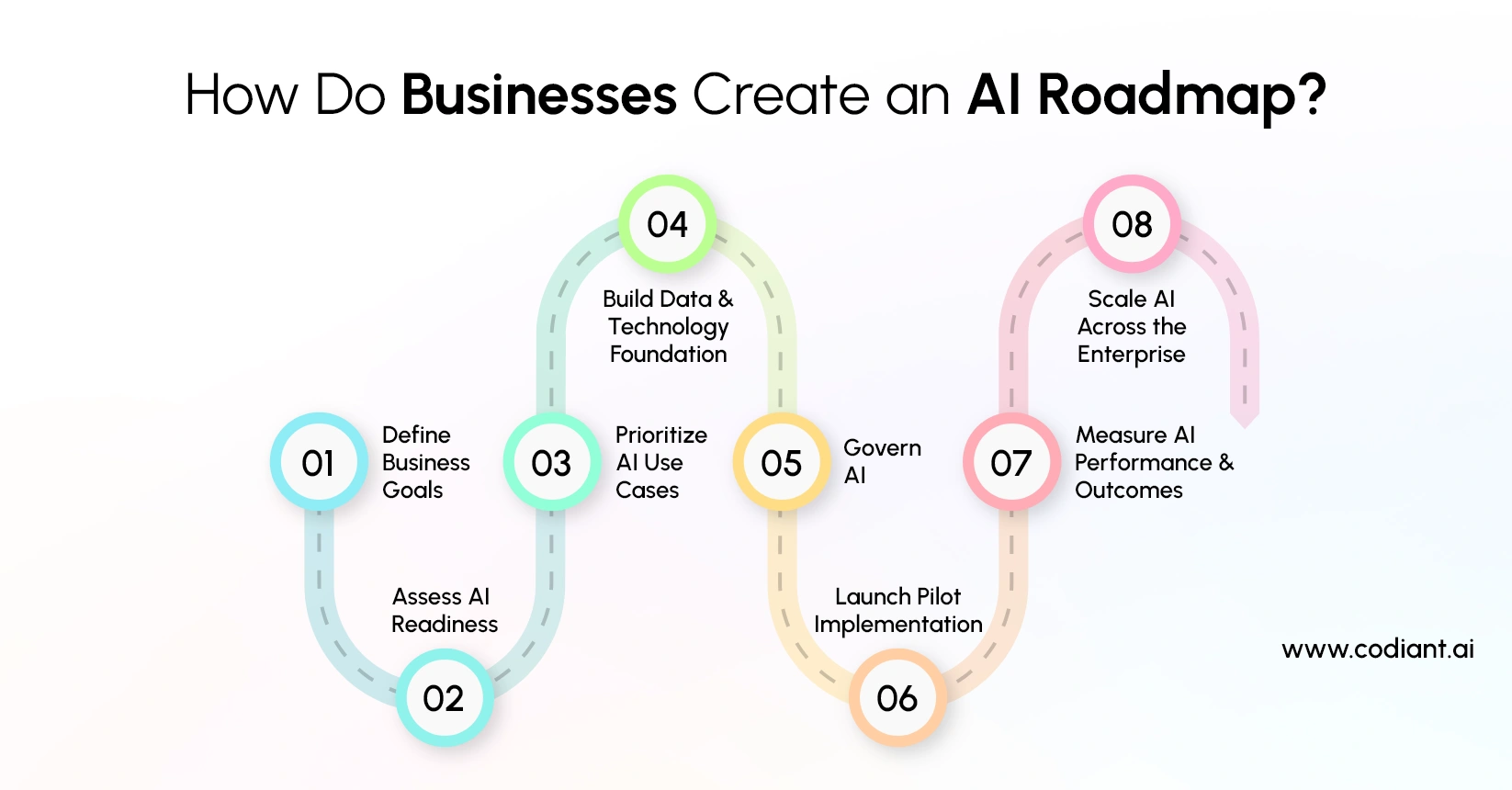
Businesses create an AI roadmap by defining business objectives, assessing AI readiness, identifying and prioritizing use cases, establishing data and technology requirements, setting governance controls, launching focused pilots, measuring outcomes, and scaling successful initiatives.
A practical AI adoption framework can follow eight stages:
- Define Business Goals
- Assess AI Readiness
- Prioritize AI Use Cases
- Build Data & Technology Foundation
- Establish AI Governance
- Launch Pilot Implementation
- Measure AI Performance & Outcomes
- Scale AI Across the Enterprise
The important point is sequencing. Enterprises should avoid beginning with “Where can we use generative AI?” and instead ask, “Which business problems justify AI, and what capabilities are required to solve them?”
1. Define Business Goals Before AI Use Cases
Start with measurable business priorities.
These could include reducing service resolution time, improving demand forecasting, automating document processing, increasing employee productivity, detecting anomalies, personalizing customer experiences, or accelerating knowledge retrieval.
Each proposed initiative should connect to a measurable outcome.
Instead of:
“Implement an AI chatbot.”
Define:
“Reduce repetitive support requests while maintaining agreed service-quality targets.”
This distinction keeps the roadmap focused on business outcomes rather than technology adoption for its own sake.
For CTOs and technology leaders, this also means determining where AI investment belongs within broader architecture and transformation priorities. A well-defined enterprise AI strategy can help align technology choices, investment priorities, implementation risk, and expected business value.
2. Assess Current AI Maturity
Before deciding where the organization wants to go, establish where it currently stands.
An AI maturity model can evaluate readiness across dimensions such as:
| Dimension | Questions to Assess |
| Strategy | Are AI initiatives tied to defined business objectives? |
| Data | Is reliable data available and governed? |
| Technology | Can existing architecture support AI workloads and integrations? |
| Talent | Are the required AI, data, engineering and domain skills available? |
| Governance | Are policies established for AI risk, privacy, security and oversight? |
| Operations | Can models be deployed, monitored and maintained? |
| Adoption | Are employees prepared to use AI-enabled workflows? |
This creates a current-state baseline. The enterprise can then define its target maturity and identify the capabilities required to close the gap.
NIST similarly describes Current Profiles and Target Profiles as a way to compare present and desired AI risk-management outcomes, identify gaps, and develop prioritized action plans.
3. Identify and Prioritize AI Use Cases
Not every process needs AI, and not every promising AI use case deserves immediate investment.
Create an inventory of opportunities across functions such as customer service, sales, finance, operations, HR, supply chain, IT, compliance, and knowledge management.
Then evaluate each opportunity against factors such as:
Business value + feasibility + data readiness + implementation effort + integration complexity + risk + time to value
High-value, technically feasible initiatives with adequate data and manageable risk are generally stronger early candidates than highly complex projects with unclear economics.
This prevents the AI transformation roadmap from becoming an unprioritized wish list.
4. Build the Data & Technology Foundation
AI initiatives depend on a reliable foundation of data, infrastructure, models, integrations, and deployment capabilities. Before development begins, organizations should determine whether their existing technology environment can support the selected AI use cases.
This includes assessing data sources, quality, accessibility, security, storage, APIs, cloud infrastructure, and integration with enterprise systems such as CRM, ERP, EHR, or knowledge platforms. The technology architecture should then be selected according to the problem being solved. Depending on the use case, this may include machine learning models, large language models (LLMs), vector databases, RAG architectures, AI agents, APIs, or existing enterprise AI platforms.
For example, an internal knowledge assistant may require RAG-powered applications that connect an LLM with approved enterprise information, while workflow automation may require models to interact with multiple systems through APIs.
The goal is to create a technology foundation that supports the initial use case without limiting future integration and scaling.
5. Establish AI Governance
AI governance defines how AI systems are approved, developed, used, monitored, and held accountable within an organization.
A practical governance framework should address data privacy, security, reliability, transparency, bias, human oversight, regulatory requirements, third-party AI models, continuous monitoring, and incident response to ensure AI systems are managed responsibly throughout their lifecycle.
Organizations should also establish clear ownership. Business teams may own the intended outcome, technology teams the implementation, and security, legal, risk, or compliance teams the controls relevant to their responsibilities.
NIST’s AI Risk Management Framework organizes AI risk management around four functions: Govern, Map, Measure, and Manage, and treats governance as a cross-cutting function throughout the AI lifecycle.
6. Launch a Pilot Implementation
Once a use case, data foundation, architecture, and governance requirements are defined, organizations can test the initiative through a controlled pilot. The pilot should validate more than whether the AI model technically works. It should test whether the solution can operate within the intended business workflow and deliver the expected outcome.
Define the pilot around a specific user group, workflow, dataset, timeframe, and measurable success criteria. Teams should evaluate model performance, integration reliability, user experience, security, operational feasibility, and business impact.
For example, rather than deploying an AI customer-service assistant across the entire organization, a company could first introduce it for one support category or team. Results from that controlled environment can reveal what needs to change before broader deployment.
This approach allows organizations to validate assumptions and address technical or operational gaps before committing resources to enterprise-wide implementation.
7. Measure AI Performance & Outcomes
AI initiatives should be measured against the business goals established at the beginning of the roadmap.
Technical metrics such as accuracy, latency, retrieval quality, error rates, or task-completion rates are important, but they do not independently demonstrate business value.
Organizations should connect them with outcome-focused KPIs such as:
| AI Use Case | Possible Business KPI |
|---|---|
| Customer service AI | Resolution time, escalation rate, CSAT |
| Document automation | Processing time, manual effort, exception rate |
| Forecasting | Forecast accuracy, inventory efficiency |
| Enterprise search | Time to find relevant information |
| AI agents | Workflow completion rate, human intervention rate |
The results should determine what happens next. A successful initiative may be expanded, while an underperforming one may require changes to its model, data, workflow, or business case.
Measurement therefore becomes an ongoing feedback loop rather than a one-time evaluation at the end of implementation.
8. Scale AI Across the Enterprise
Scaling AI means taking validated AI capabilities and extending them across more users, workflows, departments, locations, or business processes without losing reliability, security, governance, or cost control.
Organizations should avoid rebuilding the technical foundation for every new AI project. Instead, successful pilots can inform reusable capabilities such as shared AI platforms, governed data pipelines, APIs, model-evaluation frameworks, security controls, monitoring systems, and human-in-the-loop processes.
The operating model must scale as well. Organizations need clear ownership for production AI systems, processes for monitoring and improvement, employee training, governance mechanisms, and procedures for responding when models or workflows behave unexpectedly.
The progression typically moves from a validated pilot to production deployment, followed by reusable AI capabilities, cross-functional adoption, and eventually enterprise-scale AI. At this stage, the AI roadmap becomes a continuous transformation framework, helping organizations reassess business priorities, identify new use cases, evaluate existing initiatives, retire solutions that no longer deliver value, and steadily advance AI maturity across the enterprise.
What Should an Enterprise AI Roadmap Include?
An enterprise AI roadmap should include business objectives, prioritized use cases, an AI maturity assessment, data requirements, architecture decisions, governance controls, implementation milestones, ownership, KPIs, budgets, talent requirements, and a plan for scaling successful AI systems.
For larger organizations, the roadmap should operate at multiple levels.
At the strategic level, leadership needs visibility into investment priorities and expected outcomes. At the technical level, teams need architecture, data, security, model, and integration requirements. At the operational level, business units need ownership, workflows, adoption plans, and performance measures.
This is why an AI roadmap for enterprises should connect strategy and implementation rather than treating AI as a standalone IT initiative.
1. Build the Data and Technology Foundation
AI systems are only useful when they can operate with the information and systems required for their intended purpose.
The roadmap should therefore identify:
- Data sources and ownership
- Data quality and accessibility
- APIs and enterprise integrations
- Cloud or on-premise requirements
- Model and platform choices
- Security architecture
- Observability and monitoring
- Deployment and model-management processes
The architecture will differ by use case.
A customer-support copilot may require an LLM, retrieval layer, CRM integration, access controls, and evaluation framework. A forecasting system may rely on structured historical data and machine-learning pipelines. An intelligent workflow may combine APIs, models, business rules, and agents.
Enterprises moving from planning to production can use specialized AI development services to design, engineer, integrate, test, and scale AI solutions around these requirements.
2. Decide Where Generative AI Fits
Generative AI should be selected where its capabilities match the business problem rather than being treated as the default solution.
Potential enterprise applications include content generation, document summarization, conversational interfaces, code assistance, enterprise search, knowledge retrieval, and multimodal processing.
For these applications, the roadmap should also consider hallucination risk, evaluation, prompt and context management, data privacy, human review, model choice, and cost.
NIST’s Generative AI Profile specifically extends its AI Risk Management Framework to risks associated with generative AI and recommends managing them across the AI lifecycle.
Organizations pursuing these use cases can evaluate Generative AI development as part of the broader architecture and implementation plan.
3. Plan for RAG and Enterprise Knowledge
For knowledge-intensive applications, enterprises may need AI to answer questions using internal documents, policies, product information, support data, or other controlled knowledge sources.
Retrieval-Augmented Generation (RAG) is one architecture that can support this requirement by retrieving relevant information and supplying it as context to a generative model.
However, implementation requires more than connecting an LLM to documents. Teams need to consider ingestion, chunking, embeddings, retrieval quality, access permissions, evaluation, source freshness, and monitoring.
A practical guide to building RAG-powered applications can help teams understand where this architecture fits within an enterprise AI implementation roadmap.
4. Determine Where AI Agents Add Value
As AI maturity increases, some organizations may progress from AI that generates information toward systems that can coordinate actions across defined workflows.
AI agents can potentially support tasks involving multiple steps, tools, APIs, or enterprise systems. Suitable opportunities should be evaluated based on the level of autonomy required, reliability, permissions, observability, and consequences of incorrect actions.
AI adoption can progress from AI-powered search and assistants to workflow copilots, followed by controlled AI agents and eventually multi-agent workflows that coordinate tasks across more complex business processes.
Higher autonomy generally increases the importance of guardrails, authorization, monitoring, human escalation, and auditability.
Businesses exploring this stage can assess AI agent development within the wider roadmap rather than deploying agents as disconnected experiments.
What Are the Stages of AI Implementation?
The stages of AI implementation typically progress through discovery, readiness assessment, prioritization, proof of concept, development, validation, deployment, monitoring, and scaling.
These stages can be organized into four broader phases:
Phase 1: Discover and Prioritize
Define the problem, expected outcome, users, available data, constraints, and success criteria.
The output should be a prioritized use case with a clear business case rather than a broad AI ambition.
Phase 2: Validate
Build a prototype or proof of concept to test key assumptions.
Validation should determine whether the proposed approach can achieve acceptable performance with available data and within relevant cost, risk, security, and operational constraints.
Phase 3: Productionize
Move beyond the prototype by implementing production architecture, integrations, security, testing, monitoring, governance, and user workflows.
A technically successful prototype is not automatically production-ready.
Phase 4: Operate and Scale
Measure production performance, monitor risk, collect user feedback, improve the system, and determine whether the solution should expand to additional users, workflows, regions, or business units.
This makes the AI implementation guide cyclical rather than linear. Deployed systems continue to require evaluation as models, data, risks, user behavior, and business requirements change. NIST likewise states that AI risk management should be continuous across the AI system lifecycle.
Build AI Governance Into the Roadmap
Governance should begin during roadmap development, not after an AI system reaches production.
The roadmap should define who can approve AI use cases, what data can be used, how models are evaluated, when human oversight is required, how incidents are handled, and who remains accountable for outcomes.
A responsible AI governance framework should address privacy, security, reliability, transparency, and bias, while defining appropriate human oversight and regulatory requirements. It should also cover the use of third-party models, continuous monitoring, and a clear incident response process to manage risks throughout the AI lifecycle.
NIST identifies characteristics associated with trustworthy AI including validity and reliability, safety, security and resilience, accountability and transparency, explainability and interpretability, privacy enhancement, and fairness with harmful bias managed.
The appropriate controls should reflect the use case and its potential impact rather than applying identical governance requirements to every AI application.
How Can Organizations Successfully Scale AI Initiatives?
Organizations can scale AI successfully by standardizing reusable infrastructure, governance, data access, evaluation, deployment, and monitoring while redesigning business workflows around proven AI use cases.
Scaling does not simply mean deploying more models.
A pilot may serve 50 users using one data source. Enterprise deployment may need to support thousands of users, multiple departments, role-based permissions, several systems, higher availability requirements, audit trails, cost controls, and continuous monitoring.
A scalable AI transformation roadmap should therefore establish reusable capabilities such as:
- Shared AI platforms and APIs
- Governed data pipelines
- Model evaluation standards
- Reusable integration components
- Security and identity controls
- Monitoring and observability
- Human-in-the-loop processes
- AI governance policies
- Cost and performance controls
A research by McKinsey & Company also indicates that organizations pursuing value from generative AI are redesigning workflows and placing senior leaders in AI-governance roles, highlighting that scaling requires organizational change alongside technology.
Measure Business Outcomes, Not Just Model Performance
An AI roadmap needs defined KPIs before implementation begins.
Technical metrics remain important, but they should connect to business measures.
| AI Initiative | Technical Measure | Business Measure |
| Support assistant | Response quality | Resolution time |
| Forecasting | Forecast error | Inventory efficiency |
| Document AI | Extraction accuracy | Processing time |
| Enterprise search | Retrieval relevance | Time to information |
| AI agent | Task success rate | Workflow completion time |
Organizations should also monitor adoption, reliability, cost, exceptions, human interventions, and risk indicators.
The purpose is not to prove that the AI model works. It is to determine whether the AI initiative produces sufficient business value to justify continued operation and expansion.
Turning an AI Roadmap Into Enterprise Execution
A useful AI roadmap ultimately answers five questions:
Where should we use AI? Why does it matter? What capabilities do we need? How will we implement it responsibly? How will we know whether it is working?
The strongest roadmaps connect those questions across strategy, data, technology, governance, talent, operations, and measurement.
Enterprises can begin with a limited number of well-defined use cases, validate them against measurable outcomes, establish reusable technical and governance foundations, and expand only when the evidence supports scaling.
The roadmap should also evolve. AI capabilities, organizational maturity, regulations, data, and business priorities change over time. Roadmap reviews should therefore reassess priorities and determine which initiatives should be accelerated, redesigned, paused, or retired.
For organizations that need support across strategy, architecture, implementation, and scaling, Codiant.ai AI insights provide additional resources on enterprise AI adoption, development, implementation, and emerging AI architectures.
Turn Your AI Roadmap Into Real Business Outcomes
Turn your AI vision into a scalable roadmap with Codiant.ai’s AI strategy and implementation expertise.
Frequently Asked Questions
The key phases are business-goal definition, AI readiness assessment, use-case prioritization, data and architecture planning, governance design, pilot implementation, measurement, and scaling. Each phase should have defined owners, outcomes, dependencies, and decision criteria so AI investment remains connected to measurable business objectives.
Businesses can assess readiness across strategy, data quality, infrastructure, integration capability, AI talent, governance, security, operational processes, and organizational adoption. Comparing the current state with the capabilities required for target AI use cases reveals gaps that should be addressed before or during implementation.
An enterprise AI strategy typically requires participation from executive leadership, business units, IT, data, AI/ML engineering, security, legal or compliance, finance, product teams, and operational users. The exact participants depend on the use case, industry, organization, and risk profile.
Organizations should combine technical metrics with business KPIs. Model accuracy, latency, reliability, and task success may be measured alongside revenue impact, cost reduction, processing time, productivity, adoption, customer outcomes, risk indicators, and return on investment.
Common mistakes include scaling before validating business value, selecting technology before defining the problem, ignoring data readiness, treating pilots as production systems, weak governance, unclear ownership, insufficient monitoring, and failing to redesign workflows. Scaling should follow demonstrated value and production readiness rather than technical feasibility alone.
Featured Blogs
Read our thoughts and insights on the latest tech and business trends

Top Predictive Analytics Models and Algorithms to Know
- September 11, 2026
- Artificial Intelligence
Predictive analytics models are statistical and machine learning systems that use historical data to forecast future outcomes, such as customer churn, equipment failure, demand spikes, or credit risk. The most widely used categories are regression... Read more

AI Data Analytics: What It Is, Why It Matters, and Business Use Cases
- September 4, 2026
- AI-Powered Data Analytics
AI data analytics uses artificial intelligence to examine data and turn it into useful insights. It helps businesses identify patterns, predict what may happen next, and decide what actions to take. It can analyze numbers,... Read more

How to Hire AI Chatbot Developers: A Complete Guide
- September 3, 2026
- AI Chatbot Development
Hiring AI chatbot developers starts with a clear business use case, measurable success criteria, and a technical brief covering data, integrations, security, deployment, and human escalation. Businesses should then assess candidates through relevant project evidence,... Read more