RAG vs Fine-Tuning: Which Approach Is Right for Your Enterprise AI Knowledge System?
Table of Contents
Subscribe To Our Newsletter
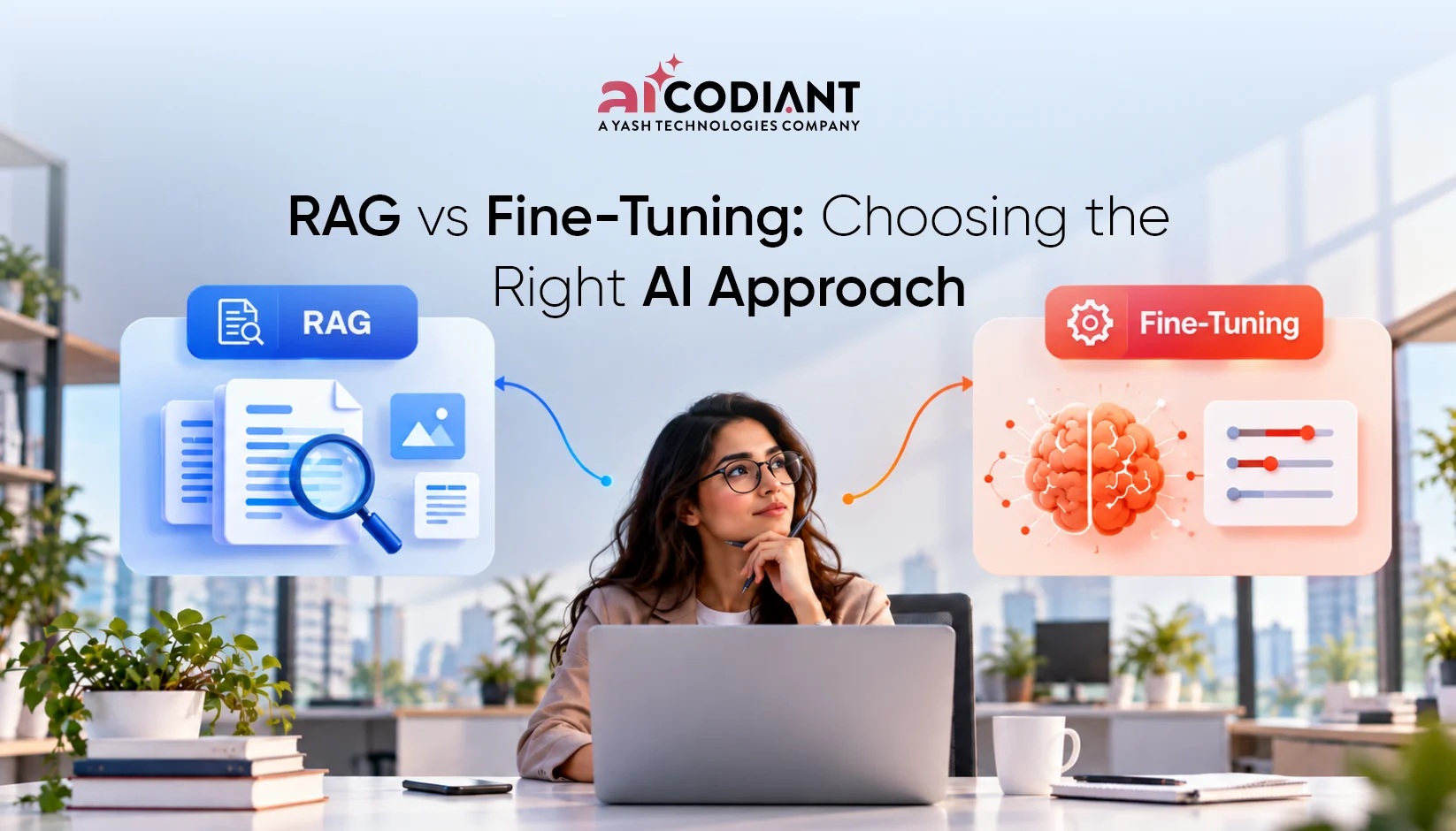
Retrieval-Augmented Generation (RAG) and fine-tuning are the two primary methods for customizing a Large Language Model (LLM) with an enterprise’s own knowledge. RAG connects a general-purpose LLM to an external knowledge base at query time, pulling in relevant documents before generating an answer. Fine-tuning retrains the model’s internal parameters on a proprietary dataset, permanently embedding that knowledge into the model itself.
Businesses need to care about this choice because it directly affects accuracy, cost, data freshness, and compliance risk. A model that answers from outdated or fabricated information erodes trust with customers and employees, and the wrong architecture choice can mean rebuilding a knowledge system from scratch after months of investment. Getting this decision right early avoids rework, controls infrastructure spend, and determines how quickly the system can adapt as company knowledge changes.
Three examples show how this plays out. A bank builds a RAG-based assistant that pulls answers from internal compliance documents, so policy updates are reflected the same day without retraining. A legal technology firm fine-tunes a model on thousands of contract precedents to internalize domain-specific reasoning patterns. An insurer combines both: a fine-tuned model handles claims-specific language and tone, while RAG retrieves the latest policy documents for accurate, current answers.
A common misconception is that fine-tuning teaches a model new facts the way a human studies a textbook. It does not. Fine-tuning adjusts how a model reasons, writes, and follows instructions within a domain, but it is a poor mechanism for injecting frequently changing factual knowledge, which is exactly what RAG is built for.
This article breaks down how RAG and fine-tuning actually work, when each approach fits an enterprise AI knowledge system, whether they can be combined, and what each one costs to implement.
In a Nutshell
- Direct answer: RAG retrieves external knowledge at query time; fine-tuning bakes knowledge and behavior directly into the model’s weights through retraining.
- Biggest takeaway: Most enterprise knowledge problems are freshness and accuracy problems, which RAG solves more directly than fine-tuning.
- Business recommendation: Start with RAG for knowledge-heavy use cases like internal search, support, and document Q&A; reserve fine-tuning for tone, format, or specialized reasoning tasks.
- Implementation insight: RAG requires strong document retrieval and data pipeline engineering; fine-tuning requires curated, labeled training data and ongoing retraining discipline.
- Enterprise perspective: The two approaches are not mutually exclusive. Mature enterprise generative AI solutions increasingly combine a fine-tuned model with a RAG retrieval layer for both accuracy and domain-specific behavior.
What Is the Difference Between RAG and Fine-tuning?
RAG and fine-tuning differ in where knowledge lives and how it gets updated. RAG stores knowledge externally, in a searchable database the model queries at answer time. Fine-tuning stores knowledge internally, encoded into the model’s parameters through a retraining process. Updating RAG means updating a document store; updating a fine-tuned model means retraining it.
This distinction has practical consequences. A RAG system can incorporate a document added five minutes ago because retrieval happens live, against current data. A fine-tuned model only knows what existed in its training data at the time of the last retraining run, so any change requires a new training cycle before the model reflects it.
The two methods also fail differently. A RAG system that cannot find a relevant document may return an incomplete answer, but it is less likely to invent facts, since it is grounded in retrieved text. A fine-tuned model, if pushed outside its training distribution, can produce confident but incorrect answers, a failure mode known as hallucination, because it is generating from learned patterns rather than checking a source.
What Is an Enterprise AI Knowledge System?
An enterprise AI knowledge system is a software layer that lets employees or customers query a company’s internal information, such as policies, product documentation, contracts, or support history, through natural language rather than manual search. It sits between users and the organization’s data, using an LLM to interpret questions and generate coherent answers grounded in that data.
These systems typically combine several components: a data ingestion pipeline that pulls in documents from sources like SharePoint, Confluence, or a CRM; a retrieval mechanism, often a vector database, that finds relevant content for a given query; and an LLM that turns retrieved content into a readable answer. Fine-tuning can also shape this system by adjusting how the LLM formats responses, follows company tone guidelines, or reasons through domain-specific tasks.
The architecture decision, RAG, fine-tuning, or both, determines how accurate, current, and maintainable this knowledge system remains as company data grows and changes over time.
How Does RAG Development Work for Enterprises?
RAG development for enterprises works by connecting a retrieval system to a generative LLM solutions through a defined pipeline: documents are indexed into a searchable format, a user query triggers a search for relevant content, and the retrieved content is passed to the LLM along with the original question to generate a grounded answer.
The pipeline has four core stages:
- Document ingestion and chunking: Source documents are broken into smaller text segments, since LLMs and retrieval systems work more accurately with focused passages than entire documents.
- Embedding and indexing: Each text chunk is converted into a numerical representation called an embedding, which captures its meaning, and stored in a vector database designed for fast similarity search.
- Retrieval: When a user submits a query, the system converts the query into an embedding and searches the vector database for the most semantically similar chunks.
- Generation: The retrieved chunks are passed to the LLM as context, and the model generates a final answer grounded in that retrieved content rather than relying solely on its internal training.
Enterprises evaluating RAG implementation services should expect this pipeline to require ongoing maintenance, including re-indexing when source documents change and monitoring retrieval quality, since a poorly tuned retrieval step is the most common cause of inaccurate RAG answers, more often than the LLM itself.
How Does LLM Fine-Tuning Work for Enterprises?
LLM fine-tuning for enterprises works by taking a pre-trained model and continuing its training process on a smaller, domain-specific dataset, adjusting the model’s internal parameters (weights) so it better reflects the target domain’s language, reasoning patterns, or required output format.
The process generally follows these steps:
- Dataset preparation: Enterprises assemble labeled examples relevant to the target task, such as question-answer pairs drawn from past support tickets or example contract summaries.
- Training configuration: Engineers select a base model and training parameters, including how much the model’s weights should shift from their original state, since over-adjusting risks degrading the model’s general capabilities.
- Training run: The model processes the custom dataset repeatedly, gradually adjusting its weights to reduce error on the target task.
- Evaluation: The fine-tuned model is tested against held-out examples to confirm it improved on the target task without losing general reasoning ability, a failure mode called catastrophic forgetting.
- Deployment and retraining cadence: Once deployed, the model needs periodic retraining as domain language or requirements evolve, since fine-tuning is not a one-time investment.
Fine-tuning tends to require more specialized machine learning expertise and computing infrastructure than RAG, which is why many enterprises evaluate it after RAG rather than as a starting point.
Is RAG Better Than Fine-Tuning for Enterprise AI?
RAG is generally better than fine-tuning for enterprise AI when the primary goal is accurate, current, and traceable answers from company knowledge. RAG is not universally better, though; fine-tuning outperforms RAG for tasks requiring a specific writing style, domain reasoning, or structured output format that goes beyond what retrieved text alone can teach the model.
RAG has three clear advantages for most enterprise knowledge use cases: it stays current without retraining, it can cite the source document it drew from, and it is faster and cheaper to update. Fine-tuning has advantages where RAG falls short: it can teach a model to reason in a specialized way, such as applying legal or medical logic consistently, and it can enforce a consistent output structure or tone across every response, not just when relevant context happens to be retrieved.
The comparison is not a strict hierarchy. It is a match between method and task, which is why enterprise teams increasingly frame this as a workflow design question rather than a single winner-take-all decision. Aligning these choices with an enterprise AI roadmap can help organizations select the right approach based on business goals, workflows, and operational needs.
Still Deciding Between RAG and Fine-Tuning for Your Business?
Discuss your data, goals, and constraints with Codiant.AI to choose a practical AI architecture today.
When Should You Use RAG Instead of Fine-Tuning?
Use RAG instead of fine-tuning when the knowledge changes frequently, when answers must be traceable to a source document, or when the enterprise needs to launch quickly without a large labeled training dataset. RAG suits internal search, customer support knowledge bases, compliance document Q&A, and any use case where factual accuracy on current data matters more than stylistic consistency.
RAG is the stronger fit in three common scenarios. First, when source content updates regularly, such as pricing sheets, policy documents, or product specifications, since RAG reflects changes immediately after re-indexing. Second, when auditability matters, because RAG can surface the exact document a response was based on, which fine-tuned models cannot do natively. Third, when the enterprise lacks a large, clean training dataset, since RAG works with existing documents as-is rather than requiring thousands of labeled examples.
Can RAG and Fine-Tuning Be Used Together?
Yes, RAG and fine-tuning can be used together, and many production enterprise AI systems combine both. A fine-tuned model can handle domain-specific reasoning, tone, and output formatting, while a RAG layer supplies it with current, factual context at query time, giving the system both specialized behavior and up-to-date accuracy.
A typical hybrid architecture fine-tunes the base model on domain vocabulary and desired response structure, such as how a legal or healthcare organization phrases answers, and then layers RAG on top so the model retrieves the latest relevant documents before responding. This avoids the two main failure modes in isolation: a pure RAG system that produces generic or inconsistently formatted answers, and a pure fine-tuned system that grows stale as company knowledge changes.
The tradeoff is complexity. A combined system requires maintaining both a retraining pipeline and a retrieval pipeline, which increases engineering overhead and calls for stronger MLOps discipline to keep both components synchronized and monitored.
How Much Does It Cost to Implement RAG or Fine-Tune an LLM?
RAG implementation typically costs less upfront than fine-tuning, since it uses a pre-trained model as-is and shifts investment toward data pipeline engineering, vector database infrastructure, and retrieval tuning. Fine-tuning costs more upfront due to training compute, dataset labeling, and the specialized machine learning expertise required, but can reduce per-query costs at high volume since it needs less context passed into each request.
Three cost drivers apply to both approaches: the volume and complexity of source data that needs preparation, the level of accuracy and reliability required for the use case, and the ongoing maintenance needed to keep the system current, whether that means re-indexing documents for RAG or scheduling retraining runs for fine-tuning. Enterprises comparing options should evaluate total cost across build, deployment, and maintenance, not just the initial development quote, since maintenance is often the larger long-term expense for either approach.
How Codiant.AI Can Help Build Your Enterprise AI Knowledge System
Choosing between RAG and fine-tuning starts with the questions your system must answer, the data it can use, and how often that data changes. Codiant.AI can help assess those requirements and plan an approach that fits your business goals.
Its services include AI strategy and consulting, generative AI development, RAG applications, and model fine-tuning. This gives teams support from architecture planning through development and integration, whether the solution requires retrieval, fine-tuning, or both.
How Should Enterprises Choose Between RAG and Fine-Tuning?
Enterprises should choose between RAG and fine-tuning by first defining the business problem, then matching it to the method built for that problem: RAG for knowledge freshness and traceability, fine-tuning for specialized reasoning and consistent output behavior, and a hybrid approach when both matter.
A practical evaluation checklist:
- How often does the underlying knowledge change? Frequent updates favor RAG.
- Does the answer need to be traceable to a source? Compliance-sensitive use cases favor RAG.
- Does the task require specialized reasoning or a strict output format? This favors fine-tuning.
- Is there a large, clean, labeled dataset available? Fine-tuning depends on this; RAG does not.
- What is the team’s engineering maturity? RAG requires strong data pipeline and retrieval skills; fine-tuning requires machine learning training expertise.
Enterprises without in-house capacity for either path often work with an external partner for RAG development or LLM fine-tuning, since both require infrastructure and expertise that take time to build internally. Whichever path is chosen, the decision should be revisited as the knowledge system scales, since a use case that starts with RAG alone may benefit from a fine-tuned layer once patterns in query behavior and required tone become clear.
Build an Enterprise AI Knowledge System That Fits
Work with Codiant.AI to design, develop, and integrate an AI knowledge system around your needs.
Frequently Asked Questions
RAG retrieves relevant company documents from a searchable database in response to a user query, then feeds that content to an LLM so its answer is grounded in current, verifiable information rather than only what the model learned during training.
Choose RAG when knowledge updates frequently, when responses must cite a traceable source, or when there is no large labeled dataset available. RAG delivers faster time-to-value for knowledge-lookup use cases without the overhead of a training pipeline.
Fine-tuning excels at teaching consistent tone, format, and domain-specific reasoning. Its limitations include high upfront cost, the need for quality labeled data, staleness between retraining cycles, and risk of catastrophic forgetting if not carefully managed during training.
Yes. A fine-tuned model can handle domain reasoning and formatting while RAG supplies current factual context. This hybrid pattern is increasingly common in production systems but adds engineering complexity, requiring both a retrieval pipeline and a retraining workflow to stay synchronized.
Start by identifying whether the core problem is factual freshness or behavioral consistency. Freshness points to RAG, consistency points to fine-tuning, and use cases needing both typically move toward a hybrid architecture once initial requirements are validated.
Featured Blogs
Read our thoughts and insights on the latest tech and business trends
AI Roadmap: How to Build and Scale AI Across the Enterprise
- September 17, 2026
- Artificial Intelligence
An AI roadmap is a structured plan that connects business priorities with AI use cases, data, technology, governance, people, implementation, and measurable outcomes. For enterprises, it provides the sequence for moving from AI opportunities and... Read more

Top Predictive Analytics Models and Algorithms to Know
- September 11, 2026
- Artificial Intelligence
Predictive analytics models are statistical and machine learning systems that use historical data to forecast future outcomes, such as customer churn, equipment failure, demand spikes, or credit risk. The most widely used categories are regression... Read more

AI Data Analytics: What It Is, Why It Matters, and Business Use Cases
- September 4, 2026
- AI-Powered Data Analytics
AI data analytics uses artificial intelligence to examine data and turn it into useful insights. It helps businesses identify patterns, predict what may happen next, and decide what actions to take. It can analyze numbers,... Read more