How Much Does It Cost to Build an NLP Solution?
Table of Contents
Subscribe To Our Newsletter
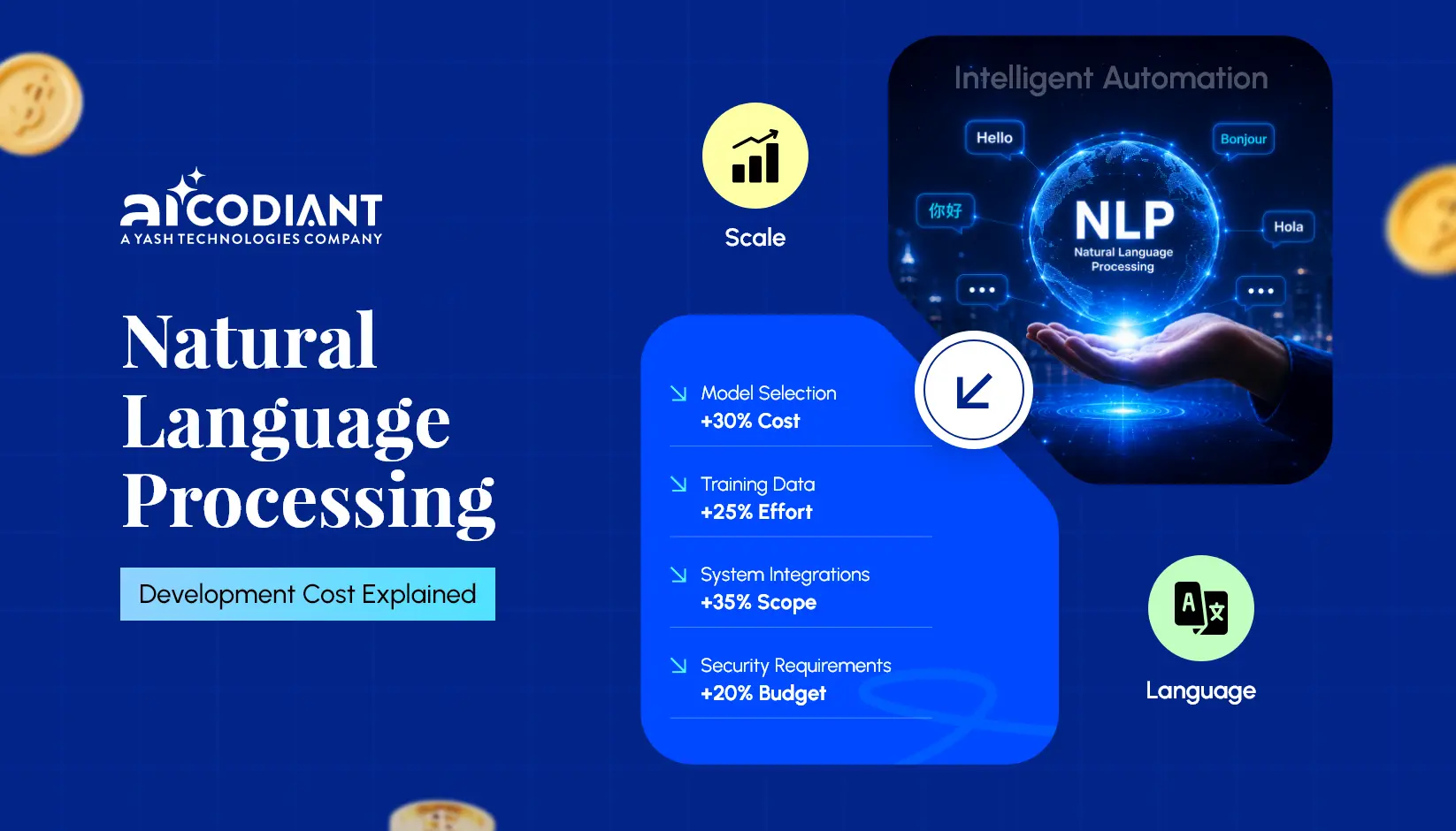
Building an NLP solution costs between $10,000 and $500,000+, depending on complexity, data requirements, model architecture, integrations, and the expertise of your NLP software development company. A rule-based chatbot for a single use case sits at the lower end; an enterprise-grade conversational AI platform with multilingual support and legacy system integration sits at the higher end.
Understanding NLP development cost upfront helps businesses budget accurately, avoid scope creep, and choose the right vendor. This guide breaks down every cost factor, provides real cost ranges by project type, and answers the most common questions buyers ask before investing in natural language processing development.
Key Takeaways
- NLP solution cost ranges from $10,000 (basic) to $500,000+ (enterprise platform).
- The 6 biggest cost drivers: model type, data, integrations, language support, compliance, and team.
- Development timelines range from 4 weeks to 18 months based on scope.
- ROI is measurable through automation rate, cost-per-interaction, and resolution accuracy.
- Custom NLP software consistently outperforms off-the-shelf tools for domain-specific use cases.
How Much Does It Cost to Build an NLP Solution?
NLP solution cost depends on scope, not just technology. A focused NLP tool for a single task such as document classification or sentiment analysis typically costs between $10,000 and $30,000. A fully integrated enterprise NLP platform handling multiple workflows, languages, and regulated data commonly ranges from $150,000 to $500,000 or more.
The table below provides realistic cost benchmarks across four project tiers, based on typical NLP application development engagements:
| NLP Solution Type | Estimated Cost Range | Timeline |
| Basic NLP (rule-based chatbot, sentiment tool) | $10,000 – $30,000 | 4–8 weeks |
| Mid-complexity NLP (custom intent engine, NER) | $30,000 – $80,000 | 2–4 months |
| Advanced NLP (multi-language, fine-tuned LLM) | $80,000 – $200,000+ | 4–9 months |
| Enterprise NLP Platform (multi-system integration) | $150,000 – $500,000+ | 6–18 months |
Important note:
Any NLP development cost estimate presented without a defined scope, dataset assessment, and integration inventory should be treated as directional only. Accurate pricing requires a discovery phase.
What Factors Affect NLP Development Costs?
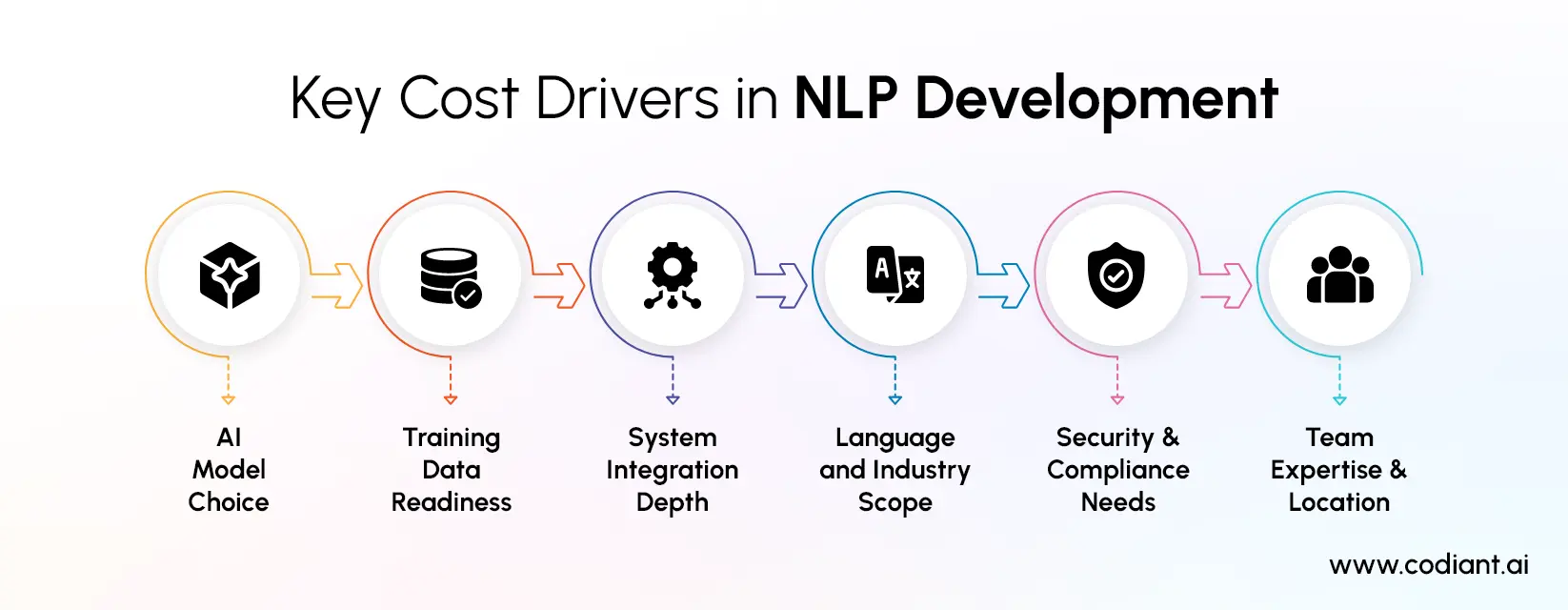
Six primary variables determine the final cost of natural language processing development. Understanding each one helps you build a more accurate budget and identify where tradeoffs are possible.
1. Model Architecture and AI Approach
Rule-based NLP systems use handcrafted logic and are faster to build but less flexible. Machine-learning models require labeled training data and iterative evaluation cycles. Fine-tuned large language models (LLMs) such as BERT, GPT variants, or domain-specific transformers deliver the highest accuracy but also carry the highest development and infrastructure cost. Choosing the right architecture for your use case not the most advanced one available is the single most important cost decision in NLP application development.
2. Data Availability and Quality
NLP models learn from data. If your organization has clean, labeled, domain-specific text data, development costs drop significantly. If data needs to be collected, cleaned, annotated, or synthesized from scratch, expect data preparation to account for 20–40% of total project cost. Poor data quality is the leading cause of NLP project overruns.
3. Number and Complexity of Integrations
Connecting an NLP solution to CRM systems, ERP platforms, ticketing tools, internal knowledge bases, or telephony infrastructure multiplies engineering hours. Each integration requires API design, authentication, data mapping, error handling, and regression testing. Enterprise NLP solutions with five or more system integrations routinely cost two to three times more than standalone tools.
4. Language and Domain Scope
English-only NLP models benefit from the largest pools of pretrained resources and are therefore less expensive to build. Adding Arabic, Mandarin, Hindi, or low-resource languages requires specialized preprocessing, separate tokenizers, and often custom training data. Domain specificity legal, medical, financial, or industrial NLP introduces further complexity because general-purpose models perform poorly on technical vocabulary without fine-tuning.
5. Compliance and Security Requirements
NLP solutions handling personally identifiable information (PII), protected health information (PHI), or financial data must comply with regulations such as GDPR, HIPAA, or SOC 2. Compliance engineering includes data anonymization pipelines, audit logging, role-based access control, and third-party security assessments. These requirements can add $15,000 to $60,000 to a project budget depending on jurisdiction and industry.
6. Team Composition and Location
Hourly rates for NLP engineers range from $40–$80 in South and Southeast Asia, $60–$120 in Eastern Europe, and $120–$250+ in North America and Western Europe. A mid-complexity NLP project requiring a project manager, NLP engineer, ML engineer, backend developer, and QA specialist will involve 800–2,500 billable hours. Team location is therefore a significant lever without compromising output quality when the vendor has demonstrated NLP domain expertise.
How Long Does It Take to Develop an NLP Application?
NLP application development timelines depend on complexity, data readiness, and integration scope. Below are realistic delivery windows across project types:
- 4–8 weeks: Basic NLP tool (single intent, no integrations):
- 2–4 months: Mid-complexity solution (custom model, 1–2 integrations):
- 4–9 months: Advanced conversational AI (multilingual, fine-tuned LLM):
- 6–18 months: Enterprise NLP platform (multi-workflow, regulated data):
Discovery and scoping typically add 2–4 weeks before development begins and should not be skipped. Projects that bypass discovery consistently experience scope changes mid-build, which extends timelines and inflates costs.
Which Industries Use NLP Solutions?
Natural language processing services are deployed across virtually every sector where unstructured text or voice data exists at scale. The highest-adoption industries are:
- Healthcare: Clinical documentation automation, medical coding, patient intake chatbots, and adverse event detection from clinical notes.
- Financial Services: Regulatory document analysis, fraud narrative detection, earnings call summarization, and automated KYC processing.
- Legal: Contract review, clause extraction, litigation risk analysis, and due diligence automation.
- Retail and e-commerce: Product search optimization, review sentiment analysis, returns classification, and voice shopping assistants.
- Telecommunications: Call center automation, churn prediction from support transcripts, and complaint routing.
- Human resources: Resume screening, employee sentiment analysis, and policy Q&A systems.
Industries with large volumes of unstructured text and repetitive language tasks consistently report the strongest ROI from NLP investments.
What Are Common NLP Use Cases?
Understanding where NLP delivers proven value helps organizations identify the right starting point before investing in custom NLP software.
- Conversational AI and chatbots: Automated customer support, lead qualification, and internal helpdesk systems built on intent recognition and dialogue management.
- Sentiment analysis: Real-time monitoring of customer feedback, social media, support tickets, and product reviews to detect satisfaction trends and emerging issues.
- Named entity recognition (NER): Automated extraction of people, organizations, locations, dates, and domain-specific entities from documents and communications.
- Document classification and routing: Automatic categorization of inbound emails, claims, contracts, and support requests to the correct workflow or team.
- Machine translation: Cross-language content localization for customer communications, product listings, and internal documentation.
- Text summarization: Condensing lengthy reports, call transcripts, legal documents, or research papers into structured executive summaries.
- Speech-to-text and voice analytics: Transcription and analysis of call center interactions, voice assistants, and meeting recordings.
How Is the ROI of an NLP Solution Measured?
ROI measurement for NLP investments combines operational efficiency metrics with revenue and risk impact. The most reliable indicators are:
- Automation rate: Percentage of previously manual tasks now handled without human intervention. A well-deployed NLP system typically automates 40–70% of tier-1 support query.
- Cost-per-interaction reduction: Difference in cost between human-handled and NLP-handled transactions, multiplied by monthly volume.
- Resolution accuracy: Rate at which the NLP system correctly resolves or routes a request without escalation. Benchmark target is 85%+ for production systems.
- Time-to-response improvement: Reduction in average response time from submission to resolution, especially relevant in customer service and compliance contexts.
- Error rate reduction: Decrease in manual processing errors in document-heavy workflows such as claims, contracts, or data entry.
ROI benchmark:
Organizations deploying enterprise NLP solutions in customer service report an average cost-per-interaction reduction of 30–60% within 12 months of full deployment, based on published case data from vendors including IBM, Salesforce, and ServiceNow.
Read more: What is NLP? Use Cases and Applications
Final Word: Building the Right NLP Solution for Your Budget
NLP solution cost is not a fixed number, it is a function of scope, data quality, integration complexity, compliance requirements, and the caliber of your NLP development services partner. A $15,000 NLP tool built on the wrong architecture for an enterprise use case will cost far more to fix than a $80,000 solution designed correctly from the start.
The most reliable path to a predictable budget is a structured discovery engagement before any development begins. Discovery should produce a defined use case scope, a data readiness assessment, an integration map, a compliance checklist, and a phased delivery plan with milestones.
If you are evaluating natural language processing services for your organization, begin with the narrowest viable scope, measure ROI within 90 days of deployment, and scale only what demonstrates measurable value.
Turn Your NLP Idea Into a Cost-Effective, Scalable Business Solution
Plan, build, and launch an NLP solution aligned with your business budget.
Frequently Asked Questions
NLP application development typically uses transformer-based models such as BERT, RoBERTa, GPT, and T5 for language understanding tasks. Python libraries including spaCy, Hugging Face Transformers, NLTK, and Stanford NLP handle preprocessing and model fine-tuning. Infrastructure is commonly deployed on AWS SageMaker, Google Vertex AI, or Azure Machine Learning. The right stack depends on the specific NLP task, latency requirements, and existing enterprise infrastructure.
Yes. NLP solutions are routinely integrated with CRM platforms (Salesforce, HubSpot), ERP systems (SAP, Oracle), ticketing tools (Zendesk, ServiceNow), internal knowledge bases, and telephony infrastructure. Integration is typically achieved through RESTful APIs or webhook configurations. Each integration adds engineering scope and should be inventoried during the discovery phase to produce an accurate NLP development cost estimate.
NLP (natural language processing) refers to the computational techniques that enable machines to understand, interpret, and respond to human language including classification, extraction, translation, and summarization. Generative AI is a subset of AI that produces new content (text, code, images) from learned patterns, using architectures such as large language models (LLMs). Many modern NLP solutions incorporate generative AI components for tasks like response generation or summarization, but NLP also covers non-generative tasks such as intent classification and entity recognition.
Four strategies consistently reduce NLP solution cost without compromising output quality: (1) Start with a narrowly scoped pilot covering one use case before expanding. (2) Audit and prepare internal data before engaging a development vendor. (3) Use pretrained foundation models and fine-tune on domain data rather than training from scratch. (4) Prioritize integrations by business impact and defer lower-priority connections to a second phase. Businesses that follow a phased delivery model reduce initial investment by 30–50% while validating ROI before full commitment.
ROI is measured across operational, financial, and quality dimensions. Key metrics include: automation rate (percentage of tasks handled without human intervention), cost-per-interaction reduction, resolution accuracy, average handling time, and error rate in document processing workflows. A meaningful ROI baseline requires capturing pre-deployment performance data across these dimensions before go-live, then comparing at 3, 6, and 12-month intervals post-deployment.
Featured Blogs
Read our thoughts and insights on the latest tech and business trends

RAG vs Fine-Tuning: Which Approach Is Right for Your Enterprise AI Knowledge System?
- September 24, 2026
- Artificial Intelligence
Retrieval-Augmented Generation (RAG) and fine-tuning are the two primary methods for customizing a Large Language Model (LLM) with an enterprise's own knowledge. RAG connects a general-purpose LLM to an external knowledge base at query time,... Read more

AI Roadmap: How to Build and Scale AI Across the Enterprise
- September 17, 2026
- Artificial Intelligence
An AI roadmap is a structured plan that connects business priorities with AI use cases, data, technology, governance, people, implementation, and measurable outcomes. For enterprises, it provides the sequence for moving from AI opportunities and... Read more

Top Predictive Analytics Models and Algorithms to Know
- September 11, 2026
- Artificial Intelligence
Predictive analytics models are statistical and machine learning systems that use historical data to forecast future outcomes, such as customer churn, equipment failure, demand spikes, or credit risk. The most widely used categories are regression... Read more