What Is MLOps? A Business Guide to Machine Learning Operations
Table of Contents
Subscribe To Our Newsletter
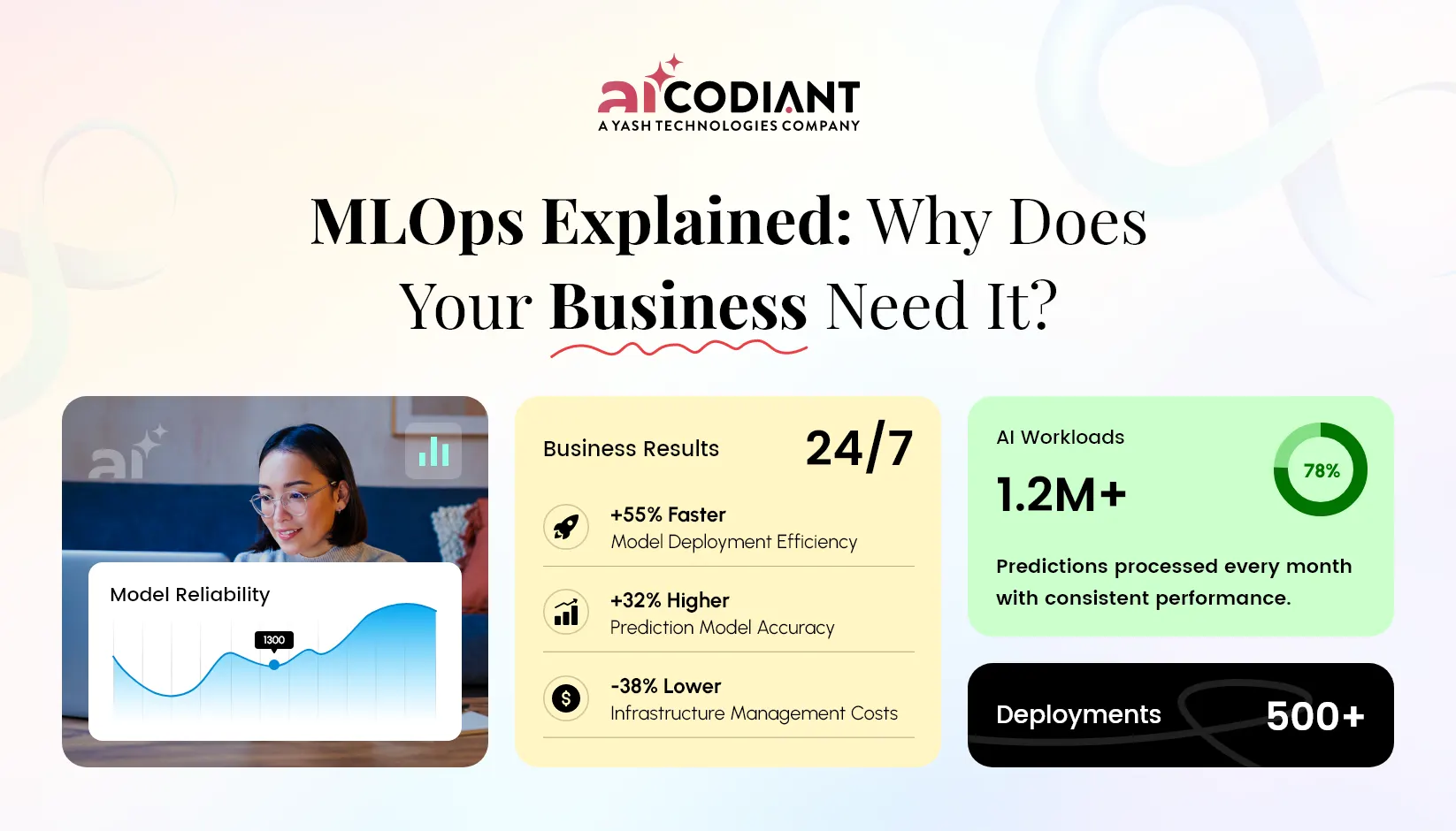
MLOps short for Machine Learning Operations is the discipline of deploying, monitoring and maintaining machine learning models in production reliably and at scale. It bridges the gap between data science teams that build AI models and engineering teams that run production systems, ensuring that AI investments actually deliver business value beyond the prototype stage.
Without MLOps, most enterprise AI projects stall after the pilot phase. Models degrade silently, data pipelines break without alerts and no one owns accountability for model performance. MLOps gives organizations the framework, tooling and processes to treat AI models like production software with versioning, testing, monitoring and governance built in.
This guide explains what MLOps is, how it works, why it matters for enterprises and what it takes to implement it successfully.
Key Takeaways
- MLOps is the operational framework that keeps AI models reliable and accurate in production.
- It combines practices from DevOps, data engineering and machine learning into one lifecycle.
- Enterprises without MLOps lose an estimated 40–85% of AI projects before they reach production (Gartner, 2025).
- The MLOps lifecycle covers six stages- data, training, evaluation, deployment, monitoring and governance.
- MLOps is not a tool it is a combination of culture, process and platform.
What Is MLOps and Why Is It Important?
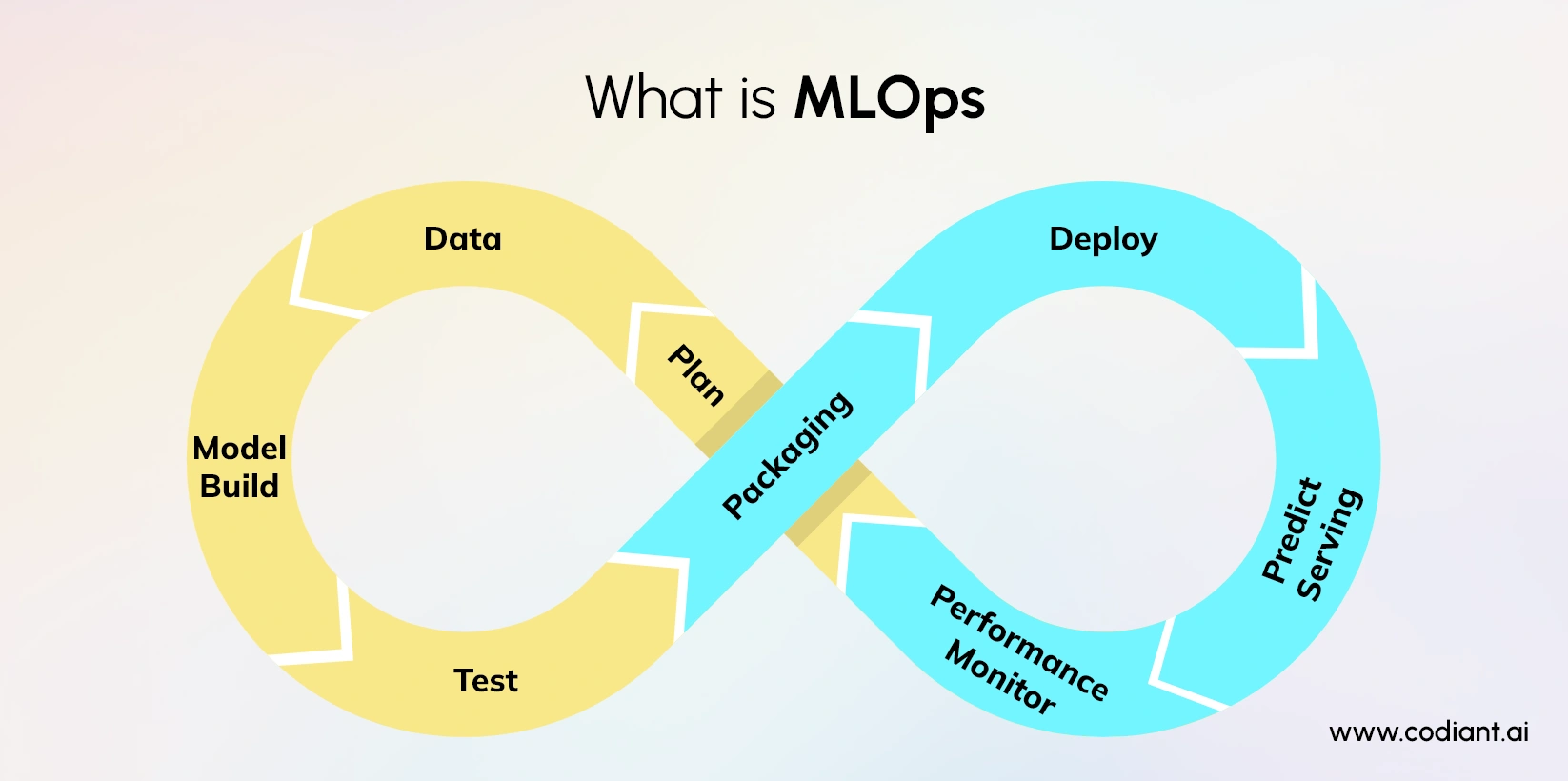
MLOps machine learning operations is the set of practices, tools and cultural principles that enable organizations to deploy machine learning models into production and keep them performing reliably over time. It is important because a model that works in a notebook is not a product it becomes a product only when it can run at scale, update automatically and be monitored continuously.
According to Gartner, fewer than 15% of enterprise AI projects made it to production as of 2022 the rest failed due to operational, not technical, reasons. MLOps directly addresses this gap by applying the same engineering discipline to AI systems that DevOps applies to software systems.
For business leaders, MLOps is important because it:
- Reduces the time from model development to revenue-generating deployment
- Prevents model degradation that erodes AI ROI silently over months
- Creates audit trails required for regulated industries such as finance and healthcare
- Enables teams to retrain and improve models without rebuilding pipelines from scratch
- Scales AI from one model to dozens of models across the enterprise
How Does MLOps Improve Machine Learning Projects?
MLOps improves machine learning projects by introducing structure, automation and accountability at every stage of the model lifecycle from data preparation through production monitoring. Without it, AI development is ad hoc, difficult to reproduce and nearly impossible to scale.
The five most measurable improvements MLOps delivers:
- Speed: Faster deployment cycles automated pipelines reduce time-to-production from weeks to hours.
- Reliability: Model reliability continuous monitoring catches data drift and performance drops before they affect business outcomes.
- Collaboration: Team collaboration shared pipelines and versioned experiments eliminate silos between data scientists, engineers and operations teams.
- Cost: Cost control automated retraining and resource optimization reduce cloud infrastructure spend.
- Compliance: Compliance readiness lineage tracking and model cards create the documentation regulators require.
A McKinsey study found that organizations with mature MLOps practices deploy models 4–6 times faster than those without and achieve 2–3x greater business value from their AI investments.
What Are the Stages of the MLOps Lifecycle?
The MLOps lifecycle has six core stages. Each stage feeds into the next and is designed to be repeatable, automated and auditable.
| Stage | What Happens | Business Outcome |
| 1. Data Management | Collection, versioning, validation and labelling of training data | Clean, reproducible datasets that reduce model errors |
| 2. Model Training | Automated experiment tracking, hyperparameter tuning and version control | Faster iteration and full experiment history |
| 3. Model Evaluation | Performance testing against business KPIs, bias checks and threshold validation | Only production-ready models are deployed |
| 4. Deployment | Containerized model serving via APIs, batch pipelines or edge devices | Models reach production reliably and repeatably |
| 5. Monitoring | Real-time tracking of data drift, model accuracy and system health | Issues detected before they affect business outcomes |
| 6. Governance | Lineage tracking, model cards, access controls and compliance logging | Auditability for regulators and stakeholders |
These six stages work together as a continuous cycle rather than a one-time sequence. If monitoring identifies model performance issues or data changes, the pipeline can automatically trigger retraining, followed by evaluation and deployment. This continuous process helps teams maintain accurate, reliable, and production-ready AI models with minimal manual effort, making MLOps solutions valuable for businesses looking to scale and manage machine learning efficiently.
Which Tools Are Used for MLOps?
MLOps platforms and tools span the full AI model lifecycle. No single tool covers all six stages, so most enterprises combine two to four tools into a unified MLOps stack.
Experiment Tracking and Model Registry
- MLflow: Open-source experiment tracking, model versioning and deployment
- Weights & Biases (W&B): Real-time experiment visualization and collaboration
- AI: Metadata tracking for large-scale ML experiments
Pipeline Orchestration
- Kubeflow: Kubernetes-native ML workflow orchestration
- Apache Airflow: General-purpose workflow scheduler widely adopted for data pipelines
- ZenML: Framework-agnostic MLOps pipeline abstraction
Model Serving and Deployment
- BentoML: Model packaging and serving with API generation
- Seldon Core: Enterprise model serving on Kubernetes
- AWS SageMaker: End-to-end managed MLOps on Amazon Web Services
- Azure ML: Microsoft’s enterprise MLOps platform
- Google Vertex AI: Google Cloud’s unified ML platform
Monitoring and Observability
- Evidently AI: Open-source data drift and model performance monitoring
- Arize AI: Production ML monitoring and explainability
- WhyLabs: Data and model health monitoring
Tool selection should follow your infrastructure, team size and compliance requirements not vendor marketing. Organizations new to MLOps typically start with MLflow for experiment tracking and one cloud-native platform such as SageMaker or Vertex AI before expanding their stack.
What Is the Difference Between MLOps and DevOps?
MLOps and DevOps share the same operational philosophy automate, monitor and iterate but they address fundamentally different types of systems. DevOps manages deterministic software code. MLOps manages probabilistic AI models whose behaviour changes as data changes, even without any code change.
| Dimension | DevOps | MLOps |
| Primary artifact | Application code | Trained ML model + data pipeline |
| Versioning | Code versions via Git | Code + data + model versions |
| Testing | Unit and integration tests | Data validation + model accuracy tests |
| Deployment trigger | Code commit or merge | Code change or data drift or schedule |
| Failure mode | Bug in code | Data drift, model drift or label shift |
| Key metric | Uptime and latency | Model accuracy and prediction stability |
| Retraining | Not applicable | Core operational requirement |
DevOps practitioners transitioning into MLOps need to extend their existing CI/CD pipelines to include data versioning, model evaluation gates and drift monitoring. The tooling differs, but the operational mindset transfers directly.
MLOps for Enterprises- What a Mature Implementation Looks Like
Enterprise MLOps goes beyond experiment tracking and deployment scripts. At maturity, it means having automated, governed and observable AI operations across dozens of models, multiple business units and regulated data environments.
A mature enterprise MLOps implementation covers:
- A centralized model registry with versioned, approved models accessible to all teams
- Automated retraining pipelines triggered by performance thresholds or data drift alerts
- Role-based access controls separating data scientists, ML engineers and business stakeholders
- Model cards documenting training data, intended use, limitations and performance benchmarks
- Integration with existing data warehouses, BI tools and enterprise security policies
- SLA-backed model serving with latency and uptime guarantees
According to a 2023 Databricks survey of enterprise AI practitioners organizations with dedicated MLOps platforms reported a 3x reduction in model incident resolution time and a 60% decrease in time spent on manual model maintenance tasks.
Conclusion- MLOps Is the Infrastructure Behind Reliable AI
MLOps is not a trend it is the operational foundation that determines whether enterprise AI investments succeed or stall. Organizations that treat model deployment as a one-time event rather than an ongoing operation consistently underperform those that build MLOps into their AI strategy from day one.
The machine learning operations framework covering data management, training, evaluation, deployment, monitoring and governance transforms AI from a research capability into a production asset. For enterprises scaling beyond their first AI pilot, MLOps is not optional. It is the difference between AI that works and AI that delivers sustained business value.
Whether you are building an internal MLOps capability, selecting an MLOps platform or evaluating MLOps consulting partners, the right starting point is always the same- define what model reliability means for your business, then build the operations to guarantee it.
Ready to Build Reliable AI Models That Deliver Real Business Results?
Transform AI prototypes into scalable, production-ready systems with expert MLOps implementation support today.
Frequently Asked Questions
Enterprises need an MLOps strategy because AI models are not static software they degrade as data changes, business conditions shift and user behaviour evolves. Without a formal strategy, models silently become inaccurate, creating business risk rather than business value. An MLOps strategy defines who owns model performance, how retraining is triggered and how compliance is maintained across the AI portfolio.
MLOps manages AI models in production through continuous monitoring, automated retraining pipelines and centralized model registries. Monitoring systems track prediction accuracy, data distribution and system health in real time. When performance drops below a defined threshold, automated pipelines retrain the model on fresh data, evaluate it against quality gates and redeploy it often without human intervention.
Financial services, healthcare, retail and manufacturing benefit most from MLOps because they operate models in high-stakes, regulated and data-intensive environments. Banks use MLOps to maintain fraud detection models that must remain accurate as fraud patterns evolve. Healthcare organizations use it to govern clinical AI tools under regulatory scrutiny. Retailers apply it to demand forecasting and recommendation engines that change with consumer behaviour. Manufacturers use it to keep predictive maintenance models synchronized with equipment telemetry.
The four most common implementation challenges are- (1) organizational resistance data science and engineering teams operating in silos with different tools, incentives and definitions of done; (2) data quality inconsistent, undocumented or ungoverned data pipelines that produce unreliable training sets; (3) tooling fragmentation no single platform covers all MLOps stages, requiring integration work across multiple vendors; and (4) talent gaps MLOps requires a rare combination of data engineering, DevOps and machine learning skills that most teams must build or hire deliberately.
A basic MLOps pipeline covering experiment tracking, model deployment and monitoring for a single use case typically takes 6 to 12 weeks to establish with an experienced team. A full enterprise MLOps platform supporting multiple models, teams and compliance requirements typically requires 3 to 6 months. Timeline depends on existing data infrastructure maturity, team experience with cloud platforms and the number of models being brought under management simultaneously.
Featured Blogs
Read our thoughts and insights on the latest tech and business trends

RAG vs Fine-Tuning: Which Approach Is Right for Your Enterprise AI Knowledge System?
- September 24, 2026
- Artificial Intelligence
Retrieval-Augmented Generation (RAG) and fine-tuning are the two primary methods for customizing a Large Language Model (LLM) with an enterprise's own knowledge. RAG connects a general-purpose LLM to an external knowledge base at query time,... Read more
AI Roadmap: How to Build and Scale AI Across the Enterprise
- September 17, 2026
- Artificial Intelligence
An AI roadmap is a structured plan that connects business priorities with AI use cases, data, technology, governance, people, implementation, and measurable outcomes. For enterprises, it provides the sequence for moving from AI opportunities and... Read more

Top Predictive Analytics Models and Algorithms to Know
- September 11, 2026
- Artificial Intelligence
Predictive analytics models are statistical and machine learning systems that use historical data to forecast future outcomes, such as customer churn, equipment failure, demand spikes, or credit risk. The most widely used categories are regression... Read more