How to Build AI Agents for Enterprise Automation?
Table of Contents
Subscribe To Our Newsletter

AI is no longer merely about writing words or forecasting events.
Companies now want systems that think, decide and take action.
That’s where the AI agents come in.
AI agents don’t simply execute rules like traditional automation tools. They monitor data and they decide and perform tasks on their own. From customer support to internal workflows, they are becoming the backbone of enterprise AI automation.
But constructing them isn’t as easy as plugging in a model. It needs to have a systematic approach, suitable architecture and well thought out tools.
This guide will break down exactly how you can build AI agents, what goes into their design and how enterprises are utilizing them to automate sophisticated workflows.
What Are AI Agents in Enterprise Automation?
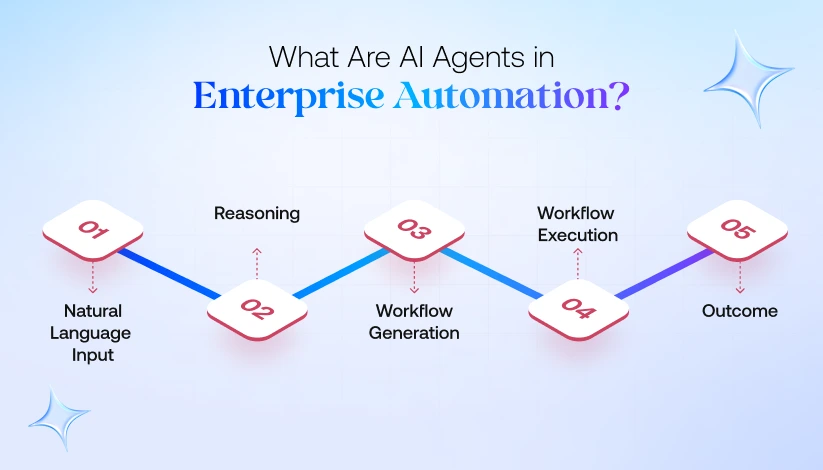
AI agents are intelligent software systems designed to perform tasks autonomously. They can analyze inputs, make decisions and take actions without constant human intervention.
In enterprise environments, these agents are used to-
- Automate repetitive workflows
- Assist in decision-making
- Handle customer interactions
- Coordinate across systems
What makes them powerful is their ability to combine reasoning, memory and execution into a single system.
Instead of static automation scripts, businesses now use agentic AI development to create systems that adapt in real time.
Build AI Agents That Actually Drive Business Outcomes
Design intelligent agents that automate workflows and deliver measurable business value.
Why Enterprises Are Investing in AI Agents?
Enterprises are not adopting AI agents just for innovation. They are doing it for measurable outcomes.
AI agents help organizations-
- Reduce operational workload
- Improve speed and efficiency
- Enable 24/7 execution without downtime
- Deliver consistent decision-making
- Scale processes without increasing costs
For example, an AI agent in a support system can understand a query, fetch data, respond intelligently & escalate only when needed. This is AI workflow automation at scale.
Step-by-Step AI Agent Development Process
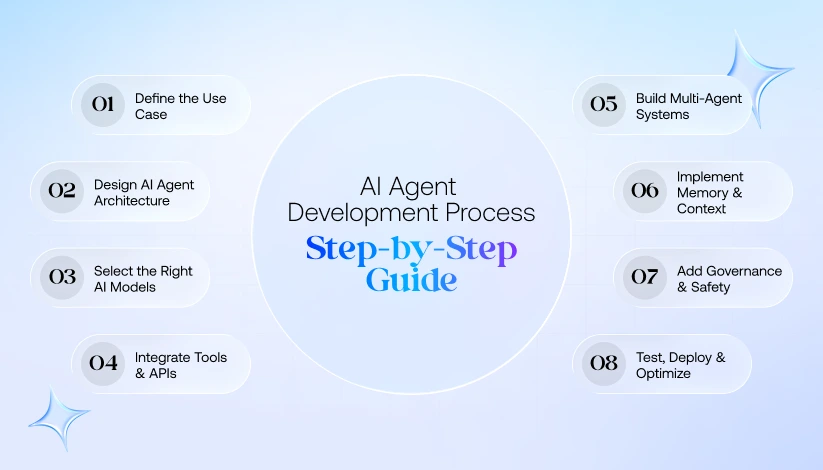
Building enterprise-grade AI agents requires a clear and structured process.
1. Define the Use Case
Start with a clear problem statement.
Decide what the agent should do.
Examples-
- Automate customer queries
- Process invoices
- Manage internal approvals
A focused use case ensures your AI agent delivers measurable value.
2. Design the AI Agent Architecture
The foundation of any agent lies in its architecture.
A typical AI agent architecture includes-
- Input layer (data, prompts, APIs)
- Reasoning engine (LLMs or logic models)
- Memory layer (context retention)
- Action layer (execution tools or APIs)
This structure allows the agent to observe → think → act → learn.
Without proper architecture, even powerful models fail to deliver results.
3. Choose the Right Models
At the core of every AI agent is a model.
Enterprises typically use-
- Large Language Models (LLMs) for reasoning
- Domain-specific models for accuracy
- Retrieval systems for real-time data
The goal is not just intelligence, but relevance and reliability.
4. Integrate Tools and APIs
AI agents become useful only when they can act.
This is where tools come in.
Common tools for building AI agents include-
- CRM integrations
- Payment gateways
- Internal databases
- Third-party APIs
These integrations allow agents to execute real-world actions like sending emails, updating records, or triggering workflows.
5. Build Multi-Agent Systems (If Needed)
For complex workflows, a single agent is not enough.
Enterprises use multi-agent systems, where multiple agents collaborate.
Example-
- One agent gathers data
- Another analyzes it
- A third executes actions
This creates a modular and scalable system.
6. Implement Memory and Context Handling
For enterprise use, agents must remember context.
This includes-
- Past interactions
- User preferences
- Workflow history
Memory ensures the agent behaves consistently and improves over time.
7. Add Governance and Safety Layers
Enterprise AI cannot operate without control.
You must include-
- Permission handling
- Data security
- Audit logs
- Human-in-the-loop approvals
This ensures the system remains reliable and compliant.
8. Test, Deploy & Optimize
Before deployment-
- Test across multiple scenarios
- Validate outputs
- Monitor performance
Post-deployment-
- Continuously optimize
- Improve accuracy
- Expand capabilities
Building AI agents is not a one-time process. It evolves with business needs.
Tools and Frameworks for Building AI Agents
Choosing the right stack is critical for success.
Popular AI agents frameworks and tools include-
Development Frameworks
- LangChain
- AutoGen
- CrewAI
- Semantic Kernel
Model Providers
- OpenAI
- Hugging Face
- LLaMA-based models
Infrastructure
- AWS
- Azure AI
- Google Cloud AI
Vector Databases
- Pinecone
- Weaviate
- FAISS
These tools help developers create scalable and production-ready AI development stacks.
Understanding AI Agent Architecture in Depth
At its core, agent architecture defines how an AI system behaves.
A well-designed architecture includes-
- Perception Layer– Collects inputs from users or systems
- Cognition Layer– Processes data and makes decisions
- Execution Layer– Performs actions using tools
- Memory Layer– Stores context and learning
This layered approach ensures the agent is not just reactive, but intelligent and adaptive.
In enterprise systems, architecture also determines scalability and reliability.
Turn Your Processes into Fully Autonomous AI Systems
Transform manual operations into intelligent workflows powered by enterprise AI automation.
Can AI Agents Automate Business Processes?
Yes and they already are.
AI agents are actively automating-
- Customer support operations
- Sales follow-ups
- HR onboarding processes
- Financial workflows
- IT service management
Instead of isolated automation, businesses now deploy autonomous AI agents that manage entire workflows end-to-end.
This reduces dependency on manual effort and increases operational speed.
Cost of Building AI Agents
The cost of building AI agents varies based on complexity.
Basic AI Agent
- $5,000 – $15,000
- Limited functionality
- Single use case
Mid-Level Enterprise Agent
- $20,000 – $60,000
- Integrations and workflows
- Moderate complexity
Advanced Multi-Agent System
- $80,000+
- Full enterprise automation
- Multi-system integration
Costs depend on-
- Model usage
- Infrastructure
- Development time
- Customization requirements
For enterprises, the ROI often outweighs the initial investment due to long-term efficiency gains.
Timeline to Build AI Agents
Development timelines vary based on scope.
- Simple agents- 3–6 weeks
- Mid-level systems- 2–3 months
- Advanced systems- 4–6 months
Factors affecting timelines-
- Complexity of workflows
- Number of integrations
- Data availability
- Testing requirements
Challenges in Building AI Agents
While AI agents are powerful, building them comes with challenges.
Data Dependency
Agents rely heavily on high-quality data.
Integration Complexity
Connecting multiple systems can be difficult.
Accuracy and Reliability
Ensuring consistent outputs requires continuous tuning.
Security and Compliance
Enterprise data must be protected at all times.
Change Management
Teams need time to adapt to AI-driven workflows.
Overcoming these challenges requires strong planning and the right expertise.
Future of Agentic AI Development
The future of AI is moving toward fully autonomous systems.
Enterprises are shifting from-
- Rule-based automation
to - Intelligent, self-operating systems
Agentic AI will power-
- Autonomous business operations
- Intelligent decision-making systems
- Real-time adaptive workflows
Companies that invest early in building AI agents will gain a strong competitive advantage.
Final Thoughts
AI agents are not just another automation tool. They represent a shift toward systems that can think, act & improve on their own.
By following a structured AI agent development process, choosing the right architecture & integrating powerful tools, enterprises can unlock true automation at scale.
The real question is no longer whether businesses should adopt AI agents.
It’s how fast they can build and deploy them.
Because in the future of enterprise operations, workflows won’t just run. They will think.
Launch Scalable Multi-Agent Systems Built for Enterprise Automation
Develop autonomous agents that collaborate, scale seamlessly, and optimize business performance
Frequently Asked Questions
The process includes defining use cases designing architecture, selecting models, integrating tools, implementing memory, adding governance & continuous optimization after deployment.
Some of the common tools are LangChain, AutoGen, CrewAI, Open AI models and vector DBs like pinecone & cloud platforms like AWS/Azure/Google Cloud.
It can take weeks for simple agents or months in case of advanced enterprise-level multi-agent systems.
Key challenges include data quality, system integration, maintaining accuracy, ensuring security compliance & adapting workflows to AI-driven processes.
Costs vary from $5,000 for basic agents to over $80,000 for advanced enterprise systems depending on complexity, integrations & customization needs.
Featured Blogs
Read our thoughts and insights on the latest tech and business trends
RAG vs Fine-Tuning: Which Approach Is Right for Your Enterprise AI Knowledge System?
- September 24, 2026
- Artificial Intelligence
Retrieval-Augmented Generation (RAG) and fine-tuning are the two primary methods for customizing a Large Language Model (LLM) with an enterprise's own knowledge. RAG connects a general-purpose LLM to an external knowledge base at query time,... Read more
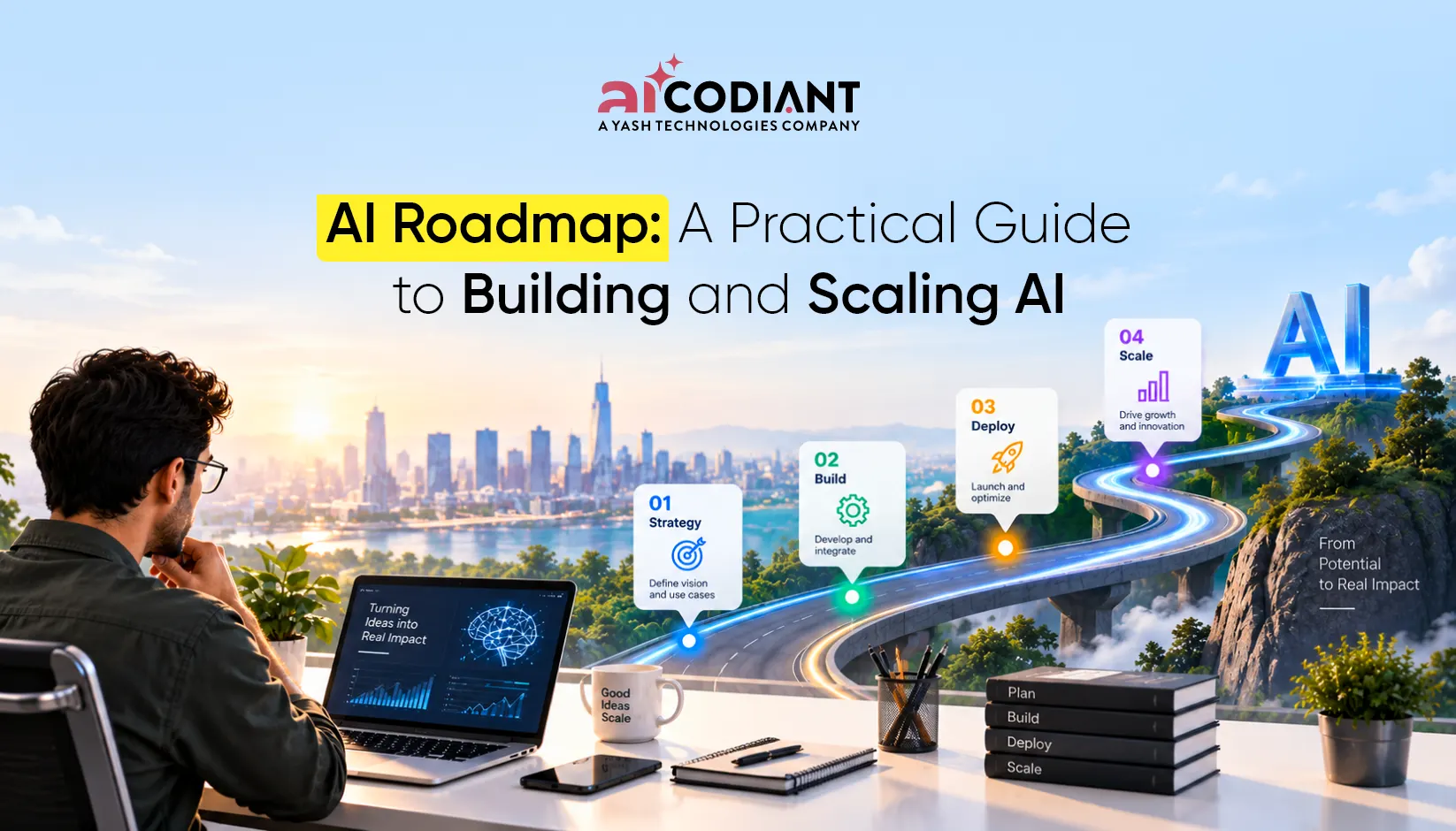
AI Roadmap: How to Build and Scale AI Across the Enterprise
- September 17, 2026
- Artificial Intelligence
An AI roadmap is a structured plan that connects business priorities with AI use cases, data, technology, governance, people, implementation, and measurable outcomes. For enterprises, it provides the sequence for moving from AI opportunities and... Read more

Top Predictive Analytics Models and Algorithms to Know
- September 11, 2026
- Artificial Intelligence
Predictive analytics models are statistical and machine learning systems that use historical data to forecast future outcomes, such as customer churn, equipment failure, demand spikes, or credit risk. The most widely used categories are regression... Read more