Hiring Generative AI Developers That Scale Your Enterprise AI: A Detailed Guide
Table of Contents
Subscribe To Our Newsletter
Hiring Generative AI developers means finding engineers who can design, build, and deploy large language models, RAG pipelines, and AI-powered workflows that solve real business problems at scale. For enterprises, the wrong hire costs more than a delayed project; it stalls competitive advantage in a market where AI adoption is accelerating fast. This guide explains exactly what to look for, what to pay, which engagement model fits your stage, and how to evaluate candidates before you sign a contract.
Key Takeaways:
- The top skills to evaluate are LLM fine-tuning, RAG architecture, vector databases, and MLOps, not just Python proficiency.
- Dedicated Generative AI developers offer the best cost-to-output ratio for ongoing enterprise projects.
- Always run a paid technical assessment (not just a portfolio review) before committing to any engagement model./li>
How Do I Hire Generative AI Developers?
Hiring Generative AI developers requires a structured process that goes beyond posting a job description and reviewing CVs. Enterprise AI projects fail most often not because of bad code, but because of misaligned technical scope and unclear evaluation criteria at the hiring stage.
Follow this step-by-step hiring process:
- Step 1 – Define the AI use case first: Specify whether you need LLM fine-tuning, a RAG pipeline, an AI agent, a multimodal system, or end-to-end Generative AI development services. A vague brief attracts generalists, not specialists.
- Step 2 – Write a skills-based job brief: List specific technologies (LangChain, OpenAI API, Hugging Face, vector DBs) rather than generic terms like ‘AI experience.’
- Step 3 – Source from the right channels: Use platforms like Toptal, Turing, Arc.dev, or work with a dedicated enterprise AI development company that pre-vets engineers for your domain.
- Step 4 – Run a structured technical screen: Include a live architecture exercise, not just a coding test. Ask candidates to design a RAG system for a given business scenario.
- Step 5 – Assess communication and documentation habits: Enterprise AI developers must explain model decisions to non-technical stakeholders. Test this explicitly.
- Step 6 – Start with a paid pilot: Run a 2–4 week scoped engagement before committing to a long-term contract.
According to LinkedIn’s 2024 Jobs on the Rise report, AI and machine learning roles were among the fastest-growing positions globally, making the talent market highly competitive. Moving too slowly in the hiring process means losing qualified candidates to better-prepared enterprises.
What Skills Should a Generative AI Developer Have?
A qualified Generative AI developer must possess a combination of deep ML engineering skills, infrastructure knowledge, and applied LLM expertise. General software development skills are a baseline, not a differentiator.
Core Technical Skills
- Large Language Model (LLM) fine-tuning using techniques such as LoRA, QLoRA, and RLHF
- Retrieval-Augmented Generation (RAG) pipeline design with vector databases like Pinecone, Weaviate, or pgvector
- Prompt engineering and system prompt architecture for production deployments
- LLM orchestration frameworks including LangChain, LlamaIndex, and Semantic Kernel
- Model evaluation, red-teaming, and hallucination mitigation strategies
- MLOps tooling MLflow, Weights & Biases, BentoML, or similar for model versioning and monitoring
- Cloud AI infrastructure on AWS SageMaker, Google Vertex AI, or Azure OpenAI Service
Secondary Skills That Distinguish Senior Candidates
- Experience with multimodal models (text + image + audio)
- Knowledge of AI safety, responsible AI frameworks, and data governance
- Ability to benchmark models against production latency, cost-per-token, and accuracy targets
- Understanding of enterprise security requirements including PII handling, data residency, and access controls
Hiring Insight
Candidates who can only reference ChatGPT API integrations are AI users, not AI developers. Enterprise AI developers should demonstrate hands-on experience with model training pipelines, evaluation datasets, and production monitoring dashboards.
How Much Does It Cost to Hire AI Developers?
The cost to hire Generative AI developers varies significantly based on engagement model, geography, seniority level, and specialization depth. The following figures are sourced from industry compensation surveys and enterprise AI development company rate cards current to 2024–2025.
Cost Reference Ranges (2024–2025)
- Junior AI Engineer (0–2 years): $60,000–$90,000/year (full-time) or $40–$65/hour (contract)
- Mid-Level Generative AI Developer (2–5 years): $100,000–$150,000/year or $75–$120/hour
- Senior LLM Engineer / AI Architect (5+ years): $160,000–$250,000/year or $130–$200/hour
- Dedicated AI Developer (offshore / nearshore via vendor): $4,000–$12,000/month depending on seniority and region
Source: Levels.fyi, Glassdoor, Turing.com rate data, 2024. Ranges reflect US-equivalent compensation. Offshore engagement rates apply to India, Eastern Europe, and Latin America vendors.
Key cost factors that influence your final budget include:
- Seniority and specialization – LLM researchers cost significantly more than prompt engineers
- Engagement model – full-time hires carry overhead (benefits, equity, onboarding) that contract and dedicated models avoid
- Geography – US-based engineers command 2–4x the rate of equally qualified engineers in India or Eastern Europe
- Project complexity – RAG systems with proprietary data pipelines require more senior (and more expensive) profiles than standard API integrations
- Timeline pressure – urgent hiring in a competitive market often requires paying 15–25% above standard rates
Should Enterprises Hire In-House or Dedicated AI Developers?
The choice between in-house hiring and dedicated Generative AI developers depends on your AI maturity stage, budget cycle, and the duration of your development roadmap. Neither model is universally superior the decision should be driven by your enterprise’s specific constraints.
| Model | Best For | Cost Profile | Flexibility |
| In-House Hire | Long-term core AI teams | High (salary + benefits) | Full control |
| Dedicated AI Developers | Ongoing enterprise projects | Mid (fixed monthly) | High |
| AI Consulting Firm | Strategy + implementation | Variable (project-based) | Moderate |
| Freelance AI Engineers | Short pilots / prototypes | Low–Mid (hourly) | Limited |
Recommendation for most enterprises: Use dedicated Generative AI developers for the first 12–18 months of AI development. This preserves budget flexibility, avoids long hiring cycles, and gives you access to pre-vetted AI engineers for hire who can begin delivering in weeks rather than months. Transition to in-house only once your AI use cases are stable, your data infrastructure is mature, and the scope justifies permanent headcount.
What Technologies Should Generative AI Developers Be Proficient In?
Generative AI developers working on enterprise-scale systems must demonstrate proficiency across four technology layers: foundation models, orchestration, infrastructure, and evaluation.
Layer 1 Foundation Models & APIs
- OpenAI GPT-4o, GPT-4 Turbo, and fine-tuning APIs
- Anthropic Claude API (claude-sonnet-4-6, claude-opus-4-6)
- Google Gemini 1.5 Pro via Vertex AI
- Open-source models: Meta LLaMA 3, Mistral, Falcon for on-premise deployments
Layer 2 Orchestration & Agentic Frameworks
- LangChain and LangGraph for multi-step AI agent workflows
- LlamaIndex for document-heavy RAG pipelines
- CrewAI and AutoGen for multi-agent enterprise systems
Layer 3 Vector Databases & Knowledge Infrastructure
- Pinecone, Weaviate, Qdrant, Chroma, or pgvector for similarity search
- Embedding models: OpenAI text-embedding-3, Cohere Embed, or open-source alternatives
Layer 4 MLOps & Deployment
- MLflow or Weights & Biases for experiment tracking
- Docker + Kubernetes for containerized model serving
- AWS SageMaker, Google Vertex AI, or Azure ML for managed deployment
- Prometheus + Grafana or Datadog for production model monitoring
How Enterprises Can Assess a Generative AI Developer’s Technical Expertise
Portfolio reviews and certifications are insufficient for evaluating senior Generative AI talent. Enterprise AI development demands judgment, not just execution and judgment only surfaces under realistic conditions.
Use this three-stage technical assessment framework:
- Stage 1 – Architecture Exercise (60 minutes): Present a real business scenario e.g., ‘Design a RAG pipeline for a 50,000-document internal knowledge base with sub-2-second query response times.’ Evaluate system design, trade-off reasoning, and cost awareness.
- Stage 2 – Live Debugging Session (45 minutes): Provide a broken LangChain pipeline with intentional hallucination issues and retrieval failures. Evaluate diagnosis speed and remediation approach.
- Stage 3 – Stakeholder Communication Test (30 minutes): Ask the candidate to explain their Stage 1 architecture to a non-technical panel. Evaluate clarity, confidence, and ability to translate AI concepts into business outcomes.
Candidates who clear all three stages are typically ready to lead enterprise AI workstreams independently a strong signal for both dedicated and in-house roles.
How Generative AI Developers Help Scale Enterprise AI Initiatives
Generative AI developers do not just build chatbots. At enterprise scale, they design the AI infrastructure that enables organizations to move from one-off AI experiments to repeatable, measurable AI systems.
The four ways dedicated Generative AI developers drive enterprise AI scale:
- They build reusable AI pipelines RAG architectures, embedding workflows, and prompt management systems that can power multiple products, not just a single use case.
- They implement enterprise-grade guardrails PII redaction, hallucination detection, content filtering, and audit logging that make AI deployable in regulated industries.
- They design for cost efficiency model selection, caching strategies, and batching approaches that keep inference costs predictable as usage grows.
- They establish AI evaluation frameworks automated testing pipelines that catch model regressions before they reach production, enabling safe continuous improvement.
Enterprise AI Scaling Insight
The difference between an enterprise AI pilot and a scaled AI product is not the model it is the infrastructure around it. Generative AI developers who understand data pipelines, access controls, monitoring, and rollback procedures are the ones who turn proof-of-concepts into production systems.
Final Takeaway: Build Your Enterprise AI Team with Intention
Hiring Generative AI developers is one of the highest-leverage decisions an enterprise can make in 2025. The right developers do not just write code they design the foundations that determine how far and how fast your AI capabilities can grow.
Start by defining your AI use case with precision. Then choose the engagement model that matches your stage dedicated AI developers for most enterprises, in-house for mature programs, consulting for strategy. Run structured technical assessments, not portfolio reviews. And prioritize developers who understand enterprise-grade concerns: security, evaluation, cost efficiency, and stakeholder communication.
The enterprises that scale AI fastest are not the ones with the biggest budgets. They are the ones that hire with clarity, evaluate with rigor, and build with the right team from day one.
Hire Expert Generative AI Developers to Accelerate Enterprise AI Success Today
Build secure, scalable AI solutions with experienced developers delivering measurable business outcomes faster together.
Frequently Asked Questions
Businesses should prioritize demonstrated experience with LLM fine-tuning, RAG pipeline architecture, and production model deployment over academic credentials alone. Look for engineers who have shipped at least one AI system to production, can articulate model evaluation methodology, and understand enterprise data security requirements. Relevant frameworks include LangChain, LlamaIndex, Hugging Face Transformers, and cloud AI platforms such as AWS SageMaker or Google Vertex AI.
Use a structured three-stage process: an architecture exercise based on a real enterprise scenario, a live debugging session with a broken AI pipeline, and a stakeholder communication test where the candidate explains their solution to a non-technical audience. Avoid relying solely on coding tests or GitHub portfolios these measure execution but not the systems thinking that enterprise AI development requires.
Dedicated Generative AI developers offer the strongest balance of cost, flexibility, and speed-to-productivity for most enterprises at the early-to-mid stage of AI adoption. In-house hiring is appropriate once AI use cases are stable and the scope justifies permanent headcount. AI consulting firms are most valuable for strategy definition and initial architecture decisions, not for ongoing development execution.
Generative AI developers scale enterprise AI by building reusable pipelines, implementing compliance and safety controls, designing cost-efficient inference architectures, and establishing automated evaluation frameworks. These capabilities move an organization from isolated AI experiments to interconnected, production-grade AI systems that operate reliably at volume across business units.
The primary cost factors are seniority and specialization depth, engagement model (full-time versus dedicated versus consulting), geography, project complexity, and timeline pressure. A mid-level dedicated Generative AI developer engaged through an enterprise AI development company in India typically costs $5,000–$8,000 per month compared to $130,000–$180,000 per year for an equivalent full-time hire in the United States.
Featured Blogs
Read our thoughts and insights on the latest tech and business trends
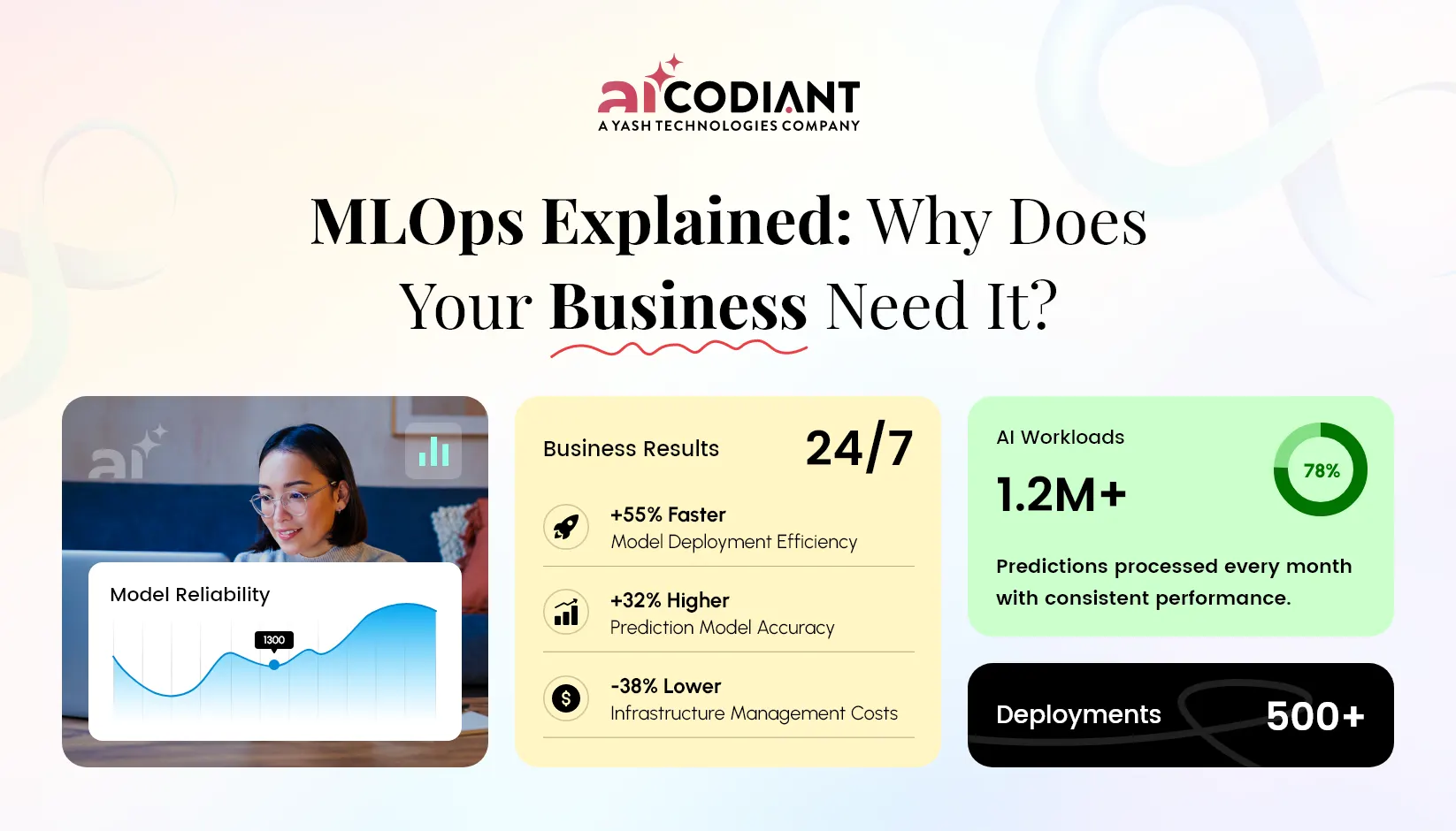
What Is MLOps? A Business Guide to Machine Learning Operations
- July 24, 2026
- Machine Learning
MLOps short for Machine Learning Operations is the discipline of deploying, monitoring and maintaining machine learning models in production reliably and at scale. It bridges the gap between data science teams that build AI models... Read more
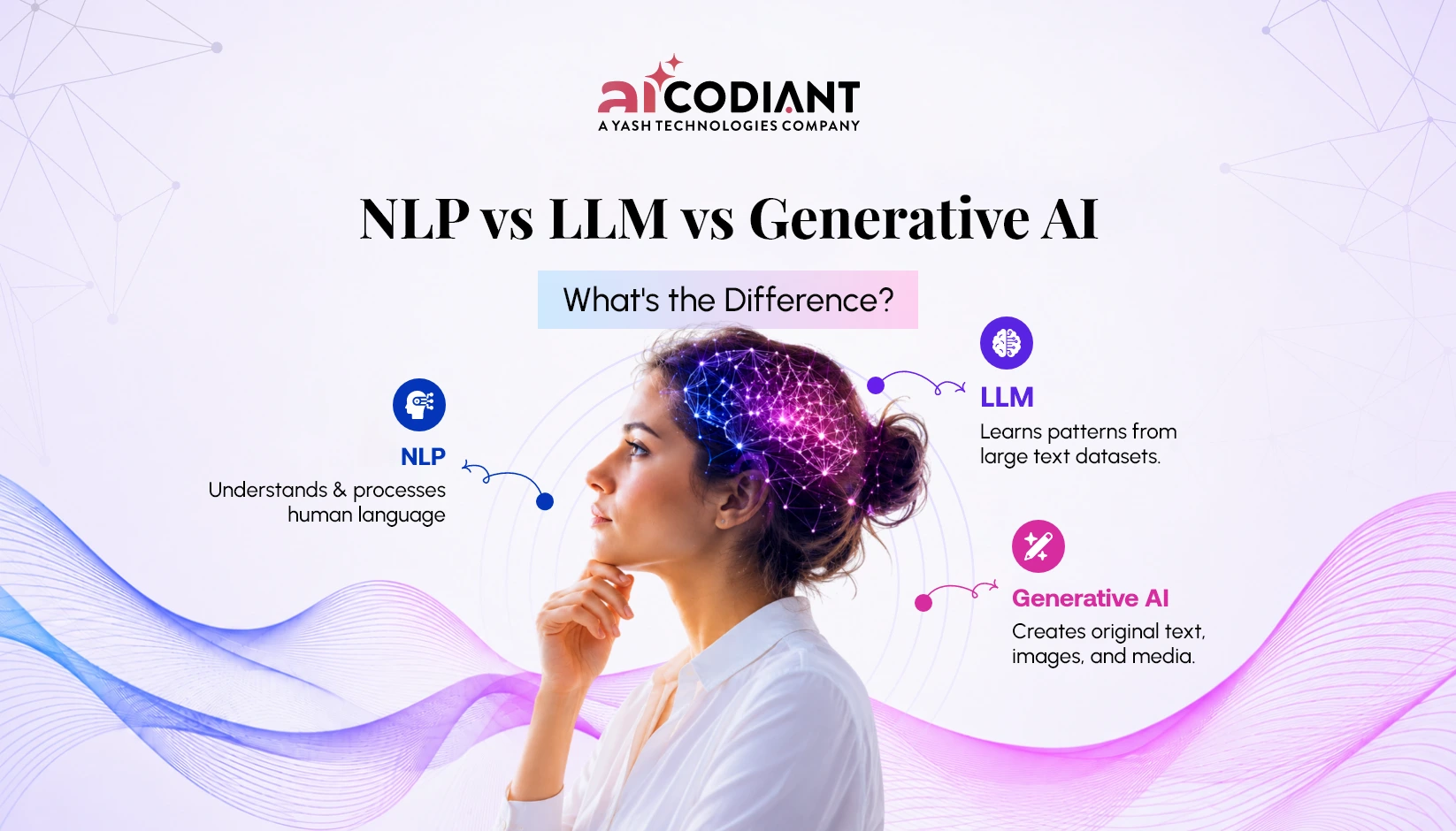
NLP vs LLM vs Generative AI Explained: Enterprise AI Terminology Guide You Actually Need
- July 22, 2026
- Artificial Intelligence
Natural Language Processing (NLP), Large Language Models (LLMs), and Generative AI are three distinct but deeply connected AI technologies and confusing them leads to costly enterprise decisions. NLP processes and understands language. LLMs are powerful... Read more
How Much Does It Cost to Build an NLP Solution?
- July 17, 2026
- NLP
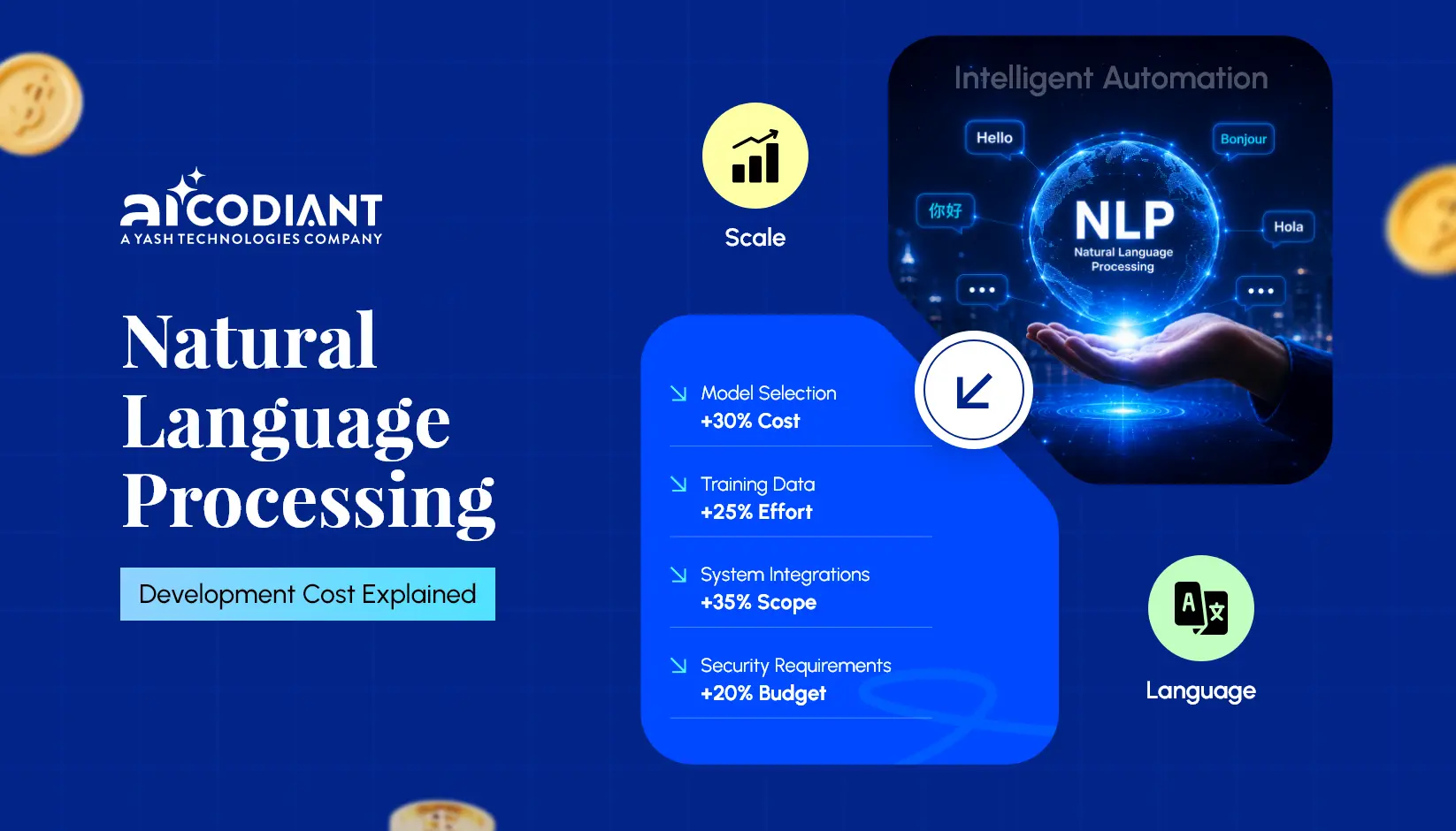
Building an NLP solution costs between $10,000 and $500,000+, depending on complexity, data requirements, model architecture, integrations, and the expertise of your NLP software development company. A rule-based chatbot for a single use case sits... Read more