Enterprise AI Development Partner Checklist- What CTOs Should Evaluate Before Hiring
Table of Contents
Subscribe To Our Newsletter
AI is no longer an experiment sitting in innovation labs. It’s driving revenue, optimizing operations, and shaping how enterprises compete.
But here’s the real challenge choosing the right enterprise AI development partner.
Because the difference between success and wasted budget isn’t the technology.
It’s who you build it with.
Many CTOs rush into partnerships based on demos, pricing, or brand reputation. Months later, they’re stuck with delayed timelines, underperforming models, or systems that don’t scale.
So how do you avoid that?
This guide breaks down a practical, real-world AI development partner checklist to help you make the right call before you hire an AI development company.
Why Choosing the Right AI Partner Is a Strategic Decision?
AI projects don’t fail because models don’t work. They fail because they’re poorly scoped, disconnected from business goals, or built without long-term scalability in mind.
A strong enterprise AI consulting services partner doesn’t just build solutions.
They help you-
- Define use cases that actually drive ROI
- Align AI with business workflows
- Build scalable, production-ready systems
- Ensure compliance, security, and governance
This is why AI implementation partner selection is not a vendor decision it’s a strategic one.
What CTOs Should Look for in an AI Development Partner?
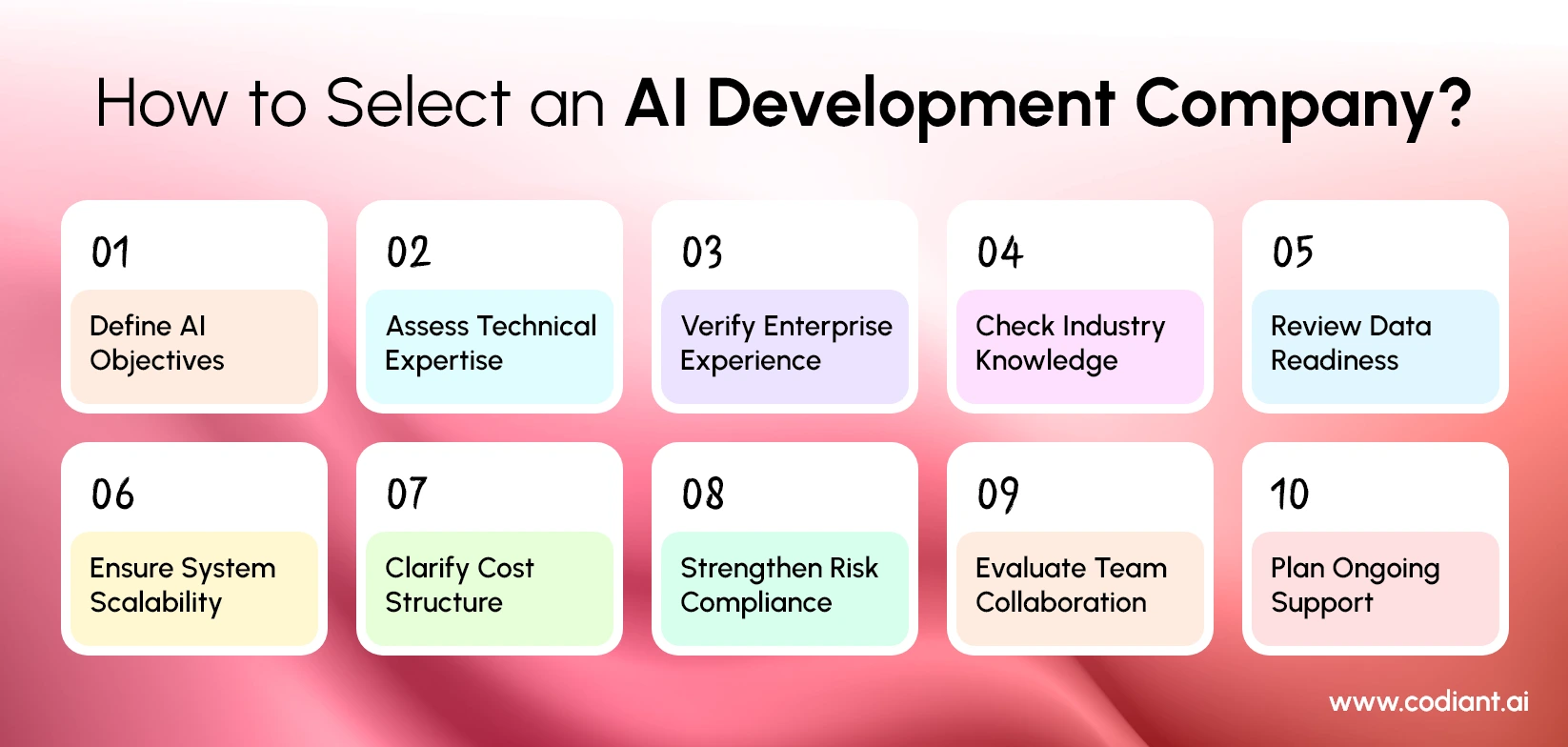
Here is a practical checklist CTOs can use to evaluate capabilities, reduce risks, and choose an enterprise AI development partner aligned with long-term business goals and scalability.
Clarity on Your Enterprise AI Goals
Before evaluating vendors, you need internal clarity.
What are you trying to achieve?
- Automating operations?
- Improving customer experience?
- Driving predictive insights?
- Reducing costs?
Top enterprises don’t start with “We need AI.”
They start with “We need to solve this business problem.”
A reliable enterprise AI strategy consulting partner will challenge your assumptions, refine your goals, and prioritize use cases based on feasibility and impact.
If a vendor jumps straight into development without this step, it’s a red flag.
Depth of Technical Expertise
Every company claims to “do AI.” Few can actually deliver enterprise-grade systems.
When evaluating an AI software development company selection, look deeper-
- Experience with LLMs, RAG, and AI agents
- Data engineering and pipeline capabilities
- MLOps and model lifecycle management
- Cloud expertise (AWS, Azure, GCP)
- Integration with enterprise systems (ERP, CRM, APIs)
Ask for real architecture explanations, not just case studies.
Because building a prototype is easy.
Building something that works at scale is not.
Proven Experience with Enterprise-Scale Projects
This is where most CTOs get it wrong.
A company that has built AI chatbots for startups may not be equipped to handle enterprise complexity.
Look for-
- Multi-system integrations
- Large dataset handling
- Compliance-heavy environments
- Cross-functional workflows
Strong AI outsourcing services enterprises providers will have experience working with-
- Healthcare regulations
- Financial compliance
- Retail scalability
- Manufacturing operations
The more complex your environment, the more critical this becomes.
Understanding of Your Industry
AI is not one-size-fits-all.
A fraud detection system in fintech is very different from a recommendation engine in retail or a diagnostic assistant in healthcare.
That’s why AI transformation consulting services must include domain understanding.
A good partner will-
- Speak your industry language
- Understand your workflows
- Know typical data challenges
- Suggest relevant use cases
Without this, you’ll spend months explaining context instead of building solutions.
Data Strategy and Readiness Approach
AI is only as good as your data.
Before development even starts, your partner should assess-
- Data availability and quality
- Data pipelines and storage
- Labeling and preprocessing requirements
- Data privacy and governance
Many AI projects fail because companies underestimate data preparation.
A strong enterprise AI development partner will prioritize data strategy just as much as model development.
Scalability and Production Readiness
This is where real AI maturity shows.
Ask yourself-
- Can this solution handle millions of users?
- Will it integrate with existing systems?
- Is there a plan for monitoring and updates?
A mature partner will focus on-
- MLOps pipelines
- Model monitoring and retraining
- Performance optimization
- Infrastructure scalability
Because AI is not a one-time build.
It’s an evolving system.
Transparency in Cost and Engagement Models
One of the most common questions CTOs ask how much does enterprise AI development cost?
The honest answer- it depends.
Costs vary based on-
- Complexity of the use case
- Data readiness
- Model type (custom vs pre-trained)
- Integration requirements
- Timeline
A reliable partner will break down-
- Development costs
- Infrastructure costs
- Ongoing maintenance
- Scaling costs
Avoid vendors who give vague estimates or underprice just to win the deal.
Security, Compliance, and Risk Management
AI introduces new risks.
From data leaks to biased models, the stakes are high especially for enterprises.
Your AI implementation partner selection should include-
- Data encryption and access controls
- Compliance with GDPR, HIPAA, or regional laws
- Model explainability and auditability
- Bias detection and mitigation
Outsourcing AI without strong governance can create long-term liabilities.
Collaboration Model and Communication
Even the best technical team will fail without alignment.
Evaluate how the partner works-
- Do they follow agile methodologies?
- How often do they share updates?
- Is there a dedicated project team?
- How do they handle feedback and iterations?
Strong AI outsourcing services enterprises providers act like an extension of your team, not an external vendor.
Post-Deployment Support and Optimization
AI doesn’t end at deployment.
Models degrade. Data changes. Business needs evolve.
Your partner should offer-
- Continuous monitoring
- Model retraining
- Performance optimization
- Feature enhancements
This is where long-term value is created.
Without this, even the best AI systems become obsolete.
Common Risks to Watch Out For
Many enterprises underestimate the risks when they hire an AI development company.
Some of the most common pitfalls include-
- Overpromising capabilities without proof
- Lack of scalability planning
- Poor data handling practices
- Hidden costs during scaling
- Limited post-launch support
The goal isn’t just to build AI.
It’s to build AI that works in real-world conditions.
What Services Should You Expect from an AI Partner?
A full-service enterprise AI consulting services provider should offer-
- AI strategy and consulting
- Data engineering and preparation
- Model development and training
- System integration
- Deployment and MLOps
- Ongoing support and optimization
If a company only offers development without strategy or post-launch support, it’s incomplete.
Why Enterprises Choose Codiant AI for AI Development?
When selecting a trusted enterprise AI development partner, Codiant AI brings a focused, AI-first approach that blends strategy, engineering, and real-world execution. The goal isn’t just to build models, but to deliver measurable business outcomes.
With Codiant AI, you get:
- End-to-end enterprise AI consulting services and implementation support
- Deep expertise in LLMs, RAG, AI agents, and automation solutions
- Dedicated AI teams aligned to your time zone and delivery goals
- Scalable, secure, and enterprise-ready AI architectures
From idea validation to full-scale deployment, Codiant AI acts as a long-term partner helping enterprises accelerate AI adoption with clarity, speed, and confidence.
Final Thoughts- Choose a Partner, Not a Vendor
AI is not a short-term project. It’s a long-term capability.
The right enterprise AI development partner will-
- Think beyond code
- Align with your business goals
- Build for scalability
- Support you through evolution
The wrong one will leave you with a half-built system and a drained budget.
So before you make a decision, go back to this AI development partner checklist and evaluate thoroughly.
Because in enterprise AI, who you build with matters just as much as what you build.
Build AI Systems That Actually Scale Across Your Enterprise Operations.
Stop experimenting with AI. Partner with experts who design scalable, secure, and ROI-driven enterprise AI solutions tailored to your business.
Frequently Asked Questions
They should have strong capabilities in machine learning, data engineering, MLOps, cloud platforms, and experience with LLMs, RAG systems, and enterprise integrations.
Review real case studies, ask for architecture walkthroughs, check industry experience, and validate their ability to handle enterprise-scale data and systems.
Industries like healthcare, fintech, retail, manufacturing, and logistics often require domain-specific AI expertise due to complex workflows and compliance requirements.
Timelines vary from 3 to 12 months depending on complexity, data readiness, integration needs, and the scale of deployment.
Choosing based on cost alone, ignoring data readiness, overlooking scalability, and not evaluating post-deployment support are some of the most common mistakes.
Featured Blogs
Read our thoughts and insights on the latest tech and business trends
Implementing Agentic RAG in Enterprises: Architecture, Challenges & ROI
- April 2, 2026
- Artificial Intelligence
In 2026, enterprises are no longer satisfied with static AI responses or generic large language model outputs. The demand has shifted toward systems that can think, retrieve, act and refine responses dynamically this is where... Read more
Agentic AI vs Generative AI- The Detailed Comparison Guide
- March 17, 2026
- Artificial Intelligence
In the past several years artificial intelligence has grown rapidly. Initially, the bulk of conversations was always about Generative AI tools that could write content, create images, summarize reports or generate code within seconds. But... Read more
How to Use AI for Predictive Analytics- A Complete Practical Guide
- March 6, 2026
- AI-Powered Data Analytics
Predictive analytics is not new, it’s been around for decades, however its capabilities have changed very fundamentally with the arrival of AI. Classical statistical models were based on small data, assumptions that could not be altered, and... Read more