How Much Does AI Development Cost 2026? A Complete Guide
Table of Contents
Subscribe To Our Newsletter
AI is no longer something businesses experiment with on the side. In 2026, it is being used to build smarter apps, automate daily work, improve customer support, and make better decisions using data. As more companies plan to use AI in real products, one question comes up early and often. How much does AI development actually cost?
In practical terms, the AI app development cost in 2026 usually starts at around $20,000 for a basic, well-scoped solution. This includes use cases like AI chatbots, simple machine learning models, or automation features. As requirements grow, so does the cost. Custom AI solutions with advanced machine learning or generative AI often fall between $100,000 and $300,000, while large enterprise AI platforms can cross $500,000 when data scale, integrations, and security needs increase.
The wide cost range exists because AI is not built in a single way. The cost of AI development depends on what kind of AI you are building, the quality of data available, the models being used, and how the system is deployed and maintained. Generative AI, AI agents, and real-time systems add new layers of effort that were not common a few years ago.
This guide explains AI development cost 2026 in clear terms. It covers pricing by use case, key cost factors, timelines, and ways to plan budgets smartly. If you are trying to estimate your AI project cost without getting lost in technical jargon, this guide will help you make sense of the numbers.
AI Development Cost Overview 2026
| AI Category | What It Includes | Typical Timeline | Estimated Cost Range (USD) |
| Basic AI Features | Rule-based automation, simple ML models, basic AI logic | 6–8 weeks | $20,000 – $70,000 |
| AI Chatbots & Virtual Assistants | Customer support bots, internal assistants, LLM API integration | 8–12 weeks | $40,000 – $120,000 |
| Machine Learning Solutions | Predictive analytics, recommendations, forecasting, fraud detection | 10–16 weeks | $70,000 – $200,000 |
| Custom AI Solutions | Tailored ML models, domain-specific logic, system integrations | 3–5 months | $100,000 – $300,000 |
| Generative AI Applications | AI copilots, content generation, RAG systems, document intelligence | 3–6 months | $120,000 – $350,000 |
| Computer Vision Systems | Image recognition, video analysis, object detection | 4–6 months | $150,000 – $400,000 |
| AI Agents & Workflow Automation | Task automation, decision-making agents, multi-system coordination | 5–8 months | $200,000 – $500,000+ |
| Enterprise AI Platforms | Large-scale AI systems, multiple users, security, compliance | 6–12+ months | $300,000 – $700,000+ |
| Post-Deployment & Ongoing Costs | Model monitoring, retraining, cloud usage, optimization | Ongoing | 15–25% of initial cost yearly |
What AI Development Means in 2026
AI development in 2026 goes beyond building a single model. It includes how AI is trained, how it connects with your product, and how it runs in real-world conditions.
Some AI solutions focus on prediction or pattern detection using machine learning. Others use generative AI to create text, images, or summaries. More advanced systems use AI agents that can perform tasks, make decisions, and interact with multiple tools automatically.
Because of this, AI software development pricing changes based on whether AI is a small feature or the core of your product.
Planning an AI Project for 2026?
Get a realistic cost estimate based on your use case, data, and goals. Understand what to build first and what can wait. Avoid overpaying for AI features you do not need.
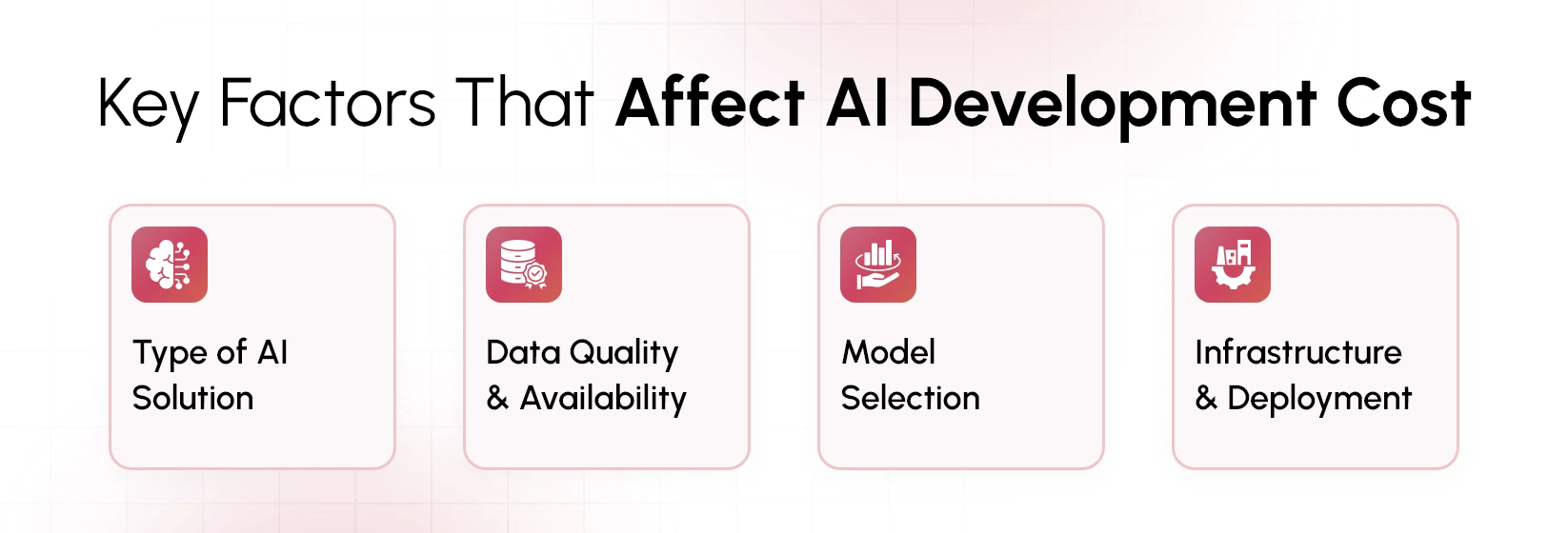
Key Factors That Affect AI Development Cost
Many businesses ask the same question before starting an AI project: what actually decides how much AI development will cost?
In 2026, AI pricing is shaped by a few practical factors. These are not technical buzzwords but real decisions that directly affect time, effort and budget.
Type of AI Solution
The type of AI you want to build has the biggest impact on cost. A simple AI chatbot that answers customer questions is far easier and cheaper to build than a full AI platform that handles predictions, automation, and decision-making.
For instance, chatbots, simple recommendation systems or rule-based automation are on the lower part of scales showing how much does it cost to develop an AI app. In contrast, while computer vision systems or generative AI tools or AI agents working across multiple systems are great, they require more development time and testing and integration. Cost of AI development raises as complexity is increased.
Read More: Artificial Intelligence Why Enterprises Need AI Strategy Consulting in the USA?
Data Quality and Availability
AI relies on heavy data dependence. If you are a business that already have clean, well structured and organized data, your development is faster and more predictable. This keeps costs under control.
But when data is fragmented, incomplete or unstructured, teams have to clean; organize and sometimes label the data before AI can even be taught. This overhead adds time and effort, which in itself increases the cost of machine learning development. In sectors such as health care or finance, extra data checks and compliance also contribute to prices.
Model Selection
Another key factor is how the AI model is built. Largely, it is less expensive to purchase a ready-made API compared to the cost of internal development. They are fast to incorporate and are efficient in many generic scenarios.
To enhance effectiveness, one can fine-tune an existing model to suit particular business real cases, which leads to higher accuracy but larger development effort. Training a model from scratch is the most costly way as building up large scale training data and higher computation power per train-test error cycle are needed. That’s why model selection is the single most influential aspect in getting to a figure for how much custom AI development cost
Infrastructure and Deployment
Where and how your AI system runs also affects pricing. Cloud-based AI solutions are popular because they are flexible and faster to launch. However, they come with ongoing costs for storage, computing, and usage.
On-premise or hybrid deployments are often used in regulated industries. These setups require more planning, stronger security, and higher maintenance efforts. While they offer more control, they usually increase both development and long-term operational costs, impacting overall AI software development pricing.
Read More: How to Develop an AI-Powered Marketplace App
AI Development Cost Breakdown: Where Your Budget Goes
Before estimating the total AI development cost in 2026, it is important to understand how AI budgets are actually spent. AI is not a single build step. It is a process made up of several stages, and each stage adds to the overall cost.
Planning and AI Use Case Design
This is where the foundation is set. The team defines the AI problem, decides what the system should do, and selects the right approach. Poor planning often leads to rework later, which increases cost.
Typical cost impact: 10–15% of total AI project cost
Data Preparation and Cleaning
Data work is often the most time-consuming part of AI development. Teams clean raw data, remove errors, handle missing values, and prepare it for training.
If data is already structured, this phase is shorter. If data is scattered or unstructured, costs rise quickly. This stage heavily affects machine learning development cost.
Typical cost impact: 20–30% of total AI project cost
Model Development or Integration
At this stage, teams either integrate existing AI models or customize them for the project. Generative AI, fine-tuned models, or custom training all fall here.
This phase largely determines custom AI development cost, especially for advanced use cases.
Typical cost impact: 25–35% of total AI project cost
Backend and Frontend Integration
The AI model must work smoothly inside the app or system. This includes APIs, databases, dashboards, and user interfaces. Even strong AI models fail if integration is weak.
Typical cost impact: 10–15% of total AI project cost
Testing and Validation
AI systems must be tested for accuracy, performance, bias, and edge cases. For regulated industries, this phase becomes more detailed and time-consuming.
Typical cost impact: 8–12% of total AI project cost
Deployment and Monitoring Setup
After launch, AI systems need monitoring to track performance, errors, and model drift. This ensures the AI keeps working as expected in real-world use.
Typical cost impact: 5–10% of total AI project cost
| Development Stage | Estimated Cost Share |
| Planning and use case design | 10–15% |
| Data preparation and cleaning | 20–30% |
| Model development or integration | 25–35% |
| Backend and frontend integration | 10–15% |
| Testing and validation | 8–12% |
| Deployment and monitoring | 5–10% |
This breakdown explains why AI project cost estimation requires more than just model pricing.
Average AI Development Cost by Use Case in 2026
The total AI app development cost depends strongly on how AI is used. Below is a clear view of what businesses typically spend in 2026, based on real-world project scopes.
AI Chatbots and Virtual Assistants
AI chatbots are often the starting point for AI adoption. They handle customer queries, internal support, and lead qualification. Most rely on existing language models with light customization.
Typical cost range: $40,000 to $120,000
Used for:
- Customer support automation
- Internal helpdesks
- Sales and lead handling
This is usually the lowest entry point for AI development.
Machine Learning and Predictive Systems
These systems analyze data to predict outcomes such as demand, fraud risk, or customer behavior. Costs depend on data volume and accuracy requirements.
Typical cost range: $70,000 to $200,000
Used for:
- Forecasting and analytics
- Fraud detection
- Churn and risk prediction
This category strongly influences machine learning development cost.
Generative AI Applications
Generative AI includes AI copilots, content generation tools, and RAG-based systems. These solutions need higher compute usage, monitoring, and usage-based pricing.
Typical cost range: $120,000 to $350,000
Used for:
- AI copilots and assistants
- Content and document generation
- Knowledge search systems
This clearly answers a common question: Is generative AI more expensive to build than traditional AI?
Yes, due to infrastructure and ongoing usage costs.
Enterprise AI Platforms and AI Agents
These are large systems that support multiple teams, workflows, and integrations. They often include automation, analytics, and decision support in one platform.
Typical cost range: $200,000 to $500,000+
Used for:
- Enterprise automation
- Operations and workflow management
- Decision support across departments
This is where enterprise AI development cost is highest but also delivers long-term value.
AI Development Cost by Use Case Table (2026)
| AI Use Case | Estimated Cost Range |
| AI chatbots and virtual assistants | $40,000 – $120,000 |
| Machine learning and predictive systems | $70,000 – $200,000 |
| Generative AI applications | $120,000 – $350,000 |
| Enterprise AI platforms and AI agents | $200,000 – $500,000+ |
Cost of Building AI In-House vs Outsourcing AI Development
When planning an AI project in 2026, one of the first decisions businesses face is whether to build the AI system internally or work with an external AI development partner. Both options come with very different cost structures, timelines, and long-term commitments.
In-House AI Development Cost
Building AI in-house means hiring your own AI engineers, data scientists, and machine learning specialists. These roles are highly paid and in strong demand. Salaries alone can take up a large part of the budget, even before development starts.
In addition to hiring costs, companies must invest in infrastructure and tools. This includes cloud resources, model training environments, data storage, monitoring tools, and security systems. These costs are ongoing and grow as the AI system scales.
There is also long-term maintenance to consider. AI models need regular updates, retraining, performance monitoring, and bug fixes. Over time, this creates a steady operational expense that increases the overall enterprise AI development cost, especially for teams managing multiple AI systems.
In-house AI development works best for companies that need full control and plan to build AI as a long-term internal capability.
Read More: How to Build an Intelligent AI Model
Outsourced AI Development Cost
Outsourcing AI development allows businesses to work with experienced teams without building everything from scratch. Most outsourcing partners offer project-based pricing, which makes costs easier to predict and manage.
Another common option is hiring dedicated AI teams. This model provides access to AI engineers, data scientists, and MLOps experts who work as an extension of your team. It reduces hiring time and removes the need for long-term salary commitments.
Outsourcing also allows businesses to choose between offshore, nearshore, and onshore teams. Offshore teams usually offer the lowest development costs, nearshore teams balance cost and time-zone alignment, and onshore teams offer closer collaboration but at higher rates. This flexibility helps control AI software development pricing while maintaining quality.
For many startups and growing businesses, outsourcing is a practical way to reduce AI app development cost while still building reliable and scalable AI solutions.
AI Development Pricing Models in 2026
In 2026, AI projects are not priced in one fixed way. The final AI development cost depends not only on what you build, but also on how you choose to engage with the development team. This is why selecting the right pricing model is important for accurate AI project cost estimation and long-term budget control.
Below are the most common AI software development pricing models used today, along with when each one makes sense.
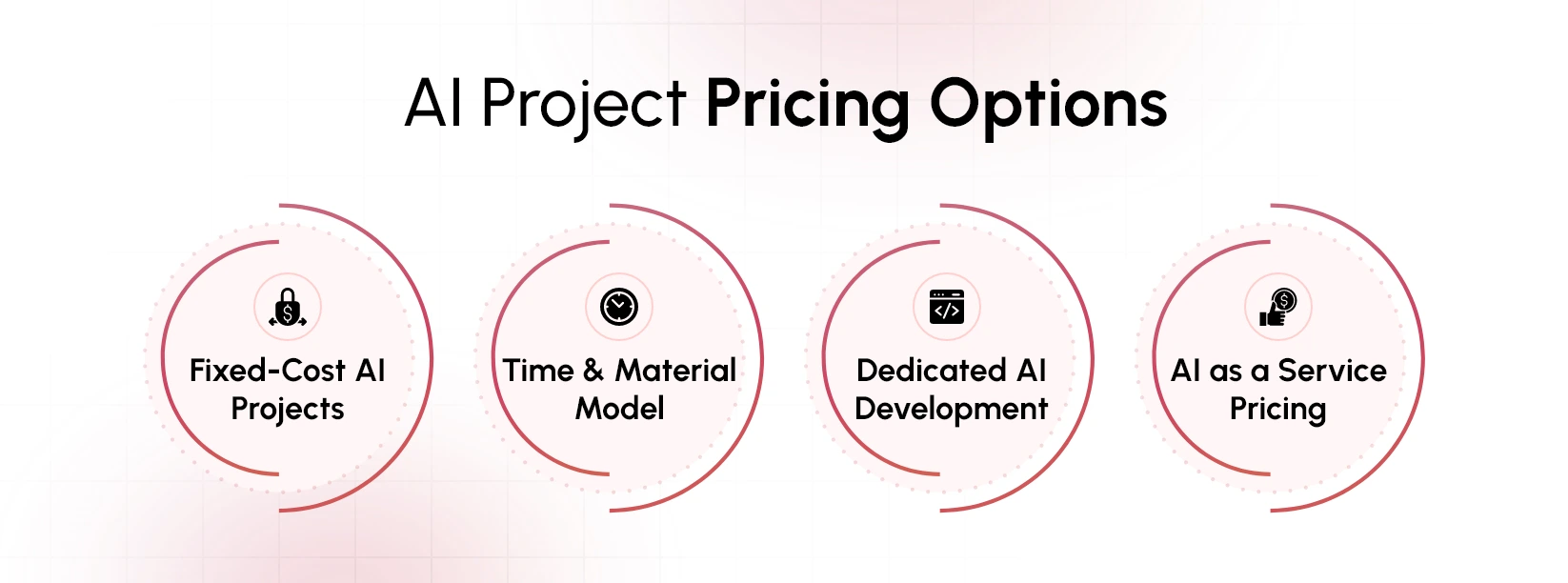
Fixed-Cost AI Projects
In a fixed-cost model, the total price of the AI project is decided before development begins. The scope, features, timeline, and deliverables are clearly defined at the start.
This model works best when the AI requirements are stable and unlikely to change. It is commonly used for small to mid-sized AI solutions where the problem is already well understood.
Fixed-cost projects make it easier to plan budgets and answer a common question buyers ask: how much does AI development cost in 2026? However, changes during development usually lead to additional charges.
Best suited for
- AI chatbots
- Simple AI features
- Proof-of-concept AI apps
- Well-defined MVPs
Time & Material Model
In the time and material model, pricing is based on the actual time and effort spent by the AI development team. The scope can evolve as the project progresses.
This model is useful when AI requirements are not fully clear at the beginning. It allows flexibility for testing, learning from data, and improving the model over time. Many custom AI development cost projects use this approach.
While this model offers flexibility, it requires close tracking to keep the cost of AI development under control.
Best suited for
- Machine learning systems
- Generative AI applications
- Data-heavy AI solutions
- Experimental or evolving AI products
Dedicated AI Development Teams
In this model, businesses hire a dedicated team of AI engineers, data scientists, and developers who work only on their project. The team is usually billed monthly.
This approach is often more cost-effective than building a full in-house team and gives better control than short-term projects. It is commonly used for long-term AI roadmaps and enterprise systems.
Dedicated teams make AI development cost 2026 more predictable over time and reduce hiring and training efforts.
Best suited for
- Enterprise AI platforms
- Long-term AI product development
- Ongoing AI improvements and scaling
AI-as-a-Service (AIaaS) Pricing
AI-as-a-Service uses a usage-based pricing model. Instead of paying a large upfront development cost, businesses pay based on how much the AI system is used. This may include API calls, tokens, or compute usage.
AIaaS allows fast deployment and lower initial investment, which helps reduce early AI app development cost. However, costs can increase as usage grows, especially for generative AI systems.
This model requires careful monitoring to avoid unexpected expenses.
Best suited for
- Generative AI features
- AI-powered SaaS products
- Consumer-facing AI apps with variable usage
| Pricing Model | Cost Predictability | Flexibility | Impact on AI Development Cost |
| Fixed-cost projects | High | Low | Clear upfront pricing |
| Time & material | Medium | High | Costs grow with scope |
| Dedicated AI teams | High (monthly) | Medium | Stable long-term costs |
| AI-as-a-Service | Low upfront | High | Usage-based ongoing costs |
How to Choose the Right AI Pricing Model
Choosing the right pricing model depends on how clear your requirements are, how long the AI solution will be used, and how much flexibility you need. Fixed-cost works well for clear scopes, while time and material or dedicated teams suit complex and evolving AI systems. AIaaS is best when speed and scalability matter more than fixed pricing.
This decision plays a major role in controlling AI software development pricing and avoiding budget surprises later.
Ready to Build AI Without Cost Guesswork?
Talk to AI experts who plan before they build. Get clear timelines, transparent pricing, and the right approach. Build AI that fits your budget and grows with your product.
Frequently Asked Questions
The cost depends on solution type, data quality, model choice, infrastructure, integrations, and post-launch maintenance.
Good data lowers cost. Poor or unstructured data increases preparation time and pricing.
Off-the-shelf tools are cheaper upfront. Custom AI costs more but fits business needs better and scales well.
Ongoing costs include monitoring, retraining, cloud usage, and system updates.
Start with a clear use case, build an MVP, plan phased growth, and include long-term operational costs.
Featured Blogs
Read our thoughts and insights on the latest tech and business trends
How AI-Powered Virtual Assistants Automate Enterprise Workflows in 2026?
- April 8, 2026
- Artificial Intelligence
Enterprises are no longer asking if AI should be part of operations. The real question now is how deeply it can be embedded. And in 2026, one answer keeps showing up across industries- AI-powered virtual... Read more

Implementing Agentic RAG in Enterprises: Architecture, Challenges & ROI
- April 2, 2026
- Artificial Intelligence
In 2026, enterprises are no longer satisfied with static AI responses or generic large language model outputs. The demand has shifted toward systems that can think, retrieve, act and refine responses dynamically this is where... Read more

Enterprise AI Development Partner Checklist- What CTOs Should Evaluate Before Hiring
- March 27, 2026
- Artificial Intelligence
AI is no longer an experiment sitting in innovation labs. It’s driving revenue, optimizing operations, and shaping how enterprises compete. But here’s the real challenge choosing the right enterprise AI development partner. Because the difference... Read more