Implementing Agentic RAG in Enterprises: Architecture, Challenges & ROI
Table of Contents
Subscribe To Our Newsletter
In 2026, enterprises are no longer satisfied with static AI responses or generic large language model outputs. The demand has shifted toward systems that can think, retrieve, act and refine responses dynamically this is where agentic retrieval augmented generation is changing the game.
Unlike traditional AI models that rely heavily on pre-trained knowledge, agentic RAG architecture combines intelligent agents with real-time knowledge retrieval, enabling enterprises to build systems that are contextual, accurate and continuously evolving.
This blog explores how enterprise RAG implementation works, the architecture behind it, key challenges and most importantly the measurable ROI it delivers.
What is Agentic RAG in Enterprise AI?
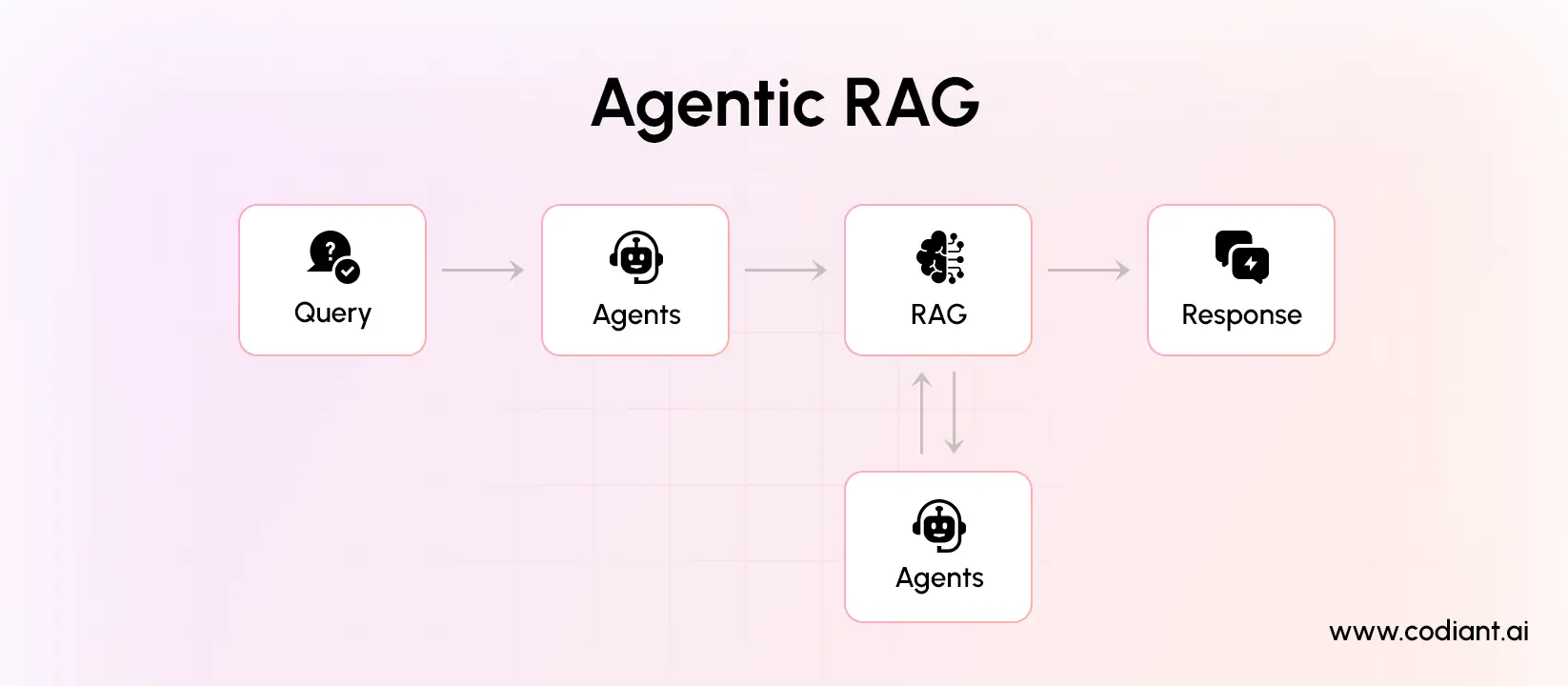
At its core, agentic retrieval augmented generation is an advanced evolution of traditional RAG systems. While standard RAG retrieves information and generates responses, agentic RAG introduces autonomous decision-making agents into the workflow.
These AI agents can:
- Decide what information to retrieve
- Choose tools or APIs dynamically
- Break down complex queries into sub-tasks
- Validate and refine outputs before delivering results
This makes enterprise AI RAG systems far more powerful than simple chatbots or search tools.
In enterprise environments, this means AI is no longer just answering queries it’s actively solving problems using structured reasoning and contextual data retrieval.
How Agentic RAG Works in Enterprise Systems?
To understand RAG architecture for enterprises, imagine a layered system where retrieval and reasoning happen in sync.
Step-by-step flow:
- User Query Input
A user asks a question or submits a request - Agent Planning Layer
AI agents analyze intent and break the query into actionable steps - Retrieval Layer
Relevant data is fetched from-- Internal databases
- Knowledge bases
- APIs or external sources
- Context Injection
Retrieved data is structured and fed into the LLM - Response Generation
The AI generates a context-aware response - Validation & Iteration
Agents verify accuracy and refine outputs if needed
This loop ensures that AI knowledge retrieval systems deliver not just answers but reliable, enterprise-grade insights.
Key Components of Agentic RAG Architecture
A robust agentic RAG architecture is built on multiple interconnected layers-
- Data Layer
Includes structured and unstructured enterprise data-
- Documents
- Emails
- CRM records
- Knowledge bases
- Embedding & Vector Database
Transforms data into searchable vectors for fast retrieval.
- Retrieval Engine
Fetches the most relevant information using semantic search.
- LLM Layer
Processes retrieved data and generates responses.
- Agent Layer
The most critical component handles-
- Task orchestration
- Tool selection
- Multi-step reasoning
- Integration Layer
Connects with enterprise systems like ERP, CRM, HRMS and APIs.
Together, these components form scalable enterprise AI knowledge assistants capable of handling complex business workflows.
RAG Use Cases in Enterprises
The adoption of RAG use cases in enterprises is rapidly expanding across industries.
- Customer Support Automation
AI agents retrieve product data, policies and past interactions to resolve queries instantly.
- Enterprise Knowledge Assistants
Employees can access company knowledge in seconds no more digging through documents.
- Sales Enablement
AI provides real-time insights, pitch suggestions and competitive intelligence.
- Legal & Compliance
Instant retrieval of regulations, contracts and policy documents.
- IT & DevOps Support
AI agents assist in debugging, documentation lookup and system monitoring.
These use cases highlight how AI agents with RAG architecture are transforming enterprise operations by reducing manual effort and improving decision speed.
Read more: Top Agentic AI Use Cases Powering Enterprise ROI in 2026
Benefits of Enterprise RAG Implementation
Implementing enterprise RAG implementation delivers significant business value-
- Improved Accuracy
Responses are grounded in real-time enterprise data, reducing hallucinations.
- Faster Decision-Making
Employees get contextual insights instantly, improving productivity.
- Enhanced Knowledge Management
Centralizes and unlocks fragmented organizational knowledge.
- Reduced Operational Costs
Automates repetitive tasks across departments.
- Scalable AI Systems
Easily adapts to growing datasets and enterprise complexity.
This is why AI knowledge retrieval systems are becoming foundational to modern enterprise AI strategies.
Challenges in Implementing RAG Systems
Despite its advantages, RAG implementation challenges can slow adoption if not addressed properly.
- Data Silos
Enterprise data is often fragmented across systems, making retrieval difficult.
- Retrieval Quality Issues
Poor indexing or embeddings can lead to irrelevant results.
- Latency Concerns
Multiple retrieval and reasoning steps can increase response time.
- Security & Compliance Risks
Handling sensitive enterprise data requires strict governance.
- Integration Complexity
Connecting RAG systems with legacy infrastructure is challenging.
- Evaluation & Monitoring
Measuring accuracy and performance is still evolving.
To overcome these, enterprises must invest in robust architecture, governance frameworks and continuous optimization.
How Agentic RAG Improves Enterprise Knowledge Management
Traditional knowledge systems rely on static documentation and keyword-based search. In contrast, enterprise AI RAG systems enable-
- Semantic understanding of queries
- Context-aware information retrieval
- Continuous learning from interactions
- Real-time updates from enterprise systems
This transforms knowledge management from a passive repository into an active intelligence layer.
Employees no longer search for information they interact with it conversationally and contextually.
Measuring ROI of Agentic RAG in Enterprises
One of the biggest concerns for enterprises is ROI. The good news is that enterprise RAG implementation delivers measurable impact across multiple dimensions.
- Productivity Gains
Employees spend less time searching for information.
- Cost Reduction
Automation reduces dependency on manual processes.
- Faster Time-to-Resolution
Customer queries and internal issues are resolved quicker.
- Improved Decision Accuracy
Data-driven insights lead to better business outcomes.
- Revenue Growth
Better customer experience drives higher conversions.
ROI Metrics to Track:
- Query resolution time
- Employee productivity increase
- Support cost reduction
- Accuracy improvement rates
- Customer satisfaction scores
Organizations implementing AI agents with RAG architecture often see ROI within 3–6 months, especially in high-volume operations.
Measuring ROI of Agentic RAG in Enterprises
One of the biggest concerns for enterprises is ROI. The good news is that enterprise RAG implementation delivers measurable impact across multiple dimensions.
- Productivity Gains
Employees spend less time searching for information.
- Cost Reduction
Automation reduces dependency on manual processes.
- Faster Time-to-Resolution
Customer queries and internal issues are resolved quicker.
- Improved Decision Accuracy
Data-driven insights lead to better business outcomes.
- Revenue Growth
Better customer experience drives higher conversions.
ROI Metrics to Track-
- Query resolution time
- Employee productivity increase
- Support cost reduction
- Accuracy improvement rates
- Customer satisfaction scores
Organizations implementing AI agents with RAG architecture often see ROI within 3–6 months, especially in high-volume operations.
The Future of Agentic RAG in Enterprises
The future of enterprise AI RAG systems lies in deeper autonomy and integration.
We are moving toward systems where:
- AI agents collaborate across departments
- RAG systems integrate with real-time workflows
- Decisions are automated with minimal human intervention
This evolution will redefine how enterprises operate shifting from reactive systems to proactive, intelligence-driven ecosystems.
Related reading: Agentic AI vs Generative AI- The Detailed Comparison Guide
Why Choose CodiantAI for Agentic RAG Implementation?
Building scalable enterprise AI RAG systems requires more than tools it demands the right strategy, architecture, and execution partner. That’s where CodiantAI steps in.
We help enterprises design and deploy agentic RAG architecture tailored to real business workflows, ensuring measurable outcomes from day one.
- Custom enterprise RAG implementation aligned with your data ecosystem
- Expertise in building AI agents with RAG architecture for automation
- Secure, scalable AI knowledge retrieval systems for enterprise use
- Continuous optimization to maximize ROI and performance
Partner with CodiantAI to turn your data into intelligent, decision-ready systems.
Conclusion
The shift from traditional AI to agentic retrieval augmented generation marks a major leap in enterprise intelligence.
By combining retrieval, reasoning, and autonomous decision-making, agentic RAG architecture enables enterprises to build systems that are not only accurate but truly intelligent.
While challenges exist, the benefits far outweigh the complexity. With the right strategy, tools & execution, enterprise RAG implementation can unlock-
- Faster operations
- Smarter decisions
- Scalable AI-driven growth
For enterprises aiming to stay competitive in 2026 and beyond, investing in AI knowledge retrieval systems powered by agentic RAG is no longer optional it’s essential.
Frequently Asked Questions
An enterprise RAG system requires data sources, embedding models, vector databases, retrieval engines, LLMs, agent orchestration layers & integration frameworks for seamless enterprise connectivity.
It enhances search by understanding intent, retrieving contextual data & refining responses through AI agents, delivering more accurate and actionable insights than traditional search systems.
Industries like healthcare, finance, legal, retail, logistics & SaaS benefit significantly due to their reliance on large knowledge bases and real-time decision-making requirements.
ROI can be measured through productivity gains, reduced support costs, faster query resolution, improved accuracy & enhanced customer satisfaction metrics across operations.
Enterprises must ensure data encryption, role-based access control, compliance with regulations, secure APIs & continuous monitoring to protect sensitive information within RAG systems.
Featured Blogs
Read our thoughts and insights on the latest tech and business trends
Enterprise AI Development Partner Checklist- What CTOs Should Evaluate Before Hiring
- March 27, 2026
- Artificial Intelligence
AI is no longer an experiment sitting in innovation labs. It’s driving revenue, optimizing operations, and shaping how enterprises compete. But here’s the real challenge choosing the right enterprise AI development partner. Because the difference... Read more
Agentic AI vs Generative AI- The Detailed Comparison Guide
- March 17, 2026
- Artificial Intelligence
In the past several years artificial intelligence has grown rapidly. Initially, the bulk of conversations was always about Generative AI tools that could write content, create images, summarize reports or generate code within seconds. But... Read more
How to Use AI for Predictive Analytics- A Complete Practical Guide
- March 6, 2026
- AI-Powered Data Analytics
Predictive analytics is not new, it’s been around for decades, however its capabilities have changed very fundamentally with the arrival of AI. Classical statistical models were based on small data, assumptions that could not be altered, and... Read more