AI Agent Development Cost In 2026: Pricing Breakdown, Timelines And ROI
Table of Contents
Subscribe To Our Newsletter
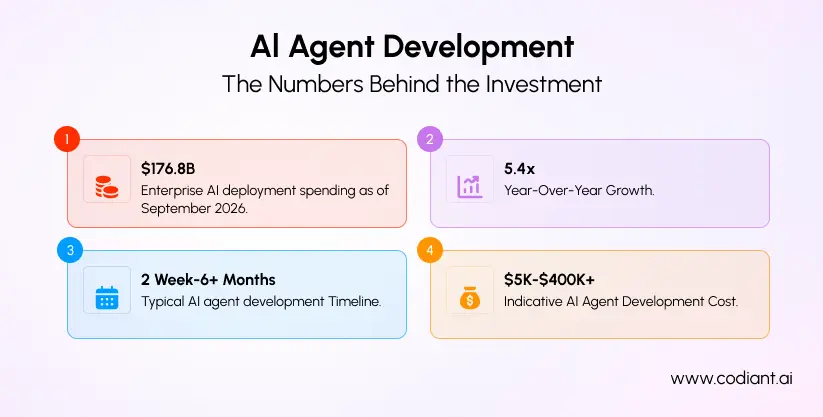
AI agent development costs in 2026 typically range from $5,000 to $400,000+, depending on complexity, autonomy, integrations, and infrastructure requirements. Development can take anywhere from 2 weeks to 6+ months. Beyond initial development, businesses must account for maintenance, operational expenses, and long-term ROI when evaluating their investment.
AI agents are quickly moving beyond experimentation to become an important part of business operations. From automating customer interactions and managing workflows to supporting complex decision-making, businesses are investing in AI agents to improve efficiency and reduce operational overhead. But how much does it actually cost to build one?
The scale of enterprise investment reflects this growing interest. According to Menlo Ventures, enterprise AI deployment spending reached $176.8 billion by September 2026, representing a 5.4x increase over the previous year. However, increased adoption also makes it important for businesses to understand the cost of building, running, and scaling AI solutions.
The AI agent development cost in 2026 can vary significantly depending on the agent’s complexity, level of autonomy, AI model selection, integrations, and scalability requirements. As businesses explore these possibilities, Codiant AI helps organizations approach AI development with solutions tailored to their operational needs and long-term goals. This guide breaks down AI agent development pricing, timelines, cost drivers, and potential ROI to help you make an informed investment decision.
Key Takeaways
- AI agent development costs vary widely: In 2026, building an AI agent can cost between $5,000 and $400,000+, depending on complexity, autonomy, integrations, and infrastructure.
- Development timelines depend on project scope: Basic AI agents may take 2–4 weeks, while enterprise-grade solutions can require 6 months or more.
- Multiple factors influence pricing: AI model selection, data preparation, system integrations, security, and development expertise all affect the overall investment.
- Ongoing costs matter: API usage, cloud infrastructure, monitoring, maintenance, and security contribute to the total cost of ownership.
- ROI should guide investment decisions: Businesses should measure cost savings, productivity improvements, operational efficiency, and revenue impact before scaling AI agent deployment.
- The right development partner makes a difference: A tailored development approach helps businesses control implementation complexity and build AI agents aligned with long-term goals.
How Much Does It Cost to Develop an AI Agent in 2026?
The cost to build an AI agent in 2026 typically ranges from $5,000 to $400,000 or more, depending on its functionality, complexity, level of autonomy, and integration requirements. A basic agent designed to handle specific tasks requires a smaller investment, while advanced and enterprise-grade agents involve sophisticated architecture, data processing, and infrastructure.
The following table provides an indicative breakdown of AI agent development pricing based on project complexity:
| AI Agent Type | Estimated Development Cost | Typical Timeline |
| Basic AI agent | $5,000–$15,000 | 2–4 weeks |
| Intermediate AI agent | $15,000–$50,000 | 4–8 weeks |
| Advanced AI agent | $50,000–$100,000 | 8–12 weeks |
| Enterprise AI agent | $100,000–$400,000+ | 3–6+ months |
Note: These are indicative development estimates for budgeting purposes. Actual costs depend on project scope, technology choices, integrations, and development requirements.
Let’s look at what each category typically includes.
- Basic AI Agents ($5,000–$15,000): Designed for well-defined tasks such as answering FAQs, scheduling appointments, and retrieving information. They typically use existing AI models, predefined instructions, and limited integrations.
- Intermediate AI Agents ($15,000–$50,000): Handle more complex workflows using capabilities such as RAG, memory, contextual reasoning, and API integrations. Examples include sales assistants that qualify leads, update CRM records, and schedule follow-ups.
- Advanced AI Agents ($50,000–$100,000): Support multi-step workflows, dynamic decision-making, and greater autonomy. They can coordinate multiple tools and manage tasks such as supply chain operations, business data analysis, and customer service workflows.
- Enterprise AI Agents ($100,000–$400,000+): Built for complex business environments, these solutions may involve multi-agent orchestration, legacy system integrations, enterprise-wide data access, advanced security, and scalable infrastructure.
Ultimately, the right investment depends on the business problem an AI agent needs to solve. Rather than opting for the most expensive solution, businesses should prioritize essential capabilities and scale functionality as their requirements evolve.
Planning to Build an AI Agent for Your Business?
Get a solution designed around your workflows, technical requirements, and budget. Codiant AI helps businesses turn AI opportunities into practical, scalable solutions.
What Factors Affect AI Agent Development Costs?
The cost of AI agent development depends on more than the AI model being used. Architecture, data requirements, integration complexity, security, and the level of autonomy all influence the overall investment. Here are six major factors that influence AI agent development pricing:
1. Agent Complexity and Autonomy
The more complex the agent’s responsibilities, the higher the development effort. A basic agent that responds to predefined queries requires less engineering than an autonomous agent capable of reasoning, making decisions, and executing multi-step workflows.
Single-agent systems are generally simpler to develop, while multi-agent architectures require additional orchestration, communication, and coordination mechanisms
2. AI Model and Technology Stack
Model selection directly affects development and operational costs. Businesses can use proprietary LLMs through APIs or deploy open-source models based on their performance, privacy, and scalability requirements.
Additional expenses may arise from model fine-tuning, RAG implementation, inference optimization, and infrastructure needed to support the selected technology stack.
3. Data Preparation and Engineering
Data quality and availability influence both development time and cost. AI agents that rely on business-specific knowledge may require data cleaning, structuring, processing, and knowledge base development.
For example, implementing RAG in enterprise AI systems may involve document chunking, embedding generation, and vector database configuration to help agents retrieve relevant information accurately.
4. Third-Party Integrations
Connecting AI agents with existing business applications adds to implementation complexity. Integrations with CRM, ERP, payment gateways, communication platforms, and internal databases require API development, authentication, data synchronization, and compatibility testing.
The number of integrations and the complexity of existing systems can significantly affect development costs.
5. Security and Compliance Requirements
Security requirements increase development and infrastructure considerations. Businesses handling sensitive information may need encryption, role-based access controls, audit logs, secure data environments, and compliance-related safeguards.
Healthcare, finance, and other regulated industries may require additional testing and governance measures to meet applicable standards.
6. Development Team and Expertise
The expertise and composition of the development team influence project pricing. Building a custom AI agent may require AI/ML engineers, backend developers, data engineers, cloud architects, and QA specialists.
Businesses can choose between in-house development and outsourcing to an experienced AI agent development company. The final cost depends on team size, technical expertise, engagement model, and project duration.
How Long Does It Take to Build an AI Agent?
The time required to build an AI agent typically ranges from 2 weeks to 6 months or more, depending on its complexity, functionality, data requirements, and integration needs. A basic agent with predefined tasks can be developed relatively quickly, while advanced and enterprise-grade solutions require more time for architecture, data engineering, testing, and deployment.
A typical AI agent development process involves the following stages:
| Development Stage | Estimated Timeline |
| Discovery and requirement analysis | 1–2 weeks |
| Architecture and technology selection | 1 week |
| Data preparation and model integration | 1–3 weeks |
| Agent development and integrations | 2–5 weeks |
| Testing and optimization | 1–2 weeks |
| Deployment | Around 1 week |
Note: These are indicative timelines. Some development stages can overlap, depending on the project scope and team structure.
What Can Affect AI Agent Development Timelines?
A few factors can extend or shorten the development cycle:
- Project complexity: Multi-agent systems and autonomous workflows require more architecture and development effort than task-specific agents.
- Data readiness: Unstructured, incomplete, or fragmented business data can increase preparation and integration time.
- Third-party integrations: Connecting multiple enterprise applications and legacy systems can introduce additional development and testing requirements.
- Testing and security: Agents handling sensitive data or critical business operations need more extensive validation, performance testing, and security checks.
Businesses can accelerate development by starting with a focused MVP, using existing foundation models, and prioritizing essential integrations. Additional capabilities can then be introduced through iterative releases as the agent’s requirements evolve.
How Do You Calculate the ROI of an AI Agent?
Investing in an AI agent makes business sense when the value it generates outweighs its development and operational costs. However, measuring its return involves more than calculating the number of tasks automated. Businesses must also consider productivity improvements, reduced operational expenses, revenue impact, and customer experience.
1. Understanding the AI Agent ROI Formula
Businesses can use the following formula to estimate the return on their AI agent investment:
Here:
- Total Benefits: Financial value generated through cost savings, productivity improvements, and additional revenue.
- Total Costs: Development expenses, model usage, infrastructure, maintenance, and other operational costs.
2. Key Metrics to Measure AI Agent ROI
The following metrics help businesses understand the financial and operational impact of AI agent implementation:
- Labor Cost Savings: Reduced manual effort and fewer repetitive tasks can lower operational expenses.
- Productivity Improvements: Employees can spend less time on routine activities and focus on higher-value work.
- Operational Efficiency: Faster workflows, fewer errors, and shorter processing times improve overall efficiency.
- Revenue Impact: AI agents supporting sales and customer engagement can help improve lead conversion and retention.
- Customer Experience: Faster responses, consistent support, and round-the-clock availability can improve customer satisfaction.
Want to Turn Your AI Investment into Measurable Business Value?
Build AI agents that go beyond task automation. Partner with Codiant AI to develop solutions focused on operational efficiency, productivity, and long-term business outcomes.
What Is the Cost of Developing an Enterprise AI Agent?
The cost of developing an enterprise AI agent typically starts at $100,000 and can exceed $400,000, depending on the scale of implementation, system complexity, security requirements, and integration needs. Unlike basic AI agents built for specific tasks, enterprise solutions are designed to operate across multiple departments, applications, and business workflows.
Several factors contribute to the higher investment:
- Multi-Agent Architecture: Enterprise systems may involve multiple specialized agents collaborating to manage complex workflows, share information, and coordinate tasks.
- Enterprise System Integrations: Connecting agents with existing CRM, ERP, HRMS, financial platforms, and legacy databases requires custom API development and data synchronization.
- Security and Governance: Sensitive business information requires stronger access controls, encryption, audit trails, monitoring, and compliance safeguards.
- Scalability and Infrastructure: Enterprise agents need infrastructure capable of handling high request volumes, concurrent users, and growing data requirements.
- Monitoring and Optimization: Continuous evaluation, performance monitoring, error handling, and model updates help maintain reliability across business operations.
Standard vs. Enterprise AI Agent Development
| Comparison Factor | Standard AI Agent | Enterprise AI Agent |
| Functionality | Task-specific automation | Complex, cross-functional workflows |
| Architecture | Usually single-agent | Single or multi-agent systems |
| Integrations | Limited APIs | Multiple enterprise platforms |
| Security | Standard access controls | Advanced security and governance |
| Scalability | Limited to defined workloads | Designed for enterprise-wide usage |
| Development Cost | $5,000–$50,000+ | $100,000–$400,000+ |
Note: Costs are indicative estimates and vary according to implementation scope and technical requirements.
For enterprises, the investment should be evaluated against the operational value the system can deliver across the organization. Starting with a high-impact workflow, validating performance, and gradually expanding agent capabilities can help manage implementation costs while reducing deployment risks.
How Much Does It Cost to Maintain and Operate an AI Agent?
Building an AI agent is only the initial investment. Businesses must also account for recurring expenses to keep it functional, accurate, secure, and aligned with changing operational requirements.
Unlike basic AI agents built for specific tasks, enterprise solutions are designed to operate across multiple departments, applications, and business workflows. Understanding how AI agents support enterprise automation can help businesses assess the scope of these implementations.
The AI agent maintenance and operational cost depends on usage volume, model selection, infrastructure, and the complexity of the solution. Key recurring expenses include:
- AI Model and API Usage: Charges for LLM API calls, token consumption, and inference increase with agent usage and workload.
- Cloud Hosting and Infrastructure: Servers, databases, vector storage, and computing resources contribute to ongoing infrastructure expenses.
- Monitoring and Performance Optimization: Regular evaluation helps identify errors, improve response accuracy, and maintain consistent performance.
- Updates and Maintenance: Model updates, knowledge base refreshes, bug fixes, and compatibility improvements keep the agent relevant and reliable.
- Security and Technical Support: Access management, security checks, system monitoring, and technical assistance help maintain operational stability.
These expenses should be included in the total cost of ownership when estimating AI agent ROI. A solution with a lower initial development cost may still require a significant operating budget as usage and business requirements grow.
Why Choose Codiant AI for Custom AI Agent Development?
Building an AI agent that delivers measurable business value requires more than integrating an AI model. It involves understanding business workflows, selecting the right architecture, connecting relevant systems, and ensuring the solution can scale with changing requirements.
Codiant AI helps businesses turn AI opportunities into practical solutions through custom AI development tailored to their operational needs. The focus is on building solutions that address specific business challenges while supporting efficiency, automation, and long-term growth.
With Codiant AI, businesses can approach custom AI agent development with:
- Business-Aligned Development: AI solutions designed around specific workflows, operational challenges, and business objectives.
- Custom AI Solutions: Agent capabilities tailored to the tasks, reasoning requirements, and level of autonomy a business needs.
- Integration and Scalability: Solutions planned to work with relevant business systems and accommodate evolving requirements.
- Long-Term Value: A development approach that considers performance, operational efficiency, and measurable business outcomes.
Choosing the right development partner can help businesses control implementation complexity while building AI capabilities that support their broader goals.
Conclusion
The cost of AI agent development in 2026 depends on what a business expects the solution to accomplish. While basic agents can be built with a relatively modest investment, advanced and enterprise-grade systems require greater spending on architecture, integrations, data, security, and infrastructure.
Businesses should look beyond the initial development price and evaluate ongoing operational expenses, implementation timelines, and measurable ROI. Starting with a focused use case, choosing the right technology, and working with an experienced development partner can help ensure the investment delivers lasting business value.
Looking to Build an AI Agent That Delivers Real Business Impact?
Turn your AI vision into a practical business solution with Codiant AI. Our team helps you plan and develop custom AI agents aligned with your workflows, operational needs, and long-term growth goals.
Frequently Asked Questions
The main factors include agent complexity, level of autonomy, AI model selection, data preparation, third-party integrations, security requirements, infrastructure, and development team expertise. Greater customization generally increases development effort and cost.
Ongoing costs depend on usage, model API consumption, cloud infrastructure, monitoring, maintenance, and security requirements. Businesses should estimate these recurring expenses alongside initial development costs when calculating total ownership costs.
Yes. CRM and ERP integrations may require custom API development, authentication, data synchronization, and compatibility testing. The cost depends on the number of systems, integration complexity, and existing infrastructure.
Businesses can reduce costs by starting with an MVP, choosing cost-effective AI models, prioritizing essential integrations, using modular architecture, and testing performance before scaling the solution.
Custom AI agent development can deliver positive ROI when measurable savings, productivity improvements, or revenue gains outweigh development and operational expenses. High-volume, repetitive workflows often offer opportunities for meaningful returns.
Featured Blogs
Read our thoughts and insights on the latest tech and business trends
RAG vs Fine-Tuning: Which Approach Is Right for Your Enterprise AI Knowledge System?
- September 24, 2026
- Artificial Intelligence
Retrieval-Augmented Generation (RAG) and fine-tuning are the two primary methods for customizing a Large Language Model (LLM) with an enterprise's own knowledge. RAG connects a general-purpose LLM to an external knowledge base at query time,... Read more
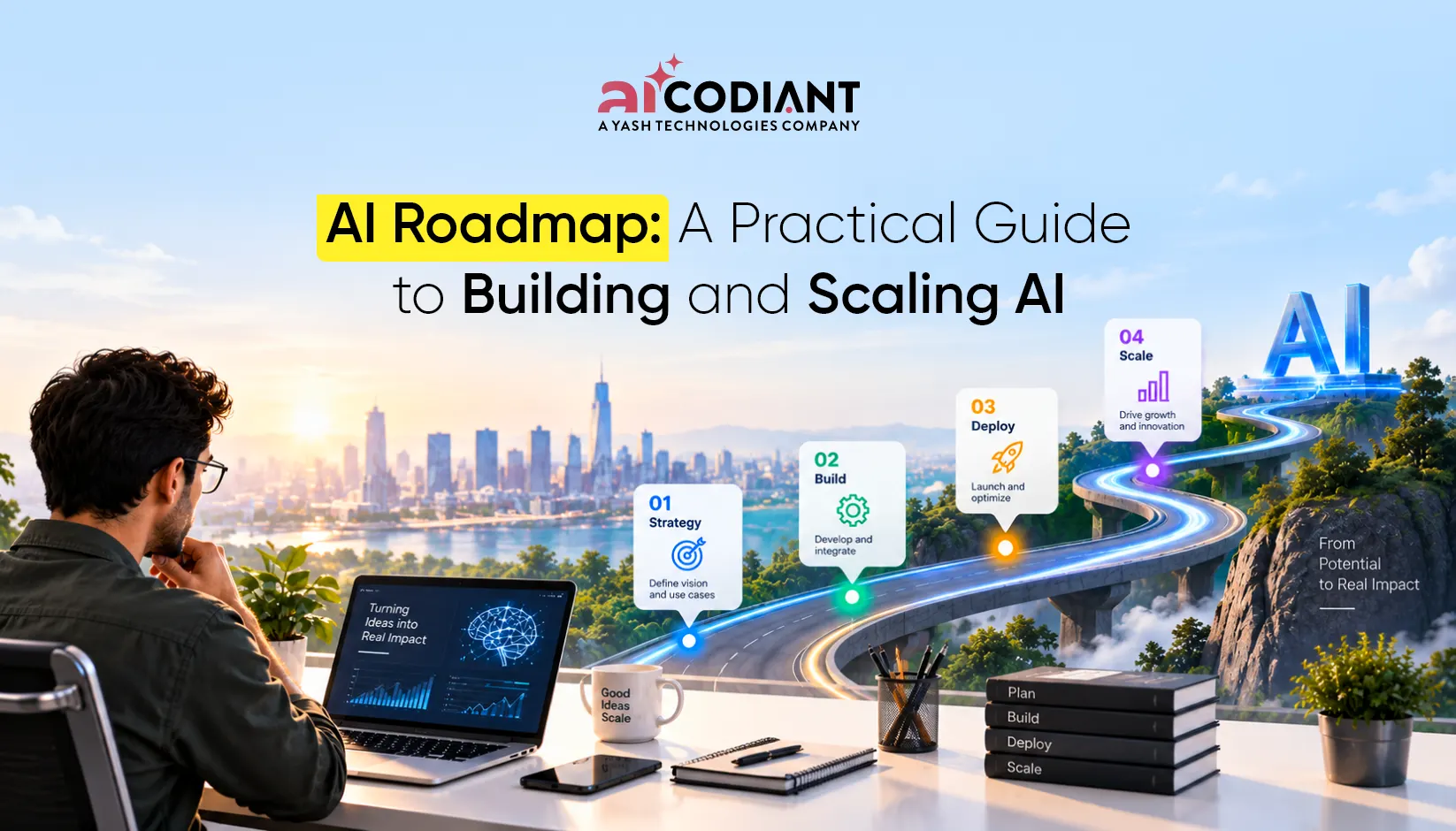
AI Roadmap: How to Build and Scale AI Across the Enterprise
- September 17, 2026
- Artificial Intelligence
An AI roadmap is a structured plan that connects business priorities with AI use cases, data, technology, governance, people, implementation, and measurable outcomes. For enterprises, it provides the sequence for moving from AI opportunities and... Read more

Top Predictive Analytics Models and Algorithms to Know
- September 11, 2026
- Artificial Intelligence
Predictive analytics models are statistical and machine learning systems that use historical data to forecast future outcomes, such as customer churn, equipment failure, demand spikes, or credit risk. The most widely used categories are regression... Read more