What Are Multi-Agent Systems? Use Cases and Business Applications
Table of Contents
Subscribe To Our Newsletter
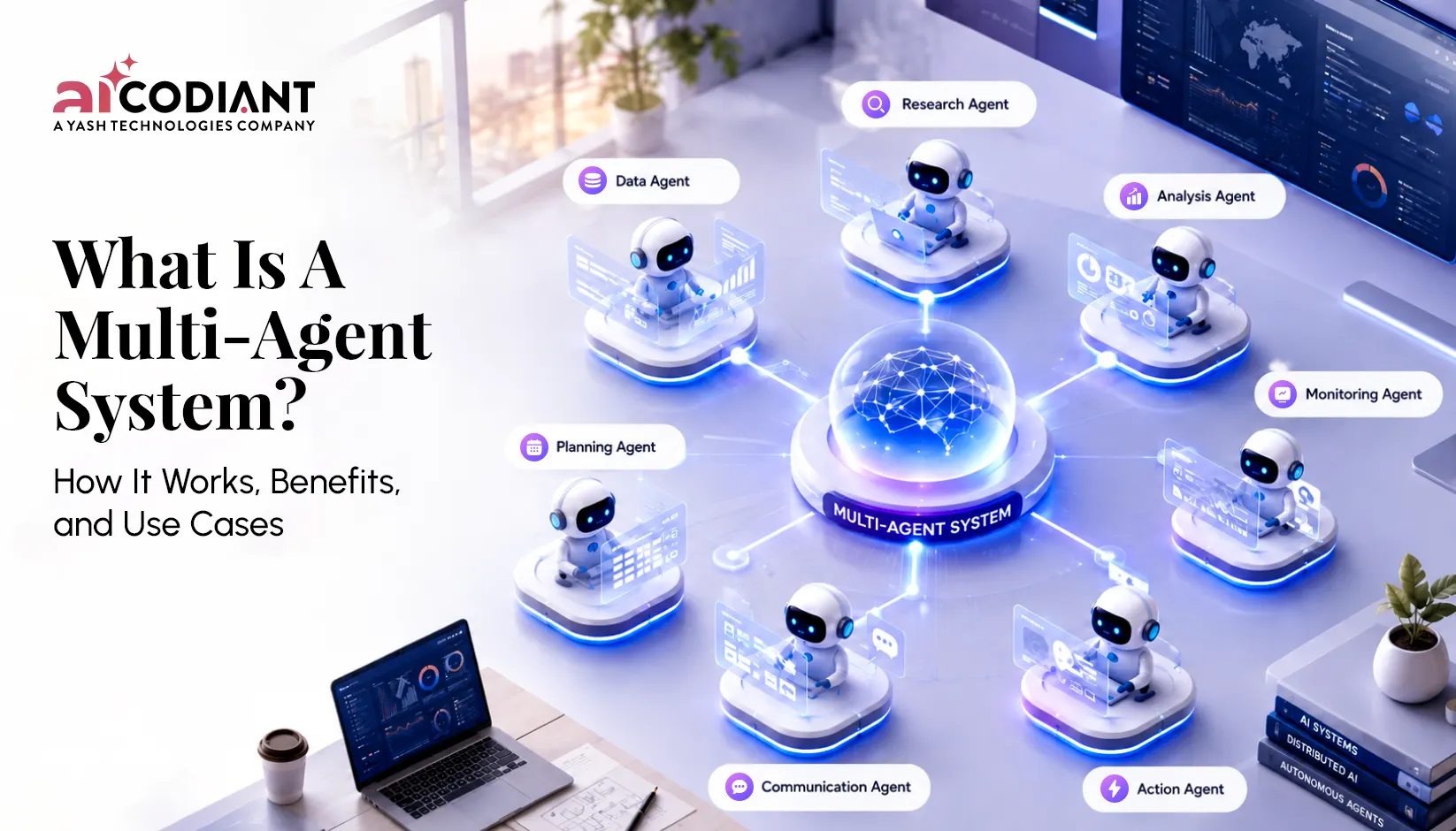
Multi-agent systems are artificial intelligence environments in which multiple specialised AI agents work together to complete a shared task or achieve a common objective. Instead of asking one agent to manage an entire process, the system distributes responsibilities across agents with different roles, tools, knowledge sources, and permissions.
Businesses should care because many enterprise workflows are too broad for one agent to handle reliably. A process may require research, planning, data retrieval, decision-making, validation, system updates, and human approval. Dividing these activities among coordinated agents can improve task specialisation, parallel execution, control, and scalability. However, it also introduces additional cost, governance, and testing requirements.
A healthcare system might use separate agents to review patient information, prepare clinical summaries, check documentation, and route cases for approval. A retailer might coordinate inventory, pricing, customer service, and fulfilment agents. A software team could use planning, coding, testing, and security-review agents within the same development workflow.
A multi agent systems is not simply a collection of chatbots. The agents must exchange information, coordinate actions, follow defined responsibilities, and contribute to a shared outcome.
This guide explains how multi-agent AI works, how it differs from a single agent, where businesses can apply it, which industries benefit, and what enterprises should evaluate before implementation.
In a Nutshell
- Direct answer: Multi-agent systems use multiple autonomous or semi-autonomous AI agents to solve a shared problem.
- Biggest takeaway: Their main value comes from specialisation, parallel work, distributed decision-making, and independent validation.
- Business recommendation: Start with one clearly defined workflow rather than deploying agents across the organisation at once.
- Implementation insight: Use a single-agent prototype first and move to multiple agents only when role separation or coordination produces measurable benefits.
- Enterprise perspective: Governance, permissions, observability, security, and human oversight matter as much as model performance.
What Are Multi-Agent Systems in AI?
A multi-agent system is an AI architecture in which two or more agents interact, exchange information, and coordinate their actions to achieve an individual or shared objective. Each agent may have its own instructions, knowledge, tools, permissions, memory, and area of specialisation.
An individual AI agent can interpret goals, use available tools and data, make decisions, and take actions within defined boundaries. Businesses evaluating multi-agent systems should first understand how AI agents work in enterprise environments before deciding when multiple agents are necessary.
In a multi-agent AI architecture, these agents do not perform identical work. They usually take on complementary responsibilities.
For example, an enterprise research system may include:
- A planning agent that breaks a question into subtasks
- A research agent that retrieves information
- A data agent that queries internal systems
- An analysis agent that compares findings
- A validation agent that checks evidence
- A reporting agent that prepares the final output
The system may use a central orchestrator to assign work, or agents may communicate directly. IBM describes this cooperation as the exchange of state information, assignment of responsibilities, coordination of actions, conflict resolution, and cooperative planning.
Many modern multi-agent systems use LLM agents as reasoning and interaction components, connecting language models with tools, memory, enterprise data, and predefined workflows.
The defining feature is coordinated agency. Multiple models running separately do not automatically form a multi-agent system unless their work is connected to a shared process or objective.
How Do Multi-Agent AI Systems Work?
Multi-agent AI systems work by decomposing a complex objective into smaller tasks, assigning those tasks to appropriate agents, coordinating their outputs, and combining the results into a final action or decision. Communication may occur through an orchestrator, direct messages, shared memory, events, or changes to a common environment.
Most systems contain six functional layers:
- User or system request: A person, application, sensor, or business event initiates the workflow.
- Planning and orchestration: An orchestrator identifies required tasks, dependencies, priorities, and responsible agents.
- Agent execution: Each agent uses its instructions, model, knowledge, and tools to complete its assignment.
- Communication and shared state: Agents exchange outputs, status updates, evidence, or unresolved questions.
- Validation and control: Rules, evaluators, approval agents, or people check whether the result is accurate and authorised.
- Action and monitoring: The system generates a response, updates an application, triggers another process, or requests human review.
Microsoft describes enterprise multi-agent designs as layered systems covering orchestration, classification, agent execution, knowledge retrieval, storage, and integration. This separation helps organisations govern and modify individual capabilities without redesigning the entire system.
Consider an insurance claim. Once a claim is submitted, an Intake Agent extracts the required information. The Policy Agent then checks coverage, while the Document Agent reviews the supporting evidence. A Risk Agent analyses the claim for anomalies, after which a Decision Agent recommends the appropriate next step. High-risk cases are routed to a human adjuster for review, and the final decision is recorded in the claims system.
The agents may operate sequentially when one result depends on another. Independent tasks, such as document classification and policy retrieval, may run in parallel.
This does not mean every agent should have unrestricted autonomy. Enterprise systems normally need limited tool access, defined approval thresholds, audit records, and escalation paths.
What Is the Difference Between a Single AI Agent and a Multi-Agent System?
A single AI agent manages a task through one decision-making unit, while a multi-agent system divides work among several coordinated agents. Single agents are generally simpler and less expensive. Multi-agent systems are more appropriate when a workflow requires distinct expertise, separate permissions, parallel execution, or independent checks.
| Feature | Single AI Agent | Multi-Agent System |
| Structure | One agent manages the workflow | Multiple agents divide responsibilities |
| Best fit | Clear, bounded tasks | Complex, multi-stage processes |
| Role specialisation | Limited or simulated through prompts | Separate specialist roles |
| Communication | Mainly user-to-agent | User-to-system and agent-to-agent |
| Execution | Usually centralised | Sequential, parallel, hierarchical, or distributed |
| Tool permissions | Managed within one agent | Different permissions for each agent |
| Testing | Easier to trace and debug | Requires agent-level and system-level testing |
| Cost | Usually lower | Usually higher due to additional calls and coordination |
| Failure points | Concentrated in one agent | Distributed across agents and orchestration |
| Governance | Relatively straightforward | Requires broader monitoring and access controls |
Multi-agent architecture becomes more useful when a workflow genuinely requires specialised roles. Understanding the different types of AI agents can help businesses determine which capabilities should remain within one agent and which may justify separate agents.
Microsoft recommends starting with a single-agent prototype when one agent can perform the task effectively. Multi-agent architecture should not be selected merely because a process has several steps or job roles. A single agent may imitate roles through prompts, conditional logic, retrieval, and controlled tool access.
A customer service assistant that answers questions from one knowledge base may need only one agent. A service operation that must identify intent, retrieve account data, diagnose technical issues, process refunds, detect fraud, and coordinate field support may justify specialised agents.
The business implication is important: more agents do not automatically produce a better system. They create value only when separation improves accuracy, security, scalability, speed, or maintainability enough to offset the additional complexity.
What Are the Business Applications of Multi-Agent Systems?
The main business applications of multi-agent systems involve workflows that require several forms of expertise, multiple systems, parallel tasks, or staged decisions. Common applications include customer service, software delivery, financial analysis, supply-chain coordination, document processing, marketing operations, and enterprise research.
1. Customer service orchestration
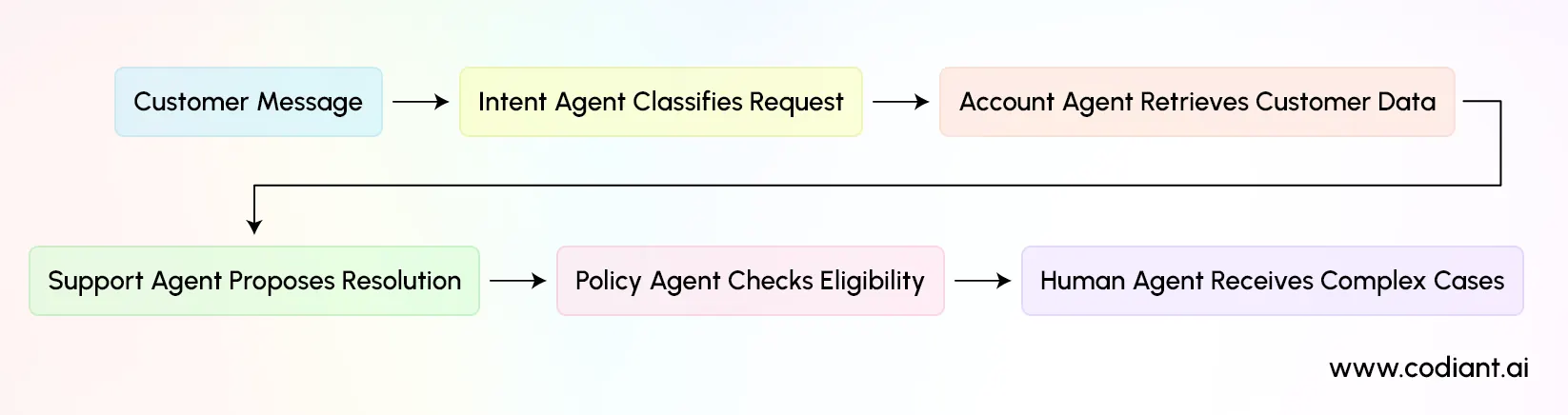
A customer service environment can use agents for intent detection, account retrieval, knowledge search, troubleshooting, sentiment analysis, and escalation.
The organisation can isolate sensitive account tools from the general conversation agent and require approval before refunds or contractual changes.
Multi-agent systems represent one approach to using AI agents for enterprise automation, particularly when business processes span multiple systems, decisions, roles, or approval stages.
2. Software development
Multi-agent AI can distribute development work across planning, coding, testing, documentation, and security-review agents.
For example:
- A product agent converts requirements into user stories
- An architecture agent proposes components
- A coding agent generates an implementation
- A testing agent creates and executes test cases
- A security agent identifies unsafe patterns
- A documentation agent records the final design
This structure can support developers, but generated code and automated changes still require testing, access controls, and accountable human review.
3. Financial and insurance operations
Financial institutions can coordinate agents for data collection, document checking, risk analysis, policy verification, scenario modelling, and report preparation.
In lending, one agent might collect application data while other agents check document completeness, evaluate policy conditions, and prepare a case summary. Final approval can remain with an authorised employee.
4. Retail and commerce
Retailers can connect demand forecasting, inventory, pricing, merchandising, customer-support, and fulfilment agents.
When demand changes, an inventory agent can identify stock risks, a procurement agent can review supplier options, and a merchandising agent can adjust product recommendations. Business rules can prevent unauthorised price or purchasing changes.
5. Enterprise knowledge work
Research, legal, compliance, and consulting teams can use multi-agent systems to retrieve sources, compare evidence, identify conflicts, evaluate policies, and draft structured outputs.
A legal research workflow may use separate agents for legislation, case law, contract terms, jurisdiction checks, and citation validation. The system supports professional review rather than replacing legal judgement.
These applications work best when the agents operate within an explicit process. Unstructured agent conversations without ownership, completion criteria, or controls are difficult to evaluate and govern.
Which Industries Benefit Most From Multi-Agent AI?
Industries with complex workflows, specialised decisions, high information volumes, and multiple operational systems are the strongest candidates for multi-agent AI. Healthcare, finance, insurance, manufacturing, logistics, retail, software, legal services, education, marketing, and real estate can benefit when tasks can be safely divided among specialised agents.
| Industry | Example Agents | Potential Business Application |
| Healthcare | Intake, documentation, clinical knowledge, scheduling | Clinical administration and care coordination |
| Finance | Research, risk, compliance, reporting | Financial analysis and controlled operations |
| Insurance | Intake, policy, document, fraud, claims | Claims support and underwriting workflows |
| Manufacturing | Maintenance, quality, production, procurement | Production coordination and issue response |
| Logistics | Routing, fleet, warehouse, exception management | Shipment planning and disruption handling |
| Retail | Inventory, pricing, service, fulfilment | Connected commerce operations |
| Software | Planning, coding, testing, security | Development workflow assistance |
| Education | Assessment, tutoring, content, administration | Personalised learning and academic support |
| Marketing | Research, audience, content, compliance | Campaign preparation and review |
| Legal | Research, contract, policy, citation | Document analysis and legal support |
| Real estate | Leasing, maintenance, tenant service, reporting | Property operations coordination |
Healthcare and finance require particularly strong safeguards because agent outputs may affect regulated, sensitive, or consequential processes. An agent should not be granted broader access simply because it can perform several tasks.
Healthcare organisations can use AI agents in healthcare for administrative and operational workflows such as intake, documentation, scheduling, knowledge retrieval, and care coordination, provided appropriate safeguards and human oversight are maintained.
Manufacturing and logistics can benefit from distributed coordination. Agents may monitor equipment, inventory, transport, supplier conditions, and operational exceptions simultaneously. An orchestrator can combine those signals and route recommendations to the responsible team.
Marketing teams can assign research, content planning, brand review, channel adaptation, and compliance checking to separate agents. This is more controlled than asking one model to research, write, approve, and publish its own content.
The most suitable industries are therefore not determined by sector alone. Suitability depends on workflow complexity, data availability, integration readiness, risk level, and whether task separation creates a practical advantage.
What Multi-Agent Architecture Patterns Can Businesses Use?
Businesses can use centralized, sequential, parallel, hierarchical, collaborative, and review-based multi-agent patterns. The right pattern depends on task dependencies, autonomy requirements, risk, response time, and the degree of control the organization needs.
1. Centralized orchestration
A central orchestrator assigns tasks to specialist agents, collects their outputs, and delivers a unified final result. This approach simplifies governance by maintaining a single point for workflow coordination, routing, and decision management.
2. Sequential workflow
Agents work in a fixed order. Each agent receives the previous agent’s output.
This approach suits document processing, approval workflows, and development pipelines where each stage depends on completed earlier work.
3. Parallel execution
Several agents work at the same time and return results to an aggregator.
A research system might ask separate agents to investigate technology, regulation, competitors, and financial implications. Parallel execution can reduce elapsed time, but the system must resolve duplication and conflicting conclusions.
4. Hierarchical architecture
A supervisor agent manages team leaders or specialist groups. This pattern supports large workflows but adds more communication and monitoring requirements.
5. Peer-to-peer collaboration
Agents negotiate, share findings, or divide responsibilities without a single permanent controller. AWS distinguishes this collaborative pattern from centrally managed agent workflows. Peer coordination may improve adaptability, but it can be harder to predict and audit.
6. Maker-checker pattern
One agent produces an output and another evaluates it. The second agent may identify missing evidence, policy violations, or logical inconsistencies.
The pattern can improve review coverage, but it does not guarantee correctness. Two agents may rely on the same incorrect information or model behaviour. Human review and deterministic controls remain necessary for high-impact actions.
What Are the Advantages and Limitations of Multi-Agent Systems?
Multi-agent systems can provide specialization, parallelism, modularity, distributed control, and independent review. Their limitations include higher cost, more failure points, coordination errors, unpredictable interactions, security exposure, and more difficult testing.
Potential advantages
- Specialized capabilities: Each agent can focus on one domain, toolset, or decision.
- Parallel execution: Independent tasks can run simultaneously.
- Modular design: Teams can update one agent without replacing the complete workflow.
- Permission separation: Agents can receive only the tools and data required for their roles.
- Independent validation: Reviewer agents can inspect outputs before execution.
- Operational scalability: Additional agents can be introduced for new functions or regions.
Important limitations
- Coordination overhead: Agents need communication, routing, state management, and conflict handling.
- Higher operating cost: Multiple model calls and repeated context processing increase resource use.
- Cascading errors: One incorrect output may influence several downstream agents.
- Longer response time: Sequential workflows may add latency.
- Complex debugging: Teams must trace decisions across models, prompts, tools, and messages.
- Security risk: More integrations and autonomous actions create a wider attack surface, making Multi-AI agent security technology essential for protecting connected systems, data, and AI-driven workflows.
- Evaluation difficulty: Individual agents may appear effective while the complete workflow remains unreliable.
NIST identifies secure operation and interoperability as central concerns for the emerging agent ecosystem. Its work on AI agent standards focuses on helping agents operate confidently on behalf of users across systems.
The correct comparison is therefore not “multi-agent versus manual work.” Decision-makers should compare a multi-agent system with simpler alternatives, including deterministic automation, workflow software, a single agent, or a combination of these approaches.
How Should Enterprises Implement Multi-Agent AI?
Enterprises should implement multi-agent AI by selecting one measurable workflow, testing whether a single agent is sufficient, defining agent responsibilities, restricting permissions, and establishing evaluation and human oversight before production deployment.
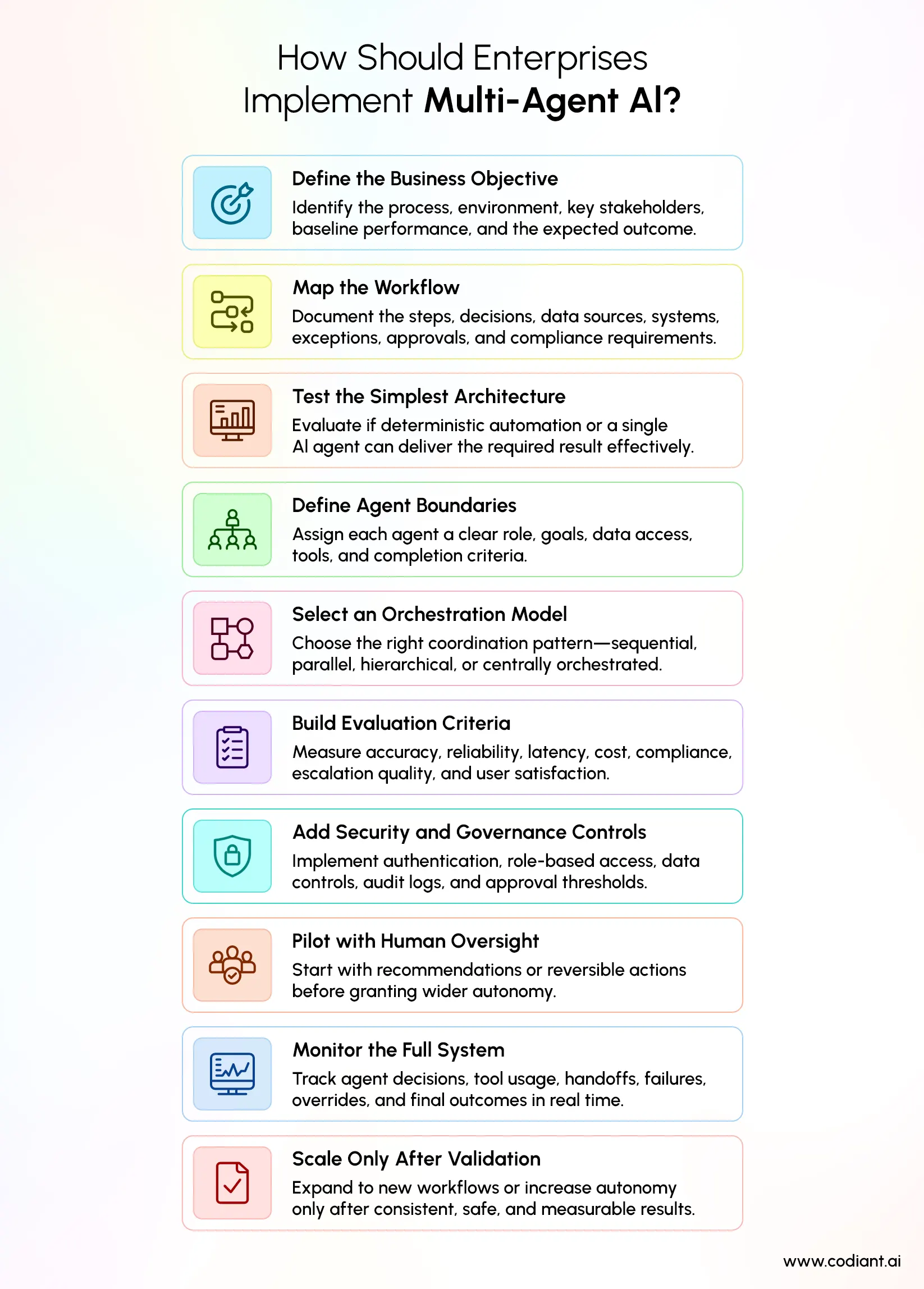
A practical implementation sequence is:
- Define the business objective: Identify the process, owner, baseline performance, users, and expected improvement.
- Map the workflow: Document decisions, systems, data, exceptions, approvals, and regulatory requirements.
- Test the simplest architecture: Compare deterministic automation, one agent, and multiple agents.
- Define agent boundaries: Assign each agent a clear role, authorised tools, accessible data, and completion criteria.
- Select an orchestration model: Decide whether work should be sequential, parallel, hierarchical, or centrally controlled.
- Build evaluation criteria: Measure task completion, accuracy, latency, cost, policy compliance, escalation quality, and user acceptance.
- Add security controls: Apply authentication, role-based access, data controls, logging, tool restrictions, and approval thresholds.
- Pilot with human oversight: Begin with recommendations or reversible actions before granting wider autonomy.
- Monitor the full system: Trace agent instructions, tool calls, handoffs, failures, overrides, and final outcomes.
- Scale only after validation: Add workflows or autonomy when performance remains stable under realistic conditions.
Organizations moving from architecture planning to implementation should also understand how to build an AI agent, including its objectives, instructions, knowledge sources, tools, integrations, evaluation criteria, and operational controls.
Codiant.ai can support this stage through AI agent development, workflow integration, retrieval architecture, orchestration, testing, and governance design. The implementation should still begin with business-process analysis rather than a predetermined technical stack.
A useful decision question is:
Does dividing this workflow among agents create an observable improvement that cannot be achieved more simply?
When the answer is unclear, a single-agent or conventional workflow prototype is the safer starting point.
Conclusion
Multi-agent systems differ from single-agent solutions by distributing work across coordinated, specialised agents. This architecture can support complex business AI automation, parallel work, controlled access, and independent validation, but it also increases technical and operational complexity.
Enterprises should not adopt multi-agent AI simply because it appears more advanced. They should begin with a clear business process, establish a single-agent baseline, and introduce multiple agents only where separation creates measurable gains.
The strongest enterprise multi-agent systems will combine agent autonomy with deterministic controls, secure integrations, continuous evaluation, and accountable human oversight. For organisations exploring AI agent development, architecture should follow the workflow, risk profile, and business objective rather than the technology trend.
Build Multi-Agent AI That Works Across Your Business
Turn complex workflows into coordinated AI systems with specialized agents, human oversight, and enterprise-ready controls.
Frequently Asked Questions
Core components usually include specialised agents, an orchestration mechanism, communication protocols, models, tools, data sources, shared or isolated memory, access controls, evaluation systems, and monitoring. The exact design depends on whether agents work sequentially, in parallel, through a hierarchy, or through direct collaboration.
Agents collaborate by dividing a larger objective into smaller assignments, exchanging results, maintaining workflow state, and coordinating dependent actions. Collaboration may be controlled by an orchestrator or occur through direct communication. Clear message formats, ownership rules, validation steps, and stopping conditions help prevent duplication and unresolved loops.
The main advantages are specialised task handling, parallel execution, modular development, permission separation, and independent review. These benefits are strongest when a process genuinely requires different expertise or system access. A multi-agent design may provide little value when one well-designed agent can complete the workflow reliably.
Businesses should evaluate coordination complexity, model and infrastructure cost, data security, cascading errors, latency, integration requirements, auditability, and human accountability. They also need methods for testing the complete workflow, since strong performance by individual agents does not prove that their combined decisions are accurate or safe.
There is no verifiable universal price for a custom multi-agent system. Cost depends on agent count, model usage, integrations, data preparation, security, workflow complexity, evaluation, and ongoing monitoring. Businesses should request a scoped estimate based on one defined workflow rather than calculate cost from the number of agents alone.
Featured Blogs
Read our thoughts and insights on the latest tech and business trends
RAG vs Fine-Tuning: Which Approach Is Right for Your Enterprise AI Knowledge System?
- September 24, 2026
- Artificial Intelligence
Retrieval-Augmented Generation (RAG) and fine-tuning are the two primary methods for customizing a Large Language Model (LLM) with an enterprise's own knowledge. RAG connects a general-purpose LLM to an external knowledge base at query time,... Read more
AI Roadmap: How to Build and Scale AI Across the Enterprise
- September 17, 2026
- Artificial Intelligence
An AI roadmap is a structured plan that connects business priorities with AI use cases, data, technology, governance, people, implementation, and measurable outcomes. For enterprises, it provides the sequence for moving from AI opportunities and... Read more

Top Predictive Analytics Models and Algorithms to Know
- September 11, 2026
- Artificial Intelligence
Predictive analytics models are statistical and machine learning systems that use historical data to forecast future outcomes, such as customer churn, equipment failure, demand spikes, or credit risk. The most widely used categories are regression... Read more