Types of AI Agents in Business Automation: Categories, Use Cases and Enterprise Applications
Table of Contents
Subscribe To Our Newsletter
AI agents are software systems that observe information, make decisions and take actions to achieve defined objectives. In business automation, they can analyze data, use enterprise tools, coordinate workflow steps and complete tasks with varying levels of human supervision.
The main types of AI agents are simple reflex, model-based reflex, goal-based, utility-based and learning agents. Businesses may also deploy collaborative and multi-agent systems that combine several specialized agents within one workflow.
Understanding these categories helps organizations choose the appropriate level of intelligence, adaptability and autonomy for each business process.
Key Takeaways
- AI agents perceive information, decide what to do and act.
- Five commonly recognized categories describe increasing decision-making sophistication.
- Reflex agents suit predictable, rule-based business processes.
- Goal-based agents plan actions around a defined business outcome.
- Utility-based agents compare alternatives before selecting an action.
- Learning agents improve their performance using data and feedback.
- Multi-agent systems divide complex workflows among specialized agents.
- Enterprise deployment requires controls, monitoring and human escalation paths.
What Are AI Agents in Business Automation?
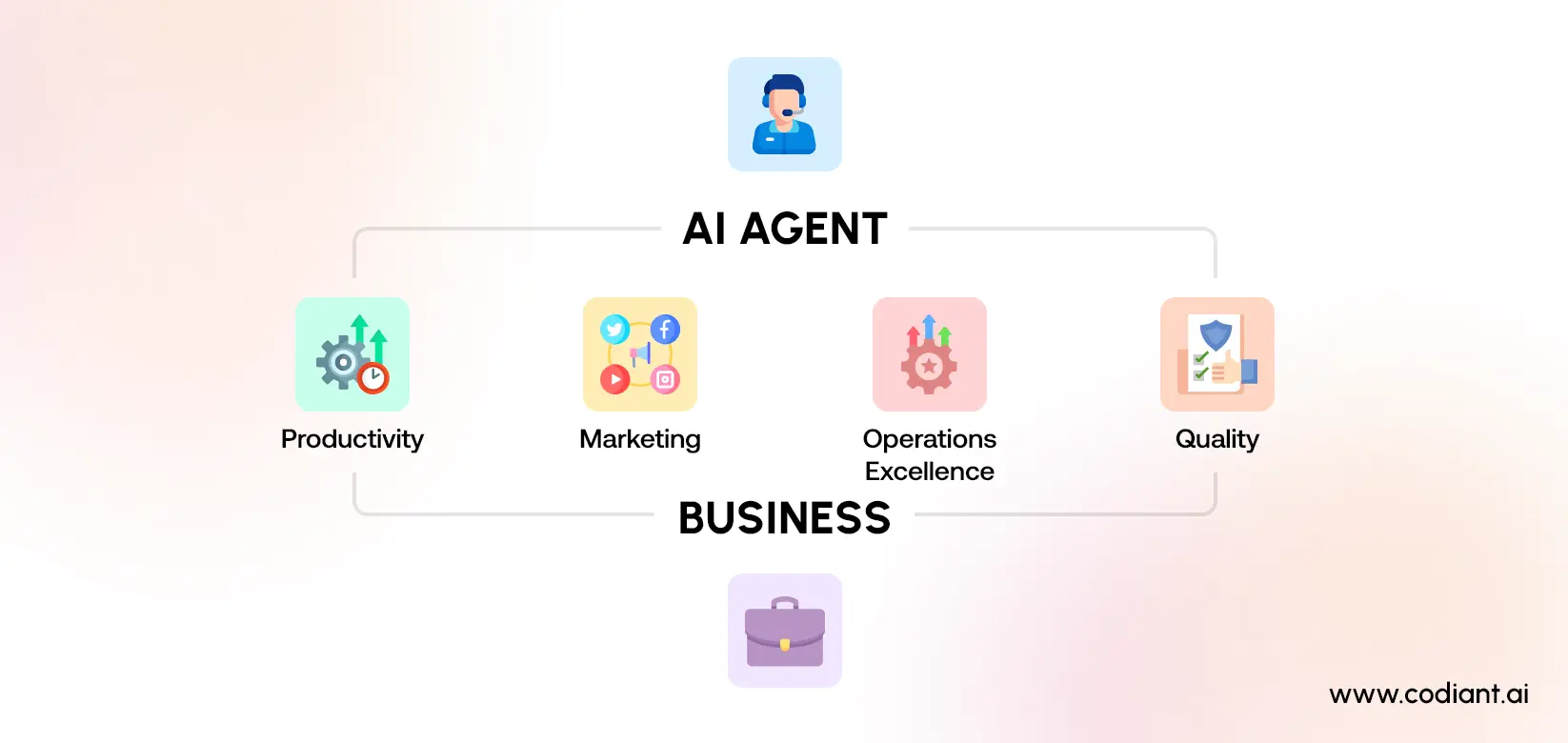
AI agents for business automation are systems designed to perform tasks or pursue business goals by interpreting inputs, selecting actions and interacting with digital tools. Unlike a single predictive model, an agent generally connects AI capabilities with instructions, memory, data sources, APIs and operational workflows.
For example, an invoice-processing agent may:
- Monitor an inbox for new invoices.
- extract supplier and payment information.
- Compare the invoice with a purchase order.
- Identify missing or inconsistent fields.
- Enter approved information into an ERP.
- Route exceptions to a finance employee.
The agent is not merely generating an answer. It is participating in a business process and taking permitted actions within connected systems.
The level of intelligence can vary considerably. Some agents follow simple conditions, while autonomous AI agent solutions may plan several steps, use different tools, and revise their approach when a task fails.
What Are the Different Types of AI Agents?
The five commonly discussed types of AI agents are simple reflex agents, model-based reflex agents, goal-based agents, utility-based agents and learning agents. These categories describe how much information an agent uses and how it selects its next action.
They should not be treated as mutually exclusive product categories. An enterprise AI agent may combine memory, goals, utility scoring and learning within the same system.
1. Simple Reflex Agents
Simple reflex agents respond to current conditions using predefined rules. They do not rely on memory of previous events or evaluate the long-term consequences of their actions.
Their basic operating logic is:
If a specific condition occurs, perform a specified action.
Business examples include-
- Routing a support ticket based on selected keywords
- Sending a reminder when an invoice becomes overdue
- Blocking a transaction that exceeds a predefined limit
- Assigning a lead according to location or product category
- Triggering an alert when inventory falls below a threshold
Simple reflex agents are suitable for stable, predictable environments where rules can be defined clearly. They are fast and relatively easy to audit, but they may fail when a situation falls outside the conditions anticipated during development.
2. Model-Based Reflex Agents
Model-based reflex agents maintain an internal representation of the environment. They use current inputs together with stored information about previous states, enabling them to work where the complete situation is not visible at once.
A customer-service routing agent, for example, may consider:
- The customer’s previous interactions
- Open support cases
- Account tier
- Product ownership
- Recent service disruptions
- Current agent availability
This context helps the system make a more informed routing decision than a simple keyword rule.
Model-based agents are useful in business processes where current information only makes sense when combined with historical or contextual data. However, the internal model must remain accurate. Old customer records, incomplete system updates or conflicting data can lead to unsuitable decisions.
3. Goal-Based Agents
Goal-based agents evaluate possible actions according to whether those actions move the system toward a defined objective. Instead of reacting only to the current condition, they can plan a sequence of steps needed to reach an outcome.
A goal-based procurement agent could receive the objective:
Source an approved component before Friday without exceeding the allocated budget.
The agent might then-
- Review approved suppliers.
- Check inventory and delivery dates.
- Request or retrieve quotations.
- Compare eligible options.
- Prepare a recommended purchase order.
- Request human approval when required.
Goal-based agents are well suited to workflows in which the required outcome is clear but the route to that outcome may change. They form an important part of many agentic AI systems because they can select and sequence actions instead of following one fixed process.
4. Utility-Based Agents
Utility-based agents compare multiple acceptable actions and choose the option expected to produce the greatest value according to a defined utility function. That function may consider cost, speed, risk, quality, customer impact or another measurable business priority.
A logistics agent selecting a delivery route may consider:
- Estimated delivery time
- Fuel or carrier cost
- Vehicle capacity
- Weather conditions
- Service-level commitments
- Probability of delay
Several routes may reach the destination, but the utility-based agent attempts to select the option that creates the best overall result.
These intelligent AI agents can support complex decisions involving trade-offs. Their reliability depends heavily on the utility criteria. When those criteria are incomplete or poorly weighted, the system may optimize one metric while harming another important outcome.
5. Learning Agents
Learning agents improve their behaviour using data, outcomes or feedback from previous actions. They can identify patterns and adjust their decision strategy rather than operating permanently under the same rules.
A learning agent for customer support might observe:
- Which responses resolved cases successfully
- Which issues required human escalation
- How customers rated different resolutions
- Which knowledge sources produced accurate answers
- Where repeated failures occurred
The system could use this information to improve retrieval, routing or response selection. Learning agents are useful in environments that change over time, including fraud detection, demand forecasting, personalization and predictive maintenance.
Learning does not mean unrestricted self-modification. Enterprises should define which components may change, how performance is evaluated and when an updated behaviour requires review.
6. Multi-Agent Systems
A multi-agent system contains several agents that cooperate, delegate tasks or exchange information to complete a larger process. Each agent may specialize in one responsibility while an orchestrator coordinates the overall workflow.
An employee-onboarding system might include-
- A document-verification agent
- An IT-access agent
- A payroll-enrolment agent
- A training-scheduling agent
- A policy-question agent
- A supervising orchestration agent
Multi-agent architectures can make complex automation more modular because individual responsibilities are separated. However, they also introduce coordination risks, including duplicated actions, conflicting decisions, unclear ownership and cascading failures.
How Do AI Agents Automate Business Processes?
AI agents automate business processes by receiving an objective, collecting relevant information, reasoning about possible actions, using authorized tools and checking whether the desired outcome has been achieved.
A typical agent workflow contains six stages:
- Perceive: Receive a request, event, document or system signal.
- Retrieve: Access relevant policies, records or contextual data.
- Reason: Determine what the information means and what action is needed.
- Plan: Divide the objective into manageable steps.
- Act: Use APIs, databases or business applications to perform tasks.
- Evaluate: Verify the result, retry where allowed or escalate an exception.
This creates a form of business process automation AI that can respond to variable inputs rather than requiring every route to be programmed in advance.
Organizations can apply agents to both isolated tasks and end-to-end workflows to improve efficiency, accuracy, and operational scalability. However, deterministic automation remains more suitable when every step must follow an exact, repeatable rule. Many enterprises therefore combine structured workflows with AI agents for business automation, enabling businesses to automate complex processes, streamline decision-making, adapt to changing conditions, and enhance overall productivity. In this approach, the workflow ensures consistency and compliance, while the AI agent provides intelligent interpretation and real-time responsiveness.
What Is an Autonomous AI Agent?
An autonomous AI agent is a system that can make decisions and perform a sequence of actions toward a defined goal with limited ongoing human direction. It may plan tasks, select tools, review results and alter its approach when conditions change.
Autonomy exists on a spectrum rather than as a simple yes-or-no capability:
| Autonomy level | Agent behaviour | Example |
| Assisted | Recommends an action for a person to perform | Drafting a supplier response |
| Approval-based | Prepares an action but waits for authorization | Creating a refund for manager approval |
| Bounded autonomy | Acts independently within defined limits | Rescheduling deliveries within approved time windows |
| High autonomy | Plans and executes most of the workflow | Resolving routine service requests across connected systems |
High autonomy is not automatically better. The appropriate level depends on the cost of error, reversibility of actions, regulatory requirements and reliability of available data.
Financial transfers, medical decisions, employee actions and legally significant communications generally require stronger controls than low-risk administrative tasks.
What are Common AI Agent Use Cases?
AI agent use cases span customer service, finance, human resources, IT, sales, supply chains and knowledge management. The best candidates involve repeated decisions, digital information and actions that can be completed through connected systems.
| Business function | Example agent use case |
| Customer service | Classify requests, retrieve account context and resolve routine cases |
| Finance | Match invoices, investigate discrepancies and prepare reports |
| Human resources | Screen documents, coordinate onboarding and answer policy questions |
| Sales | Research accounts, update CRM records and schedule follow-ups |
| IT operations | Diagnose incidents, reset access and route unresolved issues |
| Supply chain | Monitor stock, assess disruptions and recommend replenishment actions |
| Legal operations | Extract contract clauses and flag review requirements |
| Knowledge management | Retrieve approved internal information and summarize findings |
The process should be assessed before an agent is introduced. Automating a poorly designed workflow may reproduce its inefficiencies at greater speed.
Which Industries Use AI Agents?
AI agents are used across industries that manage high volumes of information, decisions and repeatable workflows. Adoption patterns vary because each industry has different data, risk and compliance requirements.
Examples include:
- Banking and financial services: transaction review, customer support and compliance workflows
- Healthcare: appointment coordination, documentation support and administrative triage
- Retail and e-commerce: product discovery, inventory monitoring and order support
- Manufacturing: maintenance planning, quality monitoring and supply coordination
- Logistics: route analysis, shipment tracking and exception management
- Insurance: claims intake, document review and policy servicing
- Telecommunications: service diagnostics, customer assistance and network operations
- Professional services: research, document analysis and project coordination
Regulated sectors usually need stricter access controls, documented decision paths, human review and validation before actions affect customers or critical systems.
What Is the Difference Between AI Agents and Chatbots?
A chatbot primarily conducts a conversation, while an AI agent can pursue a goal and take actions within connected systems. A chatbot may provide information without changing anything in the business environment.
For example:
- A chatbot explains the company’s refund policy.
- An AI agent checks the order, confirms eligibility, creates the refund and updates the customer record.
The distinction is based on capability rather than interface. A conversational tool can also be an agent when it has planning, tool-use and action-execution capabilities. Similarly, an agent may operate in the background without a chat interface.
How Should Businesses Select the Right Type of AI Agent?
Businesses should choose an agent according to process variability, decision complexity, risk and required autonomy. The most advanced agent is not always the most appropriate option.
Use a simple reflex agent when:
- Rules are stable and explicit.
- Inputs are predictable.
- Actions are low risk.
- Historical context is unnecessary.
Use a model-based agent when:
- Decisions depend on previous events.
- The environment is only partly observable.
- Customer or operational context matters.
Use a goal- or utility-based agent when:
- Several actions could achieve the outcome.
- Planning or trade-offs are necessary.
- The agent must adapt its route.
Use a learning agent when:
- Patterns change over time.
- Feedback is available.
- Improvement can be measured safely.
Use a multi-agent system when:
- The workflow contains distinct specialist responsibilities.
- Tasks can be separated clearly.
- Coordination benefits outweigh architectural complexity.
How Can Organizations Deploy Enterprise AI Agents Securely?
Organizations can deploy enterprise AI agents securely by restricting their permissions, validating their inputs and outputs, monitoring their actions and requiring human approval for high-impact decisions.
Essential safeguards include:
- Role-based and least-privilege access
- Approved tools and data sources
- Authentication and authorization controls
- Encryption in transit and at rest
- Input, output and action validation
- Audit logs and execution tracing
- Spending and transaction limits
- Human approval checkpoints
- Testing against misuse and unexpected inputs
- Emergency suspension and rollback mechanisms
- Continuous performance and risk monitoring
Security should be connected to the agent’s level of autonomy. An agent that only retrieves policy information creates a different risk profile from one that can modify financial, customer or production records.
Organizations should also assign accountable owners, document permitted behaviours and define what happens when the agent cannot complete a task confidently.
Conclusion
The main types of AI agents represent different levels of context, reasoning, planning and adaptability. Simple reflex agents handle predictable rules, model-based agents add contextual memory, goal-based agents plan toward outcomes, utility-based agents evaluate trade-offs and learning agents improve through feedback.
Businesses can combine these capabilities through enterprise AI agents and multi-agent systems to automate processes across customer service, finance, HR, IT and operations. Successful adoption, however, depends on selecting the least complex agent that can perform the task reliably and safely.
AI automation solutions should begin with a clearly defined process, measurable outcome, controlled access and documented escalation path. Autonomy should increase only when testing demonstrates that the system can operate within acceptable risk boundaries.
Ready to Put AI Agents to Work Across Your Business?
Discover where AI agents can automate workflows, reduce manual effort, and create measurable operational efficiency.
Frequently Asked Questions
The five commonly recognized categories are simple reflex, model-based reflex, goal-based, utility-based and learning agents. Multi-agent systems provide an additional architectural model in which several specialized agents coordinate to complete a wider process.
AI agents make decisions by interpreting available information and selecting an action according to rules, an internal model, a goal, a utility function or learned patterns. More advanced agents may also plan multiple steps, call external tools and evaluate the result before continuing.
AI agents can operate without continuous human intervention when they have defined goals, authorized tools and clear operational limits. Human review remains important for ambiguous, irreversible, regulated or high-impact actions.
AI agents can automate processes such as ticket routing, invoice matching, customer support, CRM updates, employee onboarding, IT incident handling, inventory monitoring and document review. The process must be digitally accessible and supported by reliable data and system integrations.
Organizations secure AI agents through least-privilege access, approved data sources, action limits, validation, audit logs, monitoring and human approval checkpoints. Controls should reflect the sensitivity of the data and the consequences of an incorrect action.
Featured Blogs
Read our thoughts and insights on the latest tech and business trends
AI Roadmap: How to Build and Scale AI Across the Enterprise
- September 17, 2026
- Artificial Intelligence
An AI roadmap is a structured plan that connects business priorities with AI use cases, data, technology, governance, people, implementation, and measurable outcomes. For enterprises, it provides the sequence for moving from AI opportunities and... Read more

Top Predictive Analytics Models and Algorithms to Know
- September 11, 2026
- Artificial Intelligence
Predictive analytics models are statistical and machine learning systems that use historical data to forecast future outcomes, such as customer churn, equipment failure, demand spikes, or credit risk. The most widely used categories are regression... Read more

AI Data Analytics: What It Is, Why It Matters, and Business Use Cases
- September 4, 2026
- AI-Powered Data Analytics
AI data analytics uses artificial intelligence to examine data and turn it into useful insights. It helps businesses identify patterns, predict what may happen next, and decide what actions to take. It can analyze numbers,... Read more