The Difference Between Generative AI and Traditional AI: The Enterprise Guide
Table of Contents
Subscribe To Our Newsletter
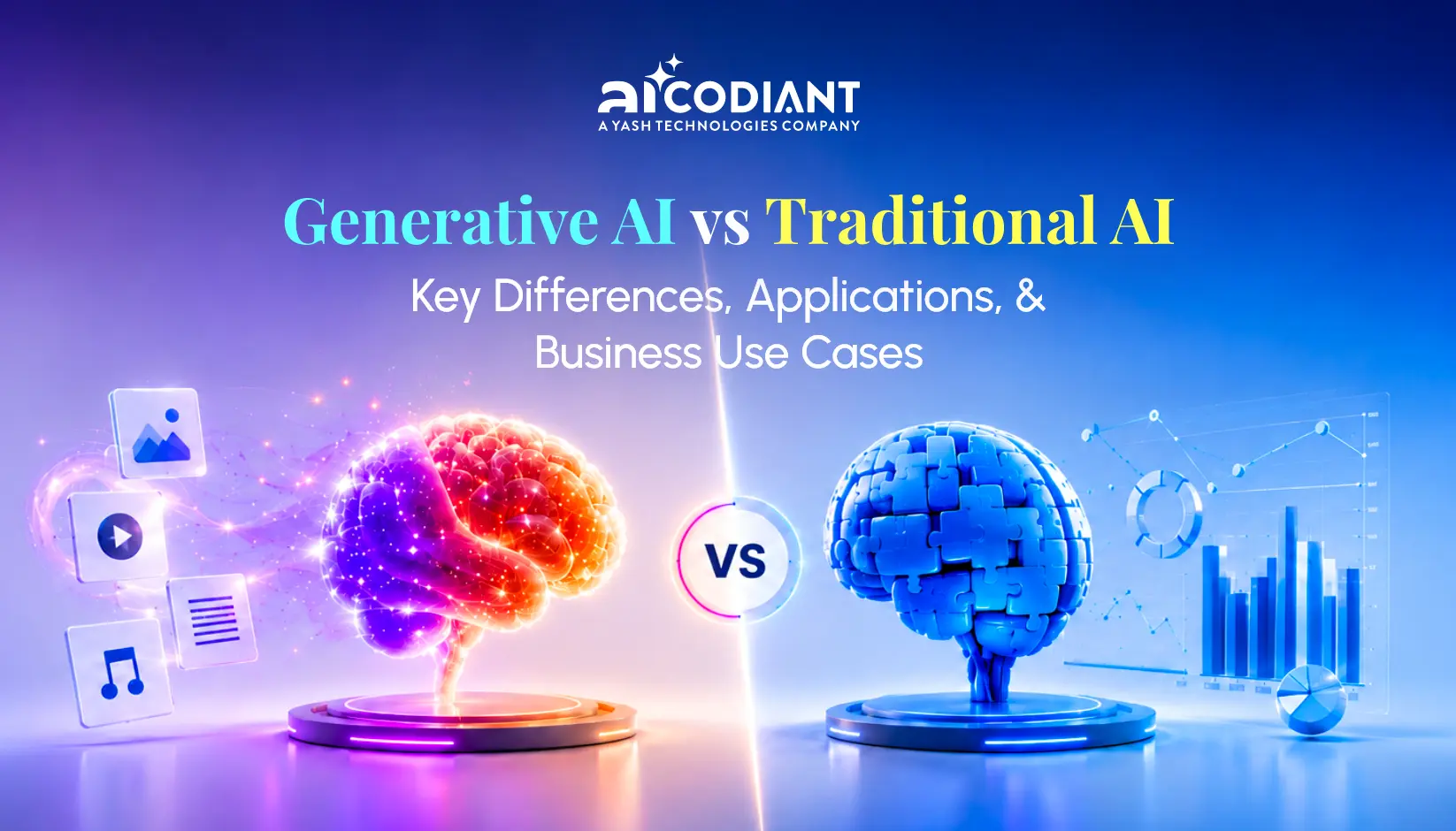
Generative AI and Traditional AI solve different business problems. Traditional AI analyses data to predict outcomes, classify information, detect patterns, and support decisions. Generative AI creates new content, including text, images, code, audio, video, summaries, and business documents.
This difference matters because companies are no longer evaluating AI as one single technology. They are comparing different artificial intelligence types to understand which approach can improve operations, customer service, employee productivity, software development, marketing, and decision-making.
For example, a Traditional AI system can detect a suspicious financial transaction, predict equipment failure, or recommend a product to an online shopper. A Generative AI system can explain the fraud alert, create maintenance instructions, write a personalised product description, or answer customer questions through a conversational assistant.
The difference between Generative AI and AI is therefore not that Generative AI exists outside artificial intelligence. Generative AI is one category within the broader AI ecosystem, while the phrase “Traditional AI” commonly refers to predictive, analytical, rule-based, and task-specific systems.
This Generative AI vs Traditional AI comparison explains how both approaches work, where businesses use them, their advantages and limitations, and how organisations can choose the right model for enterprise AI adoption. It also examines why many companies combine Traditional AI with enterprise Generative AI instead of treating them as competing technologies.
Key Takeaways
- Traditional AI analyses and predicts. It supports forecasting, fraud detection, classification, recommendations, and risk assessment.
- Generative AI creates new outputs. It produces text, images, code, audio, video, summaries, and conversational responses.
- Neither approach is universally better. The right choice depends on the business problem and expected output.
- Companies can use both together. Traditional AI may detect an issue, while Generative AI explains it or creates the next response.
- Business adoption requires careful evaluation. Data quality, accuracy, security, compliance, integration, and human oversight should guide the decision.
What is Traditional AI?
Traditional AI refers to artificial intelligence systems designed to perform a specific task, such as predicting an outcome, classifying information, detecting unusual activity, or recommending an action.
These systems process input data according to predefined rules or patterns learned during model training. Their output is usually a category, probability, score, forecast, recommendation, or automated decision.
Traditional AI includes both rule-based systems and machine learning.
Rule-Based Systems vs Machine Learning
Rule-based systems follow instructions written by people. For example, a banking system may flag a transaction when its value exceeds a defined limit and it originates from an unfamiliar location.
Machine learning systems learn patterns from historical data rather than relying entirely on manually written rules. Google defines machine learning as a way to train software to make predictions or generate content using data.
Common learning approaches include:
- Supervised learning: The model learns from labelled examples, such as emails marked as spam or not spam.
- Unsupervised learning: The model identifies patterns or groups within unlabelled data, such as customer segments.
- Reinforcement learning: The system learns through actions, feedback, rewards, and penalties.
Supervised learning commonly supports classification and numerical prediction, while unsupervised learning can help identify clusters within data.
Traditional AI is usually narrow in scope. A demand-forecasting model cannot automatically become a legal-document assistant without additional data, training, and development.
What is Generative AI?
Generative AI is a type of artificial intelligence that creates new content in response to an instruction, prompt, or system input.
It can generate:
- Written content
- Images and designs
- Audio and speech
- Video
- Software code
- Reports and summaries
- Conversational responses
- Synthetic data
Generative AI models learn patterns and relationships from training data and use those patterns to produce new outputs. IBM defines Generative AI as AI that can create content such as text, images, video, audio, and software code.
Foundation Models and Large Language Models
Foundation models are trained on broad datasets and can support several tasks rather than one narrowly defined use case. Businesses may adapt them through prompting, fine-tuning, or connections to private enterprise data.
Large Language Models, or LLMs, are deep-learning models pre-trained on large amounts of text and other data. They can generate answers, summaries, documents, and code.
Transformers and Diffusion Models
Transformers are neural-network architectures that identify relationships between elements in a sequence, such as words in a sentence. This ability helps language models understand context and generate coherent responses.
Diffusion models are commonly used for image generation. They learn to create images by reversing a gradual noise-adding process, allowing them to generate visuals from written or visual prompts.
While understanding the underlying technology is important, businesses also need to evaluate where Generative AI delivers measurable value. From customer support and software development to document automation and enterprise search, successful adoption depends on selecting the right use cases and implementation strategy. Our Generative AI guide for businesses explores these practical applications and the key considerations for enterprise adoption.
What is the Main Difference Between Generative AI and Traditional AI?
The main difference is their purpose. Traditional AI primarily predicts, classifies, detects, or recommends. Generative AI creates or transforms content.
| Feature | Traditional AI | Generative AI |
| Purpose | Predict, classify, detect, or recommend | Create or transform content |
| Output | Score, label, forecast, decision | Text, image, audio, video, or code |
| Training data | Often structured or labelled data | Large structured and unstructured datasets |
| Learning approach | Usually task-specific training | Pre-training, prompting, and fine-tuning |
| Creativity | Limited to defined outputs | Produces new combinations and responses |
| Decision-making | Supports defined operational decisions | Generates explanations, content, or suggestions |
| User interaction | Forms, system inputs, or fixed workflows | Natural-language prompts and conversations |
| Adaptability | Usually limited to a particular task | Can support several related tasks |
| Examples | Fraud detection and demand forecasting | Chatbots and image generation |
| Business applications | Risk, prediction, scoring, optimisation | Content, search, design, and knowledge support |
Traditional AI answers questions such as, “Is this payment suspicious?” or “How much demand should we expect next month?”
Generative AI responds to requests such as, “Explain why this payment was flagged” or “Create a summary of next month’s demand forecast.”
How Does Traditional AI Work?
Traditional AI converts historical data into predictions, classifications, or decisions through a structured model-development process.
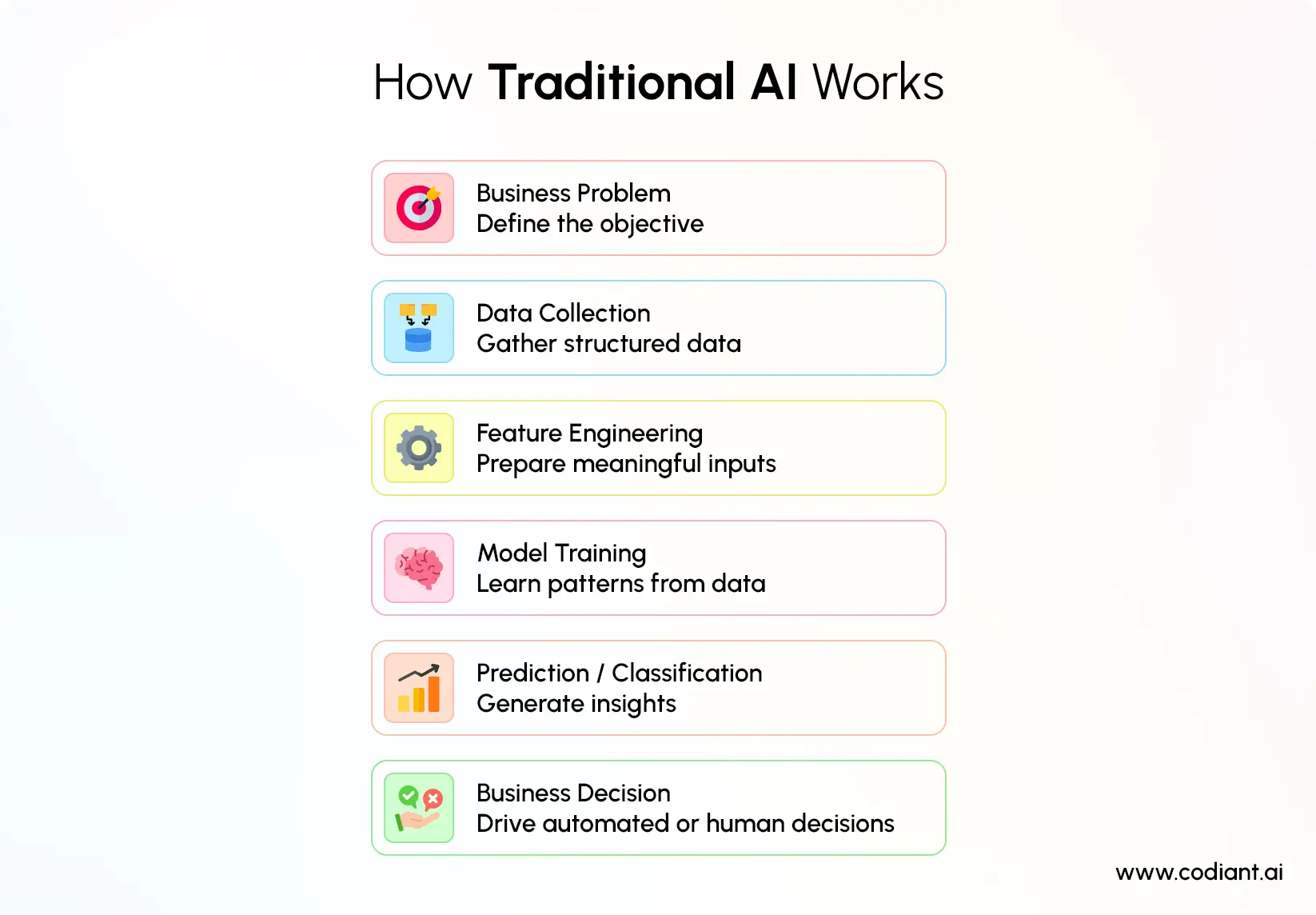
- Data collection: Relevant information is gathered from business systems, transactions, sensors, records, or user activity.
- Feature engineering: Useful data attributes are selected or created. A fraud model may examine transaction value, location, time, and account history.
- Model training: The algorithm studies past examples and identifies relationships between the inputs and expected outcomes.
- Prediction: The trained model estimates a value, probability, or future outcome.
- Classification: It may assign an input to a category, such as fraudulent or legitimate.
- Decision-making: The prediction triggers a recommendation, alert, approval, or automated action.
How Does Generative AI Work?
Generative AI processes a prompt, identifies patterns relevant to the request, and generates an output one element at a time.
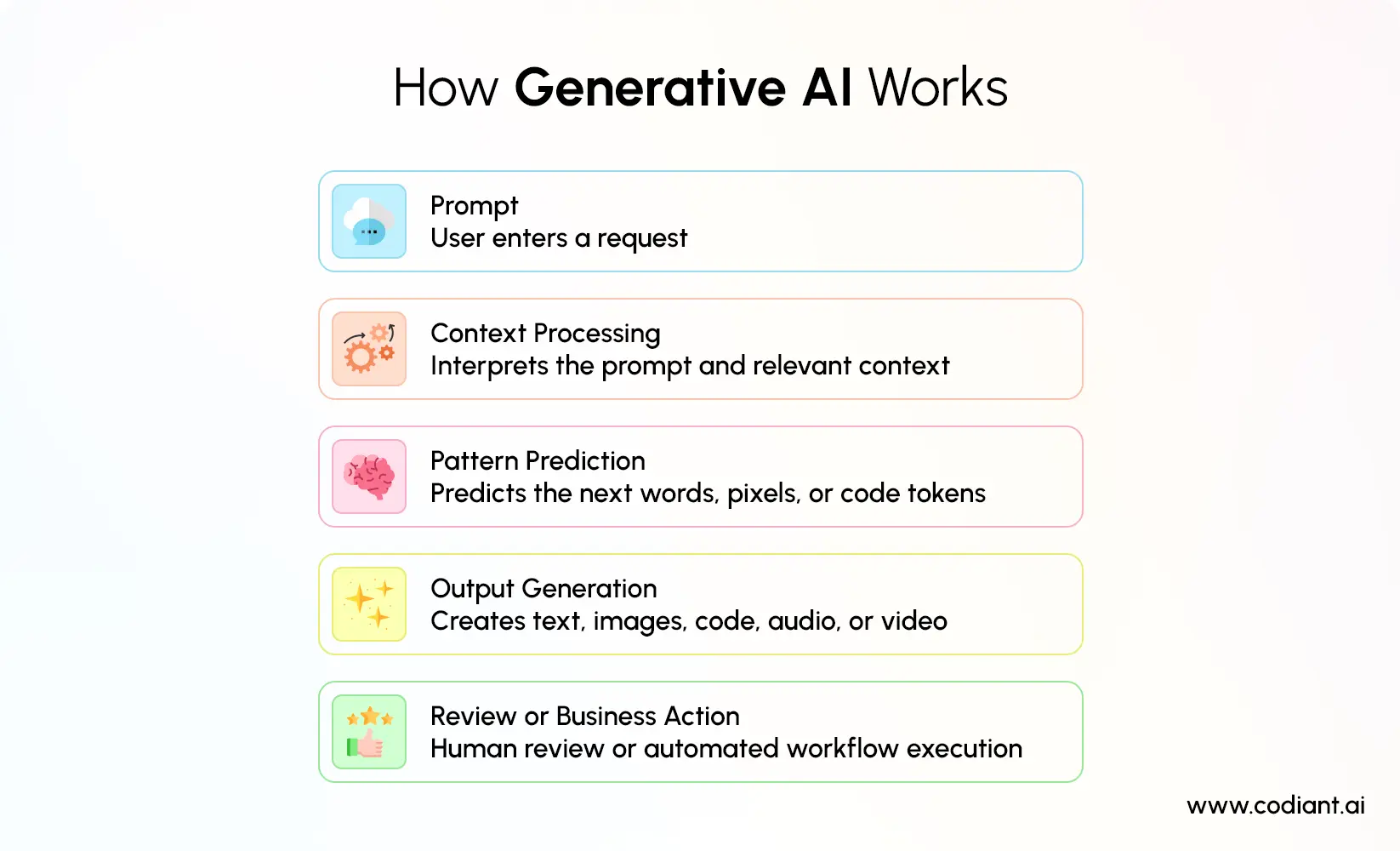
During pre-training, a neural network learns relationships from large volumes of data. Transformer-based language models use context to determine which words or tokens are most likely to follow the preceding text.
Businesses can adapt the model through:
- Prompting: Giving the model instructions, context, and output requirements.
- Fine-tuning: Training the model further on selected examples.
- Retrieval-Augmented Generation: Retrieving information from approved documents or databases before generating an answer.
- Human review: Checking outputs before they affect customers, employees, or business decisions.
RAG is especially useful for enterprise Generative AI because it can connect a model to current, organisation-specific information rather than relying only on its original training.
Building a production-ready Generative AI solution involves much more than selecting a language model. Businesses also need to choose the right models, frameworks, orchestration tools, vector databases, and deployment architecture. Learn how these components work together in our guide to the Generative AI tech stack, tools, models, and frameworks.
What Are the Common Applications of Traditional AI?
Traditional AI is widely used where companies need repeatable predictions, classifications, and operational decisions.
Common applications include:
- Fraud detection: Identifying unusual banking, payment, or insurance activity.
- Spam filtering: Classifying unwanted or harmful emails.
- Recommendation engines: Suggesting products, videos, courses, or services.
- Credit scoring: Estimating the likelihood that a borrower will repay.
- Predictive maintenance: Forecasting when machinery may require service.
- Medical decision support: Identifying patterns in patient data or medical images.
- Demand forecasting: Estimating future inventory or staffing requirements.
- Customer segmentation: Grouping customers by behaviour, value, or needs.
These applications usually have measurable outputs that can be compared with actual results.
What Are the Business Applications of Generative AI?
The business applications of Generative AI development include content generation, knowledge retrieval, software assistance, document processing, design, and customer communication.
Examples include:
- Marketing teams generating campaign drafts and product descriptions
- Software developers creating code suggestions, tests, and documentation
- Customer-service teams drafting answers and summarising conversations
- Legal teams reviewing and summarising contracts
- Healthcare teams preparing clinical documentation for human approval
- Education platforms generating explanations and learning materials
- eCommerce businesses creating product visuals and personalised copy
- Employees searching internal policies through conversational assistants
- Product teams producing early designs and prototypes
- Finance teams summarising reports and investigation notes
Generative AI for enterprises becomes more useful when it is connected to approved business information, permissions, and review workflows.
As organizations move beyond experimentation, Generative AI is becoming part of day-to-day operations across customer service, software engineering, marketing, and enterprise knowledge management. Discover how enterprises are scaling these capabilities in our guide on how Generative AI is transforming enterprises.
What Are the Benefits of Traditional AI?
Traditional AI offers strong value when the problem is narrow, repeatable, and measurable.
Its main benefits include:
- High accuracy within well-defined tasks
- More predictable output formats
- Easier testing against known results
- Clearer operational rules and thresholds
- Lower computing requirements for many smaller models
- Reliability for repetitive processes
- Mature deployment and monitoring practices
However, these advantages depend on the quality of the data, model design, evaluation process, and operating environment. Traditional AI is not automatically accurate simply because it is task-specific.
What Are the Benefits of Generative AI?
Generative AI allows users to interact with technology through natural language and produce a wide range of content from one interface.
Key advantages include:
- Generating text, visuals, code, audio, and other content
- Supporting natural conversations
- Accelerating first drafts and content variations
- Automating document-heavy workflows
- Personalising communication
- Making enterprise knowledge easier to access
- Assisting employees across departments
- Supporting rapid product and design prototyping
Its value is strongest when the system supports employees rather than operating without review in situations where accuracy or compliance is critical.
What Are the Limitations of Traditional AI?
Traditional AI can be dependable, but it is often less flexible than Generative AI.
Common limitations include:
- Models are usually built for one narrow task
- Supervised models may require substantial labelled data
- Some systems require manual feature engineering
- They cannot normally create detailed new content
- New business problems may require separate models
- Scaling across systems can create integration and maintenance work
- Performance may decline when real-world data changes
These limitations do not apply equally to every system. For example, unsupervised learning does not require labelled data, and modern deep-learning systems may reduce manual feature engineering.
What Are the Limitations of Generative AI Compared to Traditional AI?
Generative AI can produce flexible responses, but those responses are not automatically factual, unbiased, secure, or suitable for business use.
Major limitations include:
- Hallucinations: The model may produce convincing but incorrect information.
- Bias: Outputs may reflect patterns or imbalances in training data.
- Computing cost: Large models may require substantial infrastructure.
- Data privacy: Sensitive information may be exposed without proper controls.
- Copyright concerns: Training data and generated outputs can raise ownership questions.
- Prompt sensitivity: Small changes in instructions may change the result.
- Human-review requirements: High-impact outputs must be checked.
- Model governance: Organisations need evaluation, monitoring, security, and accountability processes.
NIST’s Generative AI Profile identifies risks including confabulation, data privacy, information security, harmful bias, and intellectual-property concerns.
Which Is Better: Generative AI or Traditional AI?
Neither Generative AI nor Traditional AI is universally better. The right choice depends on the required output and the business problem.
Use Traditional AI when the system must:
- Predict a measurable result
- Classify information
- Calculate a risk score
- Detect anomalies
- Optimise a repeatable process
- Produce controlled operational decisions
Use Generative AI when the system must:
- Create or transform content
- Support conversational interaction
- Summarise documents
- Search enterprise knowledge
- Generate code or designs
- Draft personalised communications
A hybrid approach is often suitable when a business needs both prediction and explanation.
When Should Businesses Use Traditional AI?
Businesses should use Traditional AI when decisions rely on structured data, measurable outcomes, and consistent rules.
Suitable scenarios include:
- Credit and risk prediction
- Sales or demand forecasting
- Fraud and anomaly detection
- Workflow classification
- Inventory optimisation
- Predictive maintenance
- Compliance monitoring
- Repetitive operational decisions
Traditional AI is particularly useful when organisations must evaluate performance against known outcomes and maintain a controlled decision process.
When Should Businesses Use Generative AI?
Businesses should use Generative AI when employees or customers need assistance creating, finding, summarising, or transforming information.
Suitable scenarios include:
- Customer-support assistants
- Marketing-content generation
- Internal knowledge assistants
- Software-development support
- Product and visual-design workflows
- Technical documentation
- Enterprise search
- Legal-document summarisation
- Training-content creation
- Personalised communication
The model should be supported by access controls, source verification, output evaluation, and human review where errors could create financial, legal, medical, or reputational harm.
Can Generative AI Replace Traditional AI?
Generative AI cannot completely replace Traditional AI because the two technologies are designed for different purposes.
A language model may explain a fraud alert, but a specialised predictive model may be better suited to calculating the underlying fraud probability. A generative assistant may describe expected inventory requirements, while a forecasting model calculates the demand estimate.
Generative AI may replace some rule-based content and support workflows. However, predictive models, classification systems, recommendation engines, and optimisation tools will remain necessary where businesses need measurable and controlled outputs.
Can Traditional AI and Generative AI Work Together?
Traditional AI and Generative AI can work together in hybrid systems that combine prediction, content generation, enterprise data, and workflow automation.
Examples include:
- Healthcare: A predictive model flags patient risk, while Generative AI prepares a summary for clinician review.
- Finance: Traditional AI detects a suspicious transaction, while Generative AI explains the alert to an investigator.
- Retail: A recommendation engine selects products, while Generative AI creates personalised descriptions.
- Manufacturing: Predictive maintenance identifies possible failure, while Generative AI produces repair guidance.
- Logistics: Forecasting models predict delays, while Generative AI drafts customer updates.
- Customer service: Classification AI routes a request, while Generative AI drafts the response.
RAG, AI agents, APIs, business rules, and human approvals can connect these capabilities into one enterprise AI workflow.
Is ChatGPT an Example of Generative AI?
Yes. ChatGPT is an example of Generative AI because it generates conversational responses from user instructions and context.
OpenAI describes ChatGPT as a model that interacts conversationally, responds to follow-up questions, and follows instructions provided through prompts.
ChatGPT is one Generative AI application, not the entire category. Generative AI also includes systems for image creation, video generation, audio synthesis, software coding, design, and synthetic data.
Which Industries Benefit Most from Generative AI?
Industries with large volumes of content, documents, customer conversations, knowledge, or design work can benefit significantly from Generative AI.
High-value applications exist in:
- Healthcare
- Banking and financial services
- Retail and eCommerce
- Education
- Marketing and media
- Software development
- Customer service
- Legal services
- Manufacturing
The level of benefit depends on workflow suitability, data quality, adoption, risk controls, and integration with existing business systems. There is no single industry that is automatically the largest beneficiary in every market.
How Do Companies Choose Between Traditional AI and Generative AI?
Companies should choose an AI approach by defining the business outcome before selecting a model.
| Business Requirement | Suitable Approach |
| Predict a future outcome | Traditional AI |
| Classify or score information | Traditional AI |
| Generate text, images, audio, or code | Generative AI |
| Provide conversational support | Generative AI |
| Automate a controlled decision | Traditional AI |
| Explain a predictive result | Hybrid AI |
| Search internal documents | Generative AI with RAG |
| Combine prediction and personalised communication | Hybrid AI |
Some organizations also evaluate whether they need Generative AI alone or more autonomous AI systems capable of planning and executing multi-step tasks. Understanding this distinction can help shape long-term AI strategy. Read our comparison of Agentic AI vs Generative AI to learn when each approach is appropriate.
Decision-makers should assess:
- Required output
- Available data
- Accuracy expectations
- Security and privacy
- Regulatory requirements
- Integration complexity
- Computing and operating cost
- Human-review needs
- Scalability
- Model monitoring
How Do AI Development Services Support Enterprise Adoption?
AI development services help organisations move from a general AI idea to a secure and measurable business system.
A development partner may support:
- Use-case assessment
- Data-readiness analysis
- AI technology selection
- Predictive-model development
- Generative AI integration
- RAG architecture
- Enterprise-system integration
- Security and access controls
- Model testing and evaluation
- Human-in-the-loop workflows
- Monitoring and governance
For mid-market and enterprise organisations, the objective should not be to add Generative AI to every process. It should be to select workflows where AI can produce measurable operational, customer, or employee value while maintaining appropriate control.
Selecting the right technology is only the first step. Successful enterprise implementation also requires experienced AI engineers who can design secure architectures, integrate business systems, and deploy production-ready solutions. This guide on hiring Generative AI developers explains the skills, evaluation criteria, and engagement models businesses should consider.
Conclusion
Traditional AI predicts, classifies, detects, and optimises. Generative AI creates, transforms, summarises, and communicates information.
The choice between Generative AI vs Traditional AI should not be based on which technology receives more attention. It should be based on the business problem, required output, data availability, accuracy expectations, security, and governance needs.
Many enterprises can gain the greatest value by combining both. Traditional AI can provide a reliable prediction, while Generative AI makes that result easier to understand and use.
Once organizations identify the right AI approach, the next question is often the investment required to build and deploy a production-ready solution. Our Generative AI app development cost guide explains the major cost drivers, development stages, and budgeting considerations for enterprise projects.
Choose the Right AI Approach for Your Business
Turn the right AI strategy into a secure, scalable solution. From predictive models to Generative AI, we help you select, build, and integrate AI around your business needs.
Frequently Asked Questions
No. Machine learning is one approach used within artificial intelligence. Traditional AI may include machine-learning models, rule-based systems, computer vision, recommendation systems, and predictive analytics. Generative AI also uses machine learning, especially deep-learning architectures such as transformers and diffusion models.
Large Generative AI models often require more computing resources than smaller task-specific models, especially during training. However, actual infrastructure needs depend on the model size, deployment method, number of users, output type, and whether the organisation trains a model or uses an existing service.
Generative AI can support decisions by summarising information, suggesting actions, or explaining data. It should not automatically control high-impact decisions without appropriate validation, business rules, human oversight, and governance. The level of autonomy should reflect the financial, legal, safety, and compliance risks involved.
Yes. Predictive AI can calculate a risk, forecast, or recommendation, while Generative AI explains the result or creates a relevant response. This combination can support customer service, finance, healthcare, logistics, retail, manufacturing, and other enterprise workflows.
The best AI type depends on the use case. Traditional AI is suitable for measurable predictions, classification, optimisation, and controlled decisions. Generative AI is suitable for content creation, knowledge assistance, search, summarisation, and conversational experiences. Enterprises may combine both when one workflow requires prediction and communication.
Featured Blogs
Read our thoughts and insights on the latest tech and business trends
RAG vs Fine-Tuning: Which Approach Is Right for Your Enterprise AI Knowledge System?
- September 24, 2026
- Artificial Intelligence
Retrieval-Augmented Generation (RAG) and fine-tuning are the two primary methods for customizing a Large Language Model (LLM) with an enterprise's own knowledge. RAG connects a general-purpose LLM to an external knowledge base at query time,... Read more
AI Roadmap: How to Build and Scale AI Across the Enterprise
- September 17, 2026
- Artificial Intelligence
An AI roadmap is a structured plan that connects business priorities with AI use cases, data, technology, governance, people, implementation, and measurable outcomes. For enterprises, it provides the sequence for moving from AI opportunities and... Read more

Top Predictive Analytics Models and Algorithms to Know
- September 11, 2026
- Artificial Intelligence
Predictive analytics models are statistical and machine learning systems that use historical data to forecast future outcomes, such as customer churn, equipment failure, demand spikes, or credit risk. The most widely used categories are regression... Read more